

REVIEW · NEW YORK CITY AUDIO TOURS
New York City’s High Line: A Self-Guided Audio Tour
A railway story with a skyline view. This self-guided walk turns the High Line into a living history lesson, linking its old freight tracks with Chelsea Market, the Standard Hotel, Hudson Yards, and Vessel. I like the story-first narration, and I like the freedom to pause whenever you want. The main drawback is that the app may not always match your walking speed.
For $14.99, you get about 90 minutes of audio, maps, and location data in English. The commentary is lively rather than a dry list of dates, and the whole experience works well for couples, families, or private groups who prefer to explore at their own pace.
Key points to know before you go

- The route follows the High Line from Gansevoort Street to Hudson Yards, connecting the Meatpacking District, Chelsea, and the newest part of Manhattan’s west side.
- The history is told through memorable stories, including the dangerous street-level railway once linked with Death Avenue.
- The audio includes unusual design proposals, such as a mile-long swimming pool and a rollercoaster running between buildings.
- Chelsea Market and the Standard Hotel add local color, but the tour does not include food, drinks, or admission to attractions.
- The VoiceMap app works offline, which helps you avoid relying on a live mobile connection during the walk.
- You need your own smartphone and headphones, and downloading the tour before arrival is a smart move.
Why this High Line walk is worth your time

The High Line can be easy to treat as an elevated photo platform. You walk above Manhattan, take pictures of old brick buildings, and move on to the next attraction. This audio tour gives the path a stronger sense of place by explaining how a freight railway became one of New York’s best-known public spaces.
I especially like the way the narration uses stories instead of piling up facts. One review praised the commentary as informative and entertaining, while another highlighted the storytelling and the app’s ease of use. That tells you what this experience does best: it gives you a reason to look closely at what you are passing.
The route takes about an hour and a half, but your actual time may vary. Since this is self-guided, you can stop for food, browse around Chelsea Market, take photographs, or pause the narration when the walkway gets busy. You are not being hurried along by a guide or a fixed group schedule.
There is one technical weakness. The audio may not always synchronize perfectly with your walking speed. If you walk quickly, the commentary may get ahead of you. If you stop often for pictures, it may continue while you are still looking at the previous point. The fix is simple: use the app controls, pause when needed, and think of the narration as a flexible companion rather than a perfectly timed escort.
More Self-Guided Audio Tours in the USA
- NYC: St. Patrick’s Cathedral Official Self-Guided Audio Tour
★ 3.5 · 45 reviews - New York City’s Financial District: A Self-Guided Audio Tour
★ 4.5 · 8 reviews - West Village’s Flappers, Freaks & Punks: A Self-Guided Audio Tour
★ 5.0 · 4 reviews
Starting at Gansevoort Street and the Meatpacking District
The experience begins at Friends of the High Line, at 820 Washington Street. This puts you at the southern end of the park, near the Meatpacking District and the Whitney Museum of American Art.
Starting here makes good historical sense. The High Line feels polished now, with planting, seating, public art, and broad city views. The commentary reminds you that this space began as transportation infrastructure, not as a park designed for strolling.
You should download the VoiceMap application, audio, maps, and geodata before you start. Offline access is included, so you do not need to depend on a live connection while walking. You also need to bring your own smartphone and headphones. Neither is supplied.
The posted operating hours cover every day and every hour, from midnight to midnight, during the stated operating period. That gives you plenty of scheduling freedom, but remember that this is not a staff-led tour with someone waiting at the starting point. You are responsible for opening the app and beginning the route.
The Whitney Museum and the southern High Line
The Whitney Museum of American Art is one of the early points on the route. The tour does not include museum admission, so you should think of this as an exterior landmark and a useful reference point unless you decide to visit the museum separately.
This part of the walk helps show how the High Line connects art, architecture, and city redevelopment. The audio does not simply tell you that the museum is nearby. It places the museum within the larger story of the neighborhood and the park.
If you are tempted to add the museum, allow extra time and budget for admission. The advertised 90-minute length refers to the audio walk itself, not to a museum visit, a meal, or extended stops. That distinction matters if you have a tight schedule.
The route is also a good choice if you like to mix structured information with free time. You can follow the narration for the main walk, then stop the app while you explore the museum or nearby streets.
Pier 57 and the changing west side
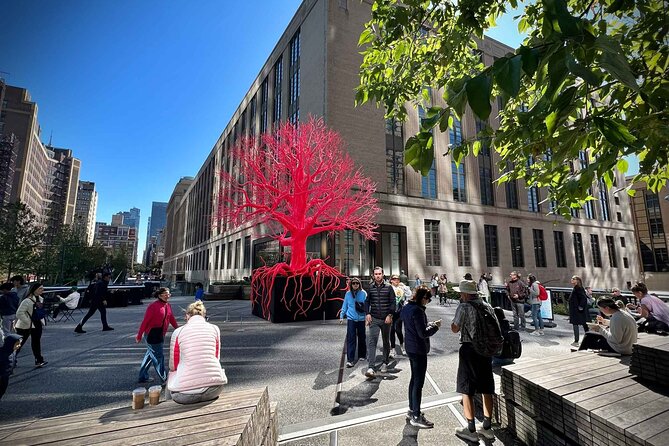
Pier 57 is another named point along the route. It helps widen the story beyond the elevated track. The walk is not only about the High Line under your feet. It also points you toward the waterfront and the larger changes along Manhattan’s west side.
This is one of the useful features of an audio tour. You can see the city in front of you while the narration supplies the connections between places. Instead of treating each attraction as an isolated stop, the walk links the park with nearby buildings and the Hudson River side of the city.
You should not expect food or drinks to be included at Pier 57 or anywhere else along the route. The price covers the digital tour only. If you want a snack or a proper meal, plan to buy it separately.
More Self-Guided Audio Tours in New York City:
- New York’s Iconic Central Park: A Self-Guided Audio Tour
★ 4.0 · 4 reviews - The Battery: A Self-Guided Audio Tour from Bowling Green Park to Stone St
★ 5.0 · 3 reviews - Boho Greenwich Village: A Self-Guided Audio Tour
★ 5.0 · 3 reviews - Broadway: A Self-Guided Audio Tour of the World’s Iconic Theatre District
★ 4.5 · 3 reviews
Chelsea Market and the Food Network connection
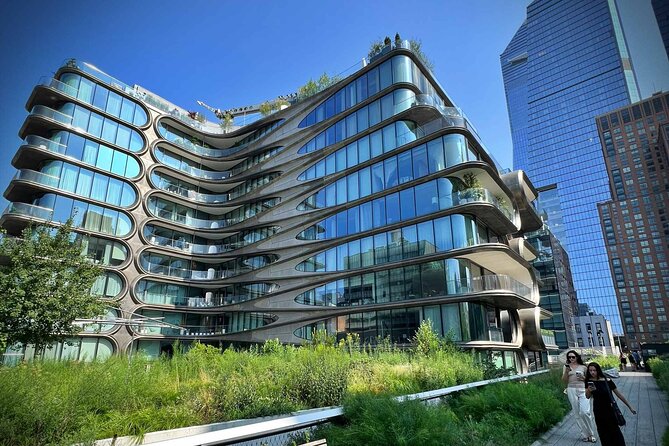
Chelsea Market is one of the most practical stops because it offers a natural break in the walk. The tour points out that the Food Network films its hit shows there, giving the market an entertainment connection as well as its food-hall appeal.
This is a good place to pause the audio. You can look around, eat, or simply take a break before continuing north. Since the walk is self-guided, you do not have to choose between following the story and stopping for lunch. You can do both, in your own order.
The important limitation is that food and drinks are not included. The tour price does not function as a food credit, and no attraction admission is bundled into it. Still, the ability to pause at Chelsea Market gives this experience more flexibility than a tightly timed walking tour.
For families or small private groups, this can be especially useful. One person may want to keep walking, while another wants to browse food stalls. You can separate those choices without losing the tour permanently because lifetime access is included.
Death Avenue and the railway beneath the park

The strongest historical section concerns the High Line before it became a public park. The narration takes you back to the late 1800s, when a street-level train caused so many pedestrian deaths that this stretch became known as Death Avenue.
That detail gives the route a sharp sense of danger. The High Line was not created as a decorative walkway. It was part of a practical response to a serious urban problem. Freight trains once moved through an area where people and traffic shared the same streets, and the consequences were grim.
I like this chapter because it changes how you see the structure. The tracks become more than a scenic relic. They reflect the pressure of a growing city, the risks of mixed traffic, and the way New York kept rebuilding itself to solve old problems.
You will get more from this portion if you slow down and look at the physical setting. The narration encourages you to connect the elevated route with the streets below and the buildings around it. Since the audio is not always perfectly synchronized with your pace, pause it if you need more time to take in the area.
The High Line’s rejected ideas and second life

The tour also explains what might have happened to the High Line after its railway days ended. More than 700 creative proposals were submitted for reusing the structure. Some were practical, while others were wonderfully strange.
Among the ideas are a mile-long swimming pool and a rollercoaster that would snake between the buildings. These proposals help you understand that the park we know was not the only possible future. The High Line could have become something far more commercial, theatrical, or downright odd.
This is one of the best reasons to choose the audio version instead of walking the route without commentary. You would still see the architecture and city views on your own, but you would miss the debate over what the structure should become.
The story also gives you a useful way to think about public spaces. The High Line was not simply rescued from demolition by magic. Its future had to be imagined, argued over, and shaped from many competing ideas. That makes the park feel like a civic decision, not just a scenic amenity.
The General Theological Seminary and the Standard Hotel

The General Theological Seminary appears as another stop. It brings a different kind of setting into the walk, contrasting with the commercial buildings, food market, and former railway infrastructure.
The tour also passes the Standard Hotel, sometimes nicknamed the Eyefull Tower because of its exposed position above the High Line. The commentary includes the hotel’s reputation for guests exposing themselves to people in the park, along with the widely reported incident involving Beyonce’s sister and Jay-Z in an elevator.
This material gives the walk a bit of tabloid humor. It also shows how the High Line sits in an unusually close relationship with surrounding buildings. The park does not offer distant views only. It passes directly beside private rooms, hotel windows, restaurants, and offices.
That closeness is part of the fun, but it may not suit anyone seeking a quiet or purely historical walk. The audio moves between serious urban history and cheekier local stories. I see that mix as a strength for most people, though listeners wanting a formal architecture lecture may find it less focused.
Hudson Yards and the approach to Vessel
The northern part of the route brings you into Hudson Yards, a newer section of Manhattan with a very different visual character from the older southern neighborhoods.
This transition is important. You move from a former freight line surrounded by historic buildings into a large-scale modern development. The High Line acts as the thread between those two versions of New York.
The tour ends its narrative at Vessel, the sixteen-story structure designed as a stairway to nowhere. It was intended to become a major Hudson Yards photo icon, and its unusual honeycomb shape makes it easy to understand why it attracted attention.
The commentary also addresses the structure’s tragic role as a suicide magnet. This is serious material, and you should know about it before booking if that subject may be upsetting for you or someone in your group. The inclusion is not just gossip. It shows how public design can change meaning after a place opens and how an ambitious landmark can become connected with difficult events.
There is a small point of route confusion to keep in mind. The narrative description places the finish at Vessel, while the stated end point says the activity ends back at the meeting point. I would check the app’s route instructions before starting so you know exactly how the digital tour handles the final section and any return journey.
What $14.99 gets you
At $14.99 per person, this is priced below many guided New York walking tours. You are paying for the narration, the VoiceMap application, offline maps, geodata, and lifetime access in English.
The value is strongest if you want flexibility. A traditional guide can offer live answers and personal interaction, but this tour lets you pause, rewind, stop for lunch, and continue without affecting anyone else. A private group also avoids the shared pace of a large public tour.
The value is weaker if you want museum entry, food, transport, or a human guide. None of those are included. You will also need a charged smartphone and headphones, which are easy to overlook when comparing prices.
I would judge the fee as fair for anyone who enjoys audio storytelling and plans to spend time on the High Line anyway. If you only want a quick walk and a few photographs, the free park itself may be enough. If you want context without committing to a scheduled guide, the small extra cost makes more sense.
App use, timing, and practical planning
The app is designed for easy downloading and starting. Offline access is a real advantage in a city where phone service, battery life, and crowded spaces can complicate navigation.
Before you arrive, install the VoiceMap application, download the tour, and test that the audio opens. Bring headphones and make sure your phone has enough battery for roughly 90 minutes, with extra power if you plan to stop often or take many photographs.
The experience is offered in English only. Most people can participate, and service animals are allowed. It is near public transportation, but transportation itself is not included, so you will need to arrange your own way to the starting point and any return trip.
Cancellation deserves attention. The experience is non-refundable and cannot be changed for any reason. Do not book it until you are reasonably sure about your date and plans.
The rating is very strong at 4.8 from four reviews, but the small number means you should treat that score as a useful signal, not a guarantee. The clearest pattern is that the storytelling earns praise, while synchronization can occasionally require a little manual control.
Should you book this High Line audio tour?
Book it if you want the High Line’s backstory, enjoy self-guided walks, and like the freedom to stop at Chelsea Market or nearby attractions. It is also a good fit for a private group that wants an informative route without a fixed guide or a shared tour schedule.
Skip it if you need a live guide, want admission to the Whitney or other attractions included, or dislike using your phone while sightseeing. I would also think twice if the discussion of Vessel’s tragic history may be uncomfortable.
For most independent visitors, the strongest reason to choose this experience is its storytelling. The High Line is already worth walking, but the tales of Death Avenue, rejected park designs, the Standard Hotel, and Vessel make the route more memorable. Download it before you arrive, keep your headphones ready, and treat the audio as a flexible guide rather than a stopwatch.
FAQ
Where does the tour start?
It starts at Friends of The High Line, 820 Washington Street, New York, New York 10014.
How long does the audio tour take?
The expected duration is about one hour and 30 minutes.
What language is available?
The tour is offered in English.
Do I need to bring my own smartphone and headphones?
Yes. A smartphone and headphones are not included, so you need to provide both.
Is offline access available?
Yes. Lifetime access to the English tour includes offline audio, maps, and geodata through the VoiceMap application.
Are museum tickets, food, drinks, or transportation included?
No. Entry fees, food, drinks, and transportation are not included.
Just added around New York City
- The Battery: A Self-Guided Audio Tour from Bowling Green Park to Stone St★ 5.0 · 3 reviews
- West Village’s Flappers, Freaks & Punks: A Self-Guided Audio Tour★ 5.0 · 4 reviews
- Boho Greenwich Village: A Self-Guided Audio Tour★ 5.0 · 3 reviews
- New York City’s Financial District: A Self-Guided Audio Tour★ 4.5 · 8 reviews
- Self-Guided Audio Tour of New York City★ 4.5 · 2 reviews
- Guided Tour (with Audio) Hamilton Musical in Lower Manhattan NYC★ 5.0 · 11 reviews
- New York’s Iconic Central Park: A Self-Guided Audio Tour★ 4.0 · 4 reviews
- Broadway: A Self-Guided Audio Tour of the World’s Iconic Theatre District★ 4.5 · 3 reviews
Self-Guided Tours, compared.

Acropolis Ticket & Optional Self-Guided Audio Tours
Read our review →


Ultimate Acadia National Park Self-Guided Driving Audio Tour
Read our review →

Santorini: Akrotiri Ticket with Optional Self-Guided Audios
Read our review →
Browse the lists this tour appears in