
REVIEW · USA AUDIO TOURS
Harpers Ferry Audio Tour History, Ruins and River Views
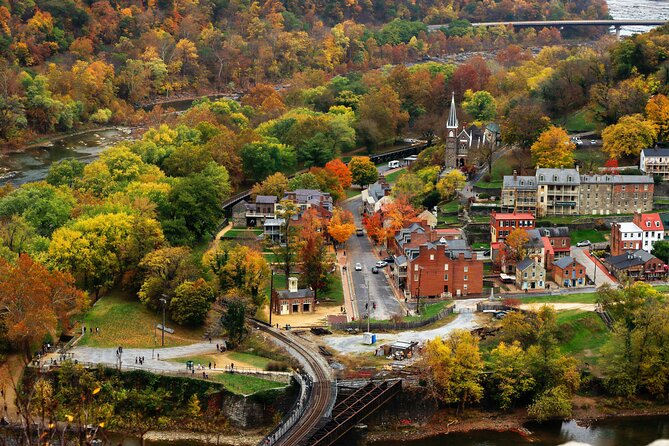
History gets personal here. This self-guided walk turns Harpers Ferry into an open-air storybook, linking John Brown’s Fort, Storer College, river overlooks, industrial ruins, and Civil War sites through your phone. I like the GPS-triggered narration, which starts as you reach each place, and the freedom to pause for photos or read the signs at your own speed. I also like the low $9.99 price, especially for a private group rather than a scheduled tour.
The catch is the walking. Several stops sit uphill or outside Lower Town, and one user found the full route too steep to finish. You also need to download the tour before arriving because cell service can be poor, and the app takes a little practice before the directions feel natural.
Five things to know before you go
- Nineteen stops tell one connected story: John Brown, the Civil War, Black education, industry, railroads, and the rivers all fit into one route.
- The narration starts by location: Reach a stop and the audio can begin automatically, letting you look around instead of constantly tapping your screen.
- The route is much more than Lower Town: It reaches cemeteries, overlooks, Virginius Island, Bolivar Heights, Murphy Farm, and the Appalachian Trail.
- The uphill sections matter: The Appalachian Trail Staircase, Harper Cemetery, and higher viewpoints add fine scenery but require effort.
- Download everything at home: Bring your own smartphone, and do not count on reliable mobile service in town.
- One major museum stop is closed: The African American history museum included in the route is currently unavailable during renovations.
Start at the train station in Lower Town

The tour begins at the Lower Town Train Station, at 182 Potomac Street. This is a sensible starting point because it introduces Harpers Ferry as a transportation center before sending you into the town’s older streets, hills, and river corridors.
Plan on about two hours, though your actual time can vary. The audio runs as a private experience for your group, so nobody is waiting for late arrivals and no guide is pushing you along. If you stop to read historic markers, take photographs, or pause between sections, the route can take longer.
The app works through your phone’s location. As you reach certain places, the next narration starts automatically. That is one of the tour’s best features. I prefer looking at a ruined wall or river junction rather than standing still with a phone menu open.
Still, you need to get your bearings early. The map is available in the app, but one useful control is easy to miss until you know where it is. You can technically begin at another stop, yet the story makes more sense in order. Download the app and tour material before leaving home, since cell service is described as spotty at best.
More History Audio Tours in the USA
- Santa Fe Historic Downtown Smart Phone Audio App Self Guided GPS Walking Tour
★ 4.5 · 112 reviews - Savannah’s Historical District: A Self-Guided Audio Tour
★ 4.5 · 69 reviews - Self-Guided Walking Audio Tour of Historic Santa Fe
★ 4.5 · 43 reviews
Appalachian Trail history begins with a symbolic stop
The first stop is the Appalachian Trail Conservancy Headquarters, where the audio introduces the 2,190-mile trail and its symbolic midpoint. You spend only about ten minutes here, but the stop gives the walking route a clear theme: Harpers Ferry is not only a town of old buildings. It is also a meeting place for people moving through a much larger American story.
The Appalachian Trail connection is useful context. You will later climb the Appalachian Trail Staircase, so this first stop helps frame that climb as more than a shortcut between streets. It is part of a trail culture built around distance, effort, and changing viewpoints.
The route also includes an African American history museum focused on people who were enslaved, freed, educated, and active in Harpers Ferry’s past. It is currently closed for renovations, so you should not plan on entering it. The audio can still point you toward the subject, but this part of the experience is less complete until the museum reopens.
Harper Cemetery and the town from above
Harper Cemetery is a short stop, listed at about five minutes, but its position above town gives it weight. The cemetery includes soldiers, local citizens, and people connected with Harpers Ferry’s development. You get quiet surroundings and broad views, along with a reminder that the town’s past belongs to ordinary residents as much as famous figures.
This is also an early warning about the route’s physical demands. The walk is not a flat loop through a compact historic district. Some stops require uphill walking, and the best views often come after the hardest sections.
If you have limited energy, pace yourself from the beginning. The audio is flexible, so you can stop, rest, and continue without losing a scheduled departure. That freedom is valuable here.
John Brown’s Fort and the arsenal story
The US Armory Site is one of the route’s most important historical settings. Only foundations remain, yet this was once a major weapons factory. Its connection to John Brown’s raid gives the site a sharp sense of cause and effect: weapons production, political conflict, abolition, and national crisis all meet in this small town.
The nearby Arsenal Square continues that story. It was part of the larger arsenal complex and witnessed the opening moments of Brown’s raid. Today, the open space is quiet. That contrast is part of its power. You are asked to imagine noise, confusion, and armed confrontation in a place that now seems almost ordinary.
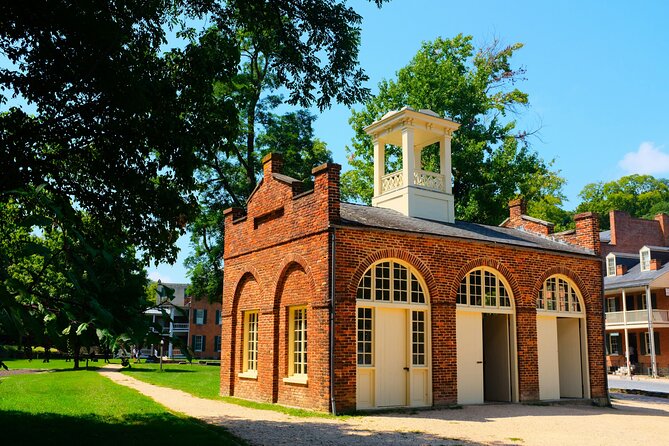
John Brown’s Fort is the emotional center of the route. The modest brick building served as a fire engine house, then became Brown’s final stronghold during the raid. The stop lasts only about five minutes, but the subject rewards a slower look at the building and the surrounding streets.
The audio format works especially well here. You can hear the historical explanation, then study the structure and imagine how a small building became tied to one of the most remembered abolitionist events in the country.
Same place, a different route to walk:
- Los Angeles: Hop-On Hop-Off Bus Tour with Audio Guide
★ 3.7 · 2,030 reviews - City Sightseeing Hop-On Hop-Off Bus Tour with Audio Guide
★ 3.0 · 1,083 reviews - Medieval Torture Museum Ticket with Audio Guide and Ghost Hunting
★ 5.0 · 962 reviews - Gettysburg Battlefield Self-Guided Driving Audio Tour
★ 4.5 · 910 reviews
Museums, churches, and the story of Black education
The Harpers Ferry Historical Museum occupies an old Lower Town building and uses hands-on exhibits and varied artifacts to cover daily life as well as major events. It is a useful counterpoint to the outdoor ruins. Instead of seeing only foundations and walls, you get objects and displays that help make the town’s people more visible.
Lockwood House adds another layer. The home was used by Union officers and later connected with Storer College leadership. Its history links military planning with education, which is one of the strongest threads in this tour.
Storer College deserves careful attention. Founded after the Civil War to educate formerly enslaved people, it became a center for Black education, leadership, and civil rights during Reconstruction and beyond. The stop is brief, but its importance is not. Harpers Ferry was not only a battlefield or industrial site. It was also a place where education offered a path toward power and independence.
St. Peter’s Roman Catholic Church gives the route another human angle. The stone church served Irish immigrant families and survived the Civil War. Its hillside setting provides a dramatic view, while its story points to the immigrant communities that helped shape the town.
The audio tour is strongest when these stops are considered together. John Brown’s Fort explains conflict over slavery. Storer College shows the struggle for education after emancipation. St. Peter’s Church reminds you that Harpers Ferry was also a working community made up of families, faith groups, soldiers, teachers, and laborers.
Jefferson Rock and the Appalachian Trail Staircase

Jefferson Rock is one of the route’s best scenic pauses. Named for Thomas Jefferson, the rocky perch looks across the meeting area of the Potomac and Shenandoah Rivers and the surrounding hills. It is an obvious photo stop, but the historical connection gives the view more meaning.
The tour asks you to look outward and think about why Harpers Ferry mattered. Rivers offered movement and power. Cliffs offered defense and visibility. Rail lines and roads connected the town to wider markets and military routes.
The Appalachian Trail Staircase links Lower Town with the trail above. It is steep and scenic, and you should treat it as a real climb rather than a decorative feature. If stairs or hills are difficult for you, this section may determine how much of the route you complete.
One user enjoyed the stops but did not finish because the uphill walk became too much. That is useful guidance, not a minor footnote. The route can be worthwhile even if you cover only part of it, but the full experience requires reasonable comfort with uneven and rising paths.
The Point and Harpers Ferry’s two rivers

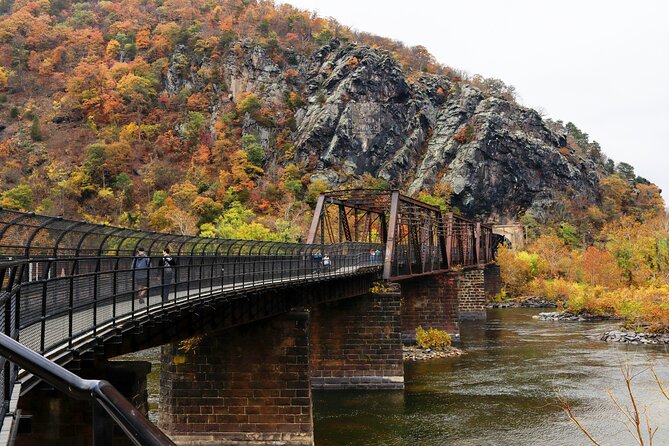
The Point is where the Potomac and Shenandoah Rivers meet. This is one of the clearest places to understand the town’s importance. Geography shaped everything here: ferry crossings, trade, industry, military strategy, rail connections, and settlement.
The original site of the Shenandoah River Bridge takes you back to Robert Harper’s 18th-century ferry. That crossing helped launch the community and explains why this seemingly small location became a regional crossroads.
I like the way the tour connects the river view to the town’s early development. You are not simply looking at water from a scenic perch. You are seeing the reason people came here, built here, moved goods here, and fought over this location.
Virginius Island and the remains of industry
Virginius Island shifts the mood again. The former industrial village is now a woodland setting with trails and moss-covered ruins. It once depended on water power, so the remains help explain how Harpers Ferry earned money before modern industry changed the town.
This stop is particularly good for people who enjoy seeing physical traces rather than only reading dates. Foundations, walls, and fragments give you something to study while the audio explains the industrial story.
The five-minute timing listed for the stop should be treated as a minimum. You may want longer if you enjoy ruins or want to follow the trails. At the same time, the woodland section adds distance to a route that already includes hills, so keep an eye on your energy.
Taverns, battlefields, and Civil War overlooks
White Hall Tavern recalls the social side of 19th-century Harpers Ferry. Travelers, local people, and Union soldiers passed through, and the tavern served as a place for food, drink, news, and political discussion. It helps you picture the town as a living community rather than a collection of battle sites.
Murphy Farm carries a more complicated past. It was a battlefield and later a setting for important civil rights speeches. That change from military conflict to public discussion gives the stop unusual reach across American history.
Bolivar Heights offers another commanding view and explains why the ridge mattered during the Civil War. Harpers Ferry’s position made it strategically valuable, and the overlook lets you see the terrain that shaped military decisions.
These stops are where the audio guide earns its price. Without context, a hill or open field can look like just another viewpoint. With the story in your ear, you can connect the view to troop movement, public speeches, and the town’s changing role.
Public Square and the surviving railway
Harpers Ferry Public Square has served as a center for markets, militias, protests, and parades. It remains a useful place to pause because so many parts of the town’s civic life passed through it.
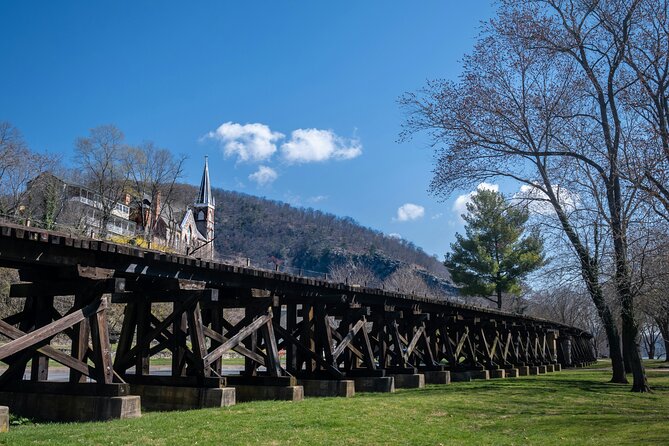
The Lower Town Train Station brings the story back to the present. It is still active, a reminder that Harpers Ferry was once an important rail connection rather than a quiet historic destination. Starting and ending here gives the tour a neat structure: you begin with transportation, walk through conflict and community, then return to the railway that helped shape the town.
The route ends back at the meeting point. That makes planning simple, especially if you arrived by train or need to return to a parked car. The tour operates daily from 8:00 AM to 8:00 PM during the stated operating period, but the audio itself remains flexible within those hours.
Is $9.99 good value?
At $9.99 per person, I consider this a strong value for anyone who wants structure without paying for a private human guide. You receive the app, the downloaded tour, unlimited access, and English audio. Children aged 10 and under are free, which helps families keep the cost down.
The value is greatest when you use the route as a framework for a half day rather than racing through it in exactly two hours. Nineteen stops cover a lot of ground. Some are short five-minute introductions, while museums, ruins, views, and markers may tempt you to stay longer.
The tradeoff is that the app is not perfect. One user found the map and starting controls awkward, especially when trying to understand where to walk next. The route can begin at another point, but the narrative is designed to flow from the train station, so I recommend following the suggested order.
You should also remember that this is not a trolley tour. Driving between stops is not presented as a simple solution, and one person found the route too spread out to walk comfortably. The tour suits an independent walker much better than someone seeking a ride with continuous commentary.
Who should choose this audio walk?
I would choose it if you like history, outdoor ruins, river views, and the freedom to set your own pace. It is a good fit for couples, families with older children, and small private groups who do not want to match a guide’s schedule.
It also suits visitors who like mixing serious history with scenery. The route covers slavery, abolition, Black education, industrial work, immigration, railroads, civil rights, and the Civil War. That range gives you a fuller picture of Harpers Ferry than a quick stroll through Lower Town.
I would hesitate if steep hills are a serious problem, if you dislike using apps while walking, or if you want a short, compact route. The closed African American history museum also means one important part of the town’s story is currently less direct.
Book at least with enough time to download the material before arrival. Free cancellation is available until 24 hours before the start time, but changes or cancellations inside that window are not refundable.
Should you book it?
Book this tour if you want an inexpensive, flexible introduction to Harpers Ferry and are comfortable walking uphill with your phone. The strongest features are the location-triggered audio, the wide range of historical subjects, and the ability to stop whenever a view or ruin deserves more time.
Skip it if you need transportation between distant stops or prefer a guide who handles navigation. For most independent walkers, though, $9.99 buys a useful story, a clear route, and the freedom to experience Harpers Ferry at your own speed.
FAQ
How long does the Harpers Ferry audio tour take?
The tour takes approximately two hours. Your visit may take longer if you pause at museums, ruins, viewpoints, and historic markers.
Where does the tour begin and end?
It begins and ends at the Lower Town Train Station, located at 182 Potomac Street, Harpers Ferry, West Virginia 25425.
Is the tour available in another language?
The audio tour is offered in English.
Do I need to bring my own phone?
Yes. A smartphone is not included, so you need to bring your own device.
Should I download the tour before arriving?
Yes. Cell service is spotty at best, so downloading the app and tour material before you go is recommended.
Is the tour suitable for children?
Children aged 10 and under are free. Most people can participate, but the route includes uphill walking and the steep Appalachian Trail Staircase.
Can I cancel for a full refund?
Yes. You can cancel at least 24 hours before the experience start time for a full refund. Cancellations or changes made less than 24 hours before the start time are not refunded.
Just added around the USA
- Self Guided Driving Audio Tour of Saguaro National Park★ 3.0 · 4 reviews
- Self-Guided Audio Driving Tour of Mount Lemmon★ 5.0 · 4 reviews
- Saguaro National Park Self-Guided Audio Tour★ 3.5 · 11 reviews
- A Self Guided Audio Tour in Tombstone★ 4.0 · 11 reviews
- Catskills Scenic Byway Self-Guided Driving Audio Tour★ 4.0 · 9 reviews
- Big Bend National Park Self Guided Audio Tour Guide★ 5.0 · 12 reviews
- Self-Guided Audio Driving Tour in Catskills Scenic Byway★ 4.5 · 7 reviews
- Black Canyon of the Gunnison NP Self-Guided Driving Audio Tour★ 3.5 · 7 reviews
Historical Tours, compared.

Colosseum, Roman Forum & Palatine Hill with Audioguide App
Read our review →
St. Mark Basilica Ticket, Audioguide+History Gallery
Read our review →
Colosseum, Ancient Rome Tour or AudioGuided Tour
Read our review →
Colosseum, Roman Forum & Palatine Hill Entry and Audioguide
Read our review →
Taormina: Ancient Theater Skip-the-Line Ticket & Audio Guide
Read our review →
Colosseum, Roman Forum & Palatine Hill Visit + Audio Guide
Read our review →
National Archaeological Museum Ticket & Audio Guide
Read our review →
Roman Forum Super Pass Entry with Audio Guide App
Read our review →Browse the lists this tour appears in