

REVIEW · BIG ISLAND AUDIO TOURS
Hawaii Volcanoes National Park Self-Guided Driving Audio Tour
Volcanoes reward a slow drive. This GPS-triggered tour turns a 24.5-mile road trip through Hawaii Volcanoes National Park into a flexible audio journey, with more than 43 stories covering geology, Hawaiian traditions, military history, and dramatic eruptions. I like the hands-free narration and the freedom to stop for a trail, snack, or photo without waiting for a group. At $16.99 per car for up to four people, it is also a strong value.
I also like that the tour works offline after you download it, a real help in a large park where cell service can be weak. The main drawback is the setup: you must find the confirmation email or text, download the separate Action app over a good connection, and enter a password before arriving. One user gave up after spending 40 minutes trying to access it, so preparation matters.
Key points to know before you go
- More than 43 audio stories cover 24.5 miles, from the Entrance Station to the Holei Sea Arch.
- The $16.99 price covers one group of up to four, making it far cheaper than a private or bus tour for many parties.
- GPS starts each story automatically, so you can keep your eyes on the road instead of tapping through a guide.
- Offline access is a major advantage, but you must download the tour while you still have strong Wi-Fi or cellular service.
- The route includes major sights and optional walks, including Thurston Lava Tube, Sulphur Banks, Kīlauea Iki, and Pu‘u Loa.
- The recommended route works best in one direction, and reverse touring is not currently supported.
A self-guided road through an active volcano park
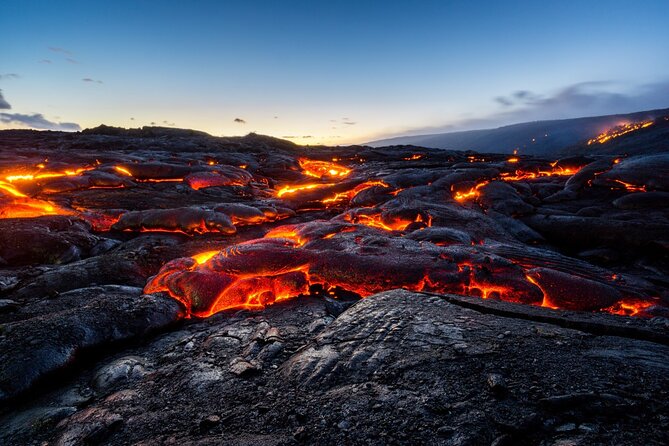
This is not a walking tour with a meeting point or a guide waiting beside a minibus. You begin at the park’s Entrance Station in Volcano, Hawaii, open the Action Tour Guide app, and let your phone’s GPS trigger the narration as you drive.
The route takes about two to three hours if you make a fairly direct visit. You can stretch it much longer by adding hikes and photo stops. One family covered the key points in about three to four hours, while another group with limited time only reached the first three sights. That flexibility is the central reason to choose this format.
The audio explains what you are seeing as you approach it. You do not need to stop and read every sign, and you can repeat a story if road noise or a missed turn interrupts it. At the same time, you should drive at the posted speed limit. The narration is timed to the route, and going too fast can mean reaching the next point before the current story ends.
The route is designed to begin at the Entrance Station and finish at the Holei Sea Arch on Chain of Craters Road. One person specifically wished for a reverse option. You can sometimes stray from the route and reconnect with the GPS tour, but the smoothest experience comes from following the suggested direction.
More Self-Guided Audio Tours in the USA
- Gettysburg Battlefield Self-Guided Driving Audio Tour
★ 4.5 · 910 reviews - Joshua Tree National Park Self-Guided Driving Audio Tour
★ 4.5 · 762 reviews - Ultimate Acadia National Park Self-Guided Driving Audio Tour
★ 4.0 · 521 reviews
Kilauea Military Camp and the park entrance area
After passing through the Entrance Gate, the opening section takes you toward Kilauea Military Camp and the area around the visitor center. Kilauea Military Camp now serves as a recreation facility for soldiers, but its past is more troubling than its present purpose suggests.
During World War II, the site was used as an internment camp for prisoners of war and Japanese civilians. That detail gives the opening drive more weight. You are not hearing only a list of volcanic facts. The tour also points to the human stories tied to this part of the island.
This is a good early stop because it helps you understand that Hawaii Volcanoes National Park is both a geological site and a place shaped by war, government policy, Native Hawaiian traditions, and local communities.
Steam Vents and the sulfur-scented trail
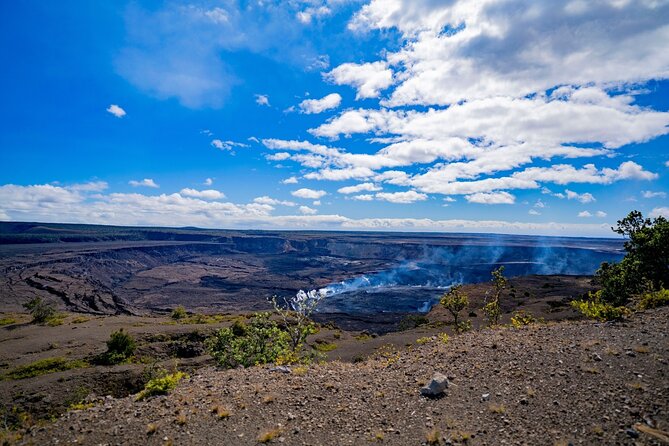
At Steam Vents, heat from Kīlauea warms groundwater trapped below the surface. The resulting steam rises through cracks and openings in the ground, giving you a visible sign that the volcano is still active below your feet.
The stop takes about ten minutes if you simply pause for the audio and a look. You can also connect this area with the short Sulphur Banks Trail. The name tells you what to expect, but the smell may still surprise you. The air can be strongly sulfurous, and the tour’s joking warning that the trail is not exactly sweet is fair.
This is one of the better places to hear the audio while standing outside the car. You get a direct connection between the explanation and the steam, fumes, and unusual ground around you. Keep the stop brief if the odor bothers you.
Kīlauea Overlook and the scale of the crater
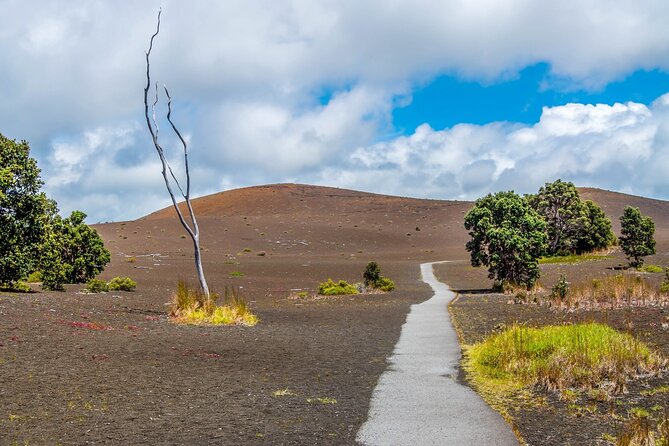
Kīlauea Overlook is one of the key stops on the route. From here, you look across the broad crater of one of the world’s most active volcanoes.
The crater may not resemble the steep, symmetrical cone many people picture when they hear the word volcano. That is part of the lesson. Kīlauea’s volcanic activity has produced a much broader and more complicated setting, and the audio helps you interpret what you see.
Allow about ten minutes for the basic stop, though you may want longer for photos. This is also a good place to pause the tour and get your bearings before continuing. The narration gives the view context without forcing you into a fixed schedule.
More Driving Audio Tours in the USA:
- Ultimate Lake Tahoe Self-Guided Driving Audio Tour
★ 4.5 · 435 reviews - Scenic Newport, RI Self-Guided Driving Audio Tour
★ 4.5 · 325 reviews - Arches National Park Self-Guided Driving Audio Tour
★ 4.5 · 288 reviews - Yellowstone National Park Self-Guided Driving Audio Tour
★ 4.5 · 249 reviews
Kīlauea Iki and Nahuku, Thurston Lava Tube
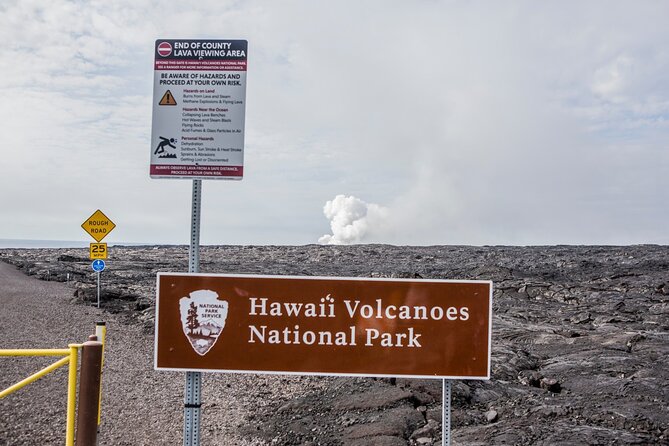
The Kīlauea Iki Trailhead marks one of the route’s biggest choices. The trail is a 3.3-mile loop that crosses the Kīlauea Iki Crater and takes about three hours. The elevation change can be strenuous, so it is not a quick roadside stroll for everyone.
The audio stop itself takes about ten minutes, but the tour does not require you to hike the entire loop. You can listen, decide how much time and energy you have, and pause the driving route while you walk. This is a useful example of how a self-guided tour works best: the narration provides structure, but you make the final call.
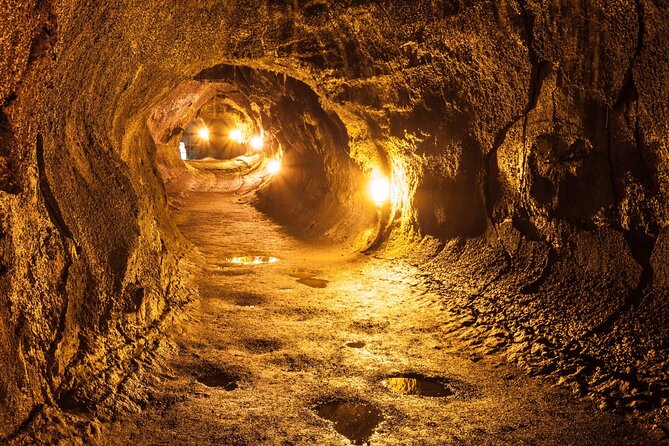
Nearby, Nahuku, also called Thurston Lava Tube, offers a very different volcanic experience. More than 500 years ago, flowing lava formed a tunnel as the outer surface cooled and hardened while lava continued moving through the center. Today, you can walk through the resulting cave system.
The lava tube is a strong stop for families and anyone who wants to see the physical result of an eruption at close range. Since the itinerary gives each point roughly ten minutes, you will need to pause the audio if you want a longer look.
Luamanu, Puhimau, and Pauahi craters
The drive continues through a series of craters that can blur together if you visit without explanation. The audio gives each one a reason to stop.
Luamanu Crater was once covered by dense forest. That changed in a single day, a reminder of how quickly volcanic activity can replace living forest with bare rock and ash.
Puhimau Crater shows another form of volcanic change. You are looking at geological features shaped by eruptions and shifting ground, not a polished attraction built for sightseeing. The appeal is in seeing how many forms volcanic activity can take across one park.
Pauahi Crater is a steep-sided pit crater about 330 feet deep and 1,000 feet across. Its lava spatter deposits and fumaroles, which release steam and gases, make it one of the more visually distinctive crater stops. The audio is especially useful here because the physical features can be difficult to interpret without some explanation.
These stops are not all dramatic in the same way. Some may look quiet or gray at first glance. I found the audio’s role most valuable in places like these, where the story turns a broad view into a record of what happened there.
Pu‘u Huluhulu and the idea of a kipuka

Pu‘u Huluhulu is a cinder cone, similar to Pu‘upua‘i. Its name means hairy hill, a reference to the low shrubs that cover it and give it a fuzzy appearance from a distance.
The next stop, Kipuka Puaulu, explains one of the park’s most interesting natural patterns. A kipuka forms when a lava flow surrounds an older patch of vegetation. The plants survive as an island of life inside a much younger lava field.
This idea is easy to miss if you only look at the road and the surrounding rock. The audio helps you notice the contrast between old vegetation and newer lava. Kipuka Puaulu can also be a worthwhile walk, but the tour data does not assign a full hiking time to it. Plan extra time if you intend to leave the car and explore beyond the short stop.
Mauna Ulu and the shapes left by moving lava
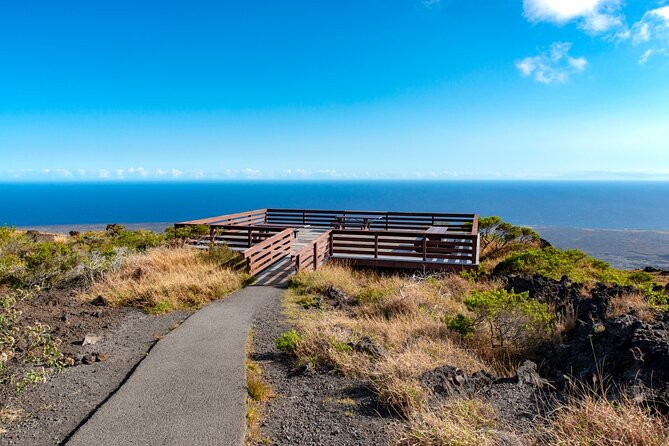
At the Mauna Ulu Lookout, a raised platform gives you broad views across the Mauna Ulu lava flow. Much of the scene is flat and gray, but the tour points you toward toadstool-shaped formations that reward a closer look.
This is a good example of why you should not rush through the park. The first view may seem plain compared with a crater overlook or sea cliff. Then the audio directs your attention to the odd forms in the lava, and the stop becomes more interesting.
Use the pause function freely here. The app is built for breaks, and you can stop the narration while taking photos or reading signs.
Pu‘u Loa petroglyphs and the long drive to the coast
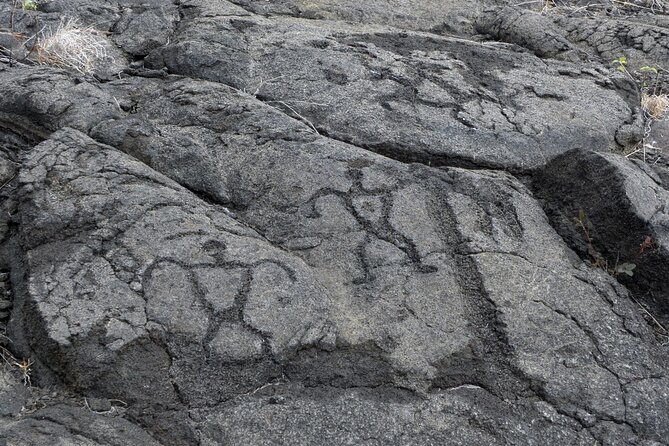
Pu‘u Loa Petroglyphs is one of the most important cultural stops on the route. Hardened lava here carries more than 23,000 ancient petroglyphs.
The carvings give the park a human dimension that volcanic features alone cannot provide. Take care to treat the site respectfully and stay with the designated visitor route. The audio can add context, but your attention should remain on the actual carvings and the place where they were made.
The route then continues toward the coast, which is one reason I would not choose this tour if you have only an hour. The park is large, and reaching the final stops takes time. One family’s practical advice was simple: make it all the way to the sea arch if your schedule allows. The drive is part of the experience, not just a transfer between attractions.
Holei Sea Arch, the route’s natural finale
The famous Holei Sea Arch is the final major stop, located along Chain of Craters Road near the coast. Waves and erosion formed the cliff opening into a natural arch, creating one of the most memorable photo points in the park.
This ending gives the route a satisfying change of scene. You begin among steam vents, craters, and high volcanic ground, then finish beside the ocean. If you have time for only a few stops, the first three points provide useful background, but skipping the sea arch means missing the route’s strongest visual finish.
Check current park conditions before setting out. Volcanic areas, roads, trails, and coastal viewpoints can be affected by closures or changing conditions. A government shutdown previously left some people touring on their own, which made the audio especially useful, but official updates remain important.
Volcano Art Center Gallery and extra time near the visitor center
The Volcano Art Center Gallery is housed in a small building separate from the main visitor center. It is a worthwhile optional stop if you enjoy fine art and want something different from geological viewpoints.
The gallery also reminds you that the park is not only about natural features. Art, cultural expression, and local interpretation have a place here too. Since the route includes more than 43 stories, you can skip anything that does not interest you and spend more time on the subjects you prefer.
The itinerary places the gallery late in the numbered list, although it is near the visitor center area at the start of the broader visit. Treat the listed stops as a suggested collection rather than a rigid tour schedule. The app’s GPS guidance is most useful when you follow the recommended route, but you can pause for side visits and return to the drive.
Price, app setup, and the real value
At $16.99 per group of up to four, this is priced per car rather than per person. A family or group of friends can split the cost four ways, making it a small addition to the park admission fee.
The admission fee for Hawaii Volcanoes National Park is separate, and no attraction tickets, reservations, or passes are included. The tour also does not replace park entry rules or official closure information.
The best value comes from the combination of narration and independence. You avoid paying per person for a bus or private tour, and you do not have to match someone else’s timetable. You can stop for Kīlauea Iki, skip a crater, repeat an audio story, or spread the route across more than one day.
The setup takes a little care. After booking, look for an email and text with the password and instructions. Download the separate Action Tour Guide app while you have strong Wi-Fi or cellular service, then download the tour content for offline use.
Connect your phone to the car by Bluetooth, USB, or AUX. Apple CarPlay is supported for audio playback. An iPhone with iOS 15 or later, an Android device with version 9 or later, or an iPad or tablet with GPS and cellular connection is recommended.
There is no guide at the starting point. You launch the app at the Entrance Station, enter the first story’s location, and let the audio begin. If more than one tour appears in the app, choose the version that matches your starting point and direction.
Who should book it?
I would choose this tour for a first visit, a family with mixed interests, or anyone with only one afternoon to organize. It is especially useful if you have not had time to study the park before arriving and want spoken explanations instead of reading facts from a phone screen.
It also suits independent drivers who dislike fixed groups. The tour is private to your party, and its lifetime access means you can use it on another trip without buying it again.
I would hesitate if you want a live guide, deep conversation, or help with every trail decision. You also need to be comfortable preparing the app in advance. The one poor experience in the feedback came from access problems, not from the route itself, so do not wait until you are inside the park to install everything.
Cancellation is free if you cancel at least 24 hours before the scheduled start time. Changes or cancellations inside that window are not refundable.
Should you book the Hawaii Volcanoes audio tour?
Book it if you want a low-cost way to give structure and meaning to a self-drive through Hawaii Volcanoes National Park. The strongest parts are the GPS-triggered stories, the offline function, the range of stops, and the freedom to set your own pace.
Skip it if you already have a detailed plan and prefer reading the free national park app, which also offers self-paced information. Still, the spoken narration is easier to use while driving, and the $16.99 group price is hard to fault. Download it before arrival, follow the route at a sensible speed, and save enough time to reach the Holei Sea Arch.
FAQ
How long does the Hawaii Volcanoes National Park audio tour take?
The suggested driving route takes about two to three hours. Your visit can take longer if you hike, stop for photos, or pause the narration for side trips.
How long is the driving route?
The route is more than 24.5 miles long and includes more than 43 audio stories.
Where does the tour begin?
It begins at the Entrance Station in Volcano, Hawaii, near the park entrance and visitor center area.
Where does the tour end?
The recommended route ends at the Holei Sea Arch on Chain of Craters Road near Pāhoa.
Is admission to Hawaii Volcanoes National Park included?
No. The national park entrance fee is separate and is not included with the audio tour.
Does the tour work without cell service?
Yes, but you must download the app and tour content while you have strong Wi-Fi or cellular service. It works offline after the download is complete.
Does a guide meet you at the entrance?
No. This is a self-guided activity. You start the app at the first location and follow the GPS-triggered stories.
Can I use the tour for more than one visit?
Yes. The tour includes lifetime access with no expiry, so you can use it on future trips and on multiple days.
Can I drive the route in reverse?
The tour is designed to work best from the recommended starting point and direction. Reverse touring is not currently supported as the standard route.
What devices and car connections are supported?
The tour recommends an iPhone running iOS 15 or later, an Android device running version 9 or later, or an iPad or tablet with GPS and cellular access. You can connect audio through Bluetooth, USB, or AUX, and Apple CarPlay supports audio playback.
Is the tour offered in more than one language?
No. The experience is offered in English.
Can I cancel for a refund?
Yes. Cancel at least 24 hours before the scheduled start time for a full refund. Cancellations or changes made within 24 hours are not refunded.
More National Park Audio Tours in the USA
- Self-Guided GPS Audio E-Bike Tour Hawaii Volcanoes National Park
★ 4.5 · 131 reviews - Shenandoah National Park Self-Guided Driving Audio Tour
★ 4.5 · 109 reviews - Self-Guided Audio Driving Tour in Glacier National Park
★ 4.5 · 101 reviews - Rocky Mountain National Park Self-Guided Driving Audio Tour
★ 4.5 · 92 reviews
Just added around the USA
- Self Guided Driving Audio Tour of Saguaro National Park★ 3.0 · 4 reviews
- Self-Guided Audio Driving Tour of Mount Lemmon★ 5.0 · 4 reviews
- Saguaro National Park Self-Guided Audio Tour★ 3.5 · 11 reviews
- A Self Guided Audio Tour in Tombstone★ 4.0 · 11 reviews
- Catskills Scenic Byway Self-Guided Driving Audio Tour★ 4.0 · 9 reviews
- Big Bend National Park Self Guided Audio Tour Guide★ 5.0 · 12 reviews
- Self-Guided Audio Driving Tour in Catskills Scenic Byway★ 4.5 · 7 reviews
- Shiloh Battlefield Self-Guided Driving Audio Tour★ 4.0 · 9 reviews
Driving Audio Tours, compared.



Ultimate Acadia National Park Self-Guided Driving Audio Tour
Read our review →



Browse the lists this tour appears in