
REVIEW · BARCELONA AUDIO TOURS
Barcelona’s El Raval and the Gothic Quarter: A Self-Guided Audio Tour
Barcelona’s old quarters reward a slow walk. This self-guided audio tour links El Raval and the Gothic Quarter in about 75 to 90 minutes, using stories, directions, and a phone map to lead you from La Rambla into narrow lanes and old squares. I like the freedom to pause whenever you wish, and I like the low $11.99 price for lifetime access in English. The main concern is the app’s navigation, since GPS can become confused among tall buildings and tight streets.
You begin at Font de Canaletes on La Rambla and finish back at the same meeting point. I also like that the audio, map, and route data work offline, which saves phone data. Still, you need your own smartphone and headphones, and a little preparation before starting will make the walk easier.
Key points to know before you go
- Two old districts in one walk: The route connects El Raval and the Gothic Quarter, moving from former working-class and red-light streets to Roman remains, churches, and civic squares.
- A flexible 75 to 90 minutes: You control the pace and can pause the audio, stop for food, or repeat the tour later with lifetime access.
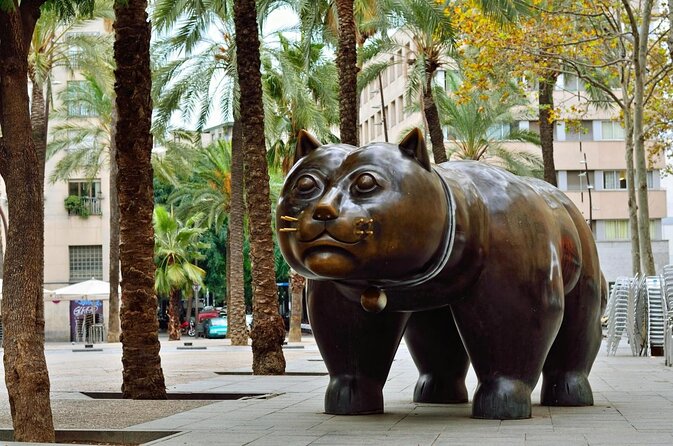
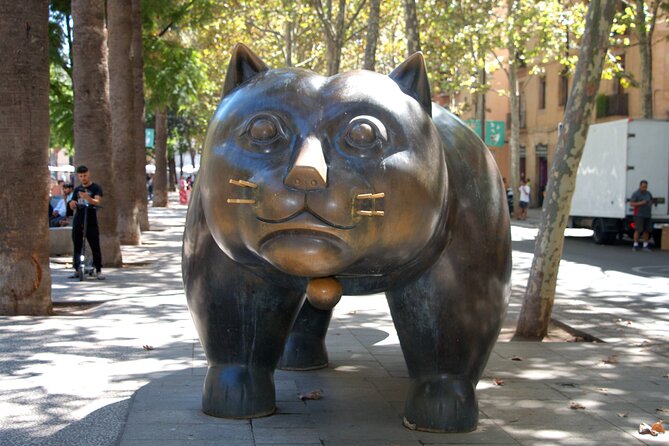
- A strong collection of unusual stops: Look for the baby drop-off hole at the House of Mercy, Botero’s El Gato de Botero, the kissing mural, and the Bishops Bridge.
- Offline help matters: Downloading the audio, map, and geodata helps preserve data, but GPS may still struggle in narrow streets.
- Good value for independent walkers: At $11.99 per person, the tour costs less than many guided outings and lets only your own group participate.
- Come prepared: The experience is in English, and entrance fees, food, drinks, transport, a phone, and headphones are not included.
Starting at Font de Canaletes on La Rambla
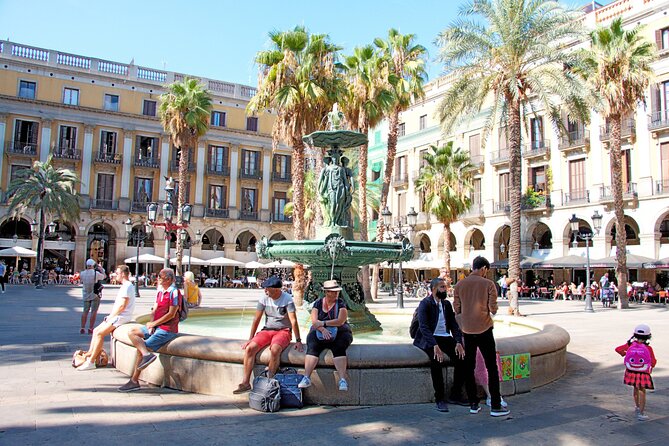
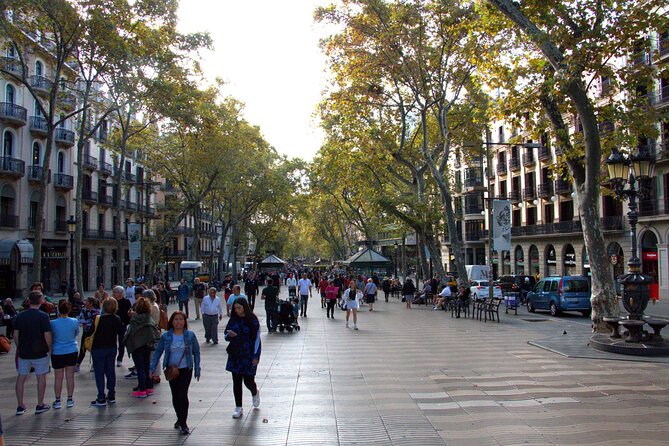
The tour begins at Font de Canaletes, La Rambla 133, in Barcelona’s Ciutat Vella. This gives you an easy-to-find starting point on one of the city’s best-known streets, but it also places you in an area where crowds and street activity can make the first few minutes feel less calm.
The audio route is designed to guide you as you walk rather than make you stand in one place for long periods. You can hear the commentary, follow the map, and move on when ready. The route returns to the starting meeting point, so you do not need to work out separate transport back to your hotel or another part of the city.
The listed duration is about one hour and 15 minutes to one hour and 30 minutes. That timing describes the walk itself, not a leisurely market visit or long stop inside an attraction. If you enter Mercat de la Boqueria, stop for food, or pause for photographs, allow extra time.
The tour is available at any time during the stated operating period, with opening hours shown as Monday through Sunday, all day. That broad schedule is useful if you want to avoid the biggest crowds, though the route’s exact feel will depend on when you walk it.
More Self-Guided Audio Tours in Spain
- Gaudi and La Sagrada Familia Exterior Self-Guided Audio Tour
★ 3.5 · 25 reviews - Self-Guided Audio Tour-The Surrealist Barcelona of Dalí and Gaudí
★ 3.5 · 8 reviews - Self-Guided Audio Tour – Legends of the Gothic Quarter
★ 4.5 · 6 reviews
El Raval, from crowded streets to difficult stories
After leaving La Rambla, the route enters El Raval. The neighborhood once had the highest population density of any urban area in Europe, and it also served as Barcelona’s Red Light District. That background gives the first part of the walk a sharper edge than a simple parade of pretty streets.
I appreciate that the route does not limit itself to grand buildings. It points you toward stories about poverty, crowded housing, and the hard choices faced by destitute mothers. At the House of Mercy, you learn about the hole in the wall where unwanted babies could be left. It is a grim detail, but it helps explain the social pressures that shaped this part of the city.
This is one place where an audio format works well. You can listen while looking at the street around you, rather than standing in a group as a guide tells a long story. The subject matter is serious, so this section may feel less lighthearted than the later stops.
The route also takes you to El Gato de Botero, the large, rounded cat statue by Fernando Botero. You can see the sculpture and, if you wish, rub its crown jewels. That small bit of local ritual adds humor after the heavier story of the House of Mercy.
Mercat de la Boqueria and a useful pause
Mercat de la Boqueria offers one of the route’s most practical breaks. The market has operated since the 1100s, giving it a long connection with daily food shopping in the city. You have the chance to step inside, look around, and decide if you want to pause for something to eat or drink.
The market is not included as a paid attraction, and food and drinks are not included in the tour price. That is important because the walk’s $11.99 fee covers the audio experience only. You should treat Boqueria as an optional stop, not a meal included with your booking.
I like the way the market interrupts the historical commentary. A good self-guided walk needs places where you can put the phone away for a few minutes, and this is one of them. If you stay for a snack or browse the stalls, the tour’s advertised 75-minute timing will no longer tell the full story.
The route then continues toward Palau Güell, one of Antoni Gaudí’s more restrained buildings. It is a useful reminder that Gaudí’s work is not always the colorful, highly decorated architecture associated with his best-known creations. You see the palace from the route, but admission to museums or attractions is not part of the experience.
Stories around Palau Güell and Carrer d’Avinyó
Palau Güell is a natural point of interest after El Raval’s denser streets. The audio gives you context as you look at the building, but you should not assume the tour includes entry. The supplied details clearly exclude tickets and entrance fees, so plan to view the exterior unless you arrange admission separately.
From there, the route takes a shortcut along Carrer d’Avinyó. The street is linked with Pablo Picasso’s Les Demoiselles d’Avignon, adding an art connection to the walk. You do not need to visit a museum to understand why this street matters within the route, since the audio supplies the connection as you walk.
The tour also passes Can Culleretes Restaurant, where you hear two different origin stories and decide which one seems more believable. This is a pleasant change from fixed dates and architectural labels. You get a local tale with room for doubt, which feels more like a conversation than a lecture.
Another stop is Meson del Cafe. The tour presents it as a place with the city’s best coffee and a chance that you might encounter the mayor. Those claims are part of the experience’s storytelling, not a promise of a meeting or a free drink. Food and drinks remain your responsibility.
More Self-Guided Audio Tours in Barcelona:
- Barcelona Self-Guided Audio Tour
★ 3.0 · 6 reviews - Self-Guided Tours Barcelona: 150+ Captivating Audio Stories
★ 5.0 · 4 reviews - Barcelona self-guided city walking tour with audio & quizzes
★ 5.0 · 3 reviews - Self-Guided Audio Tour of Barcelona City
★ 3.0 · 2 reviews
Entering the Gothic Quarter through old lanes
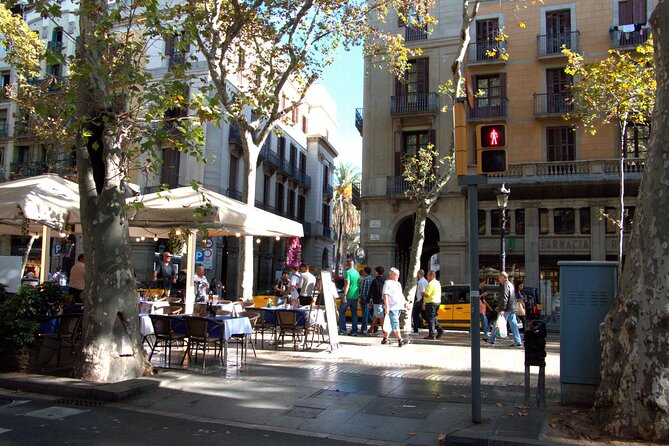
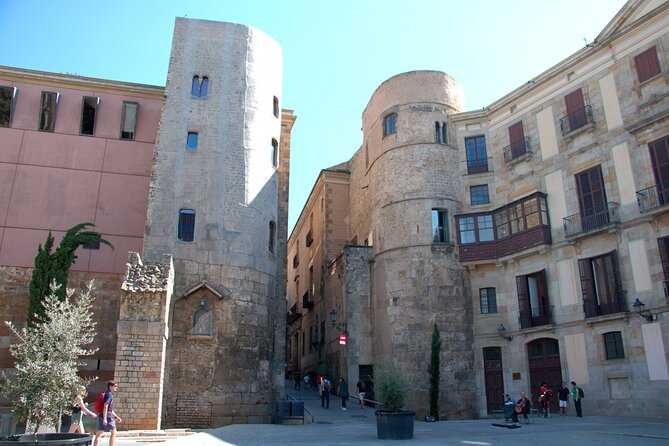
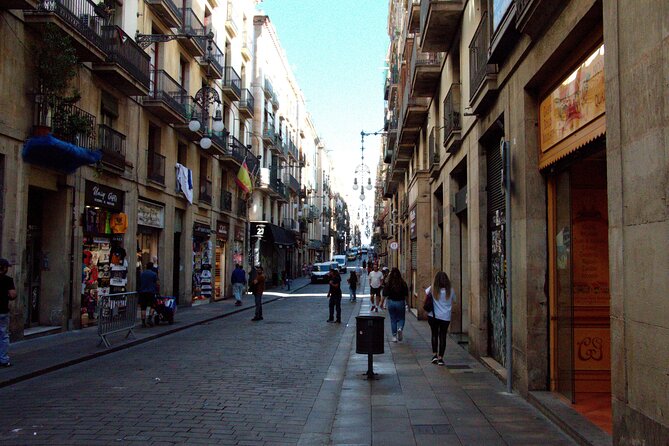
The route shifts into the Gothic Quarter, where narrow lanes and small squares replace the wider path along La Rambla. You pass through Plaça de Sant Jaume, Plaça Nova, and Plaça Sant Felip Neri. Each square gives you a place to stop, look around, and let the audio explain how the neighborhood developed.
Plaça de Sant Jaume is especially useful for understanding Barcelona’s civic center. Plaça Nova brings you close to the cathedral area, while Plaça Sant Felip Neri offers a quieter and more enclosed setting. The route does not simply point you toward one famous façade. It asks you to notice the spaces between major sights.
You also see the Cathedral of Barcelona and Pont de Bisbe, the Bishops Bridge. The Gothic Quarter’s attractions are described as neo-Gothic, which is a useful warning against assuming that every old-looking building dates from the medieval period. The audio helps separate the ancient Roman city from later buildings designed to recall an older Barcelona.
This part of the walk can be the most confusing for navigation. Tall façades and narrow lanes may affect GPS accuracy, and one person found the app’s position and direction unreliable enough to use Google Maps alongside it. The on-screen map is available as a backup, but you should download the route before setting out and pay attention to your direction at each turn.
Barcino, Roman walls, and the kissing mural
The final stretch connects today’s Gothic Quarter with Barcino, the small fortified Roman settlement that grew into Barcelona. You learn where tombs once lined the ancient village wall, a detail that makes the city’s early shape easier to picture beneath the modern streets.
This is the sort of information that gives the route purpose. You are not only moving from one photo stop to another. You are following the city’s growth from a Roman settlement to a major urban center, with later buildings and streets layered over the earlier town.
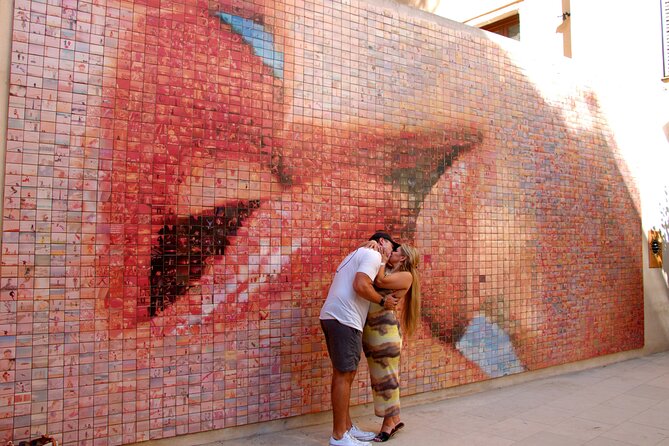
You also see El Petó, the kissing mural made from 4,000 photographic images representing freedom. The public donated the images, so the finished work has a personal quality that differs from a single painted monument. It is one of the route’s more modern sights and gives the walk a closing note that looks toward shared civic identity rather than only ancient stones.
The sequence of Roman remains, cathedral architecture, public squares, and modern art gives the route a good range. A drawback is that the first sites can feel somewhat spread out. Once the walk gathers momentum, though, the variety of things to see becomes one of its strengths.
How the VoiceMap app works for this walk
The experience uses the VoiceMap app for Android and iOS. Your purchase includes the audio tour in English, an offline map, and offline geodata. You also receive lifetime access, so you can repeat the walk later rather than treating it as a one-time download.
The best way to use this feature is to install the app and download the tour before reaching La Rambla. The supplied details do not promise that a phone signal will always be strong, and offline access protects you from data problems. You still need to bring your own smartphone and headphones.
The audio is designed to keep pace with your walking. Several people found it clear, easy to follow, and simple to pause. That matters because the route contains places where you may want to stop for a photograph, enter Boqueria, or look closely at a statue.
The main weakness is orientation. GPS may misread your position among narrow streets, and the app can leave you unsure which way to face. Use the map as well as the spoken directions. If the app causes technical trouble, VoiceMap provides support by email and telephone.
What the $11.99 price really buys
At $11.99 per person, this is a low-cost way to add structure to a walk through central Barcelona. You do not pay for a guide, group transport, or attraction tickets. In return, you get an audio route, map, offline data, and lifetime access.
The value is strongest for a couple, family, or small group that dislikes fixed schedules. Only your own group participates, and you can stop whenever you like. One family of three particularly enjoyed being able to pause, and that flexibility is the main reason to choose this format over a standard walking tour.
The price is less attractive if you want personal conversation, instant answers, or someone physically pointing out every turn. You also need to handle the app yourself. A little preparation matters, especially because cancellation is not refundable and changes are not allowed.
The published score is 4.7 from 10 reviews, with 90 percent recommending the experience. The praise centers on clear audio, useful information, freedom to set the pace, and the chance to find places that might otherwise be missed. The one clear criticism concerns the app’s user experience and GPS, so treat the technology as helpful but not perfect.
Who should book this self-guided walk
I would choose this tour if you want an independent introduction to El Raval and the Gothic Quarter, especially if you prefer not to follow a large group. It suits people who like to stop for coffee, browse a market, take photos, and continue when ready.
It also works well for families and friends sharing one route. The audio can be paused, and lifetime access means you can repeat the walk on another day. English speakers get the full experience, since English is the only listed language.
I would be more cautious if you dislike using a phone for navigation. The walk may still work, but you should be ready to check the map and use another map app if GPS becomes confused. Anyone expecting entry to Palau Güell, the cathedral, or other attractions should budget separately for admission.
FAQ
How long does the audio tour take?
The walk takes approximately one hour and 15 minutes to one hour and 30 minutes. Extra time is needed if you stop at Mercat de la Boqueria, take photographs, or visit an attraction.
Where does the tour start and finish?
It starts at Font de Canaletes, La Rambla 133, Ciutat Vella, Barcelona. It ends back at the same meeting point.
Is the tour available offline?
Yes. The included VoiceMap app provides offline access to the audio, map, and geodata.
What do I need to bring?
You need your own smartphone and headphones. Transportation, food, drinks, and attraction entrance fees are not included.
Is the tour guided in a group?
No. It is a private self-guided activity for your own group, with no shared group participation.
Can I take the tour more than once?
Yes. The booking includes lifetime access to the English tour, so you can repeat it whenever you like.
Should you book it?
Book this walk if you want low-cost freedom and a broad introduction to two central Barcelona neighborhoods. The route has enough unusual material to keep it interesting, from the House of Mercy and Botero’s cat to Roman tombs, Picasso’s Carrer d’Avinyó, and the 4,000-image kissing mural.
Skip it if you want a human guide, flawless turn-by-turn navigation, or attraction entry included. For everyone else, download the route before arriving, bring headphones, keep the map open, and allow extra time for Boqueria and the Gothic Quarter’s many tempting pauses.
Just added around Barcelona
- Self-Guided Audio Tour-The Surrealist Barcelona of Dalí and Gaudí★ 3.5 · 8 reviews
- Self-Guided Audio Tour – Legends of the Gothic Quarter★ 4.5 · 6 reviews
- Self-Guided Audio Tour of Barcelona City★ 3.0 · 2 reviews
- Montjuic Park Walking Tour with Audioguide on Your Smartphone★ 3.0 · 4 reviews
- Barcelona Self-Guided Audio Tour★ 3.0 · 6 reviews
- Montjuïc Cable Car Entry Voucher with Audio Tour on Your Phone★ 3.5 · 37 reviews
- Self-Guided Tours Barcelona: 150+ Captivating Audio Stories★ 5.0 · 4 reviews
- Sagrada Familia External Audio Tour – The 3 Iconic Facades★ 5.0 · 3 reviews
Self-Guided Tours, compared.

Acropolis Ticket & Optional Self-Guided Audio Tours
Read our review →


Ultimate Acadia National Park Self-Guided Driving Audio Tour
Read our review →

Santorini: Akrotiri Ticket with Optional Self-Guided Audios
Read our review →
Browse the lists this tour appears in