
REVIEW · BARCELONA AUDIO TOURS
Barcelona Self-Guided Audio Tour
Barcelona rewards a flexible plan. This $9 self-guided audio tour links 25 major sights, from Sants and Montjuïc to Gaudí’s masterpieces, so you can set your own pace. I like the low price and the freedom to skip places that do not interest you. The main catch is that this is commentary only, not an attraction ticket or guided walk.
You receive two links on your travel date: one to the audio content and another to an interactive map. I also like that you can listen to stops individually or follow the full route, then spread the experience over several days. Bring headphones, a charged phone, and internet access.
Read the details carefully before booking. Two customers expected admission at a landmark and were turned away, including at the Sagrada Familia. The provider makes clear that entry fees, transport, and access to attractions are not included, and the booking is non-refundable.
Key points to know before you book
- Twenty-five major stops: The route covers Sagrada Familia, Casa Batlló, La Pedrera, the Gothic Quarter, Montjuïc, Camp Nou, and more.
- You choose the route: Start and finish anywhere in Barcelona, visit only selected sights, or spread the audio tour across up to six days.
- Very low price: At $9 per person, the experience costs far less than a private guided tour, but you must handle navigation, timing, and admission yourself.
- Audio and map arrive by link: The audio uses SoundCloud, while Google My Maps shows each stop and connects it to its commentary.
- Admission is separate: Several important sites require tickets, including the Sagrada Familia, Casa Batlló, La Pedrera, Montjuïc Castle, and the Palace of Catalan Music.
- Plan for a long day: The listed stops run about 20 minutes each, but all 25 would take much longer once walking, meals, transport, and visits inside buildings are added.
What this Barcelona audio tour really gives you
Think of this experience as a portable commentary library, not a traditional tour. You do not meet a guide, join a group, or follow someone holding a flag through the city. Instead, you use the map to reach a place, open its matching audio track, and listen when it suits you.
That distinction matters. The low $9 price buys historical and cultural context, but it does not buy entry to the sights. You will still need to purchase tickets separately wherever admission is charged. You also arrange your own transport between distant areas.
The format works best for independent visitors who enjoy making decisions as they go. You can spend extra time at the Sagrada Familia, skip Camp Nou, pause for lunch in the Gothic Quarter, or stop the experience after Montjuïc. The access links remain valid for up to six days, so there is no need to force all 25 locations into one exhausting outing.
The suggested stop time is 20 minutes per attraction. That is enough for an outside introduction or a quick look inside, but not enough for a full museum visit at the Museu Nacional d’Art de Catalunya, MUHBA, CosmoCaixa, or the Sagrada Familia. Treat the timing as an audio estimate, not a complete schedule.
More Self-Guided Audio Tours in Spain
- Gaudi and La Sagrada Familia Exterior Self-Guided Audio Tour
★ 3.5 · 25 reviews - Barcelona’s El Raval and the Gothic Quarter: A Self-Guided Audio Tour
★ 4.5 · 10 reviews - Self-Guided Audio Tour-The Surrealist Barcelona of Dalí and Gaudí
★ 3.5 · 8 reviews
Starting in Sants and climbing Montjuïc
The first group of stops gives you a useful introduction to Barcelona beyond the famous Gaudí buildings.
Sants is presented as a transportation center with working-class and industrial roots. It is a sensible starting point if you arrive in the city by train or want to begin away from the central tourist core. The commentary helps explain how the district changed over time, though the attraction itself is not a conventional sightseeing monument.
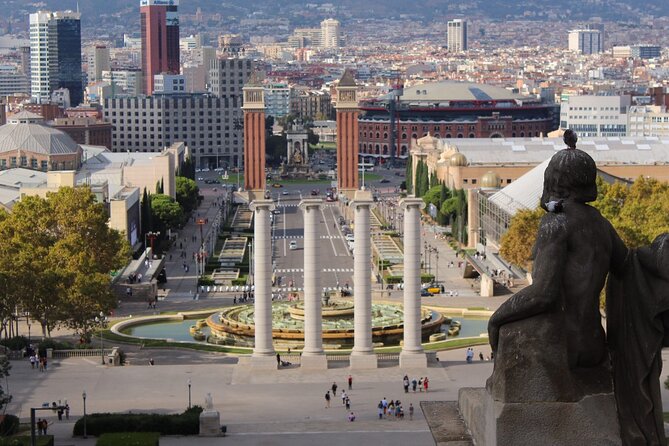
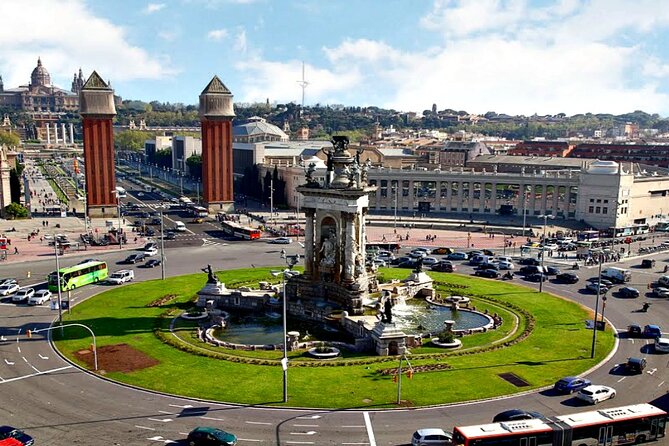
At Plaça d’Espanya, the audio focuses on the grand square created for the 1929 International Exhibition. This is one of the tour’s stronger outdoor stops because the setting is broad, architectural, and easy to view without paying an admission fee.
Nearby, the Magic Fountain adds a more theatrical note. Its water displays began in 1929, and the audio introduces the engineering behind the spectacle and the work of Carles Buïgas. Check local operating arrangements before building your evening around the fountain, since the audio tour does not guarantee that a show will be running.
The Museu Nacional d’Art de Catalunya occupies the former main pavilion of the 1929 Exposition. Its collection includes major Romanesque art, but admission is not included. Twenty minutes may be enough to understand the building and choose whether to enter, not enough to see the museum properly.
Parc de Montjuïc spreads across the hill with gardens, cultural sites, Olympic associations, and earlier military importance. You can use this stop as a pause between indoor visits. Since Montjuïc covers a large area, allow more time than the audio estimate if you plan to walk around.
At the top, Montjuïc Castle tells a more serious story of military power, resistance, revolution, and political change. Entry is separate. The hilltop location gives this stop a different feel from the city streets, but reaching it requires planning because the tour provides no pickup, drop-off, or included transport.
Plaça de Catalunya, the old city, and the waterfront quarter
The next section moves into central Barcelona, where several stops sit close enough to combine on foot.
Plaça de Catalunya is the city’s central meeting point, linking several major streets and routes into the old town and modern shopping districts. The audio frames it as a place tied to Catalan identity and everyday city life. It is a useful orientation stop, especially if you are arranging your own route.
Palau Güell introduces Gaudí through one of his early major projects for his patron, Eusebi Güell. Entry costs extra. This is a good example of why the audio can help you choose: you can hear the background first, then decide if the building deserves a ticket in your schedule.
At Plaça Reial, arcades and neoclassical design create a more contained urban space. The square also connects naturally with the surrounding old city. The stop is free, so you can listen while looking around without adding another ticket or fixed appointment.
La Boqueria market is the tour’s food-focused stop. The commentary covers its trading traditions, Mediterranean produce, and culinary role. The audio cannot replace the pleasure of browsing stalls at your own speed, so give yourself time beyond the 20-minute guide segment if you want to look, eat, or pause.
The Gothic Quarter is one of the places where the map and audio format can be especially useful. Narrow streets, Roman foundations, and Gothic buildings do not always reveal their stories at a glance. You can stop the track, explore a side street, and return to the commentary when you are ready.
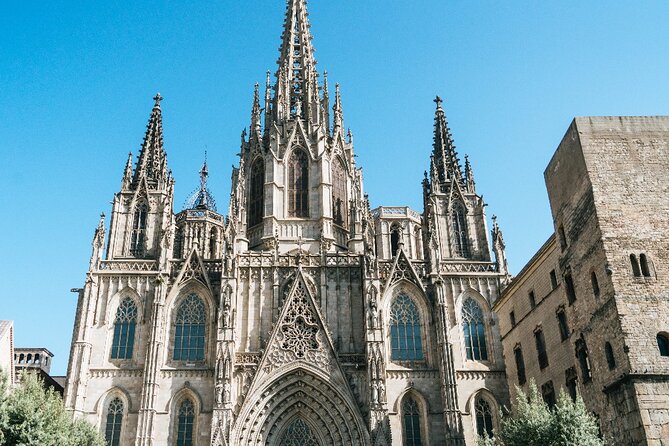
At Barcelona Cathedral, the focus turns to Saint Eulalia, the city’s patron saint, and Gothic religious architecture. Admission is not included. Dress and entry requirements can vary at religious sites, so check current details before you make this a timed stop.
MUHBA, the Museum of History of Barcelona, takes you below street level into archaeological remains showing more than 2,000 years of urban development. This is another paid attraction where the 20-minute audio segment should be treated as an introduction. The museum itself may require a longer visit.
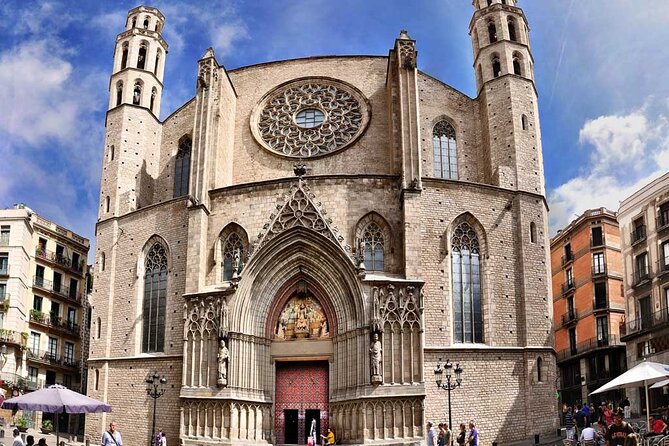
The Basilica of Santa Maria del Mar offers a different Gothic experience. It is known as the Cathedral of the Sea and was built by Barcelona’s merchant community over 54 years. The stop is listed as free, though you should still check current opening arrangements before visiting.
Parks, music, and the triumphal arch
The route then moves east toward some of the city’s most pleasant public spaces and modernist buildings.
Parc de la Ciutadella occupies ground once used for military fortifications and now serves as one of Barcelona’s main public parks. The audio explains that transformation and its connection to Catalan culture. It is a good place to slow down, especially if the denser old-town streets have tired you.
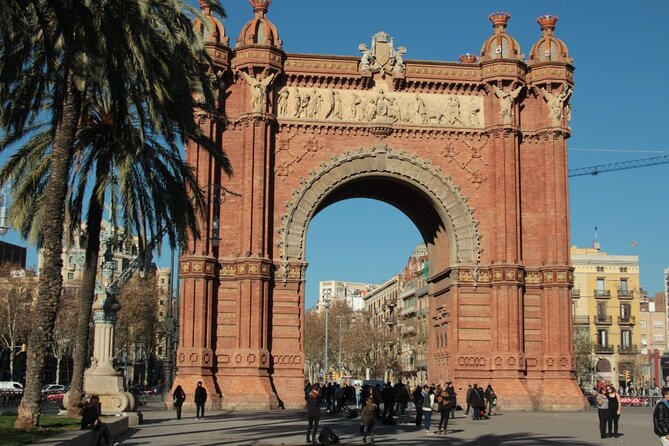
Nearby, Arc de Triomf welcomes you with a design that celebrates the 1888 Universal Exhibition rather than a military victory. Its Moorish influence gives it a distinct look, and the open setting makes it easy to visit without a ticket.
The Palace of Catalan Music is one of the most important paid stops on the route. Lluís Domènech i Montaner designed this Art Nouveau concert hall with mosaics, sculpture, and stained glass. The audio can explain what you are seeing, but it cannot provide admission to the building or guarantee a place on a visit.
These three stops work well together because they combine open-air sightseeing with one major interior. You can adjust the balance to suit your energy and budget.
More Self-Guided Audio Tours in Barcelona:
- Self-Guided Audio Tour – Legends of the Gothic Quarter
★ 4.5 · 6 reviews - Self-Guided Tours Barcelona: 150+ Captivating Audio Stories
★ 5.0 · 4 reviews - Barcelona self-guided city walking tour with audio & quizzes
★ 5.0 · 3 reviews - Self-Guided Audio Tour of Barcelona City
★ 3.0 · 2 reviews
Passeig de Gràcia and Gaudí’s headline buildings
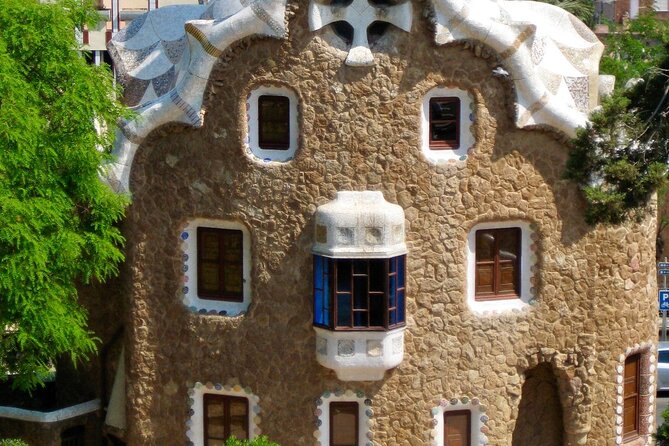
Barcelona’s modernist architecture takes center stage along Passeig de Gràcia.
The boulevard itself grew from a route linking Barcelona with nearby settlements and later became a prestigious avenue for fashion, architecture, and city life. The audio helps you read the buildings as part of a wider street rather than as isolated façades.
Casa Batlló is one of Gaudí’s most imaginative works. Ceramic decoration and unusual forms turn the building into something that feels almost alive. Admission is extra, and the interior visit is likely to take far longer than the 20-minute commentary.
A short distance away, Casa Milà, also called La Pedrera, presents Gaudí’s more sculptural side. Its curving exterior broke with conventional apartment design and made the building controversial in its own time. Again, the audio is useful preparation, but you need a separate ticket to go inside.
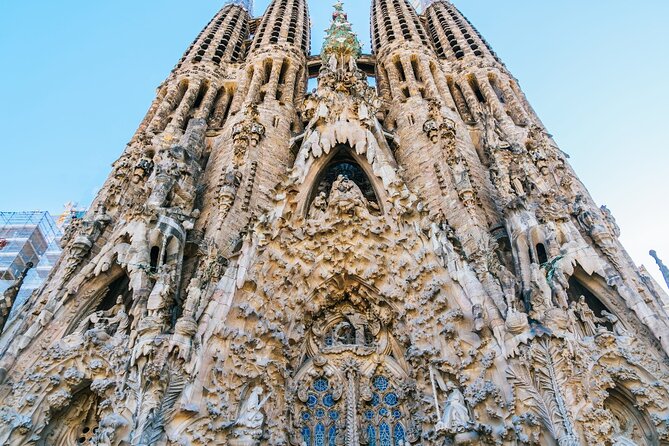
The Sagrada Familia is the major anchor of the whole experience. Gaudí’s spiritual design remains unfinished more than a century after construction began, and the basilica is a UNESCO World Heritage Site. Admission is not included, and this point must be clear: buying the audio tour does not reserve entry.
Two poor experiences connected to the product came from this misunderstanding. One customer arrived at the Sagrada Familia and was denied access because no attraction ticket had been supplied. Another reported arriving at a landmark that was closed and losing money on taxis, with no refund. The provider responded that the service is an audio commentary product and does not control opening hours, access, or ticketing.
That is not a minor detail. If you want to enter the Sagrada Familia, check the official opening information and buy an approved admission ticket separately. Use the audio tour as background material, not as proof that you have a reservation.
Sant Pau, Casa Vicens, and science beyond the center
Recinte Modernista de Sant Pau adds another major work by Domènech i Montaner. The former hospital complex was designed around the idea that beauty and good surroundings could support healing. Admission is separate, and the site deserves more than a quick exterior stop if modernist architecture is your main interest.
Casa Vicens shows Gaudí at an earlier stage of his career. Built when he was 31, it uses colorful ceramics and playful design to announce ideas that later became more famous in his mature work. Entry is not included.
The CosmoCaixa Museum of Science broadens the tour beyond architecture and old streets. Interactive exhibits and hands-on presentations make it suitable for different age groups. It is another paid stop, and its location means you should place it into a deliberate route rather than casually add it between central sights.
These northern stops show the advantage of having individual audio tracks. You do not have to make the full city circuit. If modernist buildings are your priority, choose Sant Pau and Casa Vicens. If you are traveling with children or prefer science to art, make CosmoCaixa your main destination.
Camp Nou and the limits of the route

The final stop is Spotify Camp Nou, home of FC Barcelona and a symbol of Catalan sporting identity. The commentary connects the stadium with the club’s motto, More than a Club, and its wider cultural meaning.
Admission is not included. The stadium and its visitor arrangements can change, so confirm current access before planning a visit. This is also one of the clearest examples of the route’s spread. Camp Nou, Montjuïc, the Gothic Quarter, and Casa Vicens are not next door to one another, so you will need to use Barcelona’s public transport or arrange your own taxi.
The tour says most people can participate and that stops are near public transportation, but it does not provide transport. That makes route planning part of the experience. Google My Maps shows the attractions, but you remain responsible for choosing the quickest or most practical connection.
How the $9 price holds up
At $9 per person, this is inexpensive for a city with so many major sights. A conventional private tour would cost much more, and a group tour would normally tie you to a fixed start time and route. Here, the main value is control.
You can also save money by listening outside paid attractions and choosing only one or two interiors. The tradeoff is that you do not receive a guide to answer questions, adjust the pace, or solve navigation problems in person.
The booking is non-refundable and cannot be changed. Language selection must be made when you book, since it cannot be altered after confirmation. If your preferred language is not shown, you are told to contact the provider at least 48 hours ahead so it can be prepared specially.
Before your chosen travel date, you should receive an email with the SoundCloud audio link and the Google My Maps link. Save both, charge your phone, and bring headphones. If the links do not arrive or you need help using them, customer support is available, but allow time to sort out access before you set off.
Should you book this Barcelona audio tour?
Book it if you want a cheap, flexible introduction to Barcelona and are comfortable managing your own route. It suits independent visitors, repeat visitors who want a reminder of the city’s main sights, and anyone who prefers choosing a few landmarks rather than paying for a fixed guided day.
Skip it if you expect attraction admission, reserved entry, transport, or a guide walking beside you. It is also a poor match if you need a tightly organized schedule with guaranteed access to the Sagrada Familia or another major site.
My practical advice is to select three to six stops per day, group nearby attractions, and buy paid-entry tickets separately before you go. Used that way, the audio tour offers useful background at a modest price. Used as an entry ticket, it will disappoint.
FAQ
How much does the Barcelona Self-Guided Audio Tour cost?
The price is $9 per person.
How long does the experience take?
The estimated duration is about 3 to 9 hours. Each of the 25 stops has an approximate 20-minute audio segment, but walking, transport, meals, and time inside museums or monuments can make the full experience longer.
Can I choose where the tour starts and ends?
Yes. You can start and finish anywhere in Barcelona because this is a self-guided experience.
What is included?
You receive a private access link to audio content for 25 attractions and a private Google My Maps link showing the stops and connecting each location to its audio guide. The links are valid for up to six days.
Are attraction tickets included?
No. Entry fees are not included. Several stops, including the Sagrada Familia, Casa Batlló, Casa Milà, Montjuïc Castle, Barcelona Cathedral, and the Palace of Catalan Music, require separate admission where applicable.
What do I need to use the audio tour?
Bring headphones or earphones, a fully charged smartphone, and internet access.
Can I change or cancel my booking?
No. The experience is non-refundable and cannot be changed for any reason. The audio language must also be selected during booking and cannot be changed after confirmation.
Just added around Barcelona
- Self-Guided Audio Tour-The Surrealist Barcelona of Dalí and Gaudí★ 3.5 · 8 reviews
- Self-Guided Audio Tour – Legends of the Gothic Quarter★ 4.5 · 6 reviews
- Self-Guided Audio Tour of Barcelona City★ 3.0 · 2 reviews
- Montjuic Park Walking Tour with Audioguide on Your Smartphone★ 3.0 · 4 reviews
- Montjuïc Cable Car Entry Voucher with Audio Tour on Your Phone★ 3.5 · 37 reviews
- Self-Guided Tours Barcelona: 150+ Captivating Audio Stories★ 5.0 · 4 reviews
- Gothic Quarter Barcelona Tour with Audioguide★ 4.5 · 5 reviews
- Sagrada Familia External Audio Tour – The 3 Iconic Facades★ 5.0 · 3 reviews
Self-Guided Tours, compared.

Acropolis Ticket & Optional Self-Guided Audio Tours
Read our review →


Ultimate Acadia National Park Self-Guided Driving Audio Tour
Read our review →

Santorini: Akrotiri Ticket with Optional Self-Guided Audios
Read our review →
Browse the lists this tour appears in