
REVIEW · NEW ORLEANS AUDIO TOURS
Walking the Tremé: A Self-guided Audio Tour of New Orleans
Tremé tells its story one corner at a time. This one-hour, GPS-guided walk brings you through one of New Orleans’ most important neighborhoods, with stops tied to Black culture, church life, Mardi Gras Indians, and music. I like the personal pace and the way the VoiceMap app plays the next story as you reach each location.
I also like the low price and offline access, which make this a practical choice for an independent walk. The main caution is technical: GPS did not work well for everyone, and one section reportedly directs you toward highway crossings that are not designed for pedestrians.
Key points at a glance
- The route begins at 801 N Rampart Street and ends at Saint Augustine Catholic Church on Governor Nicholls Street.
- The audio is GPS-triggered, so stories are designed to start when you reach the correct spot.
- The walk covers Tremé’s Black cultural life, including Mardi Gras Indians, second line traditions, churches, theater, and music.
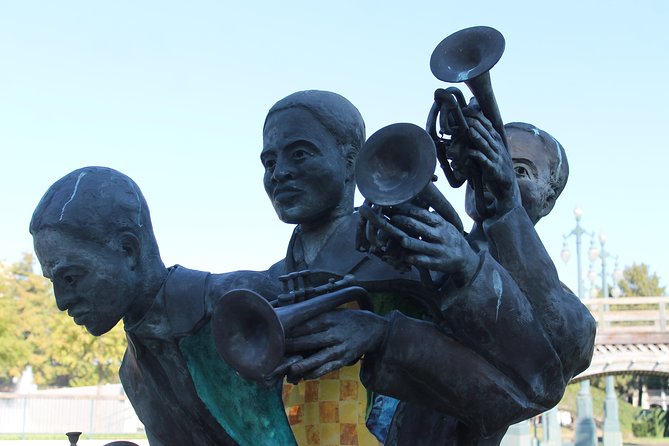
- Louis Armstrong and Mahalia Jackson receive special attention, giving the tour a strong music focus.
- Offline maps, audio, and location data are included, but you need your own smartphone.
- At $9.99, it is inexpensive, though admission fees, food, transportation, and other personal costs are extra.
Why this short Tremé walk matters
Tremé is not simply another New Orleans neighborhood to pass through on the way to the French Quarter. It has long been tied to Black music, Catholic worship, neighborhood clubs, street parades, and cultural traditions that helped shape the city’s identity.
This audio walk gives you a way to hear those connections while standing in the places where they matter. Instead of moving as part of a large group behind a guide, you use your phone and follow a set route at your own speed. You can stop for a photo, pause the narration, or spend more time looking at a building.
The tour lasts about one hour, so I would treat it as a focused introduction rather than a full day in Tremé. The route gives you several strong subjects to think about, but it cannot cover every layer of the neighborhood in such a short time.
The narration is the heart of the experience. One especially praised feature is the way the app detects where you are and begins the relevant story. When the technology works, this creates a natural rhythm: walk, arrive, listen, look around, then continue.
More Audio Walking Tours in the USA
- Self Guided Classic Freedom Trail Location Aware (GPS) Walking Audio Tour
★ 4.5 · 258 reviews - Cape Cod & Provincetown Self-Guided Driving & Walking Audio Tour
★ 4.0 · 207 reviews - Santa Fe Historic Downtown Smart Phone Audio App Self Guided GPS Walking Tour
★ 4.5 · 112 reviews
Starting at 801 N Rampart Street
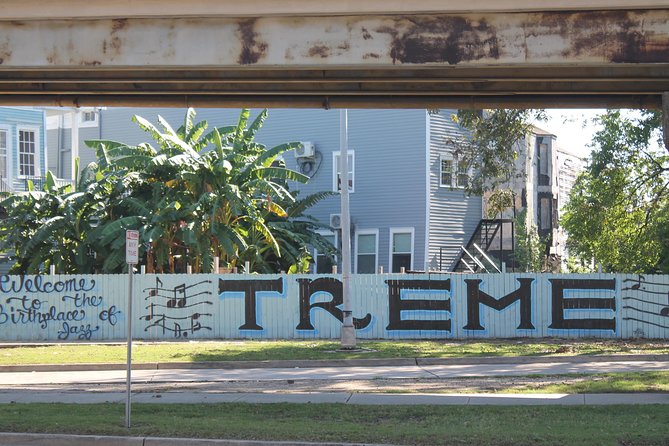
The meeting point is 801 N Rampart Street. The tour ends at Saint Augustine Catholic Church, 1210 Governor Nicholls Street, so you are not returning to the start.
That point-to-point format is useful if you are already moving through central New Orleans. It also means you should think about what comes next before you begin. You will need your own transportation plan after reaching the church, though the tour itself includes directions to the starting point.
The app is available in English. It includes offline access to the audio, maps, and geodata, which is important in a city where phone signals and location services may not always behave perfectly. Download everything before you set out, then make sure the audio starts before you leave the starting point.
The experience is self-guided, but the booking information lists a maximum of 10 participants. That limit does not turn the walk into a normal guided group tour. You still listen individually through your own device and control the timing yourself.
Saint Augustine Church and the War of the Pews
One of the tour’s first major stories centers on Saint Augustine Catholic Church and a remarkable episode from 1842.
Creoles of color began purchasing family pews inside the church for Sunday worship. White residents soon responded by buying family pews of their own. The rush became known as the War of the Pews.
This story works well as an opening because it shows that church seating was not just a matter of comfort or custom. It reflected status, race, family identity, and the struggle for a place within New Orleans society. You get a specific event rather than a broad, vague lesson about the past.
The church is also the tour’s ending point, which gives the route a useful sense of shape. You begin by considering who could claim space in a church, then move through stories about public culture, music, and community life.
Backstreet Cultural Museum and the city’s parade traditions

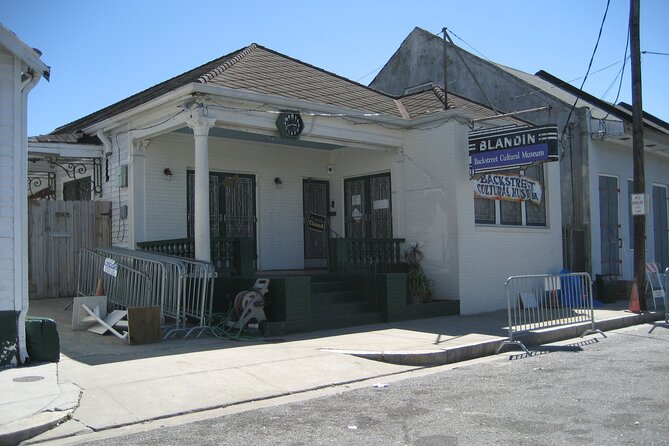
The Backstreet Cultural Museum is one of the most visually appealing stops. Its collection includes Mardi Gras Indian costumes, second line umbrellas, and photographs connected to New Orleans’ backstreet traditions.
Even if you spend only a short time at the stop, the objects help explain why local parades are much more than simple entertainment. The costumes and umbrellas carry style, competition, memory, and neighborhood pride. The photographs add human faces to traditions that can otherwise seem like colorful spectacle without context.
Admission fees are not included in the tour price, so check the cost and opening status before you plan on entering any museum site. The supplied opening information gives the audio tour access as available around the clock, but that does not mean every attraction on the route is open at all hours.
This is also a good place to slow down. The audio may be only part of the experience. Look carefully at the details of the costumes and photographs rather than treating the museum as a quick photo stop.
More Self-Guided Audio Tours in the USA
- Gettysburg Battlefield Self-Guided Driving Audio Tour
★ 4.5 · 910 reviews - Joshua Tree National Park Self-Guided Driving Audio Tour
★ 4.5 · 762 reviews - Ultimate Acadia National Park Self-Guided Driving Audio Tour
★ 4.0 · 521 reviews - Ultimate Lake Tahoe Self-Guided Driving Audio Tour
★ 4.5 · 435 reviews
The New Orleans African American Museum grounds

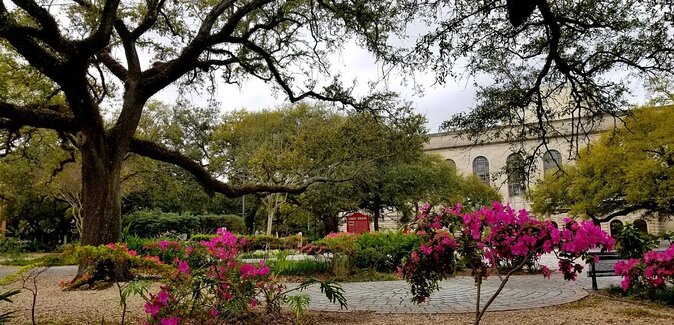
The New Orleans African American Museum provides another useful layer. The tour takes you through its tree-shaded grounds, where you can see the original kitchen dependencies of Tremé’s Villa Meilleur and several homes showing different local building styles.
The word dependencies may sound technical, but the point is easy to grasp. These separate structures help show how domestic life was organized in earlier New Orleans homes. They can tell you as much about daily work and household arrangements as a grand front room can.
The buildings also broaden the tour beyond famous names. You are not listening only to stories about performers and public figures. You are also seeing the physical spaces tied to ordinary community life and local architecture.
Again, admission is not included when a stop requires a separate entrance fee. The tour price covers the VoiceMap experience, not every site along the way.
Mahalia Jackson and the power of a local voice
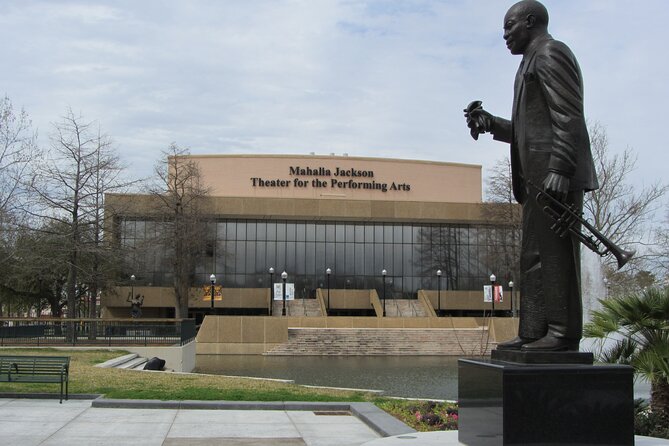
The Mahalia Jackson section shifts the focus to gospel music. After recording the best-selling gospel song in history, Jackson gained international fame, but she kept her connection to New Orleans.
The stop at the Mahalia Jackson Theater of the Performing Arts gives the story a clear public setting. It also reminds you that a performer’s career can reach far beyond the neighborhood where it began without erasing that original connection.
I find this kind of stop valuable because it links local memory to a larger cultural story. You are not just hearing that Jackson was famous. You are considering how New Orleans shaped her identity and how she remained associated with the city.
The tour does not promise a performance or an interior theater visit. Think of this as an audio story connected to the theater and to Jackson’s legacy, not as a ticketed show.
Louis Armstrong’s Tremé connection
Louis Armstrong receives another major stop. He was born in 1901 just outside Tremé and later became one of New Orleans’ most honored musical ambassadors. The narration also refers to his nicknames, Satchmo and Pops, and to the world around him as he grew up.
That setting matters. Armstrong’s early environment included churchgoers, hustlers, pimps, and musicians. The tour uses that mix to place his talent within the complicated social life of New Orleans rather than presenting him as a famous name floating free of his surroundings.
The story adds a strong human element to the walk. You get a sense of a young musician developing in a neighborhood shaped by both hardship and creativity. It is a fitting counterpoint to the Mahalia Jackson stop, since both sections show how local culture could produce artists with international reach.
Louis Armstrong Park and the route’s public spaces
Louis Armstrong Park is another important location in the route. Its name honors the musician, but the park also gives you a chance to think about how public spaces are used, controlled, and remembered.
The route information specifically connects the tour with the park, while one piece of feedback raises a pointed concern about people being physically gated out of portions of it. That issue is worth keeping in mind as you listen. A neighborhood can celebrate a famous name while still having complicated relationships with public access and official decisions.
The tour is strongest when it encourages you to hold both ideas at once: pride in the neighborhood’s cultural contributions and awareness of the pressures placed on the people who created that culture. The audio may not answer every question, but it gives you material to consider as you walk.
How the GPS audio works in practice
VoiceMap is designed to trigger narration based on your location. This is more useful than a simple recorded walking tour because you do not need to keep checking a list of stops every few minutes.
The best experience depends on the app correctly reading your position. Several people found the system easy to use, with no software trouble and accurate location-based narration. Others had serious problems. One person could not get the tour to start and became stuck on the download screen despite having a strong cell signal. Another found that the GPS link barely worked and could hear only a few descriptions at the time.
That range of results suggests a simple plan:
- Download the tour, map, and audio before arriving.
- Open the app and test the starting point.
- Keep your phone charged.
- Bring headphones if you want to hear clearly near traffic.
- Save the route information in case you need to continue manually.
The app provides lifetime access, so you can try again later if a technical problem interrupts the walk. Still, that is not much comfort if you have only one morning in New Orleans, so preparation matters.
Safety, pace, and practical comfort
The route is listed as suitable for most people, and service animals are allowed. It is also near public transportation. No transportation, food, drinks, smartphone, or personal expenses are included.
The biggest practical concern is street crossing. One section reportedly asks you to cross highway lanes that are not made for pedestrian crossing. I would not follow an audio instruction blindly. Stop, inspect the street yourself, and use a safer legal crossing if the suggested route looks wrong.
The tour is available every day at all hours in the booking system, but the audio’s availability is not the same as safe or pleasant walking conditions. You control the start time, so choose daylight and allow a little extra time beyond the one-hour estimate if you want to stop at museums or study the buildings.
This is not a food tour, a transportation tour, or a live performance. It is a walking-and-listening experience. Wear shoes you can use comfortably for an hour, and keep enough attention on your surroundings to hear traffic and notice changes in the route.
Is $9.99 a fair price?
At $9.99 per person, the tour is a good value for someone who wants structure without paying for a private guide. You receive lifetime access, GPS narration, offline maps, and directions to the starting point.
The price is especially attractive for solo visitors and couples. A live tour usually requires fitting your schedule around a fixed departure, while this one lets you start when convenient. Families may also like the ability to pause when children need a break.
The value drops if the app fails or if you want detailed answers to questions as you walk. A live guide can adjust the pace, explain a point in greater depth, and change the route when a street feels unsafe. This audio tour cannot do that.
You should also budget separately for any admission fees at museums or other sites. The $9.99 covers the digital walk, not every attraction along the route.
Who will enjoy this Tremé audio tour?
I would recommend it to you if you like history in small pieces, prefer independent sightseeing, or want a low-cost way to get beyond the most familiar New Orleans sights. The focus on churches, parade traditions, Black cultural institutions, and musicians gives the walk a clear identity.
It is also a good fit if you dislike large groups. You can listen at your own pace and spend longer at a stop that catches your attention.
You may want a different option if you need guaranteed app performance, direct conversation with a guide, or a route with no walking decisions. The highway-crossing warning is not minor, and the mixed GPS performance means you should be ready to use the map manually.
Final booking advice
Book Walking the Tremé if you want an affordable, self-guided introduction to one of New Orleans’ most important cultural neighborhoods. Its strongest features are the focused stories about Saint Augustine Church, Mardi Gras Indian traditions, Mahalia Jackson, Louis Armstrong, and the physical places tied to those stories.
Before you start, download the content, test the app, charge your phone, and plan to use your own judgment at street crossings. If the technology cooperates, this is an efficient one-hour walk with thoughtful narration and strong value. If you prefer a human guide or need a fully reliable route, spend more on a live option instead.
FAQ
How long does Walking the Tremé take?
The tour lasts approximately one hour.
Where does the tour start?
It starts at 801 N Rampart Street, New Orleans, Louisiana 70116.
Where does the tour end?
It ends at Saint Augustine Catholic Church, 1210 Governor Nicholls Street, New Orleans, Louisiana 70116.
What language is the tour offered in?
The tour is offered in English.
Do I need my own smartphone?
Yes. A smartphone is not included with the experience.
Does the tour work offline?
Yes. Offline access to the audio, maps, and geodata is included.
Are museum admission fees included?
No. Personal admission fees are not included in the tour price.
Can I take the tour whenever I want?
The self-guided tour is available every day and is designed to let you explore at your own pace.
What is the cancellation policy?
You can cancel at least 24 hours before the local start time for a full refund. Cancellations or changes made within 24 hours are not refunded or accepted.
Just added around the USA
- Self Guided Driving Audio Tour of Saguaro National Park★ 3.0 · 4 reviews
- Self-Guided Audio Driving Tour of Mount Lemmon★ 5.0 · 4 reviews
- Saguaro National Park Self-Guided Audio Tour★ 3.5 · 11 reviews
- A Self Guided Audio Tour in Tombstone★ 4.0 · 11 reviews
- Catskills Scenic Byway Self-Guided Driving Audio Tour★ 4.0 · 9 reviews
- Big Bend National Park Self Guided Audio Tour Guide★ 5.0 · 12 reviews
- Self-Guided Audio Driving Tour in Catskills Scenic Byway★ 4.5 · 7 reviews
- Shiloh Battlefield Self-Guided Driving Audio Tour★ 4.0 · 9 reviews
Self-Guided Tours, compared.

Acropolis Ticket & Optional Self-Guided Audio Tours
Read our review →


Ultimate Acadia National Park Self-Guided Driving Audio Tour
Read our review →

Santorini: Akrotiri Ticket with Optional Self-Guided Audios
Read our review →
Browse the lists this tour appears in