
REVIEW · MONTEREY AUDIO TOURS
Smartphone Audio Driving Tour between San Francisco & Monterey
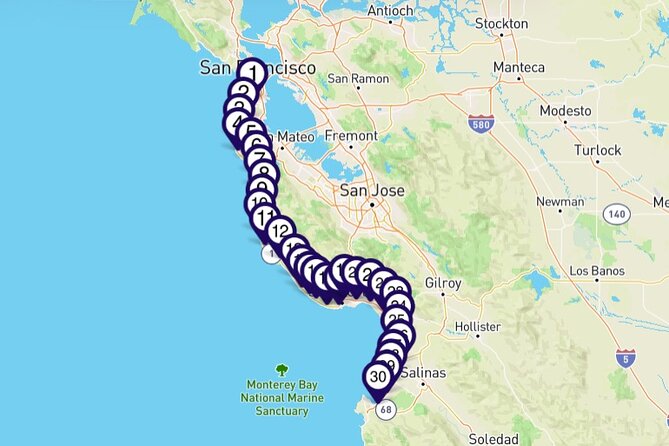
The Pacific Coast does the talking here. This self-guided audio tour turns the drive between San Francisco and Monterey into a narrated coastal journey, with stories about beaches, lighthouses, wildlife, towns, railroads, Indigenous communities, and California’s famous Highway 1.
I like the low price, just $11.99 per vehicle or group of up to 15, and the freedom to start anywhere along the route. I also like that the tour works without a phone signal after you download it. The main drawback is clear: this is more of a continuous driving companion than a stop-by-stop sightseeing tour, so you will need to choose your own places to pull over.
You can complete the route in roughly two to three hours, though the flexible format lets you take much longer. The narration is in English and plays through the Tripvia Tours app on your own smartphone or tablet.
Five useful things to know before you drive

- One booking covers the whole vehicle: Up to 15 people can share the tour for $11.99.
- Start in either direction: You can begin in San Francisco, Monterey, or anywhere along the route.
- Download before leaving: A good mobile or WiFi connection is needed at first, but no signal or mobile data is required during the drive.
- Expect narration more than formal stops: The audio explains sights along Highway 1, but many points are not structured as places to park and explore.
- Build in your own breaks: Beaches, viewpoints, and towns reward extra time, but recommended attractions can close or become inaccessible.
- Best for independent drivers: You control the pace, route timing, food stops, photographs, and detours.
What this Highway 1 audio tour actually feels like

This is not a guided bus trip with a person sitting beside you. It is a private, self-guided experience that lets you use your own car and your own schedule.
Once the tour is downloaded, the app supplies narration as you drive. That makes it useful on a long coastal stretch where you might otherwise pass sign after sign without knowing the story behind it. The route connects San Francisco with Monterey, but you can join it anywhere and travel in either direction.
The strongest part is the amount of ground covered. You hear about major cities such as San Francisco, Santa Cruz, and Monterey, along with smaller communities including Montara, Moss Beach, El Granada, Pescadero, Davenport, Aptos, and Watsonville.
The tradeoff is that the audio does not turn every point into a full attraction visit. One useful tip is to skip physically stopping at the first two points if they do not fit your plans and listen while driving toward the third. That approach makes sense for a route designed to keep you moving.
If you want a tour with a guide, reserved entrances, or a fixed schedule, this will feel too loose. If you like choosing your own stops and want some context in your ears as you drive, it is a practical bargain.
More Smartphone Audio Tours in the USA
- Self-Guided GPS Audio E-Bike Tour Hawaii Volcanoes National Park
★ 4.5 · 131 reviews - Santa Fe Historic Downtown Smart Phone Audio App Self Guided GPS Walking Tour
★ 4.5 · 112 reviews - Ultimate Portland Self-Guided Driving GPS Audio Tour
★ 4.0 · 56 reviews
Leaving San Francisco for the rocky coast
San Francisco provides the broad opening chapter. The narration places the city in the context of its cultural variety, technology, and famous landmarks before the route turns toward the Pacific coast.
The drive then moves into one of the most dramatic sections of the journey, a steep and rocky coastal route with a surprising transportation story. The audio explains the old Ocean Shore Railroad plans, an ambitious attempt to connect San Francisco and Santa Cruz.
That detail gives the road a sense of purpose beyond its views. You are not simply driving beside cliffs. You are following a corridor shaped by grand plans, difficult terrain, and the long effort to connect communities along the coast.
The route is best enjoyed with a driver who can focus on the road while another person manages the app. If you are driving alone, keep your attention on traffic and use the narration as background information rather than trying to operate the phone while moving.
Montara, Moss Beach, and the lighthouse story
Montara brings one of the first strong coastal scenes. Montara State Beach is framed by cliffs dropping sharply toward the Pacific, giving this part of the route its rugged character.
The audio points toward outdoor activities and the dramatic meeting of land and sea. You may want to treat this as a possible break rather than assuming the tour itself provides a formal stop.
Nearby Moss Beach is known for protected tide pools. At the right time, these pools can reveal marine life such as starfish and anemones. Tide pools are sensitive places, so the value here is not only the scenery but the chance to notice a small coastal world beneath your feet.
The route also introduces an historic lighthouse that has guided ships since 1875. The narration explains what the lighthouse serves as today and brings in someone who played a significant part in its story. That personal connection gives the lighthouse section a warmer touch than a simple date and location would provide.
Because access to attractions can change with the season or other conditions, think of these places as options to check rather than guaranteed visits included in the tour.
El Granada and Half Moon Bay: towns shaped by the ocean

El Granada is a particularly interesting place to hear about from inside a moving car. Its streets form a distinctive concentric-circle pattern, and the audio explains how the town’s layout developed.
The narration also points to the Pillar Point breakwater and the enormous waves associated with it. This section works well for anyone curious about how local geography affects both settlement and ocean activity.
Half Moon Bay follows with a story involving daring beginnings and a sometimes unusual past. The town is paired with coastal scenery, so the audio connects the human story to the natural setting rather than treating the town as a simple photo stop.
This stretch also shows the limits of an audio-only format. You get useful background while passing through, but the tour does not create a structured walk through town. If you want to explore, eat, or photograph the area, you will need to pause the drive and make that choice yourself.
Same place, a different route to walk:
- Los Angeles: Hop-On Hop-Off Bus Tour with Audio Guide
★ 3.7 · 2,030 reviews - City Sightseeing Hop-On Hop-Off Bus Tour with Audio Guide
★ 3.0 · 1,083 reviews - Medieval Torture Museum Ticket with Audio Guide and Ghost Hunting
★ 5.0 · 962 reviews - Gettysburg Battlefield Self-Guided Driving Audio Tour
★ 4.5 · 910 reviews
San Gregorio, Pescadero, and protected coastal habitat

San Gregorio was a booming town in the 1850s, and the nearby state beach is known for its cleanliness. The tour uses the area to show how quickly coastal settlements could grow and change.
Pescadero, whose name comes from the Spanish word for fishmonger, offers another small-town chapter. Its present-day character combines farming, tourism, and ranching. That mix is a useful reminder that Highway 1 is not only a scenic road. It also links working communities.
The Pescadero Marsh receives special attention. This seven-mile tidal slough and estuary provides habitat for native and migratory species. The narration explains why the marsh matters, giving you a better reason to slow down and look beyond the roadside.
Another section identifies the California Coastal National Monument and tells you where to find it. That can be especially useful when roadside signs and viewpoints are easy to miss.
For people interested in nature, this is one of the more rewarding portions of the audio. You hear about habitats and coastal protection while still moving through the region. The limitation is that the tour does not promise a guided wildlife viewing session, so sightings and access depend on your timing and the conditions of the day.
Año Nuevo State Park and the wildlife coast

Año Nuevo State Park is presented as a major point along the route, with attention to its biological variety and past. The park’s main attraction is intentionally saved for the narration, which gives this section a small element of surprise.
The audio helps explain why this coast is more than a pretty strip of road. The mix of marine life, protected land, and human history gives the park a wider importance.
Since recommended attractions may be closed or inaccessible, check conditions before planning a long stop here. The tour remains useful even if you cannot enter, because you can still hear the explanation while continuing along Highway 1.
This is also a good place to remember that the advertised two to three hours is an approximate driving time, not a complete sightseeing schedule. Add breaks, parking, meals, and walks, and your day can become much longer.
Davenport, Shark Fin Cove, and roadside photo stops
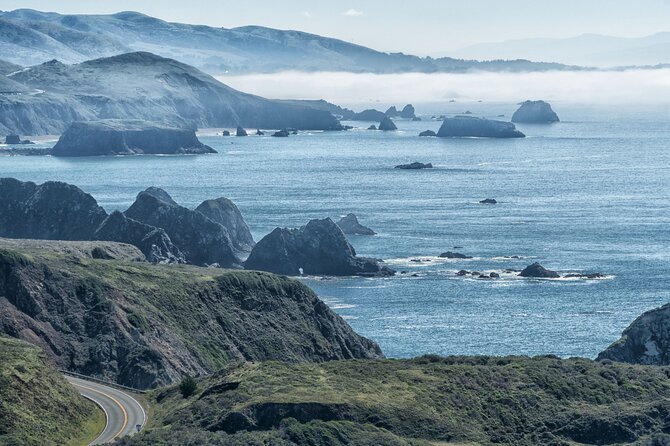
Davenport gets one of the more playful stories on the route. The narration asks what there is to do in town and leads into a tale involving the local jail. It is the sort of small detail that helps a passing town stick in your memory.
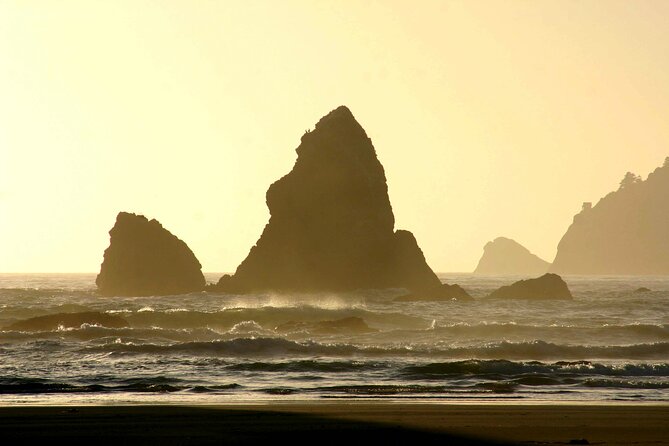
For photography, Shark Fin Cove is one of the most appealing suggestions. Its unusual rock formation and coastal setting make it a natural place for photos and short stops.
The route also identifies parking areas near scenic beaches and explains what each place is known for. This is where the audio can be most useful as a planning tool. Instead of trying to research every turnout while driving, you receive prompts about possible places to stop.
Still, you should not assume every pinpoint is a full sightseeing destination. One criticism of the format is that some locations feel like narration points rather than actual places where you can pull out, walk around, and take photographs. I would use the audio to mark ideas, then make safe parking and access decisions on the road.
Historic buildings and the 65-acre natural wonder
Further along, the tour covers a park with a collection of historic buildings. These include an elegant Victorian home from 1897 and a water-powered machine shop.
The combination of domestic life and industry gives the section a useful sense of how people lived and worked in the late 19th century. You are not only hearing about grand coastal scenery. You are also getting a look at the machines, homes, and local work that shaped the area.
Another stop describes a 65-acre natural feature formed by long-term natural forces. The audio explains why it developed as it did. This kind of narration is valuable because the scale and origins of a natural site are not always obvious from a roadside view.
As with other recommended attractions, access may depend on opening conditions. The tour is flexible, but it does not guarantee that every site will be available when you arrive.
Santa Cruz brings beaches, history, and a famous boardwalk
Santa Cruz changes the rhythm of the drive. The city combines beaches, technology, and an eclectic local identity, and the audio offers background on how it developed and where it is today.
The historic Boardwalk is the city’s best-known attraction in this route. It has operated since 1907 and includes two roller coasters recognized as National Historic Landmarks. Even if amusement parks are not your main interest, that combination of seaside entertainment and old structures gives the Boardwalk a strong sense of place.
Santa Cruz is also a practical point to pause. You can use the city as a break in the drive, though the tour itself does not include transportation, meals, or attraction admission.
The narration is especially helpful here because it prevents the city from becoming just a quick pass-through. You hear about both its beach culture and its connection to newer technology, two sides that do not always appear together in a basic sightseeing guide.
Aptos, Watsonville, and the wetlands of Monterey Bay
Aptos is described as several villages joined under one town name. That small fact gives you a better understanding of why the area can feel spread out and varied as you pass through.
Watsonville adds an Indigenous history chapter. The Ohlone nation inhabited this land before later settlement, and the tour places the city within that earlier story. This is important context, especially on a drive where modern towns can otherwise seem disconnected from the people who lived here first.
The route then turns toward a seven-mile tidal slough and estuary, described as an important part of California’s natural environment. You also hear about an area recognized as the largest untouched salt marsh on the California coast, including the features that make it special.
These wetland sections may be less immediately dramatic than cliffs and beaches, but they reward attention. Marshes, sloughs, and estuaries support birds and other species while helping explain how water shapes the bay.
The audio also includes a small town with a big reputation and a stop aimed at salad lovers. That likely reflects the agricultural character of the region, where food production is part of local identity rather than background scenery.
Monterey Bay and the underwater canyon
As you approach Monterey, the narration shifts from towns and marshes to the bay itself. You learn that only a few miles offshore lies an underwater chasm comparable in scale to the Grand Canyon.
That fact changes how you see the water. The bay is not simply a calm surface beside the road. Beneath it is a huge geological feature that helps explain the area’s marine importance.
Monterey receives the final attention as a California city with a notable past. The tour frames it as a major destination rather than just the endpoint of a drive.
Ending in Monterey gives the route a satisfying sense of arrival, but you can also start here and listen toward San Francisco. The experience is intended to work in either direction, so your choice can depend on your wider road-trip plans.
Price, app setup, and the practical value
At $11.99 per group, this is inexpensive if you have several people in the car. Even for one or two people, the price is modest compared with a private guided tour, especially since there is no fixed start time and no limit on how long you can take to complete it.
The value comes from flexibility. You can keep the tour in the Tripvia Tours app and use it on your schedule. You only need one booking for the vehicle, and the private format means no strangers are added to your group.
Download the tour with a reliable WiFi or mobile connection before setting off. Once it is stored on your device, the drive does not require a signal or use mobile data.
You provide the car, phone or tablet, fuel, parking, and any attraction costs. That arrangement keeps the purchase price low, but it also means you need to handle the practical parts of the day yourself.
The tour is listed for use from 5:00 AM to 10:00 PM, every day, during the stated operating period. Confirmation is provided at booking, service animals are allowed, and most people can participate. You can cancel up to 24 hours ahead for a full refund.
Who should book this coastal drive?
I would choose this tour if you are already renting a car and want background as you travel between San Francisco and Monterey. It suits couples, families, and groups because the low price covers the whole vehicle rather than each person.
It is also a good match for independent planners. You can stop at Shark Fin Cove, spend time in Santa Cruz, look for tide pools at Moss Beach, or continue without stopping when the road is busy.
I would be more cautious if you want a fully active sightseeing experience with clearly marked places to exit, walk, and take pictures. The audio gives you information about many places, but you must turn those suggestions into your own itinerary.
Should you book it?
Book it if you want an affordable narrative layer for a Highway 1 drive and are comfortable making your own stops. The best features are the low group price, offline playback, flexible direction, and wide range of coastal, ecological, and cultural stories.
Skip it if you expect a guide to lead you from one attraction entrance to the next. For most independent drivers, though, $11.99 is a small cost for making this famous road feel more connected and meaningful.
FAQ
How much does the audio driving tour cost?
The tour costs $11.99 per group, with up to 15 people included in one booking.
Can I start the tour in Monterey or San Francisco?
Yes. You can start in either Monterey or San Francisco, or begin anywhere along the route. The experience works in both directions.
How long does the tour take?
The estimated driving time is two to three hours. You can take as long as you like because the tour has no time limit.
Do I need phone service during the drive?
You need a good mobile or WiFi connection for the initial download. After that, no signal is required and the tour does not use mobile data during the drive.
Do I need to provide my own transportation?
Yes. Transportation is not included, so you use your own vehicle.
Is this a private experience?
Yes. Only your group participates, and one booking covers the vehicle.
More Driving Audio Tours in the USA
- Joshua Tree National Park Self-Guided Driving Audio Tour
★ 4.5 · 762 reviews - Ultimate Acadia National Park Self-Guided Driving Audio Tour
★ 4.0 · 521 reviews - Ultimate Lake Tahoe Self-Guided Driving Audio Tour
★ 4.5 · 435 reviews - Scenic Newport, RI Self-Guided Driving Audio Tour
★ 4.5 · 325 reviews
Just added around the USA
- Self Guided Driving Audio Tour of Saguaro National Park★ 3.0 · 4 reviews
- Self-Guided Audio Driving Tour of Mount Lemmon★ 5.0 · 4 reviews
- Saguaro National Park Self-Guided Audio Tour★ 3.5 · 11 reviews
- A Self Guided Audio Tour in Tombstone★ 4.0 · 11 reviews
- Catskills Scenic Byway Self-Guided Driving Audio Tour★ 4.0 · 9 reviews
- Self-Guided Audio Driving Tour in Catskills Scenic Byway★ 4.5 · 7 reviews
- Big Bend National Park Self Guided Audio Tour Guide★ 5.0 · 12 reviews
- Shiloh Battlefield Self-Guided Driving Audio Tour★ 4.0 · 9 reviews
Driving Audio Tours, compared.



Ultimate Acadia National Park Self-Guided Driving Audio Tour
Read our review →



Browse the lists this tour appears in