
REVIEW · SWEDEN AUDIO TOURS
Self Guided Tours Stockholm With 100 Captivating Audio Stories
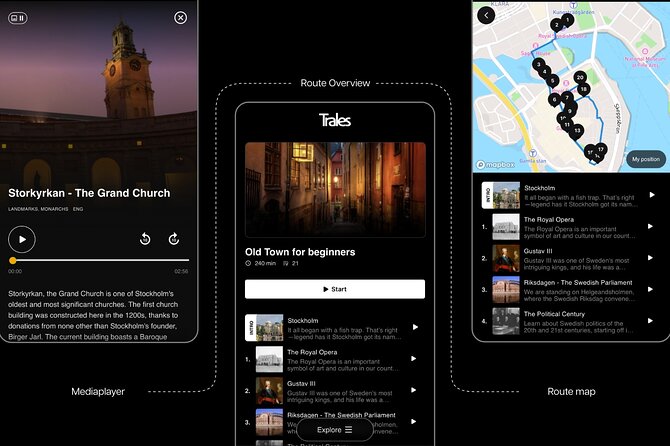
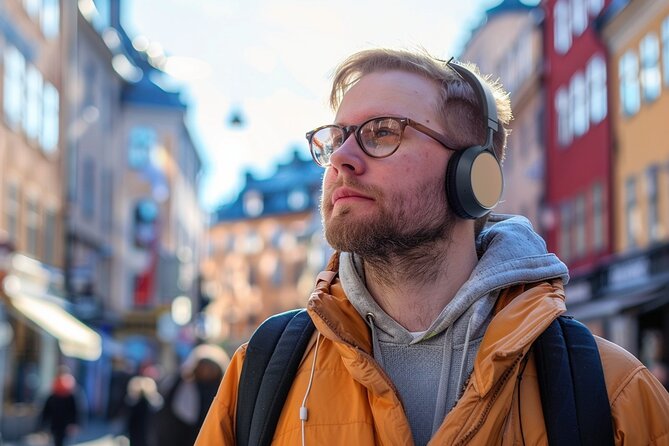
Stockholm rewards slow wandering. This browser-based audio guide gives you 100 location-based stories across the city, from Gamla Stan’s narrow lanes to Djurgården’s old oaks and Södermalm’s creative streets. I like the freedom to start and stop anywhere, and I like that you pay only $3.62 for access to a broad set of sights.
The main catch is timing. The one-hour option can disappear before you reach your first stop, especially if you are still getting set up. For a city-wide outing, the 24-hour option is the safer choice, even if you only use part of it.
Key points at a glance
- One browser link covers 100 Stockholm stories: No app download is required, and the map guides you from place to place.
- Gamla Stan gets especially strong coverage: Stortorget, Järntorget, the Royal Palace, Storkyrkan, Riddarholmen Church, and narrow Mårten Trotzigs Alley are all included.
- You choose the route and pace: Listen for ten minutes, pause for lunch, skip a stop, or build your own full-day walk.
- The guide reaches beyond the Old Town: Stories cover Djurgården, Östermalm, Norrmalm, Kungsholmen, Södermalm, Solna, and nearby islands.
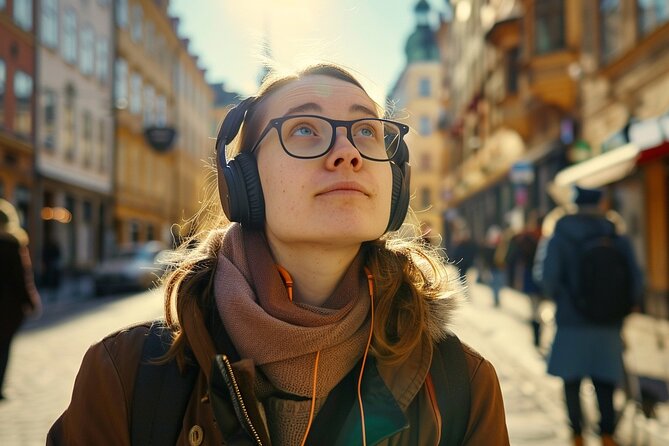
- It works best for independent explorers: Bring your own smartphone, headphones, and mobile internet connection.
- The one-hour pass needs careful planning: The 24-hour option is more practical if you want to roam rather than visit one compact area.
How this Stockholm audio guide works
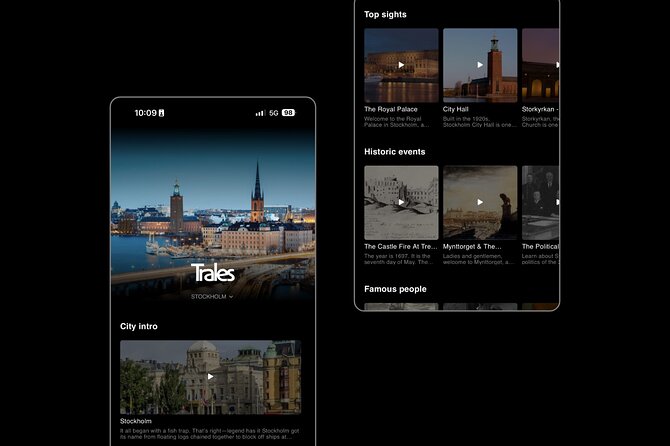
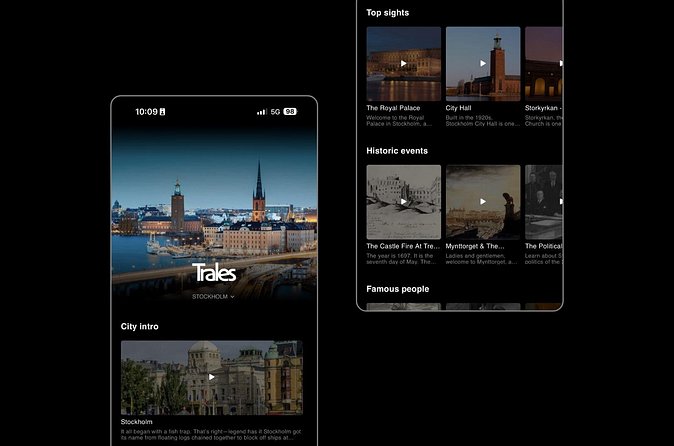
This is not a traditional walking tour with a meeting time or an in-person guide. You receive a link, open the web app in your browser, and use the map to find nearby stories. Each stop takes about ten minutes, although the City Hall story is listed at about 20 minutes.
You need your own smartphone and headphones. The service requires internet access and does not offer offline listening, so check your connection before setting out. The guide is offered in English, and soundscapes accompany the storytelling.
The format suits Stockholm well. The city is spread across islands and districts, and its best sights do not form one tidy line. You can focus on the Old Town in an hour or two, then return another day for Djurgården, Södermalm, or the central shopping streets.
The experience is private in the simplest sense: only your group uses it. You do not wait for a group to gather, and you can pause when a café, museum, shop, or excellent view gets in the way. That freedom is the best reason to choose it.
More Self-Guided Audio Tours in the world:
- Athens: Acropolis Ticket & Optional Self-Guided Audio Tours
★ 4.1 · 2,542 reviews - Gettysburg Battlefield Self-Guided Driving Audio Tour
★ 4.5 · 910 reviews - Joshua Tree National Park Self-Guided Driving Audio Tour
★ 4.5 · 762 reviews
The one-hour problem, and the better 24-hour choice
At $3.62 per person, this is inexpensive even by self-guided tour standards. The value comes from the number of stories, not from a single fixed route. You get access to 100 locations, including major sights and small details you might otherwise walk past.
But the duration options matter. If you select one hour, the clock begins to matter immediately. One person prepared the guide before leaving Odenplan, only to find the pass had expired before reaching the first stop. That is a useful warning: do not activate the short pass until you are standing in the area you want to explore.
The one-hour version makes sense for a compact visit to Gamla Stan or one central neighborhood. The 24-hour pass is a better buy for almost anyone planning to move around Stockholm. It lets you listen in the morning, stop for lunch, use public transport, and continue later without rushing.
The service provider says you can extend the period directly in the app, but I would not rely on that as your main plan. The safest approach is to choose enough time from the start.
Gamla Stan: Stockholm’s strongest cluster of stories
Start in Stortorget, the colorful main square of Gamla Stan. This is one of the easiest places to orient yourself, and the story connects the square’s attractive buildings with its role in Stockholm’s past. Since the area is compact, you can reach several other stops on foot.
Järntorget sits where Västerlånggatan and Österlånggatan meet. Its name means Iron Square, a reminder of the iron trade that continued here until 1662. This is the sort of small historical detail that gives an ordinary junction more meaning.
The Royal Palace receives its own story, including its 18th-century construction, 1,430 rooms, and 660 windows. The audio also hints at a lesser-known secret. You will need a separate palace admission if you want to tour the interior, since the audio guide itself includes only the outside location.
Mårten Trotzigs Alley is a quick and memorable stop. At its narrowest, the passage measures only 90 centimeters. You may be able to touch both walls at once, though the alley can feel tight when other people are passing through.
Stortorgsbrunnen, the fountain in the main square, once served as Stockholm’s reference point for measuring distances. It also supplied water to Gamla Stan. Nearby, Storkyrkan offers a useful contrast between its Baroque exterior and Gothic interior. The church’s 66-meter tower is one of the Old Town’s familiar markers.
Tyska Brunnsplan was formed in 1784 and 1785 by joining two buildings into a concave square. S:ta Gertrud, or the German Church, rises nearby with a 96-meter tower, the highest point in Gamla Stan. Prästgatan, one of the city’s oldest streets, adds another layer, with old stories built into the walls.
Look for the runestone U 53 at the crossing of Kåkbrinken and Prästgatan. It is set into the foundation of a building, an easily missed detail that rewards careful looking.
The small Iron Boy statue, also called Boy Looking at the Moon, measures only 15 centimeters. It is considered the world’s smallest public outdoor artwork and is often associated with good fortune. This is a good example of the guide’s range: it moves from royal buildings and churches to a tiny statue that many people would miss.
Several listed stops repeat, including Stortorget, Berzelii Park, Djurgården, Drottninggatan, and Mårten Trotzigs Alley. That is not a reason to pay twice. It simply suggests that the same location can appear in different route choices.
Riddarholmen and the royal waterfront
Riddarholmen Church is one of Stockholm’s oldest buildings, with parts dating to the 13th century. It began as a Greyfriars monastery before the Protestant Reformation and later became a Lutheran church. Most Swedish monarchs are buried here, giving the island a strong royal connection.
The Old Parliament House has an even wider story. Its cellar vaults date to the Franciscan monastery period, and the building later served as a hospital, orphanage, prison, and mint. The site shows how Stockholm’s buildings often changed purpose over the centuries.
At Evert Taube’s Terrace, you get a view over Stockholm’s inlet connected with the Swedish troubadour Evert Taube. His life and local connection give the viewpoint a human focus rather than making it just another photo stop.
Strömsborg is one of the city’s oldest inhabited islands, with origins reaching back to the 13th century. Kastellholmen offers a different setting, with a well-preserved fortress and a small-island feel. Skeppsholmen, once tied to the Swedish navy, now houses museums, galleries, restaurants, and event spaces.
The route also includes the Obelisk at Slottsbacken, outside the Royal Palace, and Parliament House on Helgeandsholmen. The obelisk was inaugurated in 1800. Parliament House, opened in 1904, remains one of the clearest symbols of national government in the city.
A few more audio tours around the world worth a look
- Barcelona: Sagrada Familia Entry Ticket with Audio Guide
★ 4.6 · 105,312 reviews - Rome: Pantheon Fast-Track Ticket and Official Audioguide
★ 4.5 · 27,353 reviews - Barcelona: Casa Batlló Entry with Self-Audioguide Tour
★ 4.7 · 25,359 reviews - Rome: Colosseum & Forum with Audio Guide App -Optional Arena
★ 4.2 · 24,770 reviews
Norrmalm: grand buildings, shopping, and public life
Central Stockholm receives plenty of attention. Stockholm City Hall is one of the most useful stops for first-time visitors. The building dates from the 1920s, took more than 12 years to construct, and was selected through an architectural competition. Its tall tower gives you a strong view over the city, although tower access is separate from the audio experience.
Stockholm Central Station handles more than 200,000 people each day, including roughly 170,000 rail passengers, commuters, and Arlanda Express users. The station is more than a transport point, and the story helps you see it as part of the city’s daily life.
The Royal Swedish Opera occupies an important place in Swedish cultural life. The story points out that the current building is not the original opera house, a useful prompt to look beyond the grand facade.
Kungsträdgården is a central park with outdoor cafés and a strong local meeting-place feel. Nearby, Berzelii Park honors chemist Jöns Jacob Berzelius. Its creation began in 1852, and it opened in 1858.
Drottninggatan is a pedestrian shopping street lined with stores and boutiques. It has also been the scene of tragic events, so the story does not treat it as merely a retail strip. Nordiska Kompaniet, known as NK, offers a look at Stockholm’s luxury shopping culture and attracts about 12 million visitors each year.
Brunkebergstorg appears modern, but its history reaches back to the Battle of Brunkeberg in 1471. Rosenbad, completed in 1902 and designed by Ferdinand Boberg, once included a restaurant and now relates to Swedish government. Sagerska huset is the official residence of Sweden’s prime minister.
Sergels Torg reflects the city’s 1960s modernism. Kulturhuset Stadsteatern explores that same period through architecture and public culture. St. Clara’s Church gives the Klara district its name, while Adolf Fredriks Church dates from 1768 to 1774.
The National Library has a collection of more than 18 million objects, including books, posters, pictures, manuscripts, and newspapers. You may not have time to explore it fully, but the story explains why the institution matters.
Djurgården and Östermalm: parks, food, and leisure

Djurgården is one of the best places to use this guide at a relaxed pace. It forms part of the Royal National City Park and offers open green space, old oaks, museums, and cultural venues. The audio story gives you a broad introduction, while separate stops add more detail.
Djurgårdsbron connects Östermalm with Djurgården. The bridge was designed by Carl Fraenell and built for the 1897 Stockholm World’s Fair. Cirkus, opened in 1892, began as a venue for circus companies and now hosts theater, concerts, and events.
Rosendal Palace, listed alongside Rosendal’s Garden, was built from 1823 to 1827 for King Karl XIV Johan as a retreat from palace life. Villa Lusthusporten is a 19th-century merchant’s house, while Waldemarsudde was the home of Swedish Prince Eugen. These stops add royal and artistic character to a day on the island.
Kastellholmen and Skeppsholmen work well with Djurgården if you want an island-focused day, though you should allow time for the distances between them. The guide gives you the stories, not a timed transport plan.
Östermalm offers a different mood. Östermalm Food Hall opened in 1889 and is a natural place to pause for food. Nybrogatan combines homes, shops, and history. Strandvägen is a prestigious waterfront street completed in time for the 1897 World’s Fair.
Stockholm Olympic Stadium opened for the 1912 Olympic Games. Architect Torben Grut designed it, and it holds about 14,000 people for sporting events, with a much larger concert capacity. Hedvig Eleonora Church, consecrated in 1737, is an octagonal church named for Queen Hedvig Eleonora.
Södermalm: viewpoints, churches, and city life
Södermalm has some of the guide’s most varied stops. The Katarina Elevator rises 38 meters above Slussen, and the first elevator opened here in 1883. Mosebacke Torg sits on Katarinaberget and took its current form after a destructive fire in 1857.
Katarina Church has endured fire and rebuilding, making it a strong stop for anyone interested in the city’s setbacks and recovery. Götgatan has served as a route toward communities south and west of Södermalm since medieval times.
SoFo, meaning South of Folkungagatan, is presented as a creative part of the district, while Nytorget offers a square with a complicated past. The description for one stop is labeled Kista but discusses Nytorget, so check the map carefully before setting out.
Skrapan, once known as Skatteskrapan, tells the story of a tall city building. Stockholm Court House adds architecture, law, and a fiery past. Sofia Church is another major landmark on Södermalm.
Tantolunden combines a park with allotment gardens. Långholmen has evidence of settlement from the 9th century and appears in written records from 1435. Reimersholme is a small island between Långholmskanalen and Liljeholmsviken, with views and a quieter feel.
Rålambshovsparken and Norr Mälarstrand shift the focus toward Kungsholmen and the waterfront. Kungsholmen itself gets a broader historical introduction, while the district stories help you build a route around central Stockholm.
Beyond the center: Solna, Hagaparken, and Kista
The guide does not stop inside central Stockholm. Solna includes stories about the municipality and Solna Church, a medieval building designed for worship and defense near Brunnsviken and Ulvsundasjön.
Hagaparken offers lawns and open space near Stockholm. Westfield Mall of Scandinavia provides a very different stop, focused on shopping and indoor convenience. Kista is also included, although the supplied description for one Kista entry refers to Nytorget, so use the map and location title as your guide.
These outer stops are most useful if you already plan to visit those areas. They are not sensible additions to a short Old Town walk simply because they appear in the same audio collection.
Who will get the most from it
I would choose this for independent visitors who enjoy setting their own route. It also works well for a local showing Stockholm to visiting relatives. One family group of about 20 people used the audio stories while walking through Gamla Stan, allowing the local host to fill gaps in historical knowledge without hiring a private guide.
It suits couples, families, and small private groups, provided everyone can share the audio or listen individually. It is not recommended for people with hearing impairment, and the experience depends on a smartphone, headphones, and an internet connection.
The storytelling was praised for covering Swedish kings, royal history, people, and historic events. That broad coverage is the main strength. The tradeoff is that ten-minute stories can only offer an introduction. If you want detailed architectural analysis or a long conversation with a local guide, choose an in-person tour instead.
The cancellation policy is strict: the experience is non-refundable and cannot be changed after booking. Take a moment to select the right duration before activating it.
Should you book this Stockholm audio guide?
Book it if you want a low-cost, flexible introduction to Stockholm and prefer wandering without a fixed group schedule. The coverage is unusually broad, and the Old Town section alone gives you enough material for a useful first walk.
Choose the 24-hour option if you plan to cross between districts. Choose one hour only when you have a clear, compact plan and are already near your starting area. At $3.62, the price is easy to justify, but the guide is valuable only if you give yourself enough time to use it.
FAQ
How much does the Stockholm audio guide cost?
The price is $3.62 per person.
How long does the experience last?
The available duration is approximately one hour to one day. The one-hour option is intended for a focused area, while the 24-hour option gives you more time to move around Stockholm.
Is a smartphone required?
Yes. You need your own smartphone with internet access.
Do I need to download an app?
No. You access the guide through a web browser using a link.
Are headphones included?
No. You need to bring your own headphones.
Is offline access available?
No. The guide does not include offline access.
What language is the guide offered in?
The audio stories are offered in English.
Is there an in-person guide?
No. This is a self-guided experience with a web app, map, audio stories, and soundscapes.
Just added around the world
- Coba Ruins: Self-Guided Walking Audio Tour in Mexico★ 3.5 · 2 reviews
- Self Guided Driving Audio Tour of Saguaro National Park★ 3.0 · 4 reviews
- Torino Walking Tour with Audio and Written Guide by a Local★ 4.5 · 35 reviews
- Trondheim’s Inner Circle: A Self-Guided Audio Tour★ 4.0 · 15 reviews
- Self-Guided Audio Driving Tour of Mount Lemmon★ 5.0 · 4 reviews
- A Tromsø Introduction: A Self-Guided Audio Tour★ 3.5 · 19 reviews
- Panorama Bus Tour with Audio Guide★ 4.0 · 3 reviews
- Saguaro National Park Self-Guided Audio Tour★ 3.5 · 11 reviews
Self-Guided Tours, compared.

Acropolis Ticket & Optional Self-Guided Audio Tours
Read our review →


Ultimate Acadia National Park Self-Guided Driving Audio Tour
Read our review →

Santorini: Akrotiri Ticket with Optional Self-Guided Audios
Read our review →
Browse the lists this tour appears in