
REVIEW · BUDAPEST AUDIO TOURS
Self Guided Tour In Budapest With 100 Captivating Audio Stories
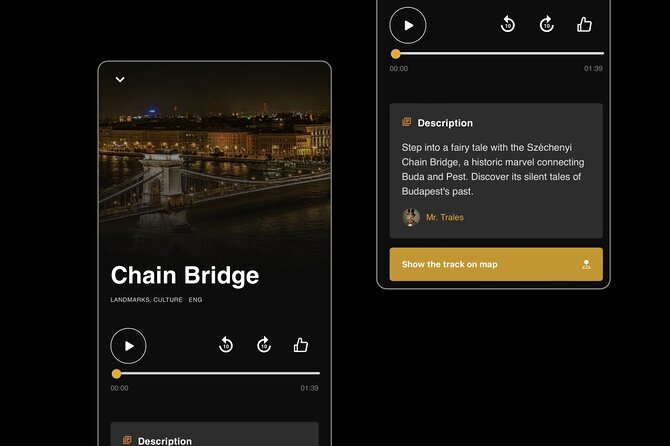
Budapest rewards curious walkers. This browser-based audio tour links more than 100 location stories to the city’s castles, bridges, squares, museums, and riverfront memorials. I like the $3.62 price and the freedom to start, stop, or change direction whenever you wish. I also like that you can choose only the sights that interest you instead of following a fixed group route.
The trade-off is simple: this is not a guided walk with a person beside you. You need your own smartphone, internet connection, and headphones, and there is no offline access. The experience is offered in English and may not suit anyone with a hearing impairment.
Key points to know before you go

- More than 100 location-based stories: Choose from major sights, small museums, historic squares, railway stations, bridges, and neighborhoods.
- A browser, not a download: Use the activation link to open the web app, map, and audio guide without a separate app installation.
- Flexible timing: You can listen for an hour or build a full day around selected stops. The stated duration is about one to eight hours.
- Excellent low-cost value: At $3.62 per person, the guide costs less than many single museum admissions and works for a private group.
- Best with your own route: Buda Castle, the Chain Bridge, Parliament, the Danube, and St. Stephen’s Basilica can form a useful central route, while Heroes’ Square and City Park belong to a separate northern outing.
- Bring the right gear: Your phone, headphones, and mobile internet are essential. The tour does not include a physical guide or offline listening.
How the Budapest audio tour works
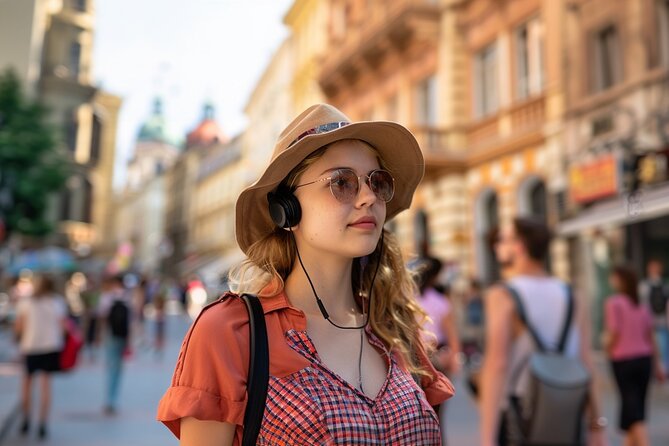
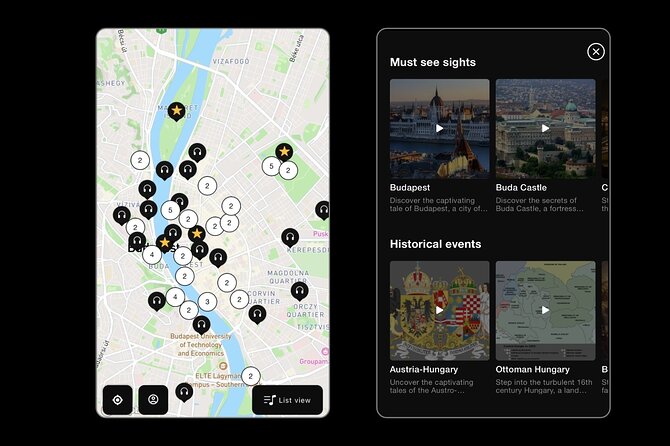
This is best understood as a large menu of short audio stories rather than one continuous walking tour. The web app uses your location and map to point you toward nearby subjects. You can follow a theme, choose a few famous sights, or simply play stories as you encounter them.
Each story is designed to take about 10 minutes, with a few listed at 20 minutes. That makes the format easy to fit around lunch, a museum visit, public transport, or a sudden change in weather. You are not tied to a meeting time, and your group does not have to wait for anyone else.
The lack of a downloaded version matters. Budapest has public transport and many busy streets, but your phone still needs internet access while you use the guide. Bring a charged phone and headphones, and check your connection before setting out.
The tour is private in the sense that only your own group participates. Yet there is no private guide accompanying you. You supply the pace, decisions, and navigation.
More Self-Guided Audio Tours in Budapest:
- Budapest Scavenger Hunt and Highlights Self Guided Audio Tour
★ 4.5 · 7 reviews - Athens: Acropolis Ticket & Optional Self-Guided Audio Tours
★ 4.1 · 2,542 reviews - Gettysburg Battlefield Self-Guided Driving Audio Tour
★ 4.5 · 910 reviews
Buda Castle, Fisherman’s Bastion, and the hilltop stories
Buda Castle is one of the strongest places to begin. The audio story focuses on battles and royalty, giving the fortress setting a clear historical frame. Allow about 20 minutes for the castle story itself, then give yourself extra time to look around.
Nearby, Fisherman’s Bastion offers another 10-minute story with folklore and city views. It is a natural pairing with Buda Castle, though the two stops should not be treated as a complete tour of the Castle District. The National Széchényi Library adds a royal connection inside the castle area, while the National Archives of Hungary offers another short story about centuries of Hungarian records.
Gül Baba’s Tomb provides a different mood. The site sits on steep Mecset Street, and the audio story connects history and spirituality. This stop is better for people who enjoy unusual corners of a city rather than only its grand monuments.
Batthyány Square gives you a contrasting view across the Danube, with a story about political power and Budapest’s changing past. The Semmelweis Museum of Medical History is another worthwhile choice if you like specialized subjects. Its story points to the institution founded in 1769 and the medical breakthroughs linked with it.
Crossing the Chain Bridge toward Pest
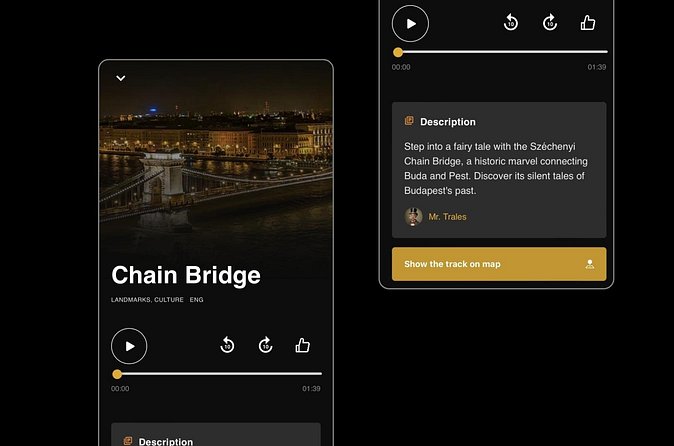
The Széchenyi Chain Bridge is one of the easiest stops to combine with other central sights. The guide offers stories at both the lion statues and the bridge itself, each listed at about 10 minutes. Listen as you cross, then stop for your own photographs and river views.
The bridge connects the two halves of the city, so it works well as the spine of a self-guided route. On the Pest side, you can continue toward the Hungarian Academy of Sciences, the Danube Promenade, Vörösmarty Square, and St. Stephen’s Basilica.
The Danube story focuses on the riverside promenade and its grand hotels. The Shoes on the Danube Bank story is more solemn, describing the memorial and the people represented by the shoes. Give this stop your attention and quiet time. It is not just another quick photo point.
Kossuth Lajos Square and the Hungarian Parliament Building add political context. The Parliament story introduces the building as a symbol of Hungary’s past and present, while Kossuth Square explores the events connected with the heart of Budapest. The Hungarian Academy of Sciences, founded in 1825, gives you another look at the city’s intellectual and civic life.
Parliament, basilicas, and central squares
St. Stephen’s Basilica has a 10-minute story centered on art, history, and the building’s views. The audio guide itself should not be confused with an admission ticket. If you plan to enter the church or visit its tower, confirm the separate entry arrangements.
That distinction matters because one booking note describes using online booking to avoid a long ticket-office line at St. Stephen’s Church. The visitor enjoyed the church but regretted not booking the tower because time ran short. The practical lesson is clear: if the tower matters to you, plan it before you arrive rather than hoping to add it at the last minute.
Deák Ferenc Square is a useful place to hear a story about Budapest’s transport links and city life. It is also a natural transfer point if you are building your own route. Vörösmarty Square offers a more historic public-space setting, with its changing identity traced back to 1812.
Liberty Square has a story tied to the Hungarian National Bank and the political echoes around it. The Hungarian National Bank Headquarters receives a separate story about currencies and monetary change. These are good choices if you prefer civic and economic subjects to royal buildings.
A few more audio tours around Budapest worth a look
- Budapest: Parliament Building Entry Ticket and Audio Guide
★ 4.5 · 3,844 reviews - Budapest Danube Cruise with Drink, Audio Guide, Margaret Island
★ 4.5 · 1,036 reviews - Budapest: Danube River Sightseeing Cruise with Audio Guide
★ 4.1 · 1,002 reviews - Parliament Tour in Budapest with Audio Guide
★ 4.0 · 814 reviews
Markets, bridges, and the working city
The Central Market Hall gives the tour a food and urban-planning angle. The story explains how this major market fits into Budapest’s city design and cultural life. You can listen before browsing the market, though admission to any interior attraction is not included in the audio experience.
Liberty Bridge adds another short stop, with its Art Nouveau design and stories of history and myth. Elisabeth Bridge offers a different theme, focusing on tragedy and rebuilding. Taken together, these bridges show how the Danube is not only scenery. It is part of Budapest’s structure and memory.
Corvinus University provides a story about education and the institution’s past. The Metropolitan Ervin Szabó Library is especially appealing to architecture fans, since the story centers on a former palace used as a place of learning. These stops reward you for looking beyond the postcard sights.
The Hungarian National Bank Headquarters, Academy of Sciences, and university stories may feel less immediate than the castle or river. I would choose them selectively rather than trying to hear every story in one day.
Heroes’ Square, City Park, and the northern route
Heroes’ Square is one of the tour’s clearest set pieces. The 10-minute story explains the Millennium Monument and the figures connected with the Magyar conquest of the Carpathian Basin. The Museum of Fine Arts and Palace of Art frame the square, giving you an easy cultural extension if you have time.
City Park is nearby, covering a large 302-acre area. Its story presents the park as a long-running public recreation space. The City Park Ice Rink and boating lake adds a seasonal angle, with the setting changing between winter skating and warmer-weather leisure.
These stops do not fit naturally into a short Castle District walk. You can reach them by public transportation, and the tour is listed as being near public transportation, but the exact route and travel time depend on where you begin. Treat Heroes’ Square and City Park as their own half-day area if you want to explore them properly.
The Franz Liszt Academy of Music brings a strong cultural subject into the mix. Its 10-minute story looks at musical figures, talent, and the institution’s place in Budapest. It is an appealing choice for anyone who wants more than architecture and politics.
Railway stations and modern Budapest

Budapest’s railway stations receive unusually good attention in this audio collection. Nyugati Railway Station has a story about its elegant Royal Waiting Room and its connection to the creators of the Eiffel Tower. Keleti Station offers another 10-minute story about railway architecture and Hungarian transport history.
Westend, located near Nyugati, shifts the focus to a shopping center and its rise and fall. That may sound less important than a castle, but it gives you a glimpse of how Budapest changes and how modern commercial spaces gain and lose their place in city life.
Újlipótváros is another neighborhood story, mixing older history with modern character. It is useful for people who enjoy walking through an area and forming their own impressions, rather than racing between famous monuments.
Millenáris takes you in yet another direction, with a story about a historic velodrome and its 412-meter track. The variety here is one of the product’s strengths. You are not limited to churches and palaces. You can choose stories about sport, education, transport, commerce, and daily city life.
Gellért Hill, the Citadella, and the caves

Gellért Hill combines folklore, history, and broad views over Budapest. The hill itself requires more physical effort than a flat riverside walk, so plan your energy accordingly. The listed story is about 10 minutes, but the hill will take longer if you stop to look around.
The Citadella continues the hilltop theme, focusing on the fortress and its position above the city. The Liberty Statue adds a story about resilience and the large bronze monument overlooking Budapest.
Gellért Hill Cave offers a contrasting setting. Instead of an open view, the story turns to an underground place associated with legends and secrets. The cave, hill, Citadella, and Liberty Statue can form a compact thematic group, though you should not expect the short audio length to cover every physical feature in detail.
Margaret Island and the bridges
Margaret Island provides a greener break from the stone streets and busy central districts. Its 20-minute story links nature and history, making it one of the longer entries in the collection.
Margaret Bridge has its own 10-minute story, including its unusual 165-degree design. You can combine the bridge and island, then use public transportation or continue on foot depending on your plans. The audio format works particularly well here because you can pause beside the river or on the island without holding up a group.
The tour also includes the Chain Bridge, Liberty Bridge, Elisabeth Bridge, and the Danube Promenade. This gives you a useful way to compare Budapest’s crossings rather than treating each one as a quick photograph.
Price, timing, and practical value
At $3.62 per person, the price is hard to fault if you want background information without paying for a private guide. A couple can use it for less than the cost of many small paid attractions, and a family or private group can share the same self-guided format.
The real value depends on how you use it. If you listen to only one story, the purchase is still inexpensive. If you use the map across several neighborhoods, it becomes a low-cost orientation tool for an entire visit.
The stated duration ranges from one to eight hours. That wide range is honest because this is not a set route. Pick a few related areas instead of trying to hear every story. Buda Castle with the Chain Bridge and Danube sights makes one good plan. Heroes’ Square, City Park, and the Franz Liszt Academy make another.
Confirmation arrives at booking, and the activation link provides one-step access. The experience cannot be refunded or changed after booking, so check the date, language, phone access, and your group’s ability to use an audio guide before paying.
Who should choose this audio tour
I would choose this for independent visitors who dislike fixed schedules, enjoy short historical stories, and want to shape the day around their own interests. It also suits repeat visitors who have already seen the headline sights and want subjects such as railway stations, libraries, archives, banks, and neighborhoods.
It is less suitable if you want questions answered on the spot, detailed interior commentary, or help with navigation from a local person. It is also not a good choice if you need offline audio or have hearing difficulties.
Should you book it?
Book it if you want a cheap, flexible way to add context while walking around Budapest. The best use is to select a small cluster of stories, keep your phone charged, and bring headphones.
Skip it if you expect admission tickets, a physical guide, or a polished door-to-door walking route. For the price, the freedom is the main attraction. Use it as a listening companion, not as a replacement for careful sightseeing plans.
FAQ
How much does the self-guided Budapest tour cost?
The price is $3.62 per person.
How long does the experience last?
The approximate duration is one to eight hours, depending on how many stories and locations you choose.
What language is available?
The audio guide is offered in English.
Do I need to download an app?
No separate download is required. You use a browser-based web app through an activation link.
What do I need to bring?
You need your own smartphone, headphones, and internet access. Offline access is not included.
Is a physical guide included?
No. This is a self-guided experience without an in-person guide.
Is the tour suitable for people with hearing impairment?
It is not recommended for people with hearing impairment.
Just added around Budapest
- Audio visual multi-sensory chefs journey dinner experience★ 5.0 · 3 reviews
- Buda Castle Walking Tour with Audioguide on Your Smartphone★ 4.0 · 24 reviews
- Mulled Wine Danube Cruise with Audio Guide in Budapest★ 4.5 · 11 reviews
- Budapest Guided City Tour and Danube Cruise Audio Guide★ 4.0 · 28 reviews
- Budapest Parliament Audio Guide Tour with Danube Cruise★ 4.5 · 14 reviews
- Budapest Scavenger Hunt and Highlights Self Guided Audio Tour★ 4.5 · 7 reviews
- Budapest Danube 1 Hour Sunset or Night Cruise with Audio Guide★ 4.0 · 204 reviews
- Sightseeing Cruise on the Danube with Audio Guide in Budapest★ 3.5 · 229 reviews
Self-Guided Tours, compared.

Acropolis Ticket & Optional Self-Guided Audio Tours
Read our review →


Ultimate Acadia National Park Self-Guided Driving Audio Tour
Read our review →

Santorini: Akrotiri Ticket with Optional Self-Guided Audios
Read our review →
Browse the lists this tour appears in