
REVIEW · CALIFORNIA AUDIO TOURS
Self-Guided Audio Driving Tour in Sequoia and Kings Canyon
The trees do most of the talking here. This GPS-guided drive turns Sequoia and Kings Canyon National Parks into a flexible audio journey, with stories, directions, and tips playing as you reach each point. I love the freedom to stop and start, and I love that one $24.99 purchase covers everyone in your vehicle, up to eight people.
The main catch is simple: you must download the app and tour before entering areas without service. The setup can feel fussy, especially when moving between booking links, account sign-in, and the app. Once downloaded, though, the tour works offline, and the GPS usually keeps the commentary in step with your route.
Key points to know before you go
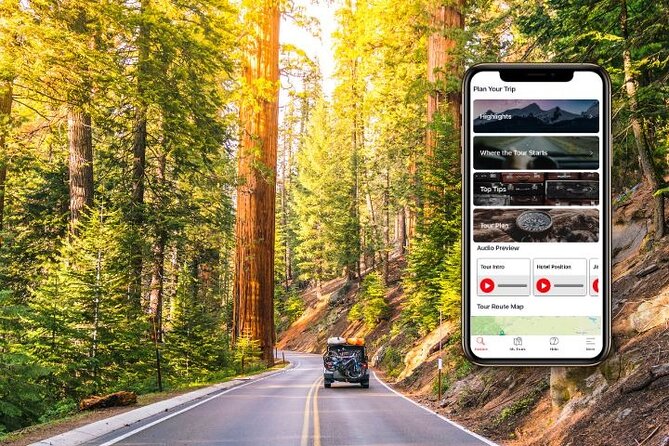
- 215-plus GPS-triggered audio points provide stories, directions, history, science, and practical tips as you drive.
- One purchase covers up to eight people, making $24.99 a strong value for families or groups sharing one car.
- The tour covers both parks, from the giant sequoias and Moro Rock to Kings Canyon’s meadows, falls, and river corridor.
- No fixed start time is required. You can begin anywhere along the route, stop for hikes, and resume later.
- Download everything over Wi-Fi before arrival. No cell signal is needed after the tour is stored on your phone.
- The 4.6 rating from 29 reviews and 90 percent recommendation rate reflect especially strong praise for the entertaining narration and accurate GPS.
How the GPS audio tour works in Sequoia and Kings Canyon
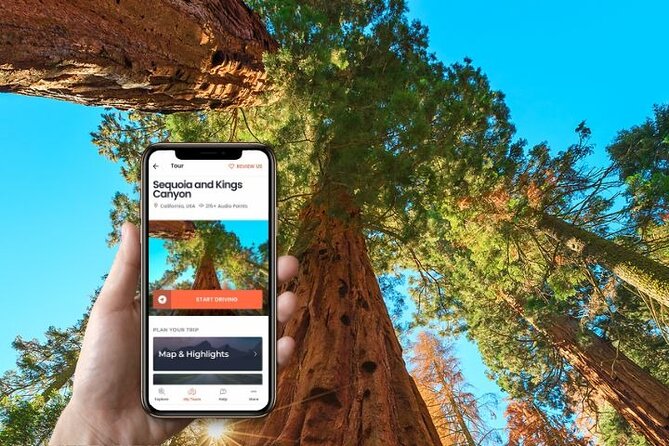
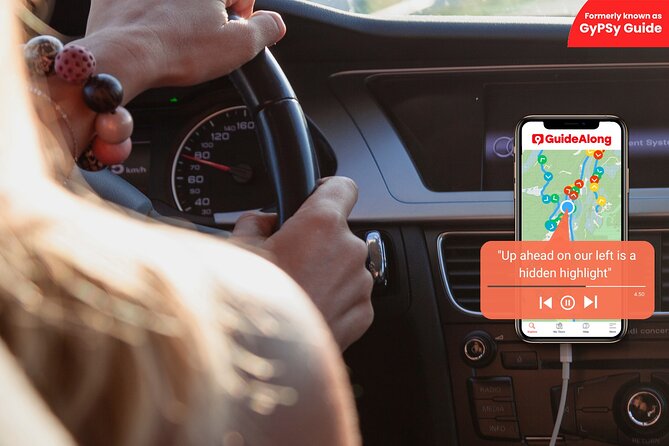
This is not a bus tour or a guide walking beside you. It is a private audio companion that uses your phone’s GPS chip to play commentary as you drive. The app suggests a route, but you remain in charge of the day.
That difference matters in these parks. Roads are winding, viewpoints take time, and a quick visit to one famous tree can easily turn into a longer walk through a grove. You can pause the narration while hiking, stop for lunch, or ignore a suggested point and return later.
The commentary includes more than tree facts. You get information about geology, Native American history, park protection, fires, logging, wildlife, and the people connected to important sites. The narration is generally educational with a light touch of humor, which helps during long stretches of mountain road.
The tour operates in English and is valid without an expiry date. You can use it on a future visit, which is useful because seeing both parks properly in one day requires a very long outing. The suggested duration is about eight hours to a full day, but you can split it across visits.
More Self-Guided Audio Tours in the USA
- Gettysburg Battlefield Self-Guided Driving Audio Tour
★ 4.5 · 910 reviews - Joshua Tree National Park Self-Guided Driving Audio Tour
★ 4.5 · 762 reviews - Ultimate Acadia National Park Self-Guided Driving Audio Tour
★ 4.0 · 521 reviews
Price and value for a full car
At $24.99 per group, the cost is not tied to the number of people in your vehicle. A family of four pays the same as a couple, and a group of eight gets particularly good value. That is far less than hiring a private guide, while still giving you commentary timed to the road.
You will need to pay the separate national park admission fee. The listed 2024 price is $35 per vehicle, with rates subject to change based on factors such as length of stay, age, and group size.
I think the audio tour earns its price if you want context while driving and do not want to research every stop in advance. It is less useful if you prefer a silent drive, already know the parks well, or plan to spend most of your time away from the suggested route.
The biggest value comes from the small details. The app may point out a historic site, an unusual tree formation, or a turn you might otherwise miss. Several people found themselves stopping at places they would have skipped without the narration. That is exactly where a self-guided tour can pay off.
Entering Sequoia National Park and meeting the Four Guardsmen
The route begins in Sequoia National Park, where giant sequoias quickly become the central event. These are Sequoiadendron giganteum, trees famous for their enormous trunk volume, great age, and ability to survive fire.
The Four Guardsmen form a natural gateway along the road toward the forest. Their story is particularly striking because firefighters protected the trees during the KNP Complex fire by wrapping their bases in aluminum blankets. The sight links the park’s grand scale with the very modern work required to protect it.
Allow about 30 minutes here. You may want to pause the audio and simply look upward. The trees are so large that the mind needs a moment to catch up.
General Sherman Tree and the Giant Forest Museum
General Sherman Tree is the headline stop. Named for Civil War general William Tecumseh Sherman, it is considered the largest tree in the world by wood volume and is estimated to be about 2,200 years old.
Reaching it involves a half-mile walk. That is not a difficult distance for many people, but it is worth planning around your group’s energy and mobility. The tree is surrounded by other giant sequoias, so the walk is not merely a march to one famous trunk.
Allow about 30 minutes for the stop, though you may want longer if you walk through the grove. The audio commentary helps explain why height is not the only measure of a tree’s size. General Sherman’s fame comes from the total amount of wood in the trunk and branches.
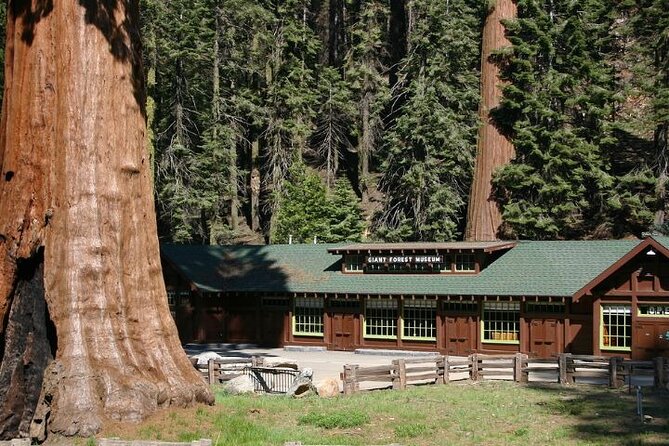
The nearby Giant Forest Museum is a useful place to build a basic understanding of the sequoias. It sits in a historic market building and explains the trees’ life cycle, environment, and protection. Short trails with interpretive signs leave from the museum, making this a good pause before longer walks.
I would use the museum as a reset point. After several huge trees, it can be hard to keep the details straight. The displays give the forest a story rather than leaving you with only a collection of impressive photographs.
More Driving Audio Tours in the USA:
- Ultimate Lake Tahoe Self-Guided Driving Audio Tour
★ 4.5 · 435 reviews - Scenic Newport, RI Self-Guided Driving Audio Tour
★ 4.5 · 325 reviews - Arches National Park Self-Guided Driving Audio Tour
★ 4.5 · 288 reviews - Yellowstone National Park Self-Guided Driving Audio Tour
★ 4.5 · 249 reviews
Hospital Rock and the road’s human history
Hospital Rock provides a quieter change of pace. Archaeological evidence shows that Native American groups used this area as far back as the 14th century. Ancient bedrock mortars and pictographs remain important reminders that these mountains were home and working ground long before the national park existed.
The modern name came from two occasions when members of a Monache band treated injured settlers at the site. One injury involved a gunshot from a trapping accident. The name may sound casual, but the place connects the road to a much older human story.
Allow about 30 minutes. This is a stop where the audio matters because the physical features can be easy to overlook if you do not know what you are seeing.
Climbing Moro Rock’s 350 steps
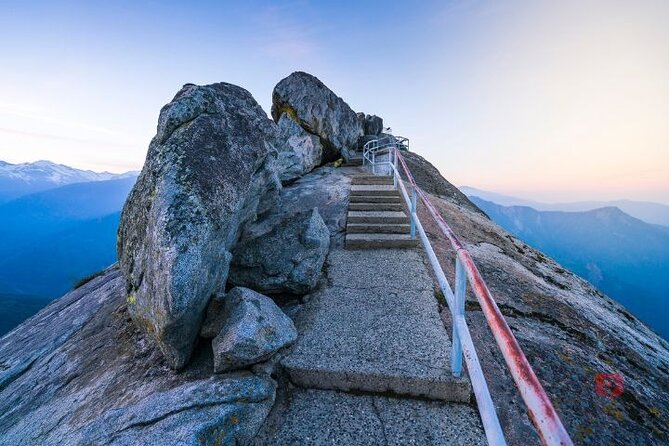
Moro Rock is one of the most rewarding active stops in Sequoia. A staircase of about 350 steps climbs the granite dome, ending with wide views toward the Great Western Divide, the foothills, and the San Joaquin Valley.
The suggested visit is one hour. That gives you time for the climb, pauses, and the view from the top. The route is short compared with a full mountain hike, but the stairs still require steady effort.
I would not treat Moro Rock as a quick photo stop. The route is one of the park’s best chances to gain a broad sense of the surrounding mountains. If heights or steep exposed routes trouble you, this is the stop to consider carefully. The view is the reward, but you do not need to force the climb if it is not comfortable.
The fallen-tree tunnel and Big Stump Grove
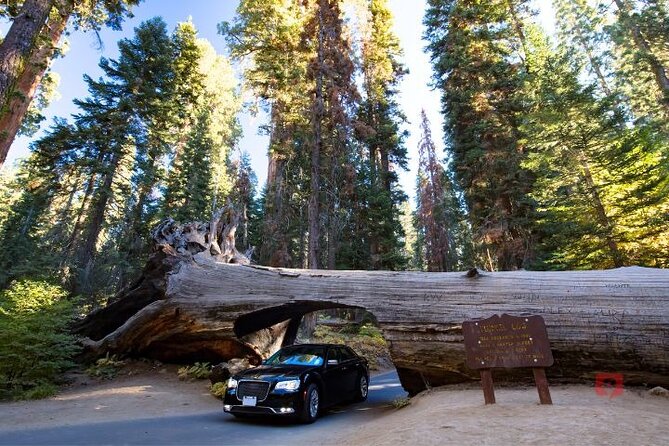
The tunnel through a sequoia is a memorable roadside stop, but its story is more thoughtful than a simple roadside stunt. The tree had already fallen naturally before park managers carved a passage through it. The aim was to help people understand the trees’ scale while making the road passable again.
If your vehicle is too large for the tunnel, a bypass is available. That removes the worry of trying to squeeze a large vehicle through a space designed to make a point about enormous trees.
Big Stump Grove offers a different lesson. It is a former logging area filled with the remains of giant trees, including the Mark Twain tree, which measured about 14 feet in diameter. The grove can feel sad, but it also makes the case for preservation more clearly than a slogan ever could.
A trail reaches the grove from the picnic area or from a trailhead near the Big Stump Entrance Station. Allow about 30 minutes, though the walk can take longer depending on how far you go. Scientists continue studying how these large trees decay and how the grove might regenerate.
General Grant Tree and Panoramic Point in Kings Canyon
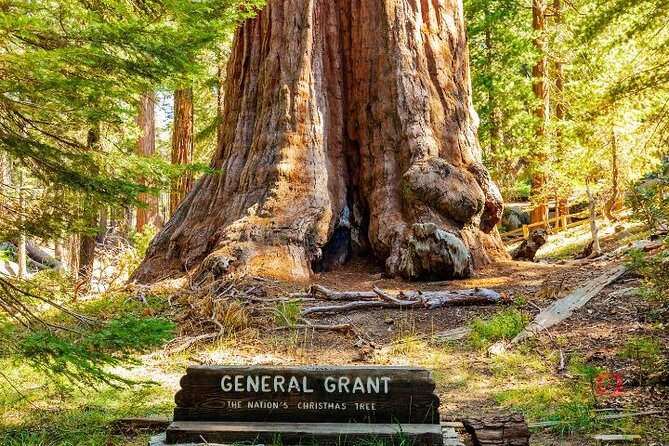
The route then moves into Kings Canyon National Park. One itinerary entry labels the famous tree as General Sherman, but the description and location clearly refer to the General Grant Tree. General Grant is near Grant Village and the Kings Canyon Visitor Center, and the parking area makes access fairly easy.
The tree is among the world’s largest. Protecting this grove from logging helped lead to the creation of Kings Canyon National Park. That background gives the stop extra weight: you are not just looking at a giant tree, but at one connected to the park’s origin story.
Allow about 20 minutes for the main visit, with more time if you walk farther into the grove. The nearby formations and additional trees reward a slower pace.
Panoramic Point is reached by a road opposite the turn for General Grant Grove. A short walk opens broad views over the high Sierra peaks and Kings Canyon. The access road is winding, and one account of the experience specifically warns that it may be uncomfortable for people with a fear of heights.
Food options in the Grant area can also take time. Plan patience at Grant Pavilion, where waits may be long and prices may not feel especially friendly. I would carry food or allow extra time rather than squeeze this stop into a rushed schedule.
Cedar Grove, Roaring River Falls, and Zumwalt Meadows
Cedar Grove Lodge marks the last major services deep in the park. The area includes campgrounds, a market, and a basic lodge, along with trails ranging from short walks to serious backcountry routes.
The river setting and waterfalls make Cedar Grove a natural place to slow down. Roaring River Falls is reached by a half-mile walk on a paved trail. In late spring, snowmelt can make the falls thunderous. Stronger hikers can continue toward Mist Falls, described as one of the park’s biggest.
Zumwalt Meadows is one of the easiest scenic hikes in the Cedar Grove area. The trail is relatively flat and follows the remains of an old lake bed. It is also one of the better places in this route for spotting wildlife, although animals are less active during the hottest part of the day.
The audio guide can help you decide how much time to give this section. You might use the short walks as a gentle finish, or treat Cedar Grove as the main event and spend much of the day here.
What the narration gets right, and where it needs help
The strongest part of the experience is the narration. The voice is described as enthusiastic, informative, and occasionally funny. It covers the kind of science and park history that can turn a scenic drive into a more meaningful visit.
The GPS timing is another major strength. When it works correctly, the commentary arrives as you approach a place, rather than forcing you to search through a long list of audio tracks. This makes the tour feel like a private guide in the car.
The weak point is the technology before the drive begins. You receive instructions by email and text, search for the download message, sign in with an Apple or Google account, redeem the voucher, install the GuideAlong app, and download the tour under My Tours. That is manageable, but it is not as simple as pressing play on a web page.
Do all setup over Wi-Fi or cellular data before entering the parks. Bring a USB or USB-C car charger, and test the sound connection before you leave. Once the tour and app are downloaded, no cell service or Wi-Fi is required.
Directions can also be imperfect in a park with winding roads and limited signage. I would preview the route and stops before starting, then treat the audio as a helpful companion rather than your only navigation tool.
Who should book this self-guided tour?
I recommend it most for first-time visitors, families, couples, and anyone who wants explanations without joining a fixed group. It is also a smart option for a group with mixed interests because one person can pause the audio while others explore.
The flexible format can help if someone in your group has limited mobility. One review described the app as the best way for a husband with mobility struggles to see the park, since the car could reach many points and the narration explained what was nearby.
I would be more cautious if you dislike phone-based setup or expect perfect turn-by-turn directions. I would also avoid relying on the tour without preparing if you arrive with a low battery or without downloading the content.
Free cancellation is available when you cancel at least 24 hours before the experience start time. Changes or cancellations inside that window are not refundable.
Should you book it?
Book it if you want the parks to explain themselves as you drive, especially on a first visit. The price is fair for a full vehicle, the one-time purchase remains valid for future visits, and the commentary adds useful context to famous stops such as General Sherman, Moro Rock, and Zumwalt Meadows.
Skip it if you prefer to explore in silence or already have a detailed plan and park knowledge. For most first-time visitors, though, downloading this tour before arrival is a sensible way to catch more stories, more viewpoints, and a few stops you might otherwise pass.
FAQ
How much does the audio tour cost?
The tour costs $24.99 per group, covering up to eight people in one vehicle.
Does the price include park admission?
No. National park passes are separate. The listed 2024 vehicle price is $35, with rates subject to change.
How long does the tour take?
Plan on about eight hours to a full day, depending on how many stops and walks you include. You can also split the route across multiple visits.
Does the tour require cell service?
No. You need Wi-Fi or cellular data to download the app and tour, but no connection is required once the content is downloaded.
Where can I start and finish?
You can start and finish anywhere along the tour route. The route begins in Sequoia National Park and ends in Kings Canyon National Park, but the GPS commentary is flexible.
Is the tour available in languages other than English?
No. The supplied tour information lists English as the available language.
Can I use the tour on another date?
Yes. The purchase has no expiry or date and time limit. You can use it on a future visit.
What should I bring for using the app?
Bring a fully charged phone and a USB or USB-C car charger. Download the tour before entering areas without reliable service.
What happens if I have trouble with the app?
GuideAlong provides support by toll-free phone, online chat, and email. Support is available daily, with the listed phone support hours from 9 AM to 6 PM Eastern Time.
Just added around the USA
- Self Guided Driving Audio Tour of Saguaro National Park★ 3.0 · 4 reviews
- Self-Guided Audio Driving Tour of Mount Lemmon★ 5.0 · 4 reviews
- Saguaro National Park Self-Guided Audio Tour★ 3.5 · 11 reviews
- A Self Guided Audio Tour in Tombstone★ 4.0 · 11 reviews
- Catskills Scenic Byway Self-Guided Driving Audio Tour★ 4.0 · 9 reviews
- Big Bend National Park Self Guided Audio Tour Guide★ 5.0 · 12 reviews
- Self-Guided Audio Driving Tour in Catskills Scenic Byway★ 4.5 · 7 reviews
- Shiloh Battlefield Self-Guided Driving Audio Tour★ 4.0 · 9 reviews
Driving Audio Tours, compared.


Ultimate Acadia National Park Self-Guided Driving Audio Tour
Read our review →



Browse the lists this tour appears in