
REVIEW · GREECE AUDIO TOURS
Olympia: The Famous VR Glasses Tour with Audio Guide
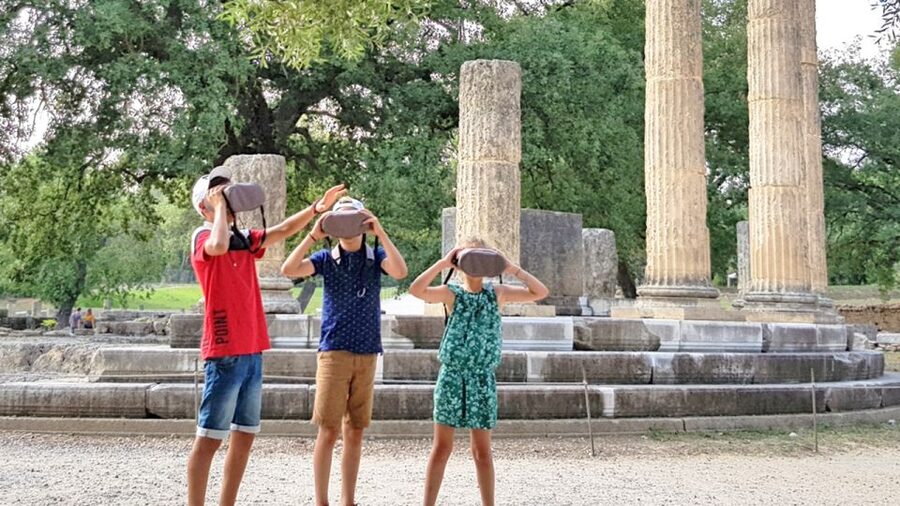
Ancient Olympia needs a little help. Much of the sanctuary is now fallen stone, but this self-guided experience uses VR glasses to rebuild 15 monuments around you. I like the clear audio guide and the freedom to move at your own pace. The main catch is that the €29 price does not include the separate €20 archaeological-site ticket.
I also like how well this works for families. The 3D scenes give children a reason to look closely, while the short explanations keep the visit from turning into a long lesson. You will need to learn the controls and allow enough time to collect and return the equipment, especially if you also plan to visit both museums.
Key points to know before you go
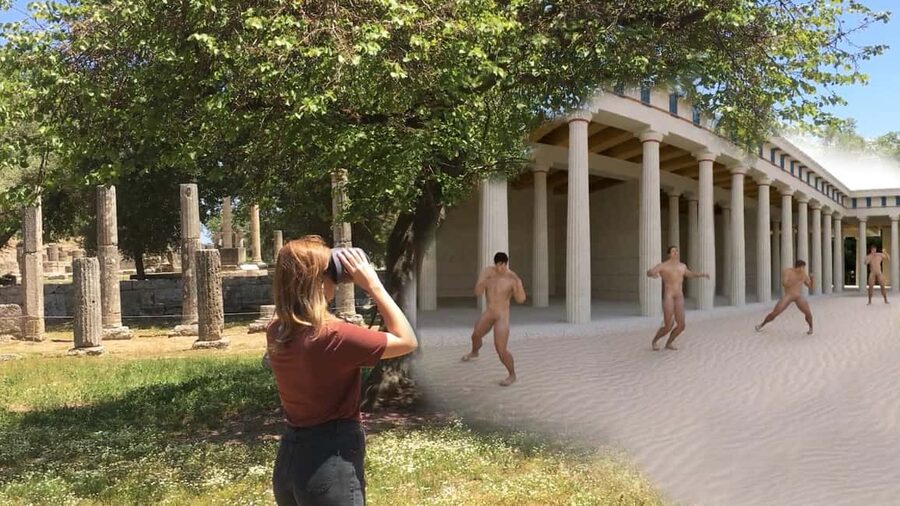
- Fifteen ancient locations come alive: The route covers the gymnasium, Palestra, Phidias Workshop, Temple of Zeus, stadium, fountain, and more.
- The Olympic Games become a real event: In the ancient stadium, virtual athletes race while you watch from the finish line.
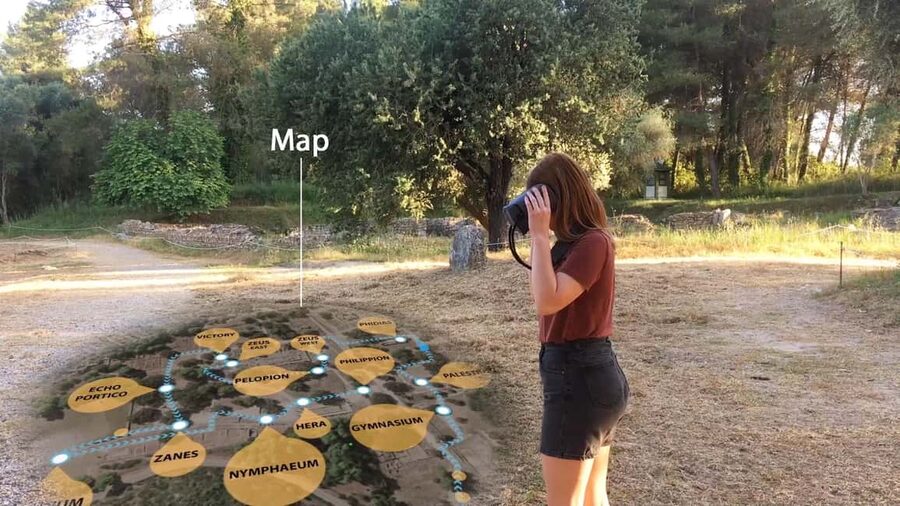
- You walk independently: A virtual map, audio guide, and location markers guide you instead of a large tour group.
- The €29 fee excludes admission: Budget another €20 for the archaeological site unless you qualify for free entry.
- Pick up the equipment in town: The office is across from the main church, usually about a five minute walk from the site entrance.
- Allow time for the headset itself: The full experience is listed as two hours, but one booking reference describes a three-hour return limit, so confirm your exact time at pickup.
Why VR makes Ancient Olympia easier to understand
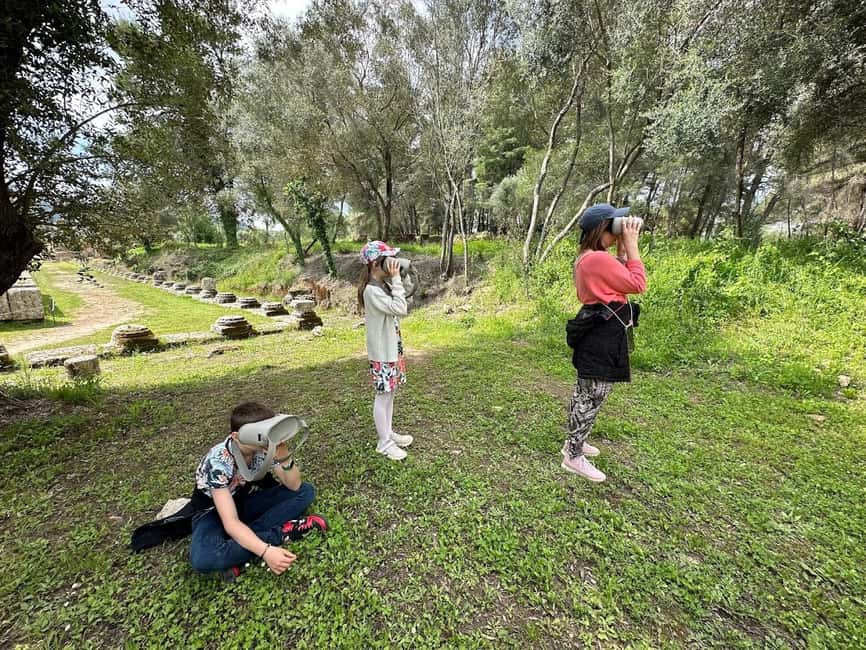
Ancient Olympia is important, but it is not always easy to read. You see foundations, scattered columns, broken walls, and the open space of the stadium. Without context, the place can feel like a collection of stones rather than a functioning sanctuary that once filled with athletes, worshippers, craftsmen, and spectators.
The glasses solve that problem by placing a digital reconstruction over the surviving ruins. You look through the device at the actual site, then see buildings restored to their former scale and shape. The images are not photographs. They have a video-game quality, but that is enough to show the height of a temple, the arrangement of a training ground, or the size of a crowd.
This is the activity’s greatest strength. You are not asked to imagine every missing wall from a small sign. The technology gives you a visual starting point, then the ruins let you compare the reconstruction with what remains.
The experience has earned a 4.8 rating from 661 bookings, and the most consistent praise is easy to understand. The glasses help people picture Olympia as a working ancient center, not simply an archaeological site. That benefit matters most at the Temple of Zeus and the stadium, where scale and movement are otherwise difficult to grasp.
A few more audio tours around Greece worth a look
- Athens: Acropolis Ticket with Optional Audio or Live Guide
★ 4.2 · 11,055 reviews - Athens: Cape Sounio & Poseidon Temple Trip with Audio Guide
★ 4.4 · 4,521 reviews - Athens: Acropolis Ticket with Audio Guide
★ 4.0 · 3,575 reviews
Picking up the glasses in Olympia
You begin at the Olympia Back In Time office. Search for that name on Google Maps. The office is across from the main church, and the walk from the archaeological site is generally about five minutes, although one booking note recommends allowing closer to 20 minutes from a coach drop-off.
At the office, staff give you a short demonstration of the glasses and audio guide. You also leave a passport, driving licence, or other accepted ID as a deposit. Bring comfortable shoes, since the activity takes you across a large outdoor site with uneven ground.
The equipment is meant to be simple. You select locations on the device, follow the map, and listen to the commentary as you go. A blue arrow helps direct you, but it can take a moment to adjust to your position. One useful instruction is to walk in the direction of the blue arrow even if the view seems to point elsewhere. The display should correct itself after a few seconds.
That learning period is worth taking seriously. The first few stops may feel less natural than the later ones, so do not rush through the demonstration. If you are sharing one device between two people, decide in advance who will wear it at each stop. Some pairs found sharing worked well, but it may slow you down if everyone wants a long look.
The gymnasium and Palestra show Olympia at work
The first major scenes focus on athletic training. At the Ancient Gymnasium, the virtual reconstruction shows athletes preparing for competition. This changes the tone of the visit. Olympia was not only a religious center with impressive temples. It was also a place of disciplined physical preparation.
The Palestra takes that idea further. This was the training ground associated with boxers and wrestlers, and the virtual scenes show how the spaces were used. The value here is not just seeing a rebuilt building. It is understanding why several plain-looking foundations mattered.
The audio guide adds short facts and stories without demanding your full attention for long stretches. That makes the route workable for families and for anyone who prefers to stop, look around, and take photographs. The commentary is available in Dutch, French, English, German, Spanish, Italian, and Greek.
You should still expect a self-guided format rather than a personal historian walking beside you. The explanations are designed to keep the route moving, so they are clear and reasonably brief. If you want an exhaustive architectural discussion, a specialist guide or additional museum time would add more depth.
The Phidias Workshop connects art with the sanctuary
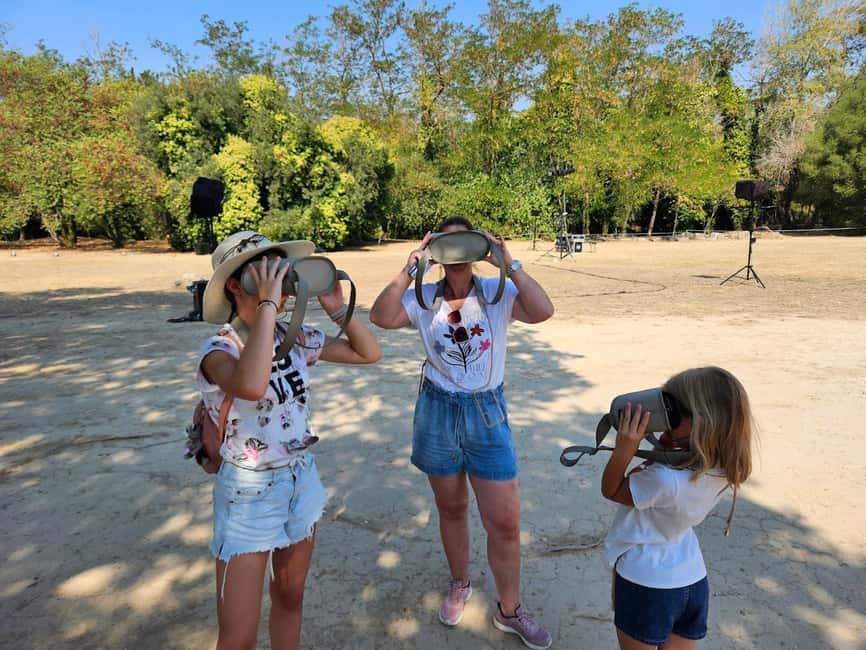
The Phidias Workshop is one of the more memorable stops because it links Olympia’s buildings with the people who made them. Here, the virtual display places you in the workshop where the sculptor Phidias created the famous Statue of Zeus.
The statue itself was one of the Seven Wonders of the Ancient World. The ruins of the workshop can be difficult to interpret on their own, but the reconstruction gives the site a clear purpose. You begin to see it as a place of design and craftsmanship, not merely another set of foundations.
This is a good example of why the route works better than a simple audio recording. The narration explains the setting, while the images give you a rough sense of the scale and activity that once filled it. You do not need to be an art expert to understand the connection.
The virtual scenes are stylized, so keep your expectations sensible. They are helpful reconstructions, not a flawless cinema production. Their job is to answer basic questions: What was here? How large was it? How did it fit into Olympia? On those points, the glasses do their work well.
Same place, a different route to walk:
- From Athens: Delphi Full Day V.R. Audio Guided Tour
★ 4.6 · 3,028 reviews - Athens: Acropolis Museum Ticket with optional Audio Guide
★ 4.4 · 2,652 reviews - Athens: Acropolis Ticket & Optional Self-Guided Audio Tours
★ 4.1 · 2,542 reviews - Parthenon & Acropolis Museum with Audio or Live Tour Option
★ 4.1 · 2,446 reviews
Inside the Temple of Zeus
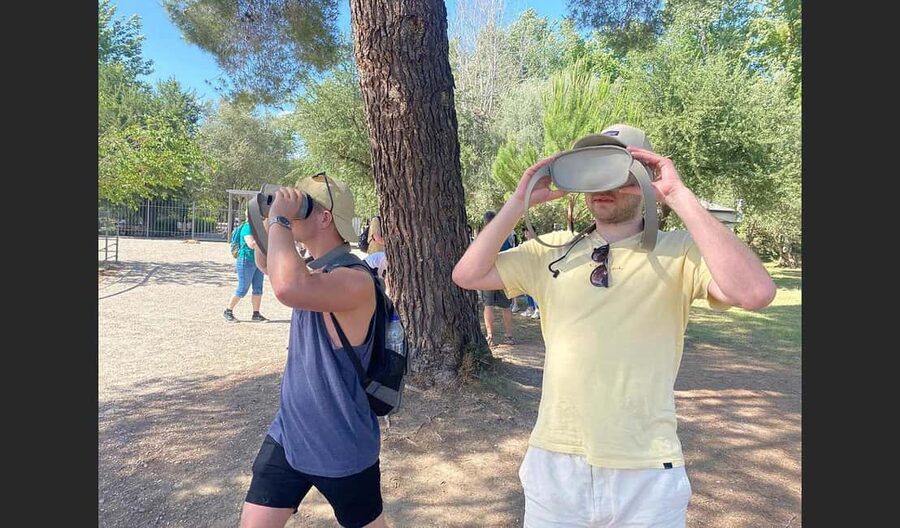
The Temple of Zeus is the emotional center of the experience. In the ruins, you can see the enormous scale of the surviving columns and the outline of the structure. Through the glasses, you can virtually enter the completed temple and see the colossal Statue of Zeus in its original setting.
That interior view is especially useful because the temple’s full height and enclosed space are hard to picture from the remaining fragments. The 3D reconstruction gives you a sense of the building as a place people entered, not just a monument viewed from outside.
Take your time at this stop. It is tempting to move on once the audio ends, but the visual effect benefits from a slower look. Walk around the real remains and compare them with the reconstructed image. That habit helps you connect the modern ruin with the ancient building instead of treating the VR scene as a separate attraction.
The Temple of Zeus also shows the limits of a short audio guide. You get the essential story and a strong visual impression, but not every detail about construction, decoration, or later damage. For most visitors, that is a fair trade because the route remains manageable and does not turn into a long lecture.
The stadium turns history into a sporting event
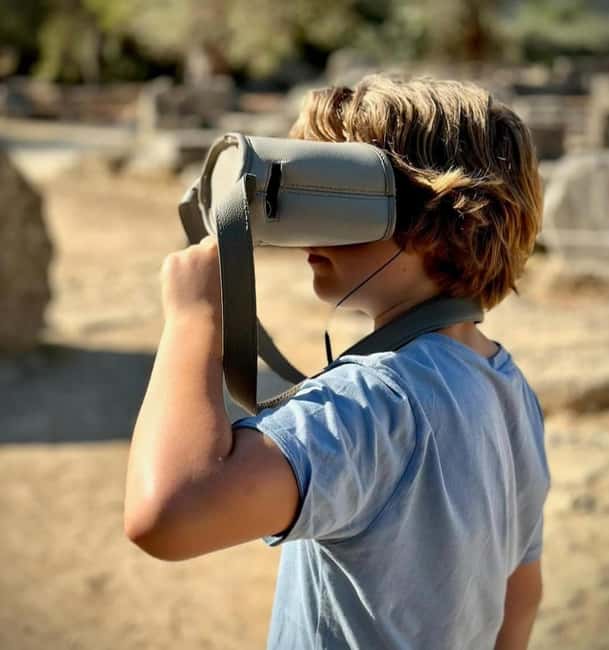
The Ancient Stadium is where the technology feels most playful. Instead of looking at an empty track, you see athletes competing in the original Olympic Games. The scene places you near the finish line, giving the event a sense of direction and movement.
This stop is often the most effective one for children, but adults benefit from it too. A bare stadium can seem surprisingly simple until you picture it filled with competitors and spectators. The virtual race shows why this space mattered and gives a human scale to the athletic tradition connected with Olympia.
The scene is not a live performance and does not turn the site into a theme park. The ruins remain visible, and the animation is relatively short. That balance works well. You get enough action to understand the purpose of the stadium, then you can look at the real track and surrounding banks in peace.
Be thoughtful around other people while wearing the glasses. One useful practical caution is that the device can make you less aware of people moving nearby. If the site is crowded, stop at a safe position before studying the screen rather than walking while your attention is fully inside the headset.
The Nymphaeum and the lighting of the Olympic Flame
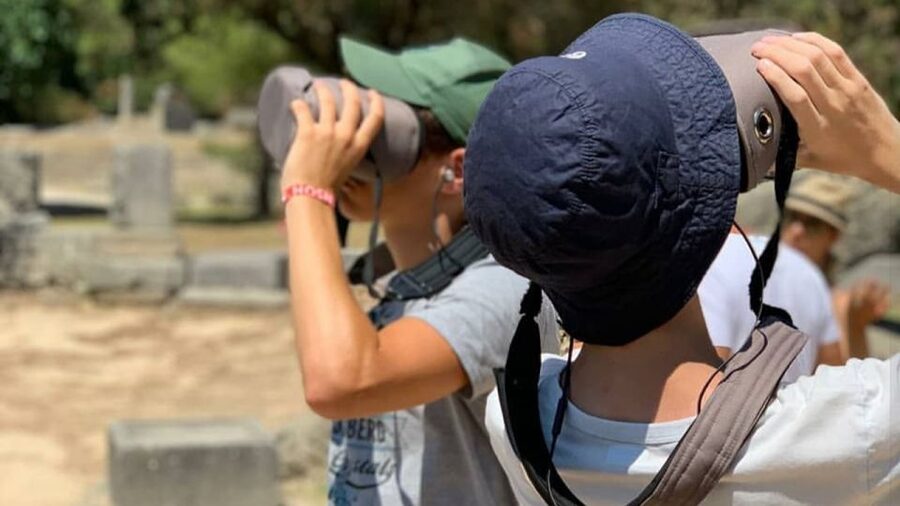
The Nymphaeum of Herodes Atticus is another place where restoration changes your understanding. The virtual version shows the fountain fully built, including the structure that helped supply water to large crowds during the hot summer Games.
That detail gives the sanctuary a more practical character. Olympia needed more than temples and athletic grounds. It needed water, movement, and services for the thousands of people who gathered there. The reconstructed fountain helps you see the site as a functioning place with serious logistical needs.
The final major scene presents the lighting of the Olympic Flame. It is a strong closing image because it links the ancient sanctuary with a ceremony that remains familiar today. The moment is less about a single building and more about continuity, memory, and the lasting pull of the Olympic tradition.
The route includes other monuments as well, for a total of 15 locations. The exact order may depend on how you move through the site and how the device recognizes your position. Use the physical signs and the virtual map together. The headset is useful, but it is not a substitute for paying attention to where you are standing.
How long you need, and how to plan the museums
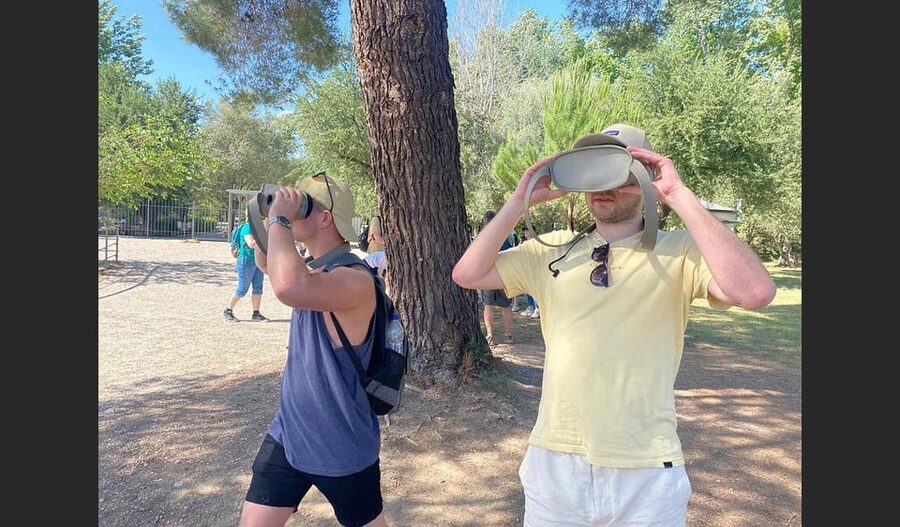
The advertised duration is two hours. That is a reasonable target for the outdoor archaeological site if you keep moving and listen to the main commentary. However, the equipment return time matters more than the headline duration.
One booking arrangement has allowed a three-hour return window, while the activity information lists two hours. Confirm your individual deadline when you collect the glasses. This is especially important if you want to visit the Museum of the History of the Olympic Games and the other museum in Olympia.
A practical plan is to use the VR equipment first at the outdoor site. Several visitors who visited a museum before collecting or returning the glasses found themselves hurrying. Another had to return the equipment, then walk back to finish the Olympic history museum.
I would treat the VR route and the museums as separate parts of your visit. Use the glasses to understand the buildings and events. Then use the museums for artifacts and closer study. If you have limited time, prioritize the outdoor site with the headset before adding museum visits.
What works well, and what can be awkward
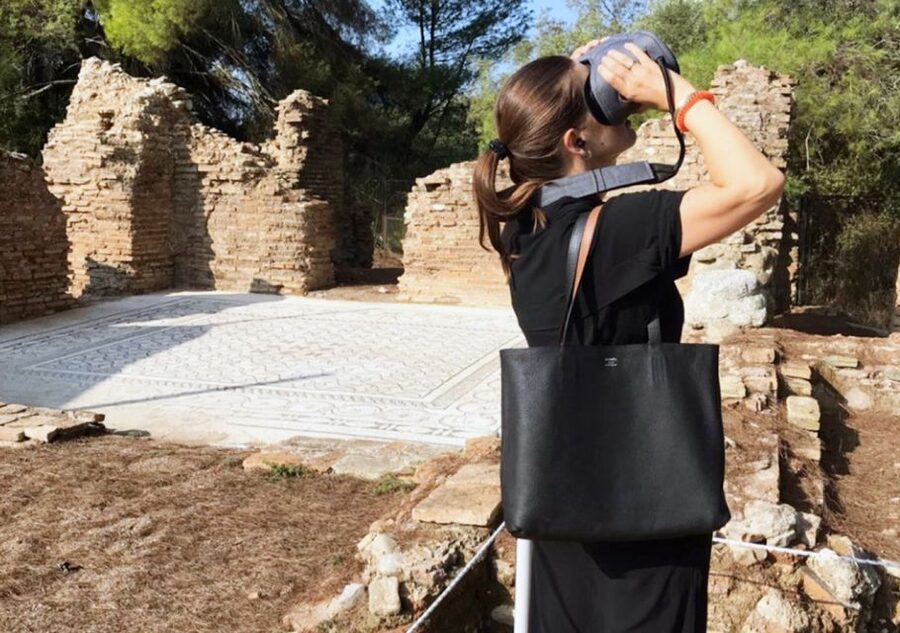
The equipment is generally easy to use, and the office staff provide a clear introduction. There have been occasional technical problems, including a headset that needed a reboot or a device that briefly lost its position. These issues were usually solved by restarting, following the instructions, or receiving a replacement from staff.
GPS recognition is not perfect. The device may occasionally fail to identify your exact location, especially when you move between stops. If that happens, use the numbered signs and listen again when you reach the matching monument. You can still get value from the audio even when the map is temporarily confused.
The route is self-guided, which is a major plus if you dislike being tied to a group. You can pause for photographs, wait for a crowded area to clear, and move at your own pace. The downside is that you must manage your own time and orientation.
The activity is wheelchair accessible, according to the supplied details. Even so, outdoor archaeological ground can require careful pacing, and the office staff can provide the practical information you need before entering.
Is €29 good value?
At €29 per person, the experience is not a cheap add-on once you include the separate €20 entry ticket. The total cost makes more sense if you value visual interpretation and plan to spend time at the sanctuary rather than making a quick stop.
I think the price is fair for families, first-time visitors, and anyone who finds ruins hard to read. The glasses can replace the need for a large group tour, and they give children a reason to stay engaged. Two people may also be able to share one device, although you should ask about the exact rental arrangement rather than assume.
The value is weaker if you already have a specialist guide, very little time, or no interest in digital reconstructions. The visuals have a game-like style, and the commentary is intentionally concise. This is a practical interpretation tool, not a full university lecture.
Free cancellation is available up to 24 hours before the activity, and you can reserve without paying immediately. Late arrivals of more than 45 minutes are canceled without a refund, so transport delays deserve some planning.
Who should book Olympia Back In Time?
I would recommend it most strongly to families with children, independent visitors, and anyone visiting Olympia without a dedicated guide. It is also useful for people who want to avoid a large group while still receiving context at each major stop.
The experience suits teenagers particularly well because the reconstructions give them something to watch and follow. Adults who enjoy photography will appreciate being able to pause and take pictures, though you should keep an eye on the time.
You may prefer a traditional guide if you want detailed conversation, rapid answers to questions, or a carefully explained historical argument. The headset cannot respond to you, and the route sometimes requires patience while the location system catches up.
Should you book this VR tour?
Book it if you want to understand what Olympia looked like before earthquakes, weather, and centuries of reuse reduced it to fragments. The Temple of Zeus, the active training grounds, the racing stadium, and the fountain all gain meaning through the reconstructions.
Before booking, add the €20 site ticket to your budget, confirm the equipment return time, and leave enough time to walk from the office. Arrive with comfortable shoes, your identification document, and a willingness to spend the first few minutes learning the controls.
For most independent visits, the glasses add genuine value rather than mere novelty. Olympia is far easier to appreciate when you can see the missing buildings and people in your mind. If that is the kind of help you want, this is a smart addition to the site visit.
FAQ
How much does the Olympia VR tour cost?
The VR experience costs $29 per person. Admission to the archaeological site is separate and costs €20, except for eligible visitors who enter free.
Is the archaeological-site ticket included?
No. You must purchase the €20 entry ticket separately unless you qualify for free admission. EU visitors under 25 and non-EU visitors under 18 enter free according to the activity information.
Where do I collect the VR glasses?
Collect them at the Olympia Back In Time office. Search for that name on Google Maps. The office is across from the main church and is generally about a five minute walk from the archaeological site.
How long does the experience take?
The activity is listed as two hours. The exact equipment return deadline should be confirmed at pickup, since one booking arrangement refers to a three-hour return period.
What languages are available?
The audio guide is available in Dutch, French, English, German, Spanish, Italian, and Greek. The instructor support is offered in the same languages.
Do I need identification?
Yes. A passport, driving licence, or other accepted identification document is required as a deposit for the equipment.
What happens if I arrive late?
Arrivals more than 45 minutes late are canceled without a refund. Plan extra time to find the office, collect the equipment, and walk to the archaeological site.
Just added around Greece
- E-Ticket to Akrotiri with Audio Tour on your Phone★ 5.0 · 2 reviews
- Authentic Santorini: A Self-Guided Audio Tour of Oia★ 4.5 · 3 reviews
- The Palace of the Grand Master E-Ticket with Audio Tour★ 4.0 · 9 reviews
- The Palace of the Grand Master. Self-guided Audio Tour★ 3.5 · 15 reviews
- Acropolis of Lindos E-Ticket with Audio Tour on your Phone★ 4.5 · 8 reviews
- Explore Lindos Acropolis in 3D & Audio★ 4.0 · 4 reviews
- Olympia Archaeological Site & Museum E-Ticket with Audio Tour★ 4.0 · 11 reviews
- Mykonos: Find your (queer) god Self-Guided Audio Tour★ 4.0 · 2 reviews
Greece Audio Tours, compared.

Cape Sounio & Poseidon Temple Trip with Audio Guide
Read our review →
Acropolis Museum Ticket with optional Audio Guide
Read our review →
Acropolis Ticket & Optional Self-Guided Audio Tours
Read our review →
Parthenon & Acropolis Museum with Audio or Live Tour Option
Read our review →
Knossos Palace Entry Ticket with Optional Audio Guide
Read our review →Browse the lists this tour appears in