
REVIEW · SACRAMENTO AUDIO TOURS
Old Sacramento: A Self-Guided Audio Tour
Old Sacramento tells its story one boardwalk at a time. This self-guided walk links Tower Bridge, Pioneer Square, railroad landmarks, and the Delta King while an audio narrator explains how Gold Rush Sacramento took shape. I like the freedom to walk at your own pace and the useful offline maps and audio. I also like the focus on ordinary buildings, Chinese railroad workers, mail routes, and early hotels, not only grand monuments.
The main drawback is technical. One person praised the app for working flawlessly, while another had trouble with the download steps and found the email support unhelpful. You need your own smartphone and headphones, and the tour cannot be refunded or changed once booked.
Key details before you set out
- About 90 minutes to two hours: Allow extra time if you pause for food, photos, or a museum.
- Starts near Tower Bridge: The listed meeting point is 1 Capitol Mall, Sacramento, California 95814.
- Ends at the Delta King: The final stop is outside the historic paddlewheeler at 1000 Front Street.
- Covers more than 50 restored buildings: The Old Sacramento Historic District includes structures dating from the late 1850s.
- English audio with offline access: VoiceMap provides the narration, maps, and geodata for Android and iOS.
- A low-cost introduction: At $11.99 per person, the tour costs less than many guided walks, but museum admission and refreshments are extra.
What this Old Sacramento audio walk actually offers
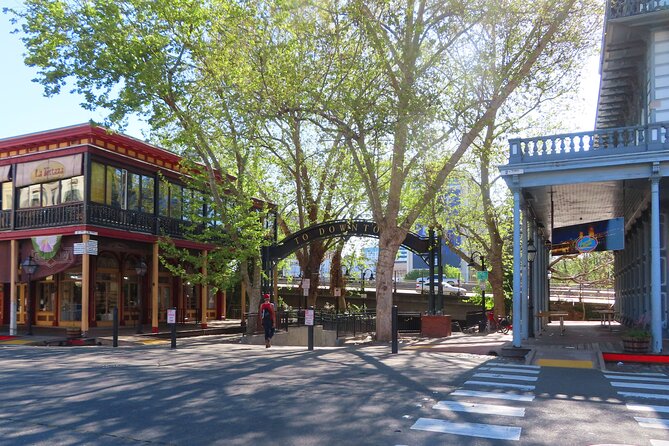
This is a walking tour, not a ticketed attraction or a live guide-led group. You download the VoiceMap app, use your phone and headphones, and follow the route through the historic district. The audio provides the commentary while you move from one point to the next.
That format suits me when I want history without a fixed departure time. You can pause to read a sign, stop inside a shop, or take a break along the waterfront. You are not waiting for a group to gather, and nobody is rushing you to the next corner.
The tour lasts about an hour and a half to two hours. That estimate covers the walking route and narration, but it does not include time inside the California State Railroad Museum or Sacramento History Museum. If you plan to visit either one, set aside additional time.
The tour is offered in English only. The cost is $11.99 per person, which is a fair price for a structured introduction to Old Sacramento, especially if you are traveling with one or two people who prefer to explore independently. It is less useful if you want a live guide who can answer questions as you go.
One important practical point: the price does not include a smartphone, headphones, museum tickets, food, drinks, or transportation. Downloading the tour before you arrive is sensible, since the package includes offline audio, maps, and location data.
More Self-Guided Audio Tours in the USA
- Gettysburg Battlefield Self-Guided Driving Audio Tour
★ 4.5 · 910 reviews - Joshua Tree National Park Self-Guided Driving Audio Tour
★ 4.5 · 762 reviews - Ultimate Acadia National Park Self-Guided Driving Audio Tour
★ 4.0 · 521 reviews
Starting at Tower Bridge and the Sacramento River
The route begins at Tower Bridge, with the meeting point listed at 1 Capitol Mall. This is a strong starting place because it puts you near the river, the waterfront, and the old district’s wooden sidewalks.
From here, the audio sets up Sacramento’s early story. The focus is on the people who came west during the Gold Rush and the city they built around trade, transport, hotels, river traffic, and rail connections. You get context before moving into the older streets, which makes the buildings easier to read.
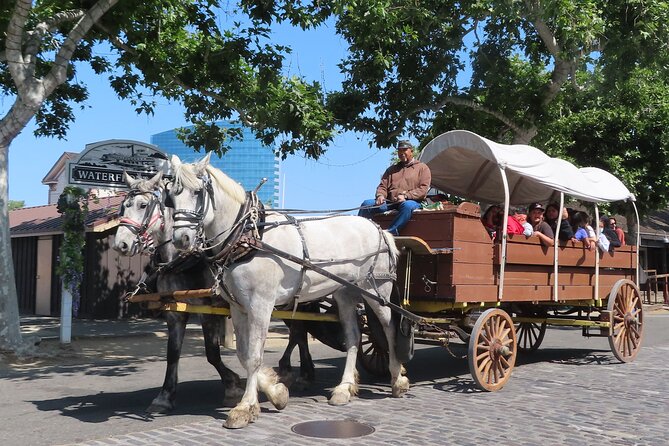
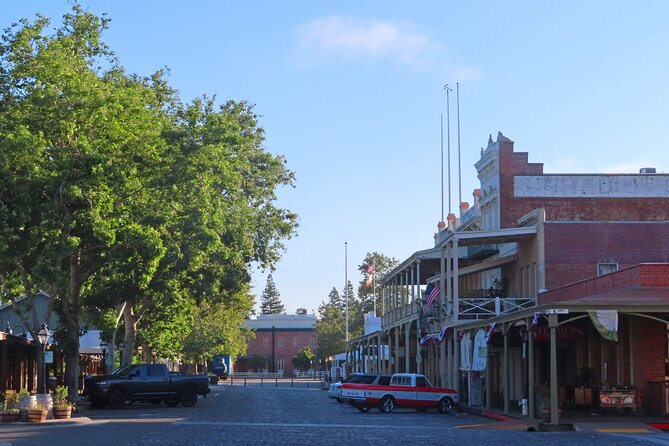
The opening walk is leisurely. You will move along cobblestone streets and wooden boardwalks while hearing about the structures around you. These surfaces are part of the appeal, though cobblestones can make the walk less smooth than an ordinary city sidewalk.
I like that the route treats the district as a collection of places with different purposes. You are not simply pointed toward a famous façade. You hear how hotels, restaurants, transport links, and commercial buildings served a young city that was still finding its footing.
Pioneer Square, the Pony Express, and Theodore Judah
Pioneer Square brings several important pieces of California history together. Here you encounter the Pony Express Statue and a monument to Theodore Judah, the Central Pacific Railroad’s first chief engineer.
The Pony Express section gives the tour a useful sense of distance and delay. Before the Pony Express began in 1860, mail could take 25 days to travel by steamboat from the East Coast to California. That detail makes the need for faster communication feel practical rather than abstract.
Theodore Judah’s monument shifts the story toward railroads. The Central Pacific Railroad changed Sacramento’s place in the West, and the tour connects that change to the people who planned and built the line. You are given a look at the railroad not just as a machine, but as a project tied to money, migration, labor, and ambition.
The short distance between the Pony Express statue and the railroad monument also helps you see how quickly communication and transport were changing. Old Sacramento was not only a Gold Rush town. It became a key point in a wider network linking California to the rest of the country.
Firehouse Restaurant, Orleans Hotel, and What Cheer House
The audio commentary continues past buildings that once served people arriving, eating, sleeping, and doing business in Sacramento. The Firehouse Restaurant, Orleans Hotel, and What Cheer House each give the route a more personal scale.
What Cheer House is especially useful to hear about because it was a former hotel and is recognized as a historical landmark. A hotel tells you something about the city’s daily life: new arrivals needed beds, meals, news, and a place to meet other people. The building is not just an old exterior. It represents the services that supported migration and commerce.
The Firehouse Restaurant adds another angle. A firehouse points to the dangers of a fast-growing city built with timber and busy commercial streets. The audio helps connect the building to the practical problems of urban life rather than treating it as a decorative stop.
The Orleans Hotel gives you another glimpse of the district’s lodging trade. As you pass these sites, the narration lets you imagine Old Sacramento as a working center filled with people who needed somewhere to stay and somewhere to spend their money.
The Historic District was named a California Historical Landmark in 1965 and contains more than 50 restored buildings dating from the second half of the 1850s. That restoration work gives the walk its visual character, but the audio is what explains why the buildings mattered.
Same place, a different route to walk:
- Los Angeles: Hop-On Hop-Off Bus Tour with Audio Guide
★ 3.7 · 2,030 reviews - City Sightseeing Hop-On Hop-Off Bus Tour with Audio Guide
★ 3.0 · 1,083 reviews - Medieval Torture Museum Ticket with Audio Guide and Ghost Hunting
★ 5.0 · 962 reviews - San Francisco: Alcatraz, Ferry & Audio Tour w/ Night Option
★ 4.4 · 617 reviews
The Lady Adams Building and the restored district
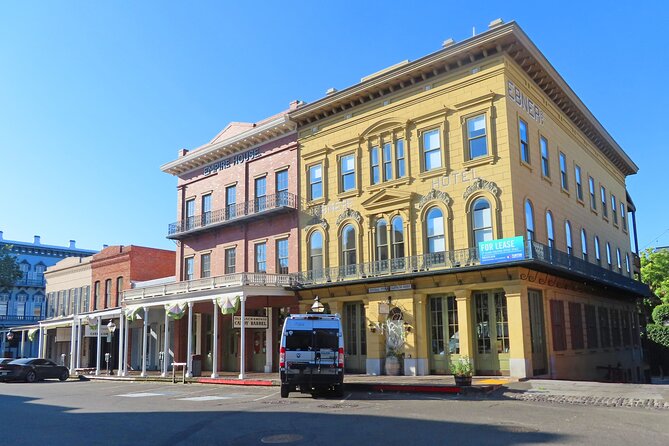
The Lady Adams Building appears as another stop along the route. The audio provides its history while you walk, adding another layer to the district without requiring you to stop for a formal presentation.
This kind of stop is one of the better reasons to choose an audio tour. You may pass a building that looks interesting but have no idea what happened there. The narration gives you a reason to pay attention to details you might otherwise miss.
Old Sacramento’s restored buildings can sometimes make the area feel like a historic set. The commentary helps correct that impression by bringing in people, work, transportation, and changing technology. I prefer that approach to a simple list of construction dates.
The route moves through the district rather than keeping you in one small square. You see how the buildings fit together along the streets, boardwalks, and waterfront. The experience is strongest when you look up from the phone and let the audio guide your eyes.
Chinese migrants and the Central Pacific Railroad
One of the most important subjects on the tour is the courage of Chinese migrants who helped build the Central Pacific Railroad. This is a valuable part of the story because railroad history can easily become a tale of engineers, investors, and locomotives alone.
The narration gives space to the workers whose labor made the railroad possible. That broadens the tour beyond the Gold Rush legend and shows how many different groups shaped California’s growth.
I also appreciate the link between this subject and Sacramento’s position as a railroad city. The rail line was not built by one famous figure. It depended on a large workforce operating under difficult conditions, and the tour makes that human contribution part of the route.
You should listen closely during this section. The audio is doing more than naming a monument. It is asking you to understand who built the connections that allowed California to communicate and trade with the rest of the country.
I Street, the Big Four Building, and Front Street
The walk continues down I Street, past the Big Four Building, and along Front Street. These streets help connect the district’s separate stories: river traffic, hotels, railroad business, restaurants, and commercial life.
The Big Four Building is tied to the men who controlled major railroad interests in the region. Hearing about it after the discussion of Theodore Judah and the Central Pacific Railroad gives you a clearer sense of how technical plans, business power, and transportation came together.
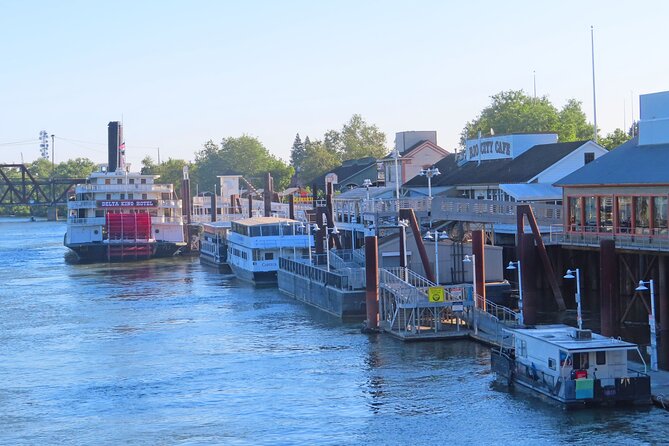
Front Street is also the most practical part of the route. You can stop at one of the bars or restaurants along the Old Sacramento Waterfront and sample the menu. Food and drinks are not included, but the ability to pause here makes the self-guided format useful.
I would not treat the walk as a restaurant tour. The food stops are optional, and the route does not include a meal. Still, Front Street gives you a natural place to end the historical portion of the walk or take a break before continuing to the final stop.
Choosing between the railroad and history museums
The route introduces the California State Railroad Museum and Sacramento History Museum as places you can visit. Admission is not included, so you can decide based on your schedule and interest.
The railroad museum is the obvious choice if the Central Pacific story, railroad engineering, and the development of western transportation interest you most. The Sacramento History Museum may suit you better if you want a wider look at the city and its people.
The audio tour does not replace either museum. Instead, it gives you orientation before you enter. You will already have heard why railroads, river travel, mail, hotels, and commerce mattered, so the exhibits may have more meaning.
If you plan to visit both, the advertised two-hour timing will not cover your whole outing. Think of the walking tour as a first chapter, then add museum time and any meal stops separately.
Ending beside the Delta King paddlewheeler
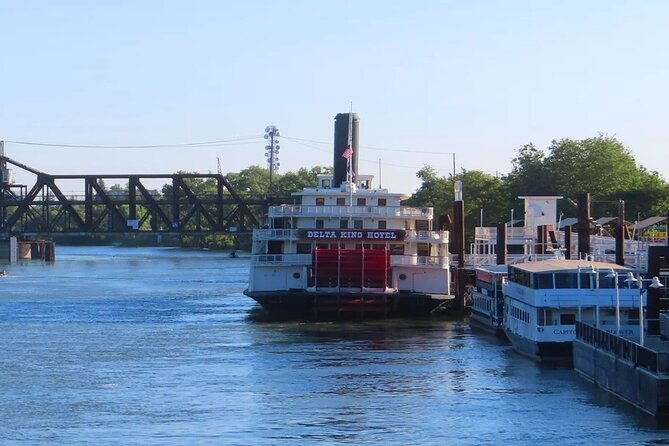
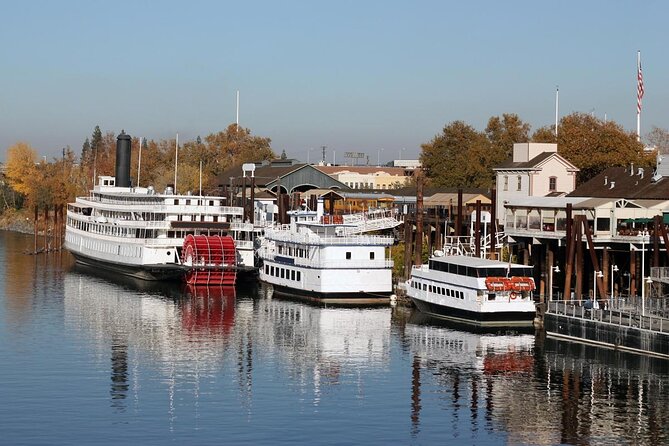
The route ends in front of the Delta King Hotel at 1000 Front Street. The paddlewheeler provides a fitting final stop because river travel was central to Sacramento’s early growth.
The audio explains the Delta King’s history and brings the route back to the waterfront. You begin near the river and finish beside a vessel tied to that same transport story. The ending feels connected to the opening rather than tacked on.
This is also a useful place to finish because you are still in the Old Sacramento Waterfront area. You can continue to a restaurant or bar, visit an attraction, or simply stop the audio and make your own plans.
The end point is clear, but remember that you arrange your own transportation after the tour. No transfers are included. The posted hours show the experience as available every day, all day, from July 30, 2020 through February 22, 2027, but the audio tour itself still depends on your phone, battery, and app setup.
The VoiceMap app and the main technical risk
The best feature of the technology is offline access. Once the audio, map, and geodata are available on your phone, you do not need to rely on a live connection as you walk.
The app also keeps the experience private. Only your group takes part, so you can listen together and set your own pace. That is a good fit for couples, families, and small groups who do not want to join a scheduled tour.
The weak point is the initial download. One user found the app and narration excellent, with the technology working without trouble. Another could not get through the confusing download steps and was unhappy with the email support response.
I recommend setting up the VoiceMap app before you reach Tower Bridge. Confirm that the tour opens, check that the audio is available offline, and bring charged headphones. Since the experience is non-refundable and cannot be changed for any reason, checking the technical side before your sightseeing day matters.
Who will get the most from this $11.99 tour?
I would choose this walk if you want a low-cost introduction to Old Sacramento and prefer to control the pace. It works especially well for someone visiting the district for the first time, since the route links the major landmarks in a logical order.
It also suits history-minded visitors who want more than a quick look at old buildings. The audio covers Gold Rush migration, mail delivery, railroad planning, Chinese railroad workers, hotels, river transport, and Sacramento’s commercial life.
You may want a different option if you need a live person to answer questions, prefer a fully guided group, or do not want to manage an app. The experience is also less convenient if you have no smartphone or headphones, since neither is supplied.
For the price, I see this as a useful orientation walk rather than a full day of sightseeing. Add a museum, a meal, or extra time along the waterfront, and the tour becomes the historical framework for a larger Old Sacramento visit.
Should you book this Old Sacramento walk?
Book it if you want an affordable, private audio route with strong coverage of Sacramento’s Gold Rush and railroad connections. The offline access, flexible timing, and clear sequence from Tower Bridge to the Delta King give you a practical way to see the district without joining a group.
Skip it if app setup makes you uneasy or you want a live guide. The technical problem reported by one user is worth taking seriously, especially because the booking cannot be refunded or amended.
At $11.99, I think it is good value for an independent visitor who prepares the app in advance. Bring your own phone and headphones, allow up to two hours, and treat the museums and waterfront dining as optional additions rather than part of the ticket.
FAQ
Where does the Old Sacramento audio tour start?
The listed meeting point is 1 Capitol Mall, Sacramento, California 95814. The route begins at Tower Bridge.
Where does the tour end?
The audio tour ends in front of the Delta King Hotel at 1000 Front Street, Sacramento, California 95814.
How long does the walking tour take?
The tour takes about one hour and 30 minutes to two hours. Museum visits, meals, and other stops take additional time.
What language is the audio tour offered in?
The tour is offered in English.
What does the $11.99 price include?
The price includes lifetime access to the English tour, offline audio, maps and geodata, and use of the VoiceMap app on Android or iOS.
Do I need to bring anything?
You need your own smartphone and headphones. Food, drinks, transportation, museum admission, and tickets for other attractions are not included.
Can I cancel or change the booking?
No. The experience is non-refundable and cannot be changed for any reason.
Just added around the USA
- Self Guided Driving Audio Tour of Saguaro National Park★ 3.0 · 4 reviews
- Self-Guided Audio Driving Tour of Mount Lemmon★ 5.0 · 4 reviews
- Saguaro National Park Self-Guided Audio Tour★ 3.5 · 11 reviews
- A Self Guided Audio Tour in Tombstone★ 4.0 · 11 reviews
- Catskills Scenic Byway Self-Guided Driving Audio Tour★ 4.0 · 9 reviews
- Big Bend National Park Self Guided Audio Tour Guide★ 5.0 · 12 reviews
- Self-Guided Audio Driving Tour in Catskills Scenic Byway★ 4.5 · 7 reviews
- Shiloh Battlefield Self-Guided Driving Audio Tour★ 4.0 · 9 reviews
Self-Guided Tours, compared.

Acropolis Ticket & Optional Self-Guided Audio Tours
Read our review →


Ultimate Acadia National Park Self-Guided Driving Audio Tour
Read our review →

Santorini: Akrotiri Ticket with Optional Self-Guided Audios
Read our review →
Browse the lists this tour appears in