
REVIEW · USA AUDIO TOURS
Lake Superior North Shore Self-Guided Audio Driving Tour
Lake Superior tells its stories slowly. This self-guided drive turns a familiar road into a moving history lesson, linking Duluth’s harbor, old mining towns, waterfalls, beaches, and lighthouses. I like the location-triggered narration, which starts as you approach each point, and the fact that one $16.99 purchase covers everyone in your car, up to four people. The main catch is that the tour depends on your phone, GPS, and correct driving speed, so audio may repeat, stop early, or fall out of sync.
You begin at the Lake Superior Maritime Visitor Center in Duluth and finish near Split Rock Lighthouse. Along the roughly 48-mile route, more than 47 stories cover shipwrecks, ore boats, forests, geology, commercial fishing, local legends, and the darker side of North Shore history. I also like the pause-and-resume freedom: you can spread the drive over two days, stop for photos, eat, explore, and return to the audio when you are ready.
Key things to know before you start

- The tour begins at Duluth’s Canal Park and ends at Split Rock Lighthouse, creating a clear northbound route along the lake.
- More than 47 audio stories fill a 2 to 3 hour drive, though sightseeing stops can make your day much longer.
- The $16.99 price covers one car of up to four people, not each individual passenger.
- Offline maps and downloaded audio help when cell service fades, but you must download everything while connected to strong Wi-Fi or cellular service.
- The route mixes major sights with small roadside stops, including French River, the Buchanan Historical Marker, and Iona’s Beach.
- You pay attraction admission separately, including entry to Gooseberry Falls State Park and Split Rock Lighthouse.
How this North Shore audio drive works
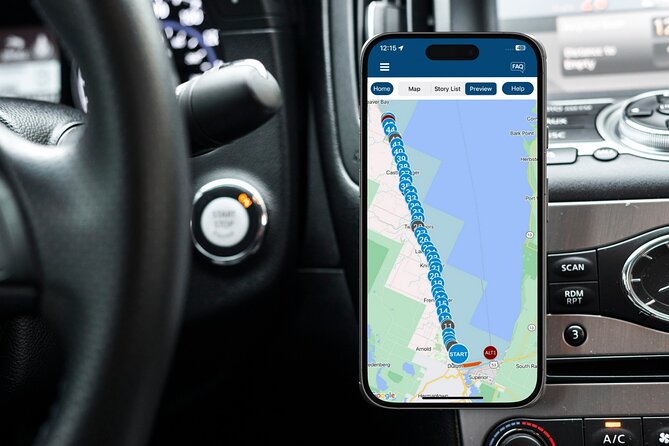
This is not a bus tour, walking tour, or guided group excursion. No guide meets you at the Lake Superior Maritime Visitor Center. You drive your own vehicle, use the Action Tour Guide app, and let your phone’s GPS trigger the stories along the route.
After booking, you receive setup instructions and a password by email and text. Search for audio tour if the message is hard to find. Download the separate Action app before you leave a strong connection. Once the tour is stored on your phone, it works offline.
Connect your phone to the car stereo by Bluetooth, USB, or AUX. Apple CarPlay is supported, and one user found the stop-and-start feature worked well with CarPlay. Android Auto support is still listed as forthcoming, so Android users should plan on using the phone or another supported connection.
The app follows your location and plays each story automatically. You can pause the tour when you stop, skip a story, or restart later. The tour has lifetime access with no expiry, so you can use it again on another trip. That is useful if you only have time for part of the shore on your first outing.
For the smoothest playback, follow the route and posted speed limits. Driving too fast can cause a story to skip toward the end or trigger nearby points more than once. That is not a dealbreaker, but it is the most important practical tip for avoiding technical trouble.
More Self-Guided Audio Tours in the USA
- Gettysburg Battlefield Self-Guided Driving Audio Tour
★ 4.5 · 910 reviews - Joshua Tree National Park Self-Guided Driving Audio Tour
★ 4.5 · 762 reviews - Ultimate Acadia National Park Self-Guided Driving Audio Tour
★ 4.0 · 521 reviews
Canal Park begins the journey beside the working harbor

Start at the Lake Superior Maritime Visitor Center, at 600 Canal Park Drive in Duluth. Exit the parking lot and turn right onto Canal Park Drive. The opening stories set the tone with Duluth’s harbor, shipping, and the relationship between the city and Lake Superior.
Canal Park is an easy place to get your bearings. The tour tells the amusing local tale that the entire population dug the canal in three days in 1870. The real work was done by a large steam dredger, but the legend is more entertaining than the truth.
This part of the drive works best if you allow extra time before setting off. The official tour audio takes about 10 minutes at each listed stop, but you may want to look around the maritime area, watch harbor traffic, or take photographs. The timed drive itself is only an estimate, not a strict schedule.
Glensheen Mansion adds a darker chapter
The next major stop is Glensheen Mansion, built in 1908 by mining magnate Chester Congdon. The story then moves into the home’s grim later history, including the 1977 murders of Elisabeth Congdon and her nurse.
This is one of the tour’s more dramatic moments. The details are unsettling, so you should know what to expect if you are driving with children or prefer a lighter historical tone. The mansion’s story gives the route a strong human element, moving beyond ships and scenery into wealth, family history, and crime.
Admission to the mansion is not included in the $16.99 tour price. The audio can introduce the site from the road, but you will need to arrange and pay for any interior visit separately.
Duluth’s name and French River’s working waters

As you leave the city, the narration explains how Duluth received its name, tracing it to the French explorer Daniel Greysolon Dulhut, who camped in the area in 1679. This short historical connection helps place the modern city within a much older pattern of exploration and trade.
At French River, the focus shifts to commercial fishing. Interpretive panels describe the fishing industry on Lake Superior, while a nearby fish sanctuary raises rainbow trout and returns their offspring to the lake. The operation is not open to the public, but the story gives you a useful look at the work done to support the lake’s fish populations.
This is a good example of why the audio format can add value. You might otherwise pass a roadside overlook, take a quick photo, and keep driving. The narration gives the stop a purpose without forcing you into a fixed schedule.
More Driving Audio Tours in the USA:
- Ultimate Lake Tahoe Self-Guided Driving Audio Tour
★ 4.5 · 435 reviews - Scenic Newport, RI Self-Guided Driving Audio Tour
★ 4.5 · 325 reviews - Arches National Park Self-Guided Driving Audio Tour
★ 4.5 · 288 reviews - Yellowstone National Park Self-Guided Driving Audio Tour
★ 4.5 · 249 reviews
The Buchanan marker and Two Harbors’ rough past

The Buchanan Historical Marker is a brief roadside stop. You are told to park in the turnout ahead if you want to see it, or continue along the route. The available stop information also shifts into a discussion of soil, tree roots, and wildflowers, so pay attention to the app’s map and audio cues here. This may feel less tightly focused than the strongest historical sections.
Two Harbors brings the route back to colorful local history. In the late 1800s, the town had 22 saloons within a two-block area, serving workers who had just been paid and were ready to spend their money. The narration does not polish the past. It presents Two Harbors as a rough port town where men could quickly lose their wages.
That humor helps break up the heavier material. You are not simply hearing dates and names. You are getting short stories that explain how a working town felt in its busiest years.
Silver Creek Cliff Tunnel replaces a dangerous road

The Silver Creek Cliff Tunnel tells a practical engineering story. Before the tunnel was finished, drivers had to travel a narrow two-lane road along the cliff edge, with the lake below. The completed project took three years and removed a particularly tense section of road.
This stop works best when you listen while approaching the tunnel, then consider how different the route must have felt before the modern road was built. The story connects infrastructure with everyday safety, a theme that appears often along the North Shore.
Because this is a driving tour, keep your attention on the road. The audio is designed for hands-free listening, but you should never stop in an unsafe place just to catch a story or photograph.
Ore boats and Lake Superior’s maritime risks

The S.S. William A. Irvin Ore Boat Museum brings Duluth’s industrial shipping story into view. The vessel represents the ore trade that helped shape the region and gives you a chance to connect the lake’s impressive size with the working ships that crossed it.
The surrounding maritime narration also includes the SS America and Captain Edward Smith, who commanded the passenger steamship in June 1928. The story concerns 47 people headed toward summer homes on Isle Royale. The stop’s audio covers more than one vessel and maritime episode, so use it as part of the wider shipping story rather than expecting a single-ship biography.
Admission to the ore boat museum is not included. If you plan to go inside, build that visit into your day rather than treating the 2 to 3 hour estimate as the full time needed for the route.
Gooseberry Falls brings water and Ojibwe tradition

Gooseberry Falls State Park is one of the route’s strongest natural stops. The falls give you a chance to leave the car, stretch your legs, and see the water that feeds into Lake Superior.
The narration explains that the place name comes from the Ojibwe name Shabonimikani-zibi, meaning River Place of the Gooseberries. It also describes the special connection between the Ojibwe and the small tart berries. That cultural detail adds meaning to what might otherwise be a quick waterfall stop.
State park admission is not included. You should account for that extra cost and allow more than the audio’s 10-minute segment if you want to explore. One practical weakness is that the tour does not provide restaurant suggestions, so plan food stops independently.
Iona’s Beach explains the rocks beneath your feet
Iona’s Beach offers a different kind of North Shore experience. Here, the story turns to volcanic activity, explaining how lava filled cracks and hardened into igneous rock. The beach is known for rhyolite and felsite, two rock types linked to that geological past.
This section is useful because it teaches you how to read the shore. Instead of seeing only stones beside the water, you begin to notice that their color and texture record ancient volcanic activity. The stop also gives the route a welcome change of pace after the shipping and town history.
As with every roadside stop, use safe parking and follow local rules. The audio encourages you to pause and look, but your vehicle should never obstruct traffic.
Split Rock Lighthouse is the fitting finish
The final stop is Split Rock Lighthouse, one of the North Shore’s best-known sights. The route points you toward a photo location where millions of people have photographed the lighthouse. The ending feels appropriate: after stories about ships, cliffs, storms, and lake traffic, you finish with a navigation landmark built to guide vessels safely along the shore.
The tour ends at the Split Rock Lighthouse Visitor Center, 3713 Split Rock Lighthouse Road, Two Harbors. Entry is not included, so decide ahead of time if you want to visit the lighthouse grounds or simply use the overlook and complete the audio route.
The end point is not a return to Duluth. You need to arrange your own return drive, overnight stay, or onward plans. That matters if you are renting a car for a short period or have a fixed evening schedule.
What the $16.99 price really gets you
At $16.99 per group, the value is strongest when three or four people share one car. A group of four pays only a few dollars per person for the audio, route guidance, and lifetime access. Even a couple can find it worthwhile if you would otherwise buy a more expensive guided excursion.
The tour does not cover attraction tickets, parking charges, food, or other personal costs. Gooseberry Falls State Park, Split Rock Lighthouse, Glensheen Mansion, and the ore boat museum may require separate admission. Think of this as a road companion, not an all-inclusive sightseeing pass.
The lifetime access improves the deal. You can start and stop over multiple days, repeat the drive on a later visit, or use bonus content and skipped stories whenever you wish. That flexibility is more valuable than a fixed two-hour recording if you want to spend real time at the waterfalls, lighthouse, or beach.
The best way to avoid app problems
The app’s automatic playback is its greatest convenience and its main weakness. When it works properly, you do not need to keep checking the screen. Stories begin as you approach a point, then pause when you stop for photos or sightseeing.
Some audio segments may end abruptly, repeat a nearby point, or skip toward the finish. Stay close to the planned route and keep to the suggested speed. Download the tour before leaving reliable service, and test the phone connection to your car stereo while parked.
You can also read the narration on screen, which helps if road noise makes a sentence hard to catch. If the audio fails, the provider directs you to contact support. The practical lesson is simple: set up the app before the drive, not at the first scenic turnout.
Who should choose this tour
I would recommend it to independent drivers who want context without joining a group. It suits couples, families, and small groups who like deciding when to stop and how long to stay. It is also useful for people who have driven the North Shore before but want fresh stories about familiar sights.
The tour is less suitable if you want a live guide, detailed restaurant planning, or admission to attractions included in one price. It is also not ideal for anyone uncomfortable with phone setup or GPS-based apps.
The narration’s tone mixes serious history with jokes, including the canal story and Two Harbors’ saloon past. That makes the drive lively, though the darker Glensheen story may not suit every audience.
Should you book the Lake Superior North Shore audio drive?
Book it if you want a low-cost, flexible way to connect Duluth with Gooseberry Falls, Iona’s Beach, Two Harbors, and Split Rock Lighthouse. The strongest features are the price per car, offline access, automatic location cues, and the ability to stretch a short route into a relaxed two-day outing.
Skip it if you expect entrance fees, meals, and a live person to be included. Download the app early, follow the route and speed guidance, and treat the 2 to 3 hours as driving time rather than a full sightseeing day. With those expectations, this is a practical way to add stories and direction to one of America’s most memorable lake drives.
FAQ
Where does the Lake Superior North Shore audio tour begin?
It begins in the parking lot of the Lake Superior Maritime Visitor Center at 600 Canal Park Drive in Duluth, Minnesota.
Where does the tour end?
The route ends at the Split Rock Lighthouse Visitor Center at 3713 Split Rock Lighthouse Road in Two Harbors, Minnesota.
How long is the driving tour?
The route is more than 48 miles long and takes approximately 2 to 3 hours to drive, not including extra time for sightseeing, meals, photographs, or attraction visits.
How many people can use one purchase?
One purchase covers a group of up to four people in the same car.
Is the tour available in languages other than English?
The tour is offered in English.
Do I need cellular service during the drive?
You need strong Wi-Fi or cellular service to download the tour before starting. After downloading, the audio and maps work offline.
Are attraction admission fees included?
No. Attraction entry tickets, passes, and reservations are not included. This applies to places such as Gooseberry Falls State Park and Split Rock Lighthouse.
Can I use the tour over more than one day?
Yes. You can pause the tour, take breaks, explore side stops, and continue later. The purchase provides lifetime access with no expiry.
What happens if I have trouble with the audio?
First, check that you followed the route and speed guidance and that your phone is connected correctly to the car stereo. If the problem continues, contact the tour support team.
Just added around the USA
- Self Guided Driving Audio Tour of Saguaro National Park★ 3.0 · 4 reviews
- Self-Guided Audio Driving Tour of Mount Lemmon★ 5.0 · 4 reviews
- Saguaro National Park Self-Guided Audio Tour★ 3.5 · 11 reviews
- A Self Guided Audio Tour in Tombstone★ 4.0 · 11 reviews
- Catskills Scenic Byway Self-Guided Driving Audio Tour★ 4.0 · 9 reviews
- Big Bend National Park Self Guided Audio Tour Guide★ 5.0 · 12 reviews
- Self-Guided Audio Driving Tour in Catskills Scenic Byway★ 4.5 · 7 reviews
- Shiloh Battlefield Self-Guided Driving Audio Tour★ 4.0 · 9 reviews
Driving Audio Tours, compared.


Ultimate Acadia National Park Self-Guided Driving Audio Tour
Read our review →



Browse the lists this tour appears in