
REVIEW · OAHU AUDIO TOURS
Downtown Honolulu Self Guided Walking Audio Tour
Honolulu’s past is packed into a few walkable blocks. This self-guided tour connects royal landmarks, government buildings, memorials, and public art while telling the story through more than 23 audio segments. I like the clear walking directions and the way the narration brings figures such as King Kamehameha and Queen Liliʻuokalani into focus. I also like the freedom to pause for photos, snacks, or shade without losing your place. The main catch is the app setup, which can frustrate anyone who is not comfortable downloading apps and entering access codes.
At $9.99, this is an inexpensive way to get context before or after visiting ʻIolani Palace and downtown Honolulu. The 1.6-mile route takes about one to two hours, though you can spread it across several days because access never expires. Plan for the morning if possible. Honolulu’s heat can make an afternoon walk feel longer than the mileage suggests.
Key points to know before you go

- A 1.6-mile route with more than 23 stories: Expect a focused walk through downtown Honolulu, not a full-city tour.
- Royal Hawaii is the main theme: King Kamehameha, Queen Liliʻuokalani, ʻIolani Palace, and Washington Place anchor the route.
- The directions are precise: Audio begins by location and guides you from one point to the next.
- The app works offline: Download the tour over strong Wi-Fi or cellular service before arriving.
- The price is modest: At $9.99 per person, couples may save by sharing headphones, if comfortable doing so.
- Morning is the smart time: You will find more shade and cooler air earlier in the day.
Starting at the King Kamehameha Statue

The route begins at Aloha Tower Marketplace and moves toward the King Kamehameha Statue. This is a fitting opening, since Kamehameha’s rise shaped the political map of Hawaii.
The audio explains the fierce contests among chiefs during the 1700s and gives you a sense of Kamehameha as a powerful, intimidating warrior. The statue itself has the grand scale you expect from a national founder, with a raised arm and ceremonial pose. The story helps turn a familiar photo stop into an introduction to Hawaii’s unification.
You do not need an admission ticket for this stop. The first audio story should begin when you enter the correct location in the app. There is no guide waiting at the starting point, so arrive with the app already downloaded and your phone ready.
That last point matters. The experience is self-guided from the first minute. You will not receive a printed map or a quick orientation from a staff member. The benefit is privacy and freedom. The drawback is that the technology has to work.
More Audio Walking Tours in the USA
- Self Guided Classic Freedom Trail Location Aware (GPS) Walking Audio Tour
★ 4.5 · 258 reviews - Cape Cod & Provincetown Self-Guided Driving & Walking Audio Tour
★ 4.0 · 207 reviews - Santa Fe Historic Downtown Smart Phone Audio App Self Guided GPS Walking Tour
★ 4.5 · 112 reviews
Kawaiahaʻo Church and the missionary period
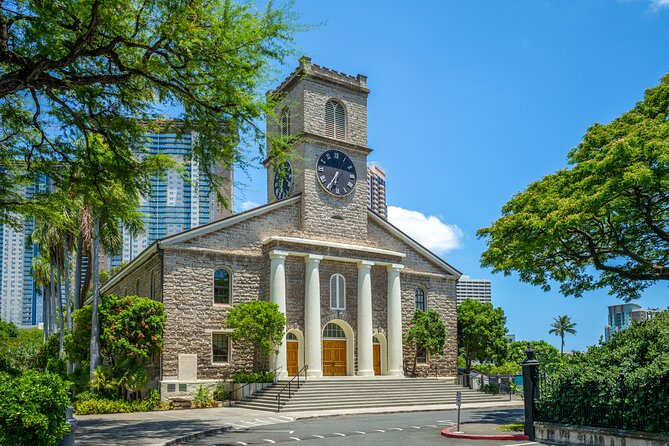
From the statue, the route continues to Kawaiahaʻo Church, once the national church of the Hawaiian Kingdom. The stop shifts the story from royal power to religion, cultural change, and the arrival of missionaries.
The church is a useful place to pause because it adds another layer to the royal district. This is not just a walk past government offices. The narration links buildings to the people and political pressures that shaped Hawaii.
The tour also includes a stop connected with a museum showing objects from Hawaii’s missionary period. The supplied details do not identify the museum by name or include an admission price, so treat this as an audio point rather than a guaranteed museum visit. Any entry ticket or reservation is your responsibility, since the $9.99 price covers the audio tour and route, not attractions.
The distinction is simple but important. You can walk the route without buying attraction tickets, yet you may want to budget extra time and money if you plan to enter buildings along the way.
Aliʻiolani Hale and the changing royal government
Aliʻiolani Hale began as a planned palace for Hawaiian monarchs. King Kamehameha V commissioned it, but King Kalakaua later chose to use it for government offices instead.
That change tells you something about the practical pressures facing the kingdom. A building designed for royal use became part of the machinery of government. The audio uses the site to explain how Hawaiian leadership, public administration, and foreign influence overlapped.
This is one of the places where the tour’s storytelling does more work than a simple plaque. You hear not just what the building is, but why its original purpose changed.
Give yourself time to look up at the building and take in its formal design. The route is not a race. The app lets you pause the audio, stop for a photograph, or take a short break before continuing.
Honolulu Hale and Kalakaua’s welcome home
At Honolulu Hale, the route moves into the political world of King Kalakaua. After his 1881 world tour, Honolulu decorated itself for his return, including a large welcome banner across the harbor.
The celebration did not tell the whole story. Political opponents were already working against the monarchy. The audio introduces the Reform Party and explains how American political interests gained influence after the 1875 Reciprocity Treaty.
This is one of the more useful stops for understanding why Hawaii’s political history cannot be reduced to palace stories and royal portraits. Public celebrations, trade agreements, political parties, and private power struggles all formed part of the story.
Honolulu Hale also gives you a chance to compare ceremonial royal history with the city’s working government. The walk keeps returning to that contrast: monarchy beside modern civic offices, old power beside new political structures.
More Self-Guided Audio Tours in the USA
- Gettysburg Battlefield Self-Guided Driving Audio Tour
★ 4.5 · 910 reviews - Joshua Tree National Park Self-Guided Driving Audio Tour
★ 4.5 · 762 reviews - Ultimate Acadia National Park Self-Guided Driving Audio Tour
★ 4.0 · 521 reviews - Ultimate Lake Tahoe Self-Guided Driving Audio Tour
★ 4.5 · 435 reviews
Patsy Takemoto Mink and a more recent Hawaii

The Patsy Takemoto Mink Statue and Memorial brings the route into modern American history. Mink was a third-generation Japanese American who grew up in Hawaii and later became a representative.
Her inclusion improves the balance of the tour. Without this stop, the walk could feel too focused on nineteenth-century royalty. Mink’s story reminds you that Hawaii’s public life also includes Asian American political leadership and the long reach of local voices into national government.
This is a short stop, listed at about ten minutes, but it adds needed range. You move from monarchs and missionaries to a figure connected with twentieth-century public service.
If you are especially interested in Hawaii’s royal period, this may feel like a side step. I see it as a strength. A good walking route should show how a place changed, not freeze it in one era.
Isamu Noguchi’s Sky Gate
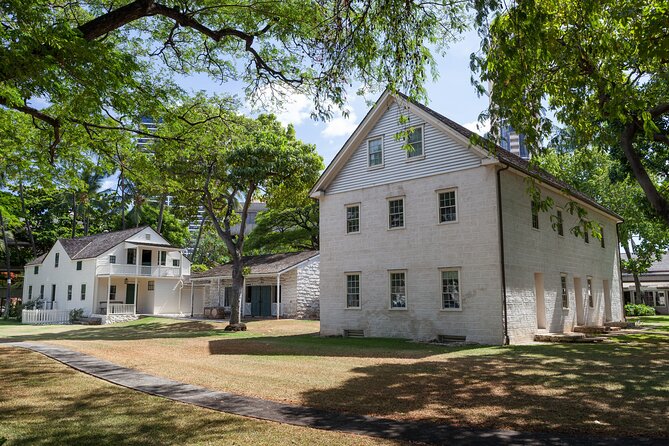
Sky Gate is the tour’s art stop. Isamu Noguchi created the black, curving structure as an evocation of Hawaii’s skies.
You can look at it from several angles and form your own impression. It may suggest tubes, a spider web, or a three-legged creature. The audio encourages that kind of looking rather than giving you one rigid answer.
This stop also changes the pace. After several sites tied to politics and monarchy, public art offers a moment to think about shape, space, and place. You do not need an art background to enjoy it. The question is simply what the form suggests to you.
The stop takes about ten minutes, though the actual time depends on how long you want to look and photograph.
The Hawaii State Capitol and ʻIolani Palace connections
The Hawaii State Capitol follows, with the audio explaining that ʻIolani Palace served as Hawaii’s seat of government before the Capitol was built.
That link is easy to miss if you walk downtown without context. The tour helps you see the Capitol not as an isolated modern building, but as part of a longer move from royal government to state government.
The route soon takes you near Iolani Barracks. Before the coup against Queen Liliʻuokalani, the barracks housed the Queen’s Royal Guard. This is a compact building with a large political story attached to it.
The audio uses the area to explain the role of the Annexation Club and the forces that worked against the Queen. You will get more from the nearby buildings if you listen in order, since the narrative builds from political pressure to the end of the monarchy.
ʻIolani Palace, the route’s great centerpiece
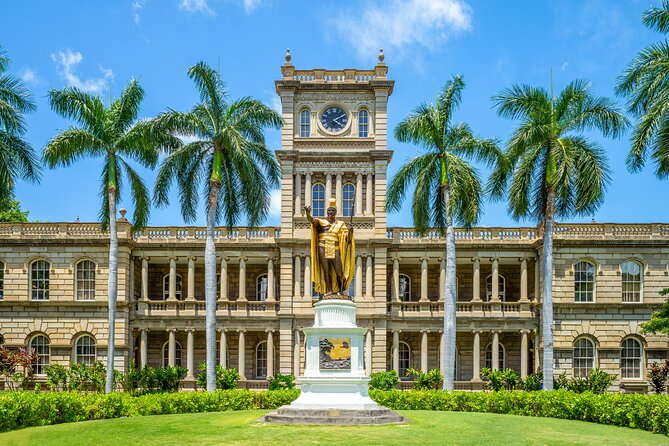
ʻIolani Palace dates to 1879 and is the only royal palace in the United States. Even if you do not enter, seeing it in context gives the walk a clear center.
The palace is not treated as a stand-alone photo opportunity. The audio connects it to the royal guard, the monarchy, government, and the political crisis that followed. That connection makes the building more meaningful than a quick exterior visit.
Admission to the palace is not included. You can complete the walking tour without going inside, but an interior visit may require its own ticket or reservation. Check separately if you want to tour the palace rooms.
This is also a good place to pause the audio and explore at your own speed. The tour provider allows breaks and side trips, so you are not forced to keep walking while a story plays.
The Eternal Flame and the cost of memory
The Eternal Flame Memorial honors the men and women who died in the attack on Pearl Harbor on December 7, 1941. The stop shifts the focus again, this time to wartime memory and national loss.
Because Pearl Harbor is such a major part of Oahu’s identity, this memorial gives the downtown walk a useful connection to the wider island. You are not visiting the Pearl Harbor sites on this tour, but the story places the memorial within the events that changed Hawaii and the United States.
Keep your pace respectful here. This is not simply another landmark on a checklist. The audio is brief, but the subject deserves a quiet moment.
Washington Place and Queen Liliʻuokalani
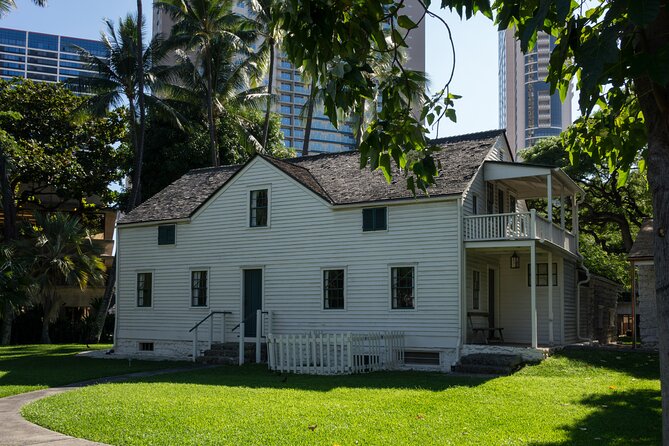
Washington Place is a two-story mansion that became the home of Queen Liliʻuokalani. The building helps bring the final part of the route close to the Queen herself.
The tour explains how Liliʻuokalani withdrew from public life after the political upheavals of the 1890s and lived at Washington Place. Native Hawaiians continued to visit her, and she remained their Queen in their eyes.
This section gives the walk its emotional center. Earlier stops explain political change through buildings and parties. Here, the story narrows to one woman, her people, and the personal cost of losing the throne.
The route ends at the Queen Liliʻuokalani Statue. That is a fitting endpoint because the tour begins with Kamehameha, the ruler who united the islands, and ends with Liliʻuokalani, the last reigning monarch of Hawaii.
How the audio app works in real life
The app is designed for hands-free walking. Once you reach the correct location, the next story should play automatically. You follow the audio cues to the next point, where another story begins.
This worked well for the strongest parts of the experience. Clear directions can remove the usual worry of taking a wrong turn, and the walking stories give you something useful to listen to between landmarks.
The setup deserves careful attention. After booking, you receive instructions and a password by email and text. Search for the words audio tour if the message is hard to locate. Download Action’s Tour Guide app separately, then enter the password.
Do this before you arrive, while you have strong Wi-Fi or cellular service. The tour works offline after the download, but the initial setup needs a reliable connection. You also need a compatible device, such as an iPhone running iOS 15 or later, an Android device running version 9 or later, or an iPad or tablet with GPS and cellular connectivity.
Bring earbuds or headphones. They make the automatic audio easier to hear and let you keep your eyes on the streets. Couples can share one tour by splitting headphones, although separate devices are more comfortable and require a password for each booked traveler.
The main weakness is the lack of hands-on help at the starting point. If the app, password, or map confuses you, the walk can stall before it begins. Contact support if the audio fails, but do not wait until you are already hot, rushed, and standing at the first stop.
Timing, heat, and the one-to-two-hour pace
The advertised walking time is about one to two hours. That estimate covers the route and audio, not a long palace visit, extended museum time, or repeated photo stops.
Morning is the best choice. A previous afternoon walk found the heat intense enough to duck into buildings, which is sensible advice for Honolulu. The route is only 1.6 miles, but heat, sun, and frequent stops affect your pace more than the distance suggests.
The listed operating hours are 9:00 a.m. to 6:00 p.m., Monday through Sunday, for the stated availability period. Even with a flexible app, start within those hours so the route fits the intended schedule.
You can pause anywhere, take a snack break, skip a story, or return to the tour later. Lifetime access with no expiry is unusual at this price. You can use it on another trip or replay favorite stories without paying again.
What $9.99 buys you
At $9.99 per person, the value is strongest if you want historical context but do not need a live guide. You get narration, automatic location-based stories, offline maps, bonus material, and the freedom to move at your own pace.
A live walking tour may offer easier setup and the chance to ask questions. This audio option costs less and gives you privacy, but you must manage the app yourself. The price is especially fair for couples who share headphones, though comfort and hearing clarity may suffer.
The admission-free stops also help keep the day affordable. Still, do not confuse free outdoor access with free entry to every attraction. Palace, museum, and other admission costs are separate, and no attraction pass or reservation is included.
Who should book this Honolulu walk?
I would recommend it to independent visitors who like history, want a short downtown route, and are comfortable using a smartphone. It suits families with older children, couples, solo walkers, and anyone with a limited schedule.
It is also useful before a palace visit. The audio gives you names, political context, and a sequence of events that can make the buildings easier to understand.
I would be cautious if you dislike phone-based tours or want a person to answer questions as you walk. The weak experience described by the setup problems comes from exactly that issue. Downloading the app and entering the password must be part of your plan.
Free cancellation is available when you cancel at least 24 hours before the local start time. Changes or cancellations inside that window are not refundable.
Should you book the Downtown Honolulu audio tour?
Book it if you want an inexpensive, flexible introduction to downtown Honolulu and its royal past. The best parts are the precise directions, lively storytelling, and route design, which links Kamehameha, Kawaiahaʻo Church, Aliʻiolani Hale, ʻIolani Palace, and Queen Liliʻuokalani in a logical arc.
Skip it if app setup sounds like a chore or if you prefer a live guide. For everyone else, download the tour before leaving Wi-Fi, start in the morning, bring headphones, and allow extra time for the palace or museum if you plan to enter. At $9.99, it is a sensible way to put the city’s buildings into human and political context.
FAQ
How long is the Downtown Honolulu audio tour?
The route is about 1.6 miles and usually takes one to two hours, depending on walking speed, photos, breaks, and side visits.
Where does the tour begin?
It begins at Aloha Tower Marketplace, 1 Aloha Tower Drive, Honolulu, Hawaii 96813.
Where does the tour end?
The tour ends at the Queen Liliʻuokalani Statue, listed at 21024001, Honolulu, Hawaii 96813.
Is a guide present at the starting point?
No. This is a self-guided activity, and no one meets you at the start.
What language is the tour offered in?
The tour is offered in English.
Does the tour include attraction admission?
No. Attraction passes, entry tickets, and reservations are not included.
Does the audio tour work without internet?
Yes. You must download the tour while connected to strong Wi-Fi or cellular service. It works offline after downloading.
Does access expire?
No. The tour provides lifetime access with no expiry, and you can use it on multiple trips or replay it as often as you like.
What happens if I need to cancel?
You can receive a full refund if you cancel at least 24 hours before the local start time. Cancellations or changes made within 24 hours are not refunded.
Just added around the USA
- Big Bend National Park Self Guided Audio Tour Guide★ 5.0 · 12 reviews
- Self-Guided Audio Driving Tour in Catskills Scenic Byway★ 4.5 · 7 reviews
- Shiloh Battlefield Self-Guided Driving Audio Tour★ 4.0 · 9 reviews
- Black Canyon of the Gunnison NP Self-Guided Driving Audio Tour★ 3.5 · 7 reviews
- Tampa Riverwalk Private Smartphone Audio Walking Tour★ 5.0 · 2 reviews
- A Highway 49 Drive: A Self-Guided Audio Tour from Angels Camp to Jamestown★ 4.0 · 8 reviews
- Saint Louis Self Guided Driving and Walking Audio Tour★ 4.5 · 6 reviews
- Downtown St. Louis Smartphone Guided Audio Walking Tour App★ 5.0 · 2 reviews
Self-Guided Tours, compared.

Acropolis Ticket & Optional Self-Guided Audio Tours
Read our review →


Ultimate Acadia National Park Self-Guided Driving Audio Tour
Read our review →

Santorini: Akrotiri Ticket with Optional Self-Guided Audios
Read our review →
Browse the lists this tour appears in