
REVIEW · USA AUDIO TOURS
Badlands National Park Self-Guided Audio Tour
Big scenery, big history, one small app. This self-guided drive links Badlands overlooks, short walks, fossil sites, Lakota history, and Cold War landmarks into an 11 to 12 hour route. I especially like the GPS-triggered narration and the fact that one $12.79 purchase covers a vehicle of up to 15 people.
I also like the freedom to skip stops, pause the tour, and return to it later. The main concern is technical reliability. One user had trouble redeeming the code and lost the audio repeatedly, so downloading everything on strong Wi-Fi before leaving is essential.
Key points to know before you go
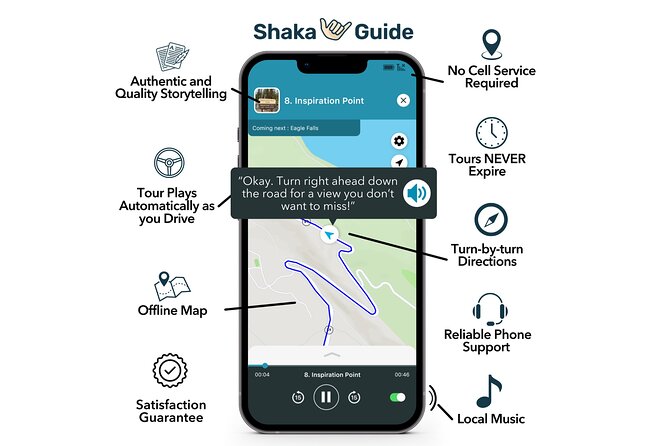
- One low price for the whole car: The $12.79 fee covers up to 15 people, making this a strong value for families and groups.
- A full-day route: Plan on 11 to 12 hours if you follow the route closely and include several walks.
- Excellent mix of subjects: The tour covers eroded rock formations, fossils, Lakota culture, homesteading, nuclear history, and prairie wildlife.
- GPS narration keeps you moving: Stories, music, and directions play automatically as you drive.
- Several hikes require judgment: The Window and Fossil Exhibit trails are easy, but the Notch Trail has a ladder and heights. Sage Creek routes are for experienced hikers.
- Prepare the app before departure: Use Wi-Fi to redeem the code, download the tour, and test the audio before reaching the park.
What this $12.79 tour really gives you
This is not a private vehicle with a human guide. It is a phone-based audio route from Shaka Guide Apps. You drive your own car, and the app uses GPS to trigger narration, directions, stories, music, and suggestions as you move.
That setup works well in Badlands National Park. The park is spread out, cell service may not be dependable, and the best stops are scattered along long stretches of road. An offline map and automatic narration mean you can keep your eyes on the road instead of trying to read directions.
The price is unusually good for a group. At $12.79 per vehicle, a family of four pays far less per person than it would for four separate tickets. A group of 10 or 15 gets especially strong value. You still pay for certain admissions, meals, and your own transportation, but the basic tour fee is modest.
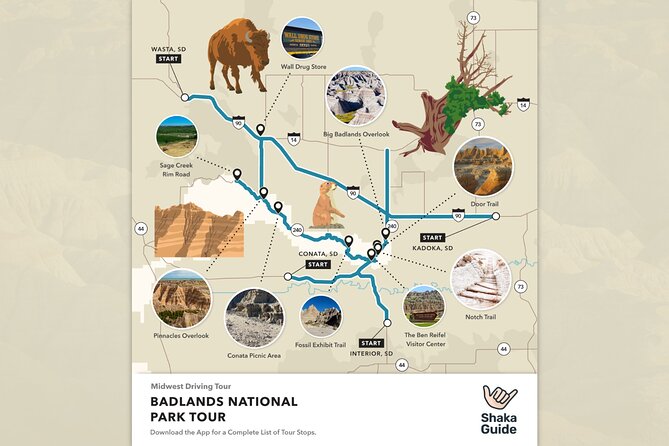
The app is also flexible. You can start in Wasta, Kadoka, Conata, or Interior, then pause or resume the tour on your own schedule. The tour does not expire, so you are not forced to finish every stop in one day. That matters because the full route is ambitious.
More Self-Guided Audio Tours in the USA
- Gettysburg Battlefield Self-Guided Driving Audio Tour
★ 4.5 · 910 reviews - Joshua Tree National Park Self-Guided Driving Audio Tour
★ 4.5 · 762 reviews - Ultimate Acadia National Park Self-Guided Driving Audio Tour
★ 4.0 · 521 reviews
Starting at Minuteman Missile National Historic Site
The route begins around Wasta, with a sharp change of mood from prairie road trip to Cold War history. At Minuteman Missile National Historic Site, you can see how the United States prepared for nuclear conflict during the Cold War.
A half-hour stop at the Delta-09 missile silo gives you a close look at a real Minuteman II missile. The site is quiet and plain, which makes the subject feel even more serious. This is not a flashy museum visit. It is a reminder that a nuclear weapon once sat ready beneath the South Dakota soil.
The Launch Control Facility adds the human side of the story. An underground bunker once held crews who could have fired missiles on command. Preserved consoles and equipment help you picture the responsibility placed on those crews.
The tour also points you toward the Delta-01 Launch Control Facility, where admission is separate. The listed price is $12 for adults and $8 for children. Check the facility details before building your day around it, since this fee is not included in the audio tour.
Lakota culture and homestead life near Pine Ridge
The Oglala Lakota Living History Village gives the route a cultural focus that the park itself cannot provide. Recreated tipis and log cabins show how Oglala people adapted their homes on the Pine Ridge Reservation.
You can see demonstrations of hide tanning and beadwork, and local Lakota guides share cultural and historical information. Allow about an hour here. This is one of the stops where slowing down matters. The point is not simply to photograph old buildings, but to better understand how people lived and adapted.
The next stop, Prairie Homestead Historic Site, shifts to settler history. A sod house built in 1909 by Ed and Alice Brown shows how difficult life could be on the open prairie. The dugout dwelling and outbuildings are modest, but that is exactly what makes the site useful.
You can see farm animals, including rare white prairie dogs, and try on period clothing. Admission is not included, so carry some extra money for this stop. Together, the Lakota village and homestead site offer two very different views of life in the same broad region.
First Badlands views at Big Badlands Overlook
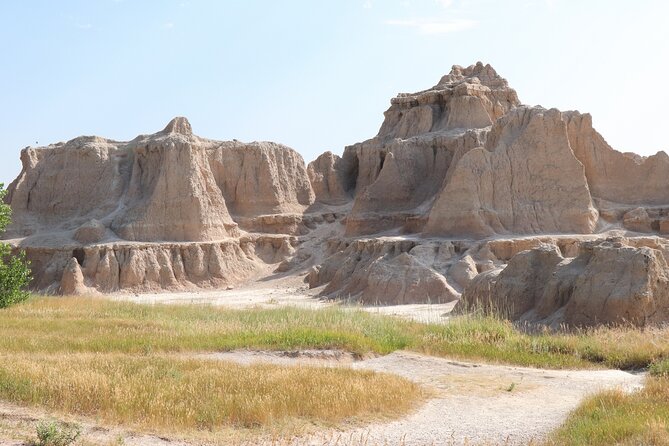
Big Badlands Overlook is a good first introduction to the park. A short, accessible trail leads to a platform with a broad view of the Wall, the eastern edge of the Badlands.
The reddish layers come from the Brule Formation, and wind and water have carved the rock into ridges, gullies, and sharp shapes. You do not need a long hike to understand why the park is famous. Give yourself about 30 minutes for photos and a first look.
The audio narration is most useful here because it can explain what you are seeing while you drive between stops. You get both the visual drama and the basic geology without having to read every sign.
More National Park Audio Tours in the USA:
- Arches National Park Self-Guided Driving Audio Tour
★ 4.5 · 288 reviews - Yellowstone National Park Self-Guided Driving Audio Tour
★ 4.5 · 249 reviews - Self-Guided GPS Audio E-Bike Tour Hawaii Volcanoes National Park
★ 4.5 · 131 reviews - Shenandoah National Park Self-Guided Driving Audio Tour
★ 4.5 · 109 reviews
The Door, the Window, and the Notch
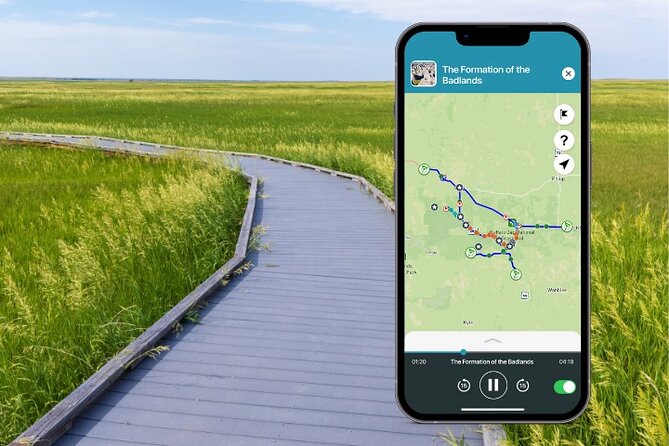
Three of the park’s best-known trails offer very different levels of effort.
The Door Trail begins with a wheelchair-accessible quarter-mile boardwalk. It passes through a natural opening in the rock called The Door, then reaches a view into the rougher Badlands terrain. Beyond the boardwalk, an unmarked route continues for hikers who want uneven ground and a closer look at spires and canyons.
The Window Trail is shorter and easier. Its quarter-mile boardwalk leads to a natural opening in the Wall, framing eroded canyons and layered rock. This is a good choice for families and for anyone who wants a strong view without a strenuous walk.
The Notch Trail is the most adventurous of the three. The 1.5-mile round trip crosses a canyon and uses a wooden ladder before reaching a view over the White River Valley. Uneven ground, heights, and the ladder make it a poor fit for anyone uncomfortable with exposed sections.
The listed stop time is about 30 minutes, but that is tight for the Notch Trail if you want to hike at a relaxed pace. Treat the time as a rough guide, not a promise. You should also allow extra time if the trail is busy or if you want to take photographs.
Fossils and the visitor center
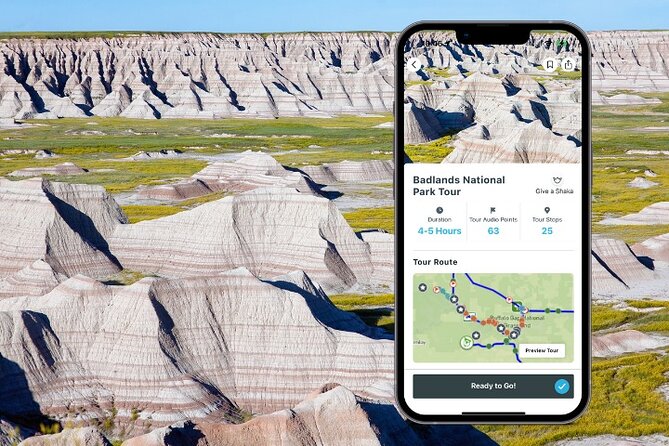
The Ben Reifel Visitor Center is the park’s main place to get oriented. Exhibits cover geology, fossils, and cultural history. You can watch a park film, ask rangers for planning help, use the restrooms, and browse the bookstore.
The fossil preparation lab is a nice bonus. At times, a scientist may be working there, giving you a look at how fossils are prepared for study. The center is fully accessible and makes a sensible break in the middle of a long day.
The Fossil Exhibit Trail adds a short, accessible walk with display panels and replicas of ancient animals. It does not show fossils still in the rock, but it explains the creatures found in the area, including saber-toothed cats and giant mammals.
For families, this may be one of the most useful stops. Children get a clear introduction to prehistoric life, while adults can connect the fossils to the colored rock layers around them.
Overlooks with history behind the scenery
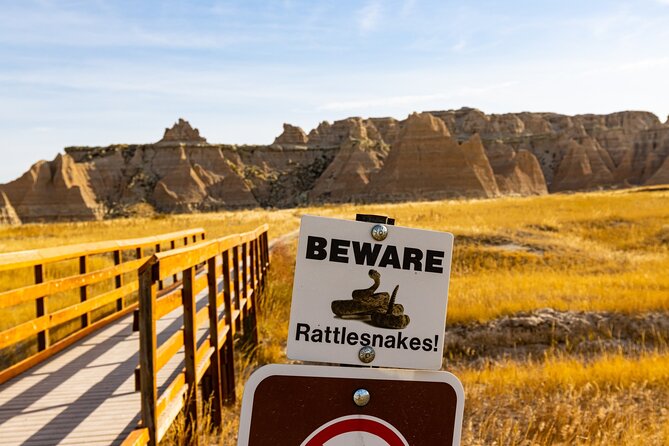
Badlands National Park has many overlooks, and each offers a slightly different view. Bigfoot Pass Overlook adds human history to the route. The site commemorates Chief Spotted Elk, also known as Bigfoot, and his Lakota band, who used this route while fleeing United States troops in 1890.
Panorama Point gives you a broad view of eroded spires, canyons, and the White River Valley. It is an easy stop for anyone who wants a sweeping photograph without a hike.
Prairie Wind Overlook offers a quieter change. A short boardwalk reaches a platform over mixed-grass prairie, an important habitat for wildlife. This stop helps you see that the park is not only about rock formations. The open grasslands are just as important to its character.
Burns Basin Overlook shows the wider prairie setting. The view reaches toward Buffalo Gap National Grassland, with an old homestead below connected to sheepherder Wilson Burns. You might spot bison, birds of prey, or other wildlife, but sightings are never guaranteed. Rattlesnakes are also possible, so stay alert and follow normal trail caution.
Homestead Overlook combines the harsh rock formations with broad green prairie. It offers a useful reminder that people tried to farm and live in a difficult setting.
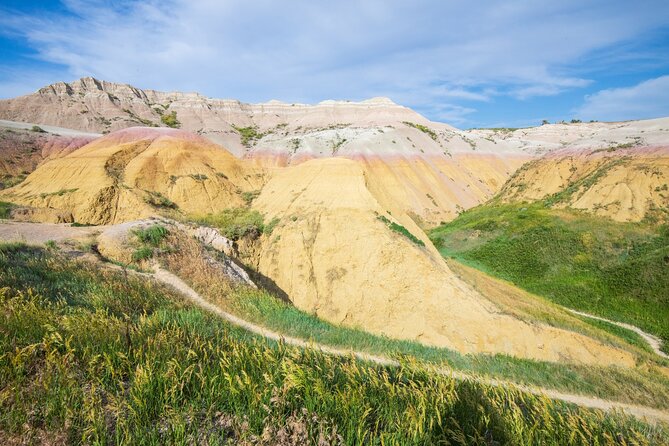
Yellow Mounds Overlook is one of the park’s more unusual stops. Yellow, orange, and beige layers replace the familiar red tones. Signs explain how ancient seas and decaying plants helped create these colors. If you think you have already seen the Badlands at Big Badlands Overlook, Yellow Mounds gives you a fresh view.
Conata Picnic Area and the tougher backcountry routes
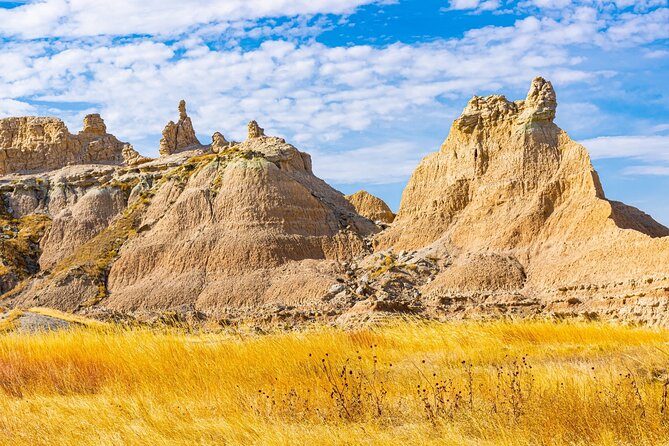
Conata Picnic Area provides a practical break near the wilderness area. Covered tables and vault toilets are available, but there is no potable water. Bring your own drinking water and food.
The nearby Deer Haven trailhead can extend your visit, but the route information also describes far more demanding options. The Sage Creek Loop is an unmarked trek of more than 20 miles with uneven ground, possible mud, limited water, and climbs through juniper areas. It is intended for experienced backpackers with navigation skills and proper supplies.
Another unmaintained route from Conata follows game trails for about three miles through rolling prairie and grassland. It is not marked, and there is no designated campsite. I would not treat either route as a casual add-on to a sightseeing day.
This is an important strength of the audio tour: it mentions options beyond the standard overlooks. But you must judge your own ability. The route description does not turn an unmarked wilderness path into an easy trail.
Cliff Shelf, Ancient Hunters, and the western views
Cliff Shelf Nature Trail takes about an hour and covers a half-mile loop. Boardwalks, stairs, and a viewing platform lead through a small juniper forest and out to broad views. The trees make this walk feel different from the open rock formations elsewhere in the park.
Ancient Hunters Overlook connects scenery with archaeology and paleontology. Displays explain evidence linked to ancient bison hunters and a dense fossil bed. The area is somewhat greener because of a geologic slump, with more trees than you might expect in the Badlands.
Pinnacles Overlook is the highest point in the park. From here, the rock formations stretch toward the distant Black Hills. Bighorn sheep may be visible on the slopes, adding a wildlife possibility to an already strong viewpoint.
Sage Creek Road then offers a different kind of drive. This unpaved route runs for about 12 miles and passes several overlooks. The scenery is less about tall spires and more about rolling ground and open prairie. Bison, pronghorn, bighorn sheep, and prairie dogs are all possible sightings.
Check road conditions before using the unpaved route, and allow extra time for slow driving and wildlife stops. The road is part of the experience, not just a shortcut.
Wall Drug and the final roadside stop
Wall Drug Store is a fitting end to a South Dakota road day. It is a large Western-themed stop with souvenirs, snacks, a pharmacy, restaurants, and the famous promise of free ice water. The giant brontosaurus is an easy photo opportunity.
Wall Drug is kitschy, but that is the point. After a day of geology, memorial sites, and hiking, it offers a light, playful finish. You can eat here, browse for gifts, or simply take a break before returning to the meeting point.
App performance, timing, and practical preparation
The biggest risk is not the scenery. It is the technology. One user had a redeem code fail, then lost the audio soon after getting the tour started. Repeated downloads and several contacts with customer support did not solve the problem quickly, and the person eventually had to retrace the route.
That experience is unusual compared with the strong praise for the narration, music, and directions, but it is serious enough to plan around. Before leaving Wi-Fi, redeem the code, download the route, open the app, and test the first audio segment.
The tour is designed to play hands-free through GPS. Keep the phone mounted safely and avoid handling it while driving. Reliable support is available by phone, chat, or email, but park time is too valuable to spend troubleshooting.
The start and end point is listed in Wasta, though you can also begin in Kadoka, Conata, or Interior. The activity ends back at the meeting point. Since the tour is available daily from midnight to 11:30 p.m., you have broad timing freedom, but park facilities and paid attractions may follow their own hours.
Who should book this Badlands tour?
I would choose this tour for a self-driving couple, family, or group that wants context without paying for a private guide. It is especially useful if you like mixing short walks with scenic stops and want help understanding what you are seeing.
It also suits repeat visitors who want to use the route over more than one day. Since the tour does not expire, you can split the main road, the hikes, and the Sage Creek area into separate outings.
I would be cautious if you want a simple two-hour scenic drive. This route includes enough stops and side trips to fill most of a day. I would also avoid relying on it without preparation if your phone or app use tends to be troublesome.
Should you book it?
Book it if you want an inexpensive, flexible audio companion for a full Badlands day. The narration, music, automatic directions, offline map, and wide range of stops give you much more than a list of viewpoints.
The best value comes when several people share one car and when you use the historical stops as well as the overlooks. Download the tour before you go, carry water and food, budget separately for paid sites, and do not underestimate the Notch or backcountry routes.
With those precautions, this is a practical way to connect the Badlands’ rocks, prairie, fossils, Lakota culture, homesteading past, and Cold War story.
FAQ
How much does the Badlands self-guided audio tour cost?
The tour costs $12.79 per group, with up to 15 people included in one vehicle.
How long does the tour take?
The full route takes approximately 11 to 12 hours, depending on how many stops and hikes you include.
Where can I start the tour?
The main starting point is Wasta, South Dakota. Optional starting points include Kadoka, Conata, and Interior.
Does the tour work without cell service?
Yes. You should download the tour and offline map using strong Wi-Fi before starting. The audio and directions use GPS.
Are park entrance fees included?
No. Entrance fees, parking fees, meals, and refreshments are not included. The Delta-01 Launch Control Facility costs $12 for adults and $8 for children.
Is the tour accessible for people with limited mobility?
Several stops include accessible features. The Door and Window trails have accessible quarter-mile boardwalks, and the Ben Reifel Visitor Center is fully accessible. The Notch Trail and unmarked backcountry routes are more difficult.
Can I cancel for a refund?
You can receive a full refund if you cancel at least 24 hours before the experience start time. Cancellations or changes made within 24 hours are not refunded.
Just added around the USA
- Big Bend National Park Self Guided Audio Tour Guide★ 5.0 · 12 reviews
- Self-Guided Audio Driving Tour in Catskills Scenic Byway★ 4.5 · 7 reviews
- Shiloh Battlefield Self-Guided Driving Audio Tour★ 4.0 · 9 reviews
- Black Canyon of the Gunnison NP Self-Guided Driving Audio Tour★ 3.5 · 7 reviews
- Tampa Riverwalk Private Smartphone Audio Walking Tour★ 5.0 · 2 reviews
- A Highway 49 Drive: A Self-Guided Audio Tour from Angels Camp to Jamestown★ 4.0 · 8 reviews
- Saint Louis Self Guided Driving and Walking Audio Tour★ 4.5 · 6 reviews
- Downtown St. Louis Smartphone Guided Audio Walking Tour App★ 5.0 · 2 reviews
National Parks, compared.

Ultimate Acadia National Park Self-Guided Driving Audio Tour
Read our review →
Vesuvius National Park Skip-The-Line Ticket and Audio Guide
Read our review →
Self-Guided GPS Audio E-Bike Tour Hawaii Volcanoes National Park
Read our review →
Browse the lists this tour appears in