

REVIEW · ATHENS AUDIO TOURS
Acropolis Hill & Acropolis Museum E-Tickets with 3 Audio Guides
Ancient Athens rewards a slow look. This package pairs pre-booked Acropolis entry with admission to the Acropolis Museum, so you can visit two essential sights without arranging separate tickets. I like the freedom to explore without a group and the offline map, which is useful when phone signal fades on the hill. The main catch is that the audio system requires careful preparation, and the $96.11 price is high if the app or ticket delivery goes wrong.
The experience lasts about four hours, with roughly two hours for the Acropolis and two for the museum. I also like that you choose an entry time for the Acropolis, then visit the museum at your own pace. But do not assume this means a live skip-the-line tour: you still may face a long entrance queue, and the museum has no timed slot.
Key points before you book

- Download everything on Wi-Fi: Tickets and audio content may arrive only 24 hours before your visit, so prepare before reaching Athens.
- Choose your Acropolis time carefully: The selected time applies to the hill, not the museum, and changing it can be difficult.
- Use headphones: Crowd noise can drown out the narration, especially around the Parthenon.
- Expect real uphill walking: You will cross stairs, sloping paths, slippery marble, pebbles, and uneven ground.
- The audio is flexible but not foolproof: Some directions can be hard to follow, and the app has not worked reliably on every phone.
- The best value is independence: This suits you if you want historical context without joining a group or following a guide’s pace.
What this Acropolis package actually gives you
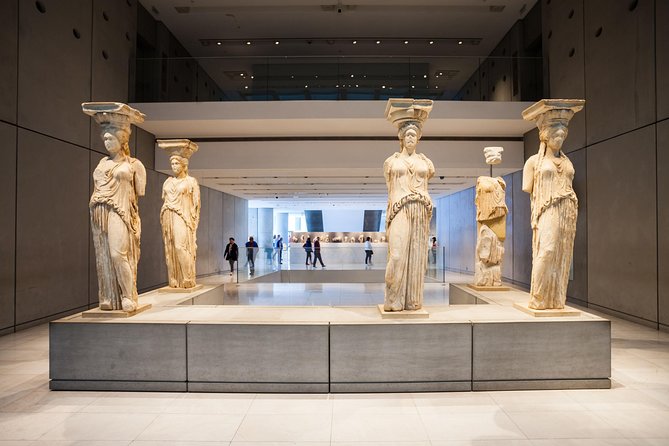
At $96.11 per person, this is not simply an entrance ticket. It combines adult admission to the Acropolis of Athens and the Acropolis Museum with three self-guided audio tours for Android and iOS phones, plus offline material and an interactive map.
The package is offered in English. There is no live guide, no headset pickup, and no guide waiting at the meeting point. You bring your own smartphone and headphones, then follow the route on your own.
That independence is the central appeal. You can pause the commentary for photographs, skip a section that does not interest you, or listen again later. You are not tied to a group that stops every few minutes while half the people look at their phones.
The tradeoff is simple: you become your own tour manager. You must download the app, retrieve the tickets, charge your phone, understand the route, and deal with any technical problem yourself. If that sounds like too much work, a live guide may feel easier.
The stated meeting point is at Dionysiou Areopagitou 43, near the Acropolis approach. The experience ends at the Acropolis Museum at Dionysiou Areopagitou 15. From Acropolis Metro Station on Line 2, walk toward Dionysiou Areopagitou Street. The Theatre of Dionysus will be on your right as you approach the hill.
More Museum Audio Tours in Athens
- Athens: Acropolis Museum Ticket with optional Audio Guide
★ 4.4 · 2,652 reviews - Athens: Acropolis Museum Ticket with Audio Guide
★ 4.1 · 835 reviews - Athens: National Archaeological Museum Ticket w/ Opt. Audio
★ 4.4 · 713 reviews
Reaching the Acropolis at your selected time
Your visit begins at the Acropolis, and this is the part that needs the most attention. Your chosen time slot applies to the hill, so arriving late can create a serious problem. One booking had a requested time that did not match the final ticket, resulting in a 45-minute wait. Check the actual time printed on your ticket, not just the time shown in an email conversation.
Tickets are sent by email 24 hours before the visit. That timing may be convenient for the operator, but it is not ideal for you if you are planning ahead or have limited internet access. Save the ticket to your phone as soon as it arrives. Check your spam folder too.
At the archaeological site, use the validating machines and show your e-ticket. The ticket may help you avoid the ticket-buying line, but it does not promise instant entry through every queue. One important point is easy to miss: the expedited service at the Acropolis does not necessarily let you bypass the main entrance line. At busy times, you may still wait before entering.
For a smoother visit, arrive early and avoid carrying a large bag. The site can become especially busy after cruise ships arrive. You will also have a better chance of hearing the audio before the crowd noise builds.
Walking through the Propylaea
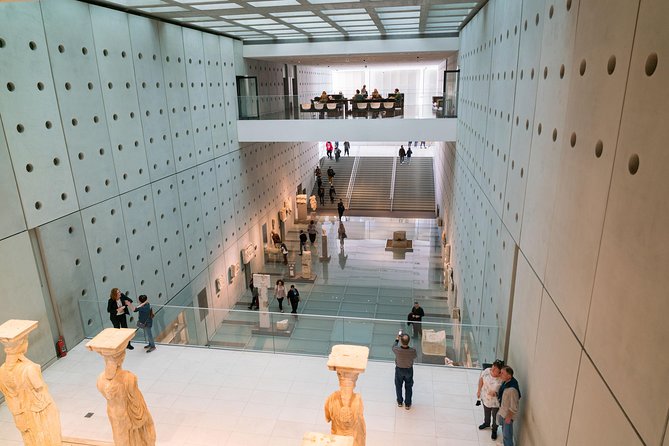
The Propylaea is your grand first encounter with the Acropolis. This monumental entranceway was designed to make arrival feel important, and the audio commentary uses it to introduce the political and cultural world of classical Athens.
The narration brings in figures such as Socrates, helping you connect the stones underfoot with the people and ideas associated with the city. That is useful because the first approach can feel like a jumble of marble, scaffolding, steps, and visitors unless you know what to look for.
I like the way the audio gives you a story to follow rather than only listing dates. You can pause near the entrance and look back toward the city, then continue upward when you are ready.
Still, the route directions are not always perfectly clear. If the narration runs for several minutes, you may reach the next feature before the audio tells you what to notice. I suggest pausing when you move between monuments and checking the offline map rather than walking while staring at your screen.
The surface is uneven. You should be comfortable with uphill walking, stairs, loose pebbles, and smooth marble that can become slippery. The Acropolis is not an easy-access site, and the climb can be demanding in hot weather.
Seeing the Parthenon with context
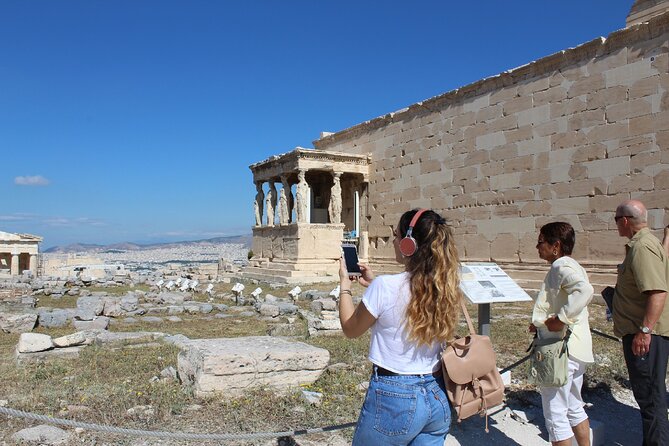
The Parthenon is the main reason most people come to the hill, but its familiar outline can hide the cleverness of the building. The audio explains how the temple reflects the ideals of classical Athens and discusses the optical adjustments built into its design.
These visual tricks matter. The temple was not made from perfectly straight lines in the simple way you might expect. The commentary encourages you to look at the structure as an engineered object, not just a famous ruin.
You cannot enter the interior of the Parthenon. The visit takes place around the outside, where you view the columns, sculpture fragments, and changing city views. That can disappoint anyone expecting to walk inside the temple, so set your expectations before climbing.
The audio is strongest when you stop, look, and then listen. If you walk quickly, the commentary may feel slow or you may lose track of which feature it describes. Some people prefer to listen to the material before or after the visit, then explore the hill quietly. The app allows repeated listening, which makes that approach practical.
Bring headphones rather than relying on your phone speaker. The hill is exposed, and crowd noise can swallow soft narration. Your phone also needs a full charge, since you are using tickets, maps, and audio from the same device.
More Museum Audio Tours in Greece
- Athens: Acropolis & Acropolis Museum Ticket with Audio Guide
★ 4.1 · 556 reviews - Athens National Archaeological Museum E-Ticket with Audio Guide
★ 3.0 · 57 reviews - Acropolis Museum E-Ticket and Multilingual Audio Guide
★ 4.0 · 42 reviews - Athens: Acropolis Museum Ticket with Self-Guided Audio tour App
★ 3.5 · 40 reviews
Allowing two hours for the Acropolis Museum
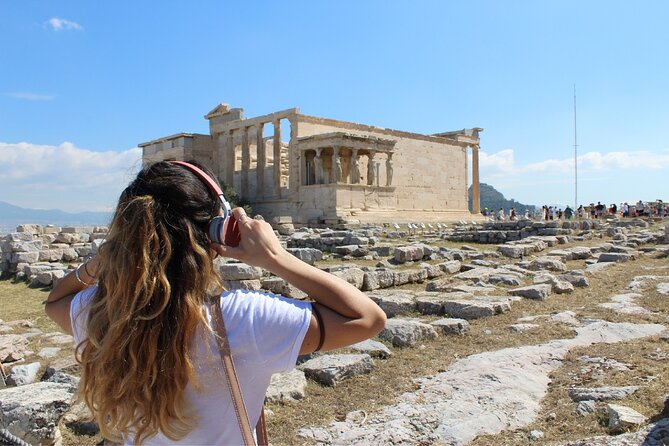
After the hill, continue to the Acropolis Museum at Dionysiou Areopagitou 15. The museum has no time slot in this package, so you can enter during its operating hours and set your own pace.
The museum is a useful counterpart to the hill because it gives you a closer look at sculpture and architectural pieces that are difficult to study outdoors. The building is modern, spacious, and organized around the story of the Acropolis.
The Archaic Acropolis Gallery focuses on the period before and around the development of democracy. You will see representations of gods, heroes, monsters, and the human body, with the audio tracing changes in artistic style.
This section works best if you do not rush. The objects show how Greek artists moved from more rigid forms toward increasingly natural treatments of the body. The commentary gives the exhibits a narrative thread, which is helpful when the gallery begins to feel like a long sequence of statues.
Museum signage can be limited in places, so the audio is valuable here, provided it works properly. If you prefer reading labels, give yourself extra time to find your way through the displays.
The Parthenon Gallery and the Panathenaic procession

On the upper floor, the Parthenon Gallery presents the temple sculpture in a way that lets you think back to the building you just visited. The frieze relates to the Panathenaic Procession, a major civic and religious celebration in ancient Athens.
The audio also explains scenes from Greek mythology shown on the metopes and pediments. The birth of Athena and the battle between the Centaurs and Lapiths are among the stories brought into the discussion.
This is where the two-part visit becomes worthwhile. On the hill, you see the Parthenon as architecture and setting. In the museum, you can study the carved figures and understand how the decoration carried meaning.
Plan on about two hours for the museum if you want to use the audio and pause at the main displays. You can certainly move faster, but that would make the $96.11 package harder to justify.
The audio guides: useful content with technical limits

The audio tours are the most unpredictable part of the experience. When they work, they add welcome context without forcing you to follow a stranger holding a flag. The commentary covers the monuments in detail, and several people have found it informative enough to listen to again later.
The system is not as simple as opening a standard audio file. You need to download the app and audio tours before your visit, using a compatible Android or iOS device. Windows Phones are not supported, nor are older devices such as the iPhone 5, iPhone 5C, older iPod Touch models, the iPad 4 or older, and the first-generation iPad Mini.
The app has worked on some phones but failed to download or play properly on others, including both Android and iPhone devices. That is why I would not wait until you are standing at the Acropolis to solve the problem. Mobile signal can be weak, and there is no promise of Wi-Fi at the site.
Use Wi-Fi to download the tickets and audio content before leaving your accommodation. Open the app once, confirm that the tours are available offline, and test the sound. Keep the booking email and ticket stored on your phone as well.
The narration can sometimes be too long for the physical route. You may hear a detailed explanation while already standing near the next exhibit. If the directions feel confusing, pause the tour, look at the map, and match the audio to the monument rather than following the narration blindly.
Is the $96.11 price good value?

The price is reasonable only if you value convenience, included admission, and independence. You are paying for two major entrances, advance ticket handling, offline navigation, and audio content. For someone who wants background information but dislikes group tours, that combination can work well.
The value drops if you are eligible for reduced or free admission. The rules are complicated. EU citizens aged 0 to 25 can receive free admission to the Acropolis, though they must wait in line with identification. Certain young people from outside the EU, seniors from Greece or EU and European Economic Area countries, and children may qualify for reduced or free entry under specific conditions and dates.
At the museum, eligible people may need to wait in line to show an identification card or passport. This package is aimed at adult admission, so check your eligibility before paying the full amount.
There is also a non-refundable policy, and changes are not allowed. That makes the correct date, time, phone compatibility, and ticket details especially important. If your plans are uncertain, this is not a flexible purchase.
Who should book this experience?
I would choose it if you want to see the Acropolis and museum in one half-day, prefer setting your own pace, and are comfortable managing an app. It is especially useful for couples or families who do not all want to stop at every monument for the same length of time.
It also suits you if a live guide sounds too rigid or expensive. You can walk quietly, use the commentary when you want it, and return to sections that interest you.
I would hesitate if you need guaranteed technical simplicity, have a weak phone, dislike downloading apps, or require a fully accessible route. The Acropolis includes steep and uneven sections, and the audio has had enough technical and navigation issues that you should have a backup plan.
For many visitors, the simplest backup is to save the ticket offline and use the museum and site signage if the audio fails. You can still visit the monuments without the app, but part of what you paid for would go unused.
Should you book the Acropolis and Museum audio package?
Book it if the freedom of a self-guided visit matters more to you than having a person lead the way. The strongest parts are the combined admission, the useful historical commentary, and the chance to revisit the audio after your walk.
Do not book it expecting a private guide or a guaranteed way past every entrance queue. Confirm the printed entry time, download everything on Wi-Fi, carry headphones, and allow more than four hours if you like to stop often.
My final call: this is a good fit for a prepared, independent visitor with a compatible phone. It is a poor fit for anyone who wants a foolproof ticket, hands-off service, or a fully guided explanation from start to finish.
FAQ
How long does the experience take?
The visit is approximately four hours, with about two hours planned for the Acropolis and two hours for the Acropolis Museum.
Does the package include a live guide?
No. This is a self-guided experience with smartphone audio tours. No live guide accompanies you, and no AR or VR content is included.
When do I need to visit the Acropolis?
You choose a time slot for entry to the Acropolis Hill. The time slot does not apply to the Acropolis Museum, which can be visited during its operating hours.
When will I receive the tickets?
The tickets are sent to your email 24 hours before your visit. Check your spam folder if you do not see the message.
Do I need internet access at the Acropolis?
You should download the tickets, app, audio tours, and offline map on Wi-Fi before your visit. Mobile signal may be weak at the archaeological site.
What should I bring?
Bring a fully charged compatible smartphone and headphones. Avoid carrying large bags, and wear footwear suitable for hills, stairs, slippery marble, and uneven ground.
Just added around Athens
- Temple of Olympian Zeus: Self-Guided Audio Tour on your Phone (without ticket)★ 4.0 · 8 reviews
- Athens Ticket Pass: Acropolis & 6 Sites with 5 Audio Guides★ 3.5 · 84 reviews
- Ancient Agora of Athens: A Self-Guided Audio Tour★ 3.5 · 3 reviews
- Self Guided Tour In Athens With 100 Captivating Audio Stories★ 4.0 · 4 reviews
- Athens Hop-On Hop Off w/ Acropolis & Acr.Museum tickets & 3 audio★ 3.0 · 5 reviews
- E-ticket for Kerameikos with Audio Tour on Your Phone★ 5.0 · 4 reviews
- Athens Acropolis Museum Reserved Entry Ticket and Audio Tour★ 3.0 · 2 reviews
- Audioguided tour of Athens’ alternative neighbourhood of Exarchia★ 5.0 · 2 reviews
Museums, compared.

Uffizi Priority Ticket & Masterpieces Audio App
Read our review →
Louvre Museum Hosted Entry and Mona Lisa Audioguide
Read our review →
St. Mark Basilica Ticket, Audioguide+History Gallery
Read our review →
Borghese Gallery Skip-the-Line Ticket & Audioguide
Read our review →
Borghese Gallery Ticket + Audioguide or Guided Tour
Read our review →
Orsay Museum Entry Ticket and Digital Audio Guide App
Read our review →
Uffizi Gallery Timed Entry Ticket & Audio Guide
Read our review →
Acropolis Museum Ticket with optional Audio Guide
Read our review →Browse the lists this tour appears in