
REVIEW · ISTANBUL AUDIO TOURS
Istanbul:Basilica Cistern Skip-the-Line Ticket & Audio Guide
Ancient columns wait below Istanbul. This self-guided visit pairs the Basilica Cistern’s remarkable architecture with an English audio guide and skip-the-ticket-line entry, giving you a simple way to see one of the city’s most unusual sights. I like the freedom to arrive during the ticket’s one-day validity, and the included audio guide should help turn rows of marble columns into a readable story. The main catch is important: you cannot skip the security line, and the $54 price is high for a self-guided attraction.
This works best if you want to explore at your own pace rather than follow a group. The cistern is striking even without narration, but the audio guide adds useful context about Emperor Justinian I, the Medusa heads, and the structure’s enormous water capacity. The free internet eSIM is a nice limited-time extra, though it should not be the reason you book.
Key points to know before you go

- 336 columns fill the underground reservoir, arranged in 12 rows of 28 columns, creating the sight’s memorable rhythm.
- The Medusa heads are the main visual prize, with two Roman-era sculptures placed beneath columns at the cistern’s northwest edge.
- Skip-the-ticket-line does not mean skip security, so allow time for the mandatory entrance check.
- The English audio guide is separate from the physical ticket, with both the QR codes and guide link sent by email.
- The ticket is valid for one day, giving you flexibility around your Istanbul sightseeing schedule.
- The $54 cost includes more than basic entry, with the audio guide and, for a limited time, a free internet eSIM, but it remains a costly choice for independent visitors.
What you are really visiting beneath Istanbul
The Basilica Cistern sits southwest of Hagia Sophia, in the historic center of Istanbul. From street level, it is easy to underestimate what lies below. You descend a staircase of 52 steps, then enter a huge underground chamber built during the reign of Byzantine Emperor Justinian I, from 527 to 565.
The cistern measures about 140 meters long and 70 meters wide. Its floor covers roughly 9,800 square meters, and the reservoir once held an estimated 100,000 tons of water. Those numbers sound dry on paper, but they become meaningful once you stand among the columns and realize that this was practical city infrastructure, not merely a decorative hall.
The local name, Yerebatan Cistern, refers to its underground marble columns. It is also called the Basilica Cistern because a basilica once occupied the site above. That layered identity is part of the appeal. You are not simply entering an old room. You are seeing a Byzantine water system built beneath a city that has repeatedly rebuilt itself.
I like this setting because it offers a different side of Istanbul. The Hagia Sophia and Blue Mosque rise above ground with domes, courtyards, and grand façades. The Basilica Cistern works by contrast. Its drama comes from darkness, water engineering, repeated arches, and the cool sense of space below the streets.
More Church Audio Tours in Istanbul
- Istanbul: Basilica Cistern Fast-Track Entry and Audio Guide
★ 4.6 · 7,521 reviews - Istanbul: Basilica Cistern Skip-the-Line Entry & Audio Guide
★ 4.6 · 1,477 reviews - Basilica Cistern Guided Tour & Blue Mosque Audio Guide
★ 4.3 · 1,337 reviews
Descending the 52 steps into the cistern
The visit begins with the descent into the chamber. The 52 steps are not a long journey, but they mark a clear change from modern Istanbul to the old reservoir below. As you go down, the scale of the room gradually reveals itself rather than arriving all at once.
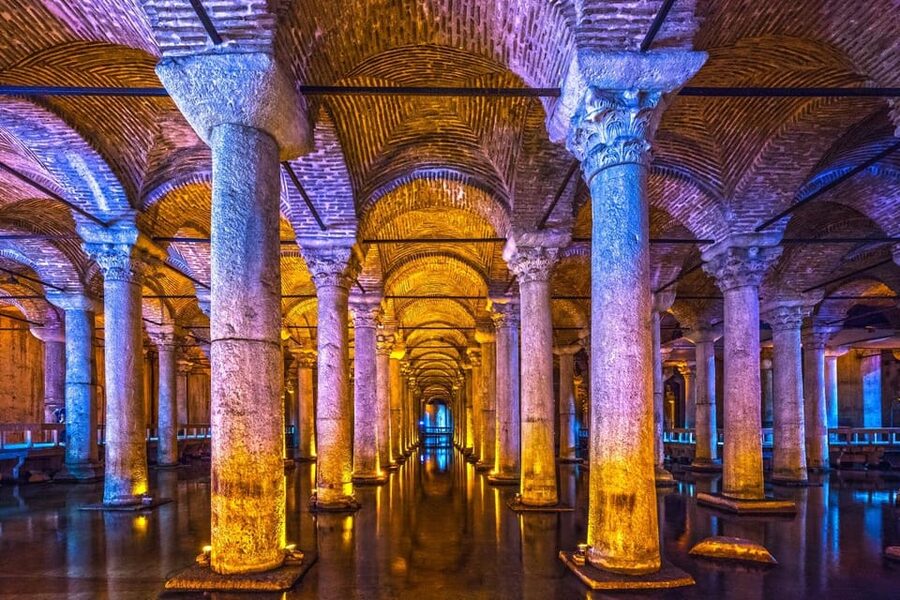
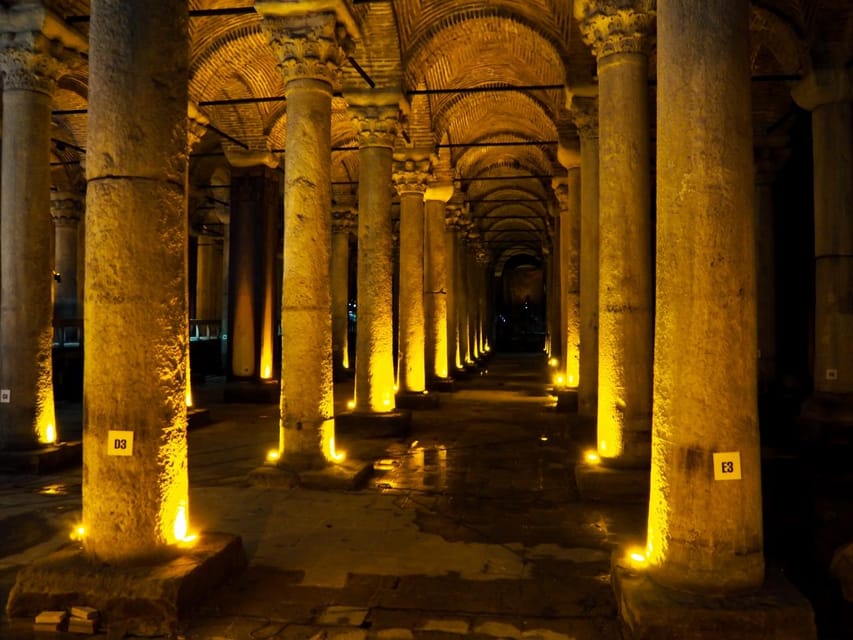
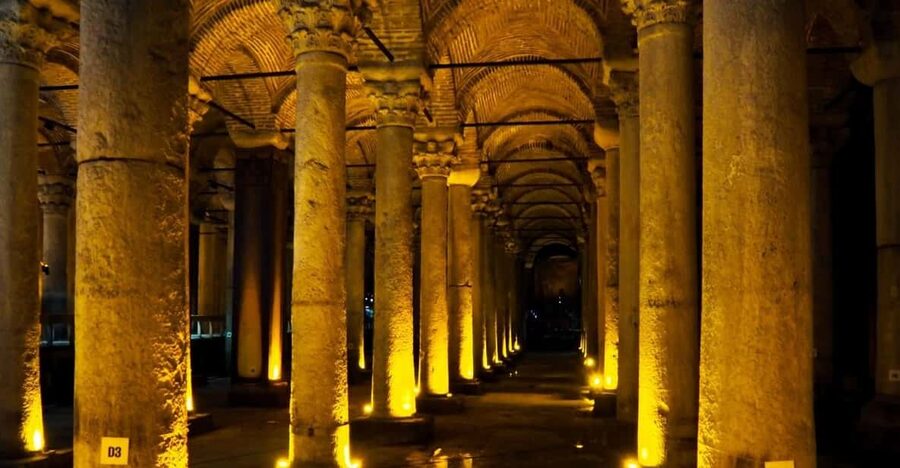
At the bottom, the first impression is the forest of columns. There are 336 of them, each about 9 meters high. They are arranged in 12 rows, with 28 columns in each row, and each column is set about 4.80 meters from the next.
That regular pattern is the cistern’s strongest visual feature. The columns support arches that stretch across the chamber, creating long lines that seem to continue farther than your eye can easily follow. Take your time here. The architecture is less about one single monument and more about the repeated effect of hundreds of supports working together.
Many of the columns were taken from older buildings and carved from different types of marble. Most are single pieces, while a few are made from two sections. You can also spot different styles among them. Ninety-eight columns reflect the Corinthian style, while others show Dorian forms.
The audio guide is useful at this point because it gives you something to look for. Without context, the columns can blur into one impressive but repetitive scene. With a little explanation, you begin to notice the differences in capitals, materials, and construction.
Why the columns matter more than the water

The Basilica Cistern was built to store water, but the water system is not the first thing most people notice today. The columns and arches dominate the experience. They show the scale and skill required to create a sealed underground reservoir in the sixth century.
The cistern’s brick walls rise about 4.80 meters. The floor uses bricks covered with a thick layer of brick-dust mortar to keep the reservoir watertight. This practical detail gives the structure its real weight. The site was not designed as a palace or church. It was built to help supply water, yet its construction has the order and beauty of monumental architecture.
I would pay attention to the ceiling and wall surfaces as you move through the chamber. The lighting draws attention to the columns and arches, but the structure is also interesting in the less decorated areas. Look for the way the brickwork supports the marble and how the columns change from one section to another.
The audio guide can help answer the basic questions you will naturally have. Why are the columns different? Why were pieces from older buildings used? How could a place built for water storage become one of Istanbul’s most memorable sights? These details give the visit more substance than a quick walk through a photogenic underground room.
Finding the two Medusa heads
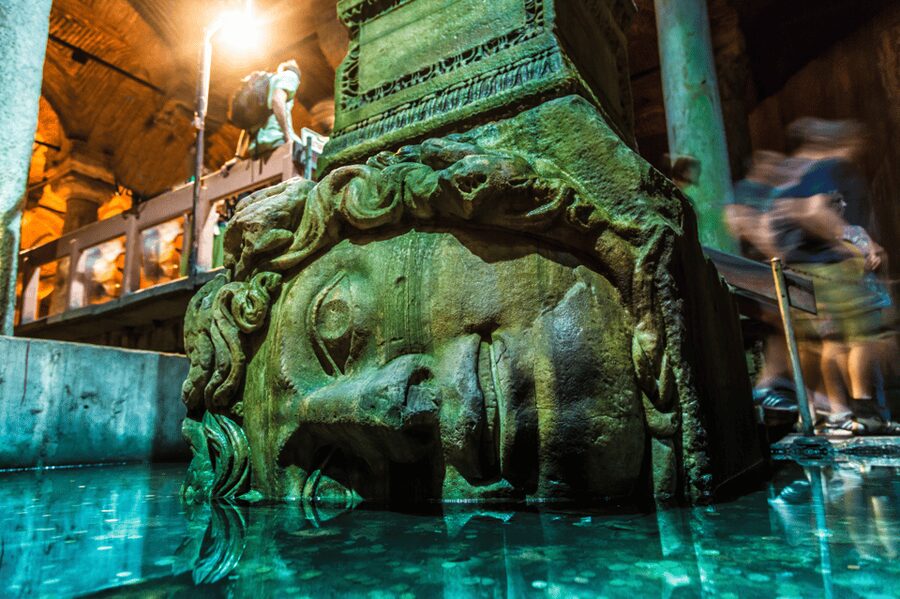
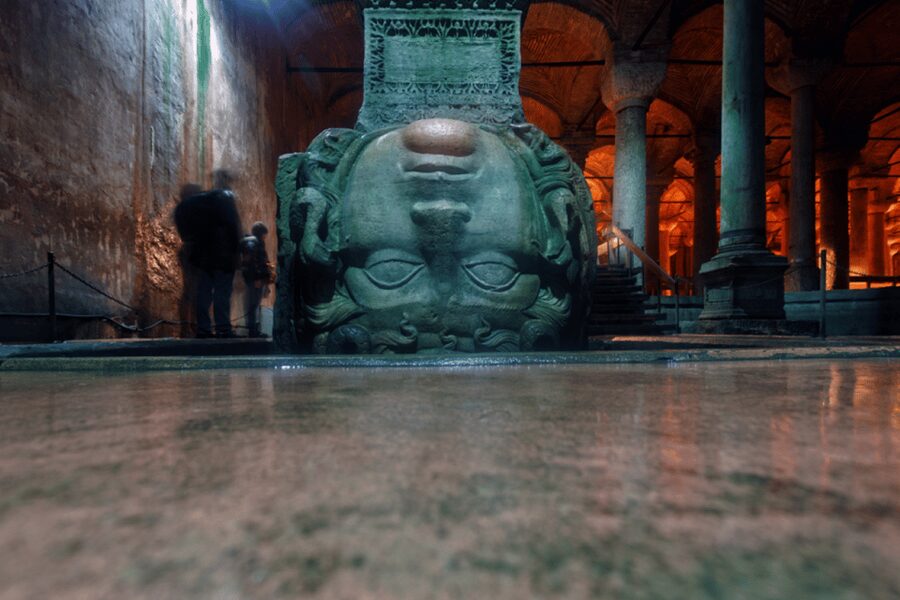
The two Medusa heads are the cistern’s most famous detail. They sit beneath columns at the northwest edge of the structure. These sculptures date from the Roman period, but their original source is not known.
One head is placed sideways, and the other is positioned upside down. Their unusual placement has encouraged plenty of stories. The practical explanation is that the sculptures may have been brought from an older building and reused as supports during construction. The legends are more dramatic, and the audio guide should help you separate the known facts from the speculation.
In Greek mythology, Medusa was one of three Gorgons. She had snakes for hair and the power to turn anyone who looked at her into stone. Images of the Gorgons were used to protect important places, so placing Medusa in the cistern may have had a protective purpose.
I think this is where the audio guide earns its keep. The heads are easy to find once you know where to look, but the story makes them far more memorable. Do not rush past them simply because they are smaller than the surrounding columns. They connect Roman art, Greek mythology, Byzantine construction, and modern Istanbul in one compact sight.
The space around the Medusa heads may also feel like the natural end point of your visit. After seeing the full scale of the cistern, these two carved faces give you a specific object to study. They provide the kind of detail that stays with you after the larger architectural impression fades.
More Church Audio Tours in Turkey
- Istanbul: Basilica Cistern Skip-the-Line Entry & Audio Guide
★ 4.2 · 993 reviews - Topkapi Palace + Basilica Cistern Tickets & Audio Guide
★ 4.5 · 30 reviews - Basilica Cistern& Hagia Sophia Audio Guided Tour w/Tickets
★ 4.6 · 22 reviews - Istanbul: Chora Church (Kariye Camii) & Digital Audio Guide
★ 4.2 · 19 reviews
How the self-guided format works
This is not a guided walking tour with a person leading a group. You receive two separate emails from the supplier, Istanbul Tourist Pass. One contains the entry ticket QR codes, and the other provides the audio guide link.
That arrangement gives you control. You can move slowly through the columns, pause the narration, repeat a section, or simply stop listening and enjoy the space. If you prefer a fixed route and a guide who manages the timing, this format may feel less satisfying. If you like setting your own pace, it is a better match.
The English audio guide is included with the package. Be sure to have the email and QR codes ready before you reach the entrance. Since the ticket and audio link arrive separately, checking both in advance can prevent confusion at the door.
The ticket is valid for one day, with starting times subject to availability. That flexibility matters in Istanbul, where a morning at one historic site can easily run longer than planned. You can fit the cistern around other stops instead of committing to a long scheduled program.
The phrase skip-the-ticket-line needs careful reading. It means you can avoid the regular ticket-purchase line, but you cannot avoid the security line. Security checks are mandatory for everyone, and there may still be a line at the entrance. I would not schedule this as a timed dash between two nearby sights.
Is the $54 price fair?
At $54 per person, this is not a bargain ticket. The value depends on what you need. You are paying for entry to the Basilica Cistern, an English audio guide, the convenience of QR-code admission, and, for a limited time, free internet through an eSIM.
The audio guide is the most useful included feature. It gives an independent visit some structure and explains details that are easy to miss, especially the column styles, reused materials, water capacity, and Medusa heads. If you already plan to research the cistern yourself and only want entry, the price may feel steep.
The eSIM adds practical value for visitors who need internet access, but the offer is limited-time. Treat it as a bonus, not a guaranteed reason to choose this product. The core purchase is still the ticket and English audio guide.
The published rating is 3.8 out of 5 from 38 ratings. I read that as a sign to keep expectations realistic. The attraction itself is highly distinctive, but a digital ticket product can be judged on email delivery, entrance procedures, and the gap between skip-the-line wording and the unavoidable security queue.
For me, the package makes the most sense when you value convenience and want one simple purchase. It makes less sense if you are focused only on the lowest possible admission cost.
Other Istanbul highlights need careful interpretation
The experience information also mentions views over the Golden Horn and Bosphorus, plus Hagia Irene, described as Istanbul’s second-biggest church. These are notable Istanbul sights, but the Basilica Cistern ticket details specifically identify entry to the cistern and the English audio guide.
I would not assume that a view stop or Hagia Irene admission is included unless your confirmation clearly says so. The cistern itself is underground, so it does not provide the broad Golden Horn or Bosphorus outlook suggested in the wider highlights. Check the exact option you are buying, especially if you see an audio-guide-only choice. The physical entry ticket is not included with that audio-guide-only option.
This distinction matters because the Basilica Cistern is a focused attraction, not automatically a full historic-center tour. You may still want to visit Hagia Sophia, the Blue Mosque, the Grand Bazaar, or Hagia Irene separately, but do not build your day around extras that are not confirmed on your ticket.
Who will get the most from this visit
I would recommend this experience to independent sightseers who want a major Istanbul landmark without joining a group. It suits people who enjoy architecture, ancient engineering, and short audio explanations rather than a long live lecture.
It also works well for visitors with a tight schedule. The one-day validity gives you room to fit the cistern around other plans, while skip-the-ticket-line entry can reduce the ticket-buying process. Remember that security can still slow you down.
Families may like the Medusa story and the dramatic underground setting, though young children may not care about the construction details. The audio guide is in English, so it is most useful to English-speaking visitors.
I would be more cautious if you dislike digital tickets, want a live guide, or are trying to keep costs low. The experience is self-guided, and the $54 price is difficult to justify if you only want a quick look inside.
Practical advice before you arrive
Save both emails from Istanbul Tourist Pass before heading out. You need the entry QR codes and the separate audio guide link, and it is easier to sort them out before you are standing at the entrance.
Allow time for the mandatory security line. The skip-the-ticket-line benefit does not remove this step. A line at the entrance is possible, so leave some breathing room in your schedule.
Plan to spend enough time looking at the repeated columns rather than treating the cistern as a quick photo stop. The first impression is powerful, but the details are what give the visit lasting value. Listen for the sections about the Roman Medusa heads and the Byzantine water system.
If you buy the package mainly for the eSIM, confirm that the limited-time internet offer is still active. The attraction remains the main reason to book.
Should you book the Basilica Cistern ticket?
Book it if you want a flexible, self-guided visit to one of Istanbul’s most distinctive historic spaces, and if an English audio guide and digital convenience are worth paying for. The 336 columns, huge underground scale, and two Medusa heads provide plenty to see in a single visit.
Skip it if you want a live guide, the lowest entry price, or a package that definitely includes every sight named in the wider highlights. The $54 cost is the key concern, and security lines remain possible despite the ticket-line benefit.
My call: this is a practical choice for first-time Istanbul visitors who value flexibility and clear historical context. Just read the exact ticket option, arrive prepared with both QR codes and the audio link, and keep the Bosphorus views and Hagia Irene separate unless your confirmation specifically includes them.
FAQ
Where is the Basilica Cistern?
The Basilica Cistern is in Istanbul Province, southwest of Hagia Sophia.
How long is the ticket valid?
The ticket is valid for one day. Starting times depend on availability.
Does the ticket let me skip all lines?
No. It provides skip-the-ticket-line entry, but security lines are mandatory for all visitors. A line may still be present at the entrance.
Is an audio guide included?
A professional audio guide in English is included with the ticket option. The audio guide link arrives in a separate email from the entry QR codes.
Is entry included with every option?
No. The Basilica Cistern entry ticket is not included if you purchase only the audio-guide option.
How much does the experience cost?
The listed price is $54 per person.
Can I cancel for a full refund?
Yes. You can cancel up to 24 hours in advance for a full refund.
More Skip-the-Line Tickets in Istanbul
- Topkapi Palace and Harem Skip-the-Line-Tickets & Audio Guide
★ 4.3 · 4,745 reviews - Hagia Sophia Skip-the-Line Ticket & Blue Mosque Audio Guide
★ 4.1 · 1,879 reviews - Istanbul: Hagia Sophia Skip-the-Line Ticket with Audio Tour
★ 4.4 · 1,767 reviews - Dolmabahce Palace & Harem Skip-the-Line Entry & Audio Guide
★ 4.7 · 927 reviews
Just added around Istanbul
- Topkapi Palace Museum Skip The Ticket Line Tickets + Audio Guide★ 3.0 · 2 reviews
- Topkapi Palace and Harem Museum Ticket with Audio Guide★ 3.0 · 2 reviews
- Istanbul: Bosphorus and Golden Horn Cruise with Audio Guide★ 4.5 · 83 reviews
- Istanbul Walking Tour with Audioguide on Your Smartphone★ 5.0 · 6 reviews
- Hagia Sophia Skip-the-Line Ticket with Audio Guide★ 5.0 · 4 reviews
- Istanbul Self-Guided Audio Tour★ 3.0 · 2 reviews
- Istanbul Bosphorus Sightseeing Cruise with Audio Guide★ 5.0 · 67 reviews
- Istanbul: Hagia Sophia Entry Ticket with Digital Audio Guide★ 4.5 · 7 reviews
Church & Cathedral Audio Tours, compared.
St. Peter’s Basilica & Dome Entry Ticket & Audio Tour
Read our review →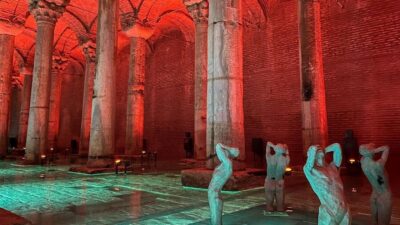
Basilica Cistern Fast-Track Entry and Audio Guide
Read our review →
Cathedral & Brunelleschi’s Dome Ticket & Audio App
Read our review →
Vatican & Sistine Chapel Ticket with Optional Audio Guide
Read our review →
St. Mark Basilica Ticket, Audioguide+History Gallery
Read our review →
Skip the Line: Vatican & Sistine Chapel Ticket with Audio Guide
Read our review →
St. Peter’s Basilica with Optional Dome Ticket & Audioguide
Read our review →
Browse the lists this tour appears in