
REVIEW · USA AUDIO TOURS
Shiloh Battlefield Self-Guided Driving Audio Tour
History comes alive between the trees. This self-guided drive turns more than six miles of Shiloh Battlefield into a moving history lesson, with over 34 audio stories triggered by your location. I like the clear route, which helps you avoid getting turned around on the park’s many side roads, and I like the freedom to stop for photos, walking, or a quiet look at a monument.
The price is $14.99 per group of up to four, not per person, so it is a strong deal for a family or small group sharing one car. The main catch is simple but important: you must download the tour before arriving, since Shiloh has no Wi-Fi. The visitor center or museum may also have changing hours or renovation closures, so do not treat the app as a substitute for checking current park information.
Five things to know before you go
- The route covers more than six miles and takes about one to two hours at a steady pace.
- The audio starts automatically as you reach each location, so you can keep your phone in the car.
- The tour begins at the Shiloh Battlefield Visitor Center and ends at Pittsburg Landing.
- Download everything before arrival, using strong Wi-Fi or cellular service.
- One purchase covers the whole car, with lifetime access and no expiry.
- The history moves beyond the Civil War, including the 800-year-old Shiloh Indian Mounds.
Starting at the visitor center on Pittsburg Landing Road
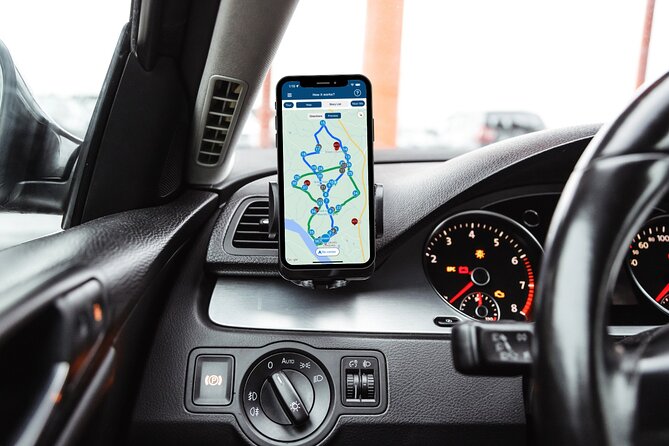
Your starting point is the Shiloh Battlefield Visitor Center at 1055 Pittsburg Landing Road in Shiloh, Tennessee. No guide meets you there. Instead, you open the Action Tour Guide app, enter the password sent by email and text, and begin at the first story point.
The tour is designed for a driving loop, with narration linked to your location. That makes it easy to keep your eyes on the road and let the next story play as you reach each stop. Connect your phone to the car by Bluetooth, USB, or AUX. Apple CarPlay works with the audio, while Android Auto support is still listed as coming soon.
Download the tour while you have a good connection. This point deserves repeating. A poor signal at the park can prevent the app from loading, and there is no Wi-Fi to rescue you. One particularly useful tip is to tap the map while the narrator is quiet. You can see how far you need to drive to the next point and where to turn, which helps on a route with several offshoots.
The visitor center is listed as open daily from 8:00 a.m. to 5:00 p.m. for the stated operating period. The audio tour itself has lifetime access, so you can use it later, pause it, or repeat the drive on another trip.
More Self-Guided Audio Tours in the USA
- Gettysburg Battlefield Self-Guided Driving Audio Tour
★ 4.5 · 910 reviews - Joshua Tree National Park Self-Guided Driving Audio Tour
★ 4.5 · 762 reviews - Ultimate Acadia National Park Self-Guided Driving Audio Tour
★ 4.0 · 521 reviews
Iowa’s eagle monument and Grant’s desperate last line
The first featured monument is the Iowa State Monument, a granite tower topped by an eagle caught in flight. The eagle represents freedom of the soul. Below it, a 12-foot bronze figure called Fame holds a quill against the monument, as if writing an elegy for the men who died here.
This is a good early stop because it shows how Shiloh’s monuments often combine military memory with grand symbolism. You can walk up for a closer look, but the stop is short enough to keep the drive moving.
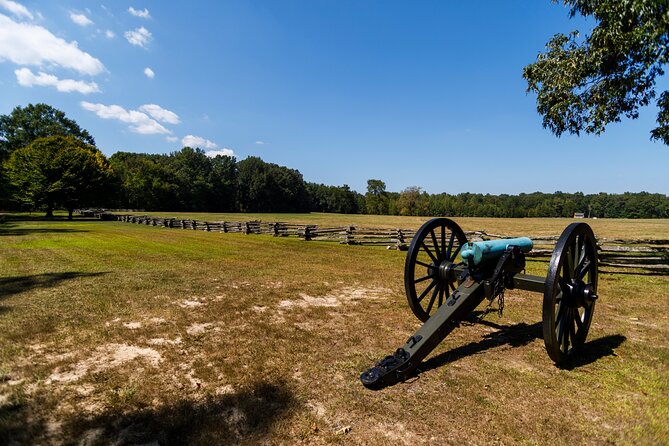
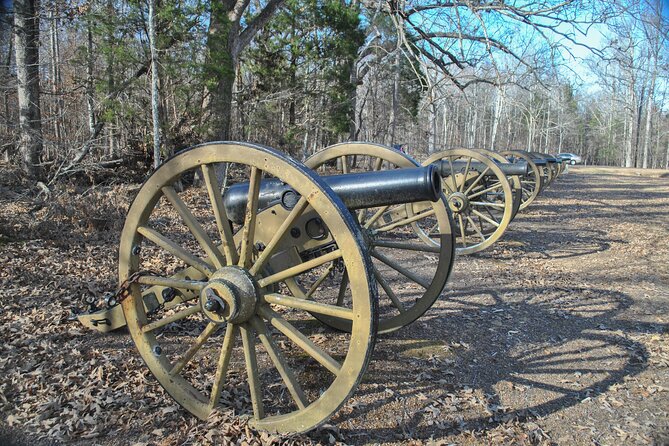
Next comes Grant’s Last Line. The audio asks you to picture dusk on a warm April day, with Union troops pulling heavy siege guns into position. Around 20,000 men from different brigades gathered here in a final effort to block the Confederate advance.
The story is valuable because it gives the battlefield a sense of pressure and movement. Instead of seeing only cannons and open ground, you begin to understand why this line mattered. The stop takes about five minutes, though you can pause the tour if you want more time outside the car.
Michigan soldiers and the Confederate memorial
The route then passes the Michigan State Memorial. Follow Confederate Road straight through an awkward intersection, using the soldier monument on your left as a visual check that you are on the correct road.
That direction is more useful than it may sound. Shiloh’s roads include several branches, and a missed turn can send you away from the intended sequence. The audio points out the Michigan monument’s 353 soldiers who were killed, wounded, or missing during the battle.
The Daughters of the Confederacy Monument comes next. Pull into the turnout across from it. Below the central statues, a bronze plaque shows the face of General Albert Sidney Johnston, the Confederate commander at Shiloh.
This stop also gives you a chance to think about how the park remembers both armies. The monument reflects the commemorative style of its era, while the narration supplies the military context. You are not simply collecting photos of stone markers. You are learning who the people were and why their names appear here.
Shiloh Church and the first hard fighting
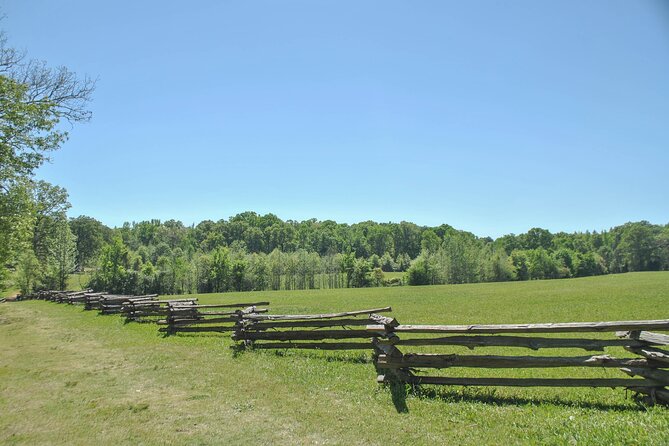
At Shiloh Church and Cemetery, turn left into the parking area. Two structures are featured: a large modern church from the 1950s and a one-room log cabin replica of the original Shiloh Church.
The cabin is tied to General William Tecumseh Sherman and his men, who camped in this area. This stop works best if you get out and look closely rather than listening only from the driver’s seat. The modern church and the small cabin make an immediate visual contrast, and the audio explains how the site fits into the battle.
The next stop, Seay Field, shifts the mood. Union General Benjamin Prentiss orders his men to hold their ground as Confederate troops emerge from the woods. The Union force is badly outnumbered, but delaying the attack becomes its main task.
That is one of the strengths of this tour. It explains not only major victories or famous commanders, but also the small acts of resistance that slowed an advancing army. At Seay Field, the battlefield begins to feel like a series of connected decisions rather than one single clash.
More Driving Audio Tours in the USA:
- Ultimate Lake Tahoe Self-Guided Driving Audio Tour
★ 4.5 · 435 reviews - Scenic Newport, RI Self-Guided Driving Audio Tour
★ 4.5 · 325 reviews - Arches National Park Self-Guided Driving Audio Tour
★ 4.5 · 288 reviews - Yellowstone National Park Self-Guided Driving Audio Tour
★ 4.5 · 249 reviews
Munch’s Battery and the Hornet’s Nest
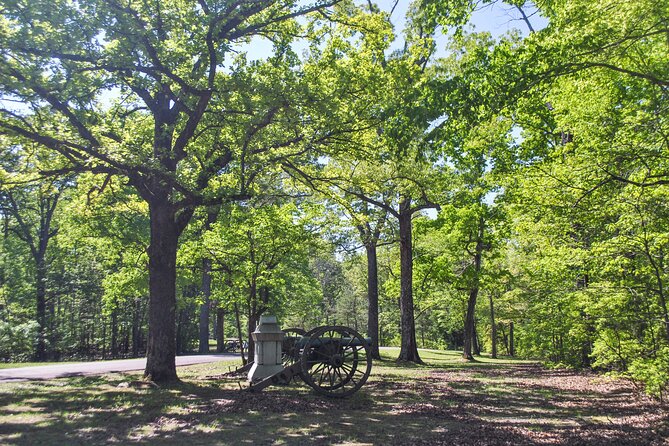
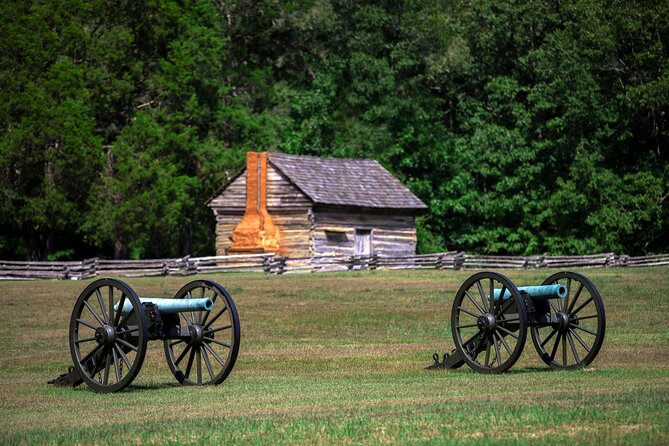
Watch for two cannons on the left marking Munch’s Battery of the 1st Minnesota Light Artillery. Union Captain Emil Munch placed his guns here after Union troops fell back from their camp.
The narration points you toward the Hornet’s Nest, about a mile farther along. This is one of the key sections of the drive because it explains how artillery and infantry positions worked together. The battery was not simply placed beside the road for decoration. It helped defend a position that became central to the Union effort.
At Jones Field, the story follows General Sherman as Confederate pressure forces him back from the church. The situation looks grim until General John McClernand arrives with a different plan.
This stop is a useful reminder that the battle did not unfold in a neat line. Positions shifted. Units were pushed back, regrouped, and reinforced. The automatic audio format helps you follow that movement while you drive from one field to the next.
Tennessee, Illinois, and Texas memorials
The Tennessee State Memorial features three bronze figures. One holds a rifle, one has fallen, and a third reaches for the flag dropped by his comrade. The scene represents survivors remaining loyal to those who died.
The monument is emotionally direct, and the audio gives you enough context to understand its message without turning the stop into a long lecture. You can pull over, listen, and take a closer look before moving on.
The Colonel Julius Raith Mortuary Monument honors a Union general who had served in the Mexican-American War and later organized a regiment of German-Americans. Four pyramids of cannonballs surround a black Parrott Rifle, creating a stark memorial to a commander who led several Illinois regiments at Shiloh.
The Texas State Monument brings the Confederate side back into focus. It honors the Texas regiments and includes General Johnston, a Texan by birth. Before the Civil War, Johnston had fought in the Black Hawk War, the Texas Revolution, and the Mexican-American War, among other conflicts. He became the highest-ranking soldier killed in Civil War combat.
Park by the monument and take time with this stop. Johnston’s story helps explain why military experience mattered so much to both armies, while also showing how personal loyalties shifted when states seceded.
Shiloh’s older story at the Indian Mounds
The Shiloh Indian Mounds National Historic Landmark is one of the most important changes of pace on the route. The mounds mark an 800-year-old settlement, long predating the Civil War.
You can turn into the parking area to learn more, or continue if you need to keep the drive within the one to two hour estimate. I recommend stopping if you have enough time. The mounds remind you that the area’s story did not begin in 1862, and they keep the tour from treating the park as a place defined by one battle alone.
This stop also makes the route more useful for mixed-interest groups. Someone who is less focused on Civil War tactics may find the earlier settlement especially meaningful.
Shiloh National Cemetery and the final landing
The Shiloh National Cemetery is on the left. After the battle, Union and Confederate dead were first placed in mass graves. Later, 3,584 bodies were moved to the cemetery, and about two thirds remained unidentified.
This is a quiet, serious stop. The numbers are hard to absorb, but the cemetery gives the human cost of the battle a clear place. You may want to pause the narration and walk rather than rush through in the car.
The tour ends at Pittsburg Landing, where General Buell’s men arrived to help the Union. Pull over and park here. The landing gives the route a natural ending because it returns you to the river approach that helped shape the battle.
Ending here also gives you a chance to review the route in your mind. You have followed the fighting from monuments and defensive lines to cemeteries and the arrival of reinforcements. The audio stops, but the site gives you room to look around without another scheduled departure.
What the $14.99 price really buys
At $14.99 for one car, this is inexpensive if four people share the cost. Even for two people, the price is modest compared with a private guide, and you are not tied to a departure time or fixed group.
The strongest value is the route planning. Shiloh contains many roads, monuments, and side paths. The narration helps you spend your limited time on the main sequence instead of circling around trying to locate the next stop.
You also get lifetime access with no expiry. You can pause for lunch, return another day, or repeat sections without buying again. That flexibility matters more than it would on a short city walk because the battlefield can reward a slower second visit.
The tradeoff is that you handle everything yourself. There is no person beside you to answer a question, adjust the route, or explain a detail outside the programmed stories. The app also depends on a compatible phone with GPS and cellular capability. Use an iPhone with iOS 15 or later, an Android device with version 9 or later, or an iPad or tablet with GPS and cellular service.
Who will enjoy this drive most
I would choose this tour if you want history without joining a fixed group. It suits families, couples, and small groups who prefer to stop when they like and continue when they are ready.
It is also a good match for anyone who finds battlefield roads confusing. The route guidance saves time, and the automatic audio means you do not need to keep checking your phone while driving.
You may want another option if you prefer a live historian or a long museum visit. The audio offers prepared stories, not conversation. Also remember that attraction entry, reservations, and other passes are not included. The battlefield route itself has free admission at the stated stops, but park facilities can change.
One practical concern came up when the museum was closed for renovation and the lack of Wi-Fi prevented an audio download. Check conditions before leaving, and download the tour at home. That one step removes the biggest avoidable problem.
Free cancellation is available up to 24 hours before the scheduled start time. Changes or cancellations inside that window are not refundable.
FAQ
Where does the Shiloh audio tour begin?
It begins at the Shiloh Battlefield Visitor Center, 1055 Pittsburg Landing Road, Shiloh, Tennessee.
Where does the tour end?
The route ends at Pittsburg Landing in Shiloh, Tennessee.
How long is the driving tour?
The route is more than six miles long and usually takes about one to two hours.
How many people can use one purchase?
The $14.99 purchase covers one group of up to four people in the same car.
Does the tour work without cellular service or Wi-Fi?
Yes, but you must download the tour while you have a strong Wi-Fi or cellular connection. After downloading, the audio and maps work offline.
Is a guide included at the battlefield?
No. This is a private, self-guided activity. You use the Action Tour Guide app, and the audio begins automatically as you reach each story point.
Should you book the Shiloh audio tour?
Book it if you want a low-cost, flexible way to understand Shiloh while staying in your own car. The best reasons are the well-planned route, the clear automatic narration, and the chance to stop at important places such as the Hornet’s Nest, Shiloh National Cemetery, and Pittsburg Landing.
Skip it if you need a live guide or do not want to prepare an app before arrival. For everyone else, download it at home, connect it to your car stereo, and use the map when the narrator is quiet. At $14.99 for a carload, it is a practical way to see the battlefield without getting lost or rushing from stop to stop.
Just added around the USA
- Self Guided Driving Audio Tour of Saguaro National Park★ 3.0 · 4 reviews
- Self-Guided Audio Driving Tour of Mount Lemmon★ 5.0 · 4 reviews
- Saguaro National Park Self-Guided Audio Tour★ 3.5 · 11 reviews
- A Self Guided Audio Tour in Tombstone★ 4.0 · 11 reviews
- Catskills Scenic Byway Self-Guided Driving Audio Tour★ 4.0 · 9 reviews
- Big Bend National Park Self Guided Audio Tour Guide★ 5.0 · 12 reviews
- Self-Guided Audio Driving Tour in Catskills Scenic Byway★ 4.5 · 7 reviews
- Black Canyon of the Gunnison NP Self-Guided Driving Audio Tour★ 3.5 · 7 reviews
Driving Audio Tours, compared.



Ultimate Acadia National Park Self-Guided Driving Audio Tour
Read our review →



Browse the lists this tour appears in