
REVIEW · SAN FRANCISCO AUDIO TOURS
Food, History, and Resistance: A Self-Guided Audio Tour
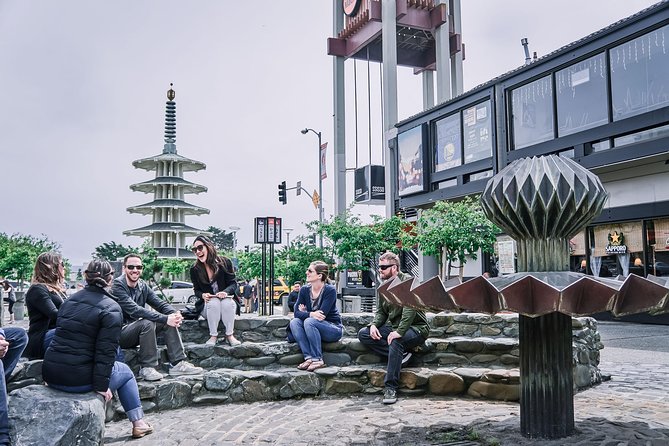
A small neighborhood holds big stories. This self-guided walk through San Francisco’s Japantown connects traditional sweets, Black jazz culture, and Japanese American resistance in a way a restaurant visit alone cannot. I like the careful pacing, which lets you pause at places that deserve a closer look, and I like the offline maps and audio, useful when you want to explore without relying on a signal. The main drawback is that you need your own smartphone, and the experience does not include food, transport, or admission to attractions along the way.
This is a quiet, reflective tour rather than a food crawl. You will hear about manju, internment, the Japanese Language School, and Fillmore Street’s jazz era while walking from Osakaya Restaurant on Post Street to Geary Boulevard. The route takes about 50 minutes to one hour, but you should allow extra time if you want to stop, eat, or look around.
Key points to know before you go
- Start at Osakaya Restaurant: The walk begins at 1737 Post Street in San Francisco’s Japantown.
- Manju is part of the story: Benkyodo is one of only three traditional Japanese manju makers remaining in the United States.
- Japantown’s past reaches beyond food: The audio explains wartime removal and the places connected to Japanese American families.
- Fillmore Street adds a second cultural layer: Bop City hosted major jazz names, including John Coltrane, Billie Holiday, Miles Davis, and Duke Ellington.
- Plan for about an hour: The route ends at 1010 Geary Boulevard, though stops and food purchases can extend your visit.
- Bring a charged smartphone: The VoiceMap application provides audio, maps, and geodata, with offline access after setup.
Why this Japantown walk is worth your time
San Francisco’s Japantown is easy to reduce to ramen, sushi, and souvenir shopping. Those are pleasant reasons to visit, but they tell only a small part of the neighborhood’s story. This audio tour gives you a reason to look more closely at the streets and buildings around you.
I like the way the route connects everyday places with events that changed the city. A confectionery is not presented only as a place to buy something sweet. A gate near the Japanese Language School carries a more painful meaning. A former Fillmore Street nightclub opens a window onto Black life and music in the 1940s.
That combination gives the walk a wider frame. You are not hearing a single, tidy story about one community. You are hearing how Japanese American and Black communities shaped nearby parts of San Francisco, often under difficult conditions.
The tour is delivered in English through VoiceMap. It is self-guided, so you move at your own speed instead of following a group leader. That matters here. Some stops call for a few extra minutes, and you may want to pause the audio while you examine a building or gather your thoughts.
More History Audio Tours in the USA
- Santa Fe Historic Downtown Smart Phone Audio App Self Guided GPS Walking Tour
★ 4.5 · 112 reviews - Savannah’s Historical District: A Self-Guided Audio Tour
★ 4.5 · 69 reviews - Self-Guided Walking Audio Tour of Historic Santa Fe
★ 4.5 · 43 reviews
Starting at Osakaya Restaurant on Post Street
The tour begins at Osakaya Restaurant, 1737 Post Street. This gives you a clear address and a practical place to orient yourself before the audio starts.
The opening section introduces the idea that Japantown has stories many people never encounter unless they are part of the community. That is an important promise for the walk. You are not simply being directed from one eating place to another. You are being asked to notice what has survived, what has changed, and what is easy to miss.
Because the route is self-guided, you can start when it suits you. The published operating hours cover every day and list the experience as available around the clock. Still, your actual visit will be more useful when the places along the route are open and the streets feel comfortable for walking.
You will need your own smartphone. The phone is not included, and neither are meals or drinks. Install or prepare the VoiceMap application before setting out, then use the offline audio, maps, and location data so you are not dependent on a mobile connection during the walk.
Benkyodo and the taste of traditional manju
One of the most memorable food-related stops is Benkyodo. It is one of only three traditional Japanese manju makers left in the United States. The other two are in the remaining Japantowns of Los Angeles and San Jose.
That fact gives this stop real weight. Manju is a traditional Japanese confection made with sweet bean paste and a mochi wrapper. The mochi is produced from glutinous rice that is pounded until it becomes sticky and soft.
Even if you already know Japanese sweets, the stop helps explain why local food traditions matter. A small confection can carry family practice, technique, and memory. It also gives you something concrete to look for during the walk, rather than asking you to absorb only dates and names.
The tour does not include food or drinks, so any purchase is your own expense. That is both a limitation and an opportunity. You can keep the visit focused on the story, or add your own tasting stop if Benkyodo is open and you want to try manju.
You should not expect a guided cooking demonstration or a full food tour. The value comes from the context. The audio shows how food connects to the survival of Japantown as a cultural place.
The Japanese Language School and the painful wartime story
The walk also addresses Japanese American internment during World War II. One especially affecting detail concerns the gate next to the Japanese Language School. The audio explains that this was connected to a location where Japanese people reported for internment.
The power of this stop comes from its ordinary appearance. You may be standing near a gate while daily life continues around you, yet the site points to a moment when families were forced to leave their homes and communities. The story becomes more personal when you consider that some families from San Francisco were first held at Tanforan horse track and later sent to Topaz, Utah.
This part of the tour is likely to stay with you longer than the food stops. It asks you to picture families arriving at a place connected to removal, perhaps carrying only what they could take. The audio does not need a large museum display to make the point. The location itself becomes the prompt.
A useful feature of the walk is that the sites discussed remain in existence. That does not mean every historic building or setting looks exactly as it once did. It means you can connect the narration to actual places rather than hearing about locations that have vanished completely.
Give yourself time here. The audio is reported to be paced so you can pause and explore the stops in more detail. That flexibility is especially useful for the internment section, where rushing from one point to the next would weaken the experience.
More Self-Guided Audio Tours in the USA
- Gettysburg Battlefield Self-Guided Driving Audio Tour
★ 4.5 · 910 reviews - Joshua Tree National Park Self-Guided Driving Audio Tour
★ 4.5 · 762 reviews - Ultimate Acadia National Park Self-Guided Driving Audio Tour
★ 4.0 · 521 reviews - Ultimate Lake Tahoe Self-Guided Driving Audio Tour
★ 4.5 · 435 reviews
Bop City and the Harlem of the West
The tour then broadens its focus beyond Japantown to the Black community on Fillmore Street. At 1712 Fillmore Street, Bop City became an after-hours place for jazz musicians.
The names associated with the club are remarkable: John Coltrane, Billie Holiday, Miles Davis, and Duke Ellington all played there. In the 1940s, San Francisco’s Black community grew greatly, and Fillmore Street became known as the Harlem of the West.
This stop adds an important layer to the route. Japantown and Fillmore Street were not isolated stories. San Francisco’s neighborhoods changed through migration, displacement, music, business, and community life. The audio helps you see how close these histories were geographically.
Bop City is also a good reminder that a street’s importance may not be obvious from its current appearance. You might pass a place without realizing that musicians who shaped American jazz once gathered there. The route asks you to imagine the energy of those after-hours performances without pretending that the past is still physically present in the same form.
If you are mainly interested in food, this section may feel like a detour. I think it improves the tour. It keeps the experience from becoming a narrow account of Japanese food and gives you a fuller sense of the surrounding district.
A thoughtfully paced walk, not a guided group outing
The route takes approximately 50 minutes to one hour. That is a manageable length for an afternoon, especially if you are already visiting Japantown.
The pace is one of the experience’s strongest features. You are not locked into a fixed group schedule. You can pause the audio, inspect a location, take a break, or spend more time at a stop that matters to you. One hour is a realistic listening time, but it is not a strict total visit time.
The maximum group size is listed as 10 people, though the self-guided format means you are not depending on a guide to gather everyone together. You can listen alone, with a companion, or with a small group.
The audio is offered in English only. That is important to know before booking. If everyone in your party is comfortable listening in English, the format is simple. If not, this will not be the right choice.
The route is near public transportation, and most people can participate. Service animals are allowed. No transport is provided, so you need to make your own way to the start and from the ending point.
What the $11.99 price really buys you
At $11.99 per person, the cost is modest compared with a conventional guided tour. You are paying for the narration, the VoiceMap application, mapped route information, and lifetime access rather than for a guide, a meal, or entry to a museum.
That makes the value depend on how you use it. If you want a short introduction to Japantown and nearby Fillmore Street, the price is reasonable. You receive more than a simple list of addresses because the audio gives those places historical and cultural meaning.
The lifetime access is useful if you want to listen again or return to the area later. You could also pause the route and resume it another day, though the stated walking time is short enough to complete in one outing.
The value is weaker if you expect tastings, personal conversation, or admission to attractions. Those are not included. Food, drinks, museum tickets, and other entrance fees are extra.
Since the experience is non-refundable and cannot be changed after booking, check your schedule before paying. The tour is available in English and requires a smartphone, so those two points should also be settled in advance.
Who will enjoy this experience most
I would recommend this walk to anyone who wants cultural context with a manageable amount of walking. It suits solo visitors, couples, and small groups who prefer to stop when they wish instead of staying with a guide.
It is especially fitting if you have a family connection to Japanese American history. The internment section may feel personal, even if you are only beginning to learn about what happened to families in San Francisco.
It also works well for people interested in jazz, Black history, neighborhood change, or food traditions. You do not need to be an expert in any of those subjects. The route introduces each theme through specific places.
Families may appreciate the short format, but adults should decide how to discuss the internment material with younger children. The subject is serious, and the audio is not simply a light sightseeing commentary.
You may want a different experience if your priority is a sit-down meal, a chef-led food tour, or a large collection of museum interiors. This is primarily an audio walking tour. Its strongest material is heard while you look at the streets and sites around you.
Practical tips for making the walk better
- Charge your smartphone before leaving, and prepare the VoiceMap application in advance.
- Download the audio, maps, and geodata for offline use.
- Start with enough time to pause. The 50-minute estimate does not include meals or extended stops.
- Bring your own food budget if you want to try manju or eat along the route.
- Wear comfortable walking shoes, since the experience connects several locations on foot.
- Take the internment stop slowly. The story gains force when you give the place a moment rather than treating it as another audio marker.
- If you care most about jazz, pay close attention to the Bop City section and its connection to Fillmore Street’s 1940s Black community.
- Confirm that English audio suits everyone in your group before booking.
Should you book this Japantown audio tour?
Book it if you want a low-cost, self-paced walk that links food, Japanese American history, internment, and San Francisco jazz. I especially like that the route refuses to treat Japantown as only a place for lunch. Benkyodo and manju give you a food tradition to understand, while the Japanese Language School and Bop City add stories that are easier to miss.
Skip it if you need a live guide, included tastings, or admission to historic attractions. You will get the most from this experience if you bring curiosity, a charged phone, and enough time to pause. At $11.99, it is a sensible way to spend an hour exploring a part of San Francisco whose most important stories are not always visible at first glance.
FAQ
Where does the tour start?
It starts at Osakaya Restaurant, 1737 Post Street, San Francisco, California 94115.
Where does the tour end?
The tour ends at 1010 Geary Boulevard, San Francisco, California 94109.
How long does the audio tour take?
The estimated duration is 50 minutes to one hour.
How much does the experience cost?
The price is $11.99 per person.
What language is the tour offered in?
The tour is offered in English.
Do I need a smartphone?
Yes. A smartphone is not included, and you need one to use the VoiceMap application.
Can I use the tour offline?
Yes. Offline access to the audio, maps, and geodata is included.
Are food and drinks included?
No. Food and drinks are not included in the experience.
Are museum tickets or other admission fees included?
No. Tickets and entrance fees for museums or other attractions along the route are not included.
Is the tour refundable?
No. The experience is non-refundable and cannot be changed for any reason after booking.
More Food Trips in the USA
- Bologna Food Tasting box- Audio Guided Tour with Food Tasting
★ 4.5 · 31 reviews - Old Delhi: Food Tasting Tour On Rickshaws With Audio Headsets
★ 5.0 · 11 reviews - Cool Nørrebro and Foodie Tips Self Guided Audio Walking Tour
★ 5.0 · 4 reviews
More Food and Drink Trips in the USA
- Bruges: The Beer Experience Museum Entry with Audio Guide
★ 4.4 · 201 reviews - Bologna: Audio-Guided Archiginnasio Visit with Food Tasting
★ 3.3 · 79 reviews - Bologna: Clock Tower Audio Guide and Food Tasting
★ 4.4 · 58 reviews - Krakow: Vodka Factory Museum Ticket & Audioguide and Tasting
★ 4.3 · 38 reviews
Just added around the USA
- Self Guided Driving Audio Tour of Saguaro National Park★ 3.0 · 4 reviews
- Self-Guided Audio Driving Tour of Mount Lemmon★ 5.0 · 4 reviews
- Saguaro National Park Self-Guided Audio Tour★ 3.5 · 11 reviews
- A Self Guided Audio Tour in Tombstone★ 4.0 · 11 reviews
- Catskills Scenic Byway Self-Guided Driving Audio Tour★ 4.0 · 9 reviews
- Big Bend National Park Self Guided Audio Tour Guide★ 5.0 · 12 reviews
- Self-Guided Audio Driving Tour in Catskills Scenic Byway★ 4.5 · 7 reviews
- Shiloh Battlefield Self-Guided Driving Audio Tour★ 4.0 · 9 reviews
Self-Guided Tours, compared.
Acropolis Ticket & Optional Self-Guided Audio Tours
Read our review →


Ultimate Acadia National Park Self-Guided Driving Audio Tour
Read our review →
Santorini: Akrotiri Ticket with Optional Self-Guided Audios
Read our review →
Browse the lists this tour appears in