REVIEW · SELF-GUIDED TOURS
The Golden City of Samarkand: A Self-Guided Audio Tour
Samarkand rewards a little context. This one-hour audio tour connects the city’s headline sights with facts, folklore, and local stops, giving you more to notice as you move from Shah-i-Zinda toward the Registan. I like the GPS-triggered narration, which lets you pause and continue at your own pace, and I like the offline maps and audio, a useful feature in Uzbekistan. The main drawback is the app setup: one reviewer found it a little awkward to locate the exact starting point and manage pause and resume controls at first.
At $6.99 per person, this is a low-cost way to add structure to a visit without joining a group or hiring a private guide. The content comes from an award-winning author of a book about Central Asia, and the route includes both major monuments and everyday places such as Uzbek chaikhanas, or teahouses. You should still allow extra time for entrances, photos, food, and unplanned wandering because the recorded portion lasts about an hour.
Key points to know before you go
- The route begins at Shah-i-Zinda Street and ends on Tashkent Road, linking several of Samarkand’s best-known sights.
- GPS-based recordings play at set locations, so you can walk at your own pace rather than keep up with a guide.
- Offline access is included for audio, maps, and geographic data, with no connectivity required during the tour.
- The Registan receives the historical spotlight, with attention to the region’s scholars, rulers, and architectural traditions.
- The Siab Bazaar adds daily life to the route, balancing grand monuments with food stalls, traders, and local commerce.
- The $6.99 price is strong value, provided you already have a smartphone and do not need entry tickets or transport.
Why this audio tour works well in Samarkand
Samarkand can feel like a string of grand sites scattered across a large city. You can admire the tilework and take plenty of photographs, but without some background, the buildings may blur into one impressive blue-and-turquoise procession.
This audio tour gives those places a narrative thread. It links the Shah-i-Zinda complex, Siab Bazaar, Bibi Khanym Mosque, and Registan, then adds the Sher Dor Madrassa. That mix matters. You get mausoleums, a market, a mosque, and the city’s famous square rather than five versions of the same monument.
I also like the freedom built into the format. The recordings are tied to GPS locations, so the tour is not a race against a guide’s schedule. You can stop to look around, take photographs, enter a site if you have a ticket, or pause for tea. The app is designed to continue once you are ready.
The system is not perfectly simple at the start. One review describes the first attempt to find the precise launch point as a little confusing, with pause and resume controls that were not immediately obvious. The practical lesson is simple: give yourself a few minutes at Shah-i-Zinda Street to get the app running before you begin.
More Self-Guided Audio Tours in the world:
- Athens: Acropolis Ticket & Optional Self-Guided Audio Tours
★ 4.1 · 2,542 reviews - Gettysburg Battlefield Self-Guided Driving Audio Tour
★ 4.5 · 910 reviews - Joshua Tree National Park Self-Guided Driving Audio Tour
★ 4.5 · 762 reviews
Starting among the tombs at Shah-i-Zinda
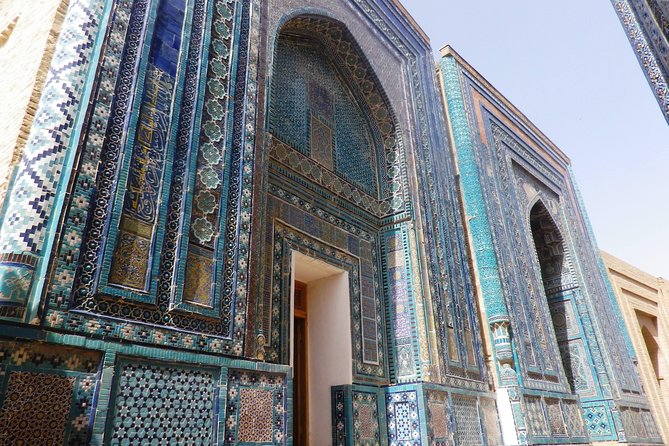
The route opens at Shah-i-Zinda, one of Samarkand’s most atmospheric religious complexes. Its origins reach back to the ninth century, giving this first stop a very different feel from the grander Timurid monuments later in the route.
The audio focuses on the complex’s mausoleums and the customs connected with them. One memorable detail concerns the tiny doorways. Their low height means that anyone entering must bow to Allah. That is the sort of small architectural point you might miss if you are looking only at the patterned façades.
The stop also draws attention to the plain white graves and the gifts left by pilgrims. This helps you see Shah-i-Zinda as more than a row of decorated buildings. It remains a sacred place, and the religious meaning is part of what gives the complex its quiet force.
You should listen carefully here, since the site can reward a slower pace. The tour is only about an hour overall, but nothing requires you to hurry through this section. If you want time for photographs or a closer look at the mausoleum details, pause the recording and restart it when convenient.
Finding everyday Samarkand at Siab Bazaar
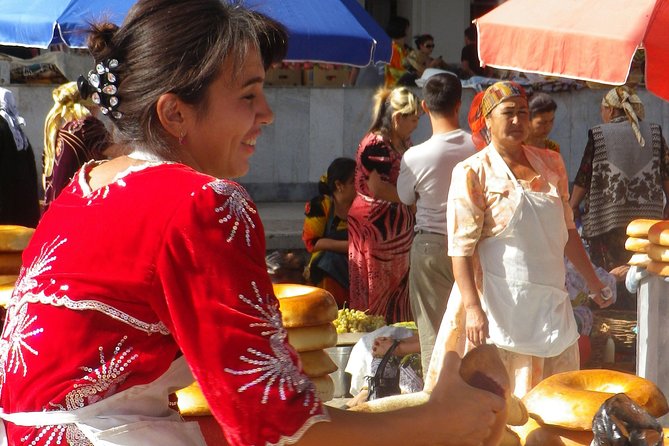
The next stop shifts from sacred architecture to ordinary commerce at Siab Bazaar. The market is described through its unusual roof, a two-tiered corrugated structure supported by girders, with extra traders gathered beneath gazebos and parasols around the edges.
That description gives you a useful way to read the market. It is not presented as a polished attraction. It is a working place where a wide range of goods are sold, and the audio points you toward the scale and character of the trade.
For me, this is one of the route’s strongest choices. The Registan is the obvious reason many people come to Samarkand, but a market gives you a better sense of how the city functions between monuments. You might find the bazaar more visually busy than the mausoleum complex, with stalls and displays competing for attention.
The tour does not include food or drink, so plan to pay separately if you want to buy something. It also does not provide a meal stop or a guide to purchases. Its job is to add context, not to organize a tasting or shopping session.
Looking up at Bibi Khanym Mosque
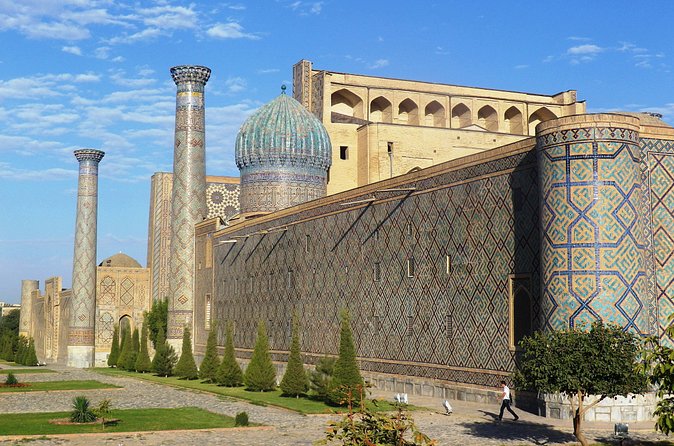
Bibi Khanym Mosque brings the story back to monumental building and imperial ambition. Timur commissioned the mosque after his campaign in India in 1399, using treasures taken from the subcontinent to fund its construction.
The audio also explains that Timur ignored advice from his architect and insisted on a very specific design. That detail gives the building a human edge. This was not simply an anonymous royal project. It reflected the demands and decisions of a ruler who wanted an extraordinary monument.
The stop is valuable because it connects the mosque to the political power behind Samarkand’s grand architecture. You are not just looking at tiles, arches, and scale. You are hearing how conquest, wealth, and personal authority shaped the city.
Keep the tour’s limitations in mind here. Any entry fee for a museum or attraction is not included, and the experience does not provide transport between stops. If you plan to go inside sites along the route, budget separately for tickets and allow enough time to explore beyond the audio prompts.
A few more audio tours around the world worth a look
- Barcelona: Sagrada Familia Entry Ticket with Audio Guide
★ 4.6 · 105,312 reviews - Rome: Pantheon Fast-Track Ticket and Official Audioguide
★ 4.5 · 27,353 reviews - Barcelona: Casa Batlló Entry with Self-Audioguide Tour
★ 4.7 · 25,359 reviews - Rome: Colosseum & Forum with Audio Guide App -Optional Arena
★ 4.2 · 24,770 reviews
Meeting the city’s greatest square at the Registan
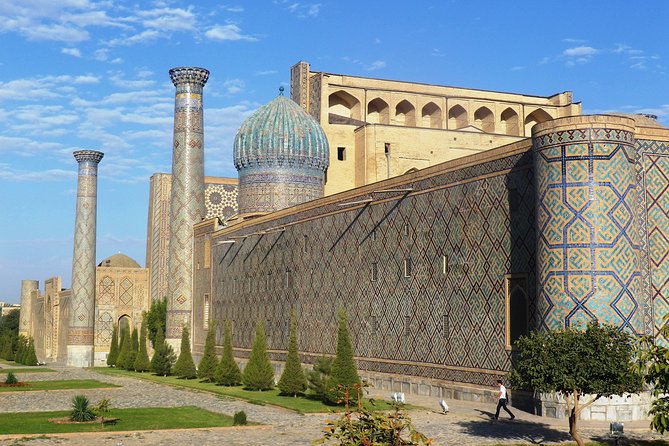
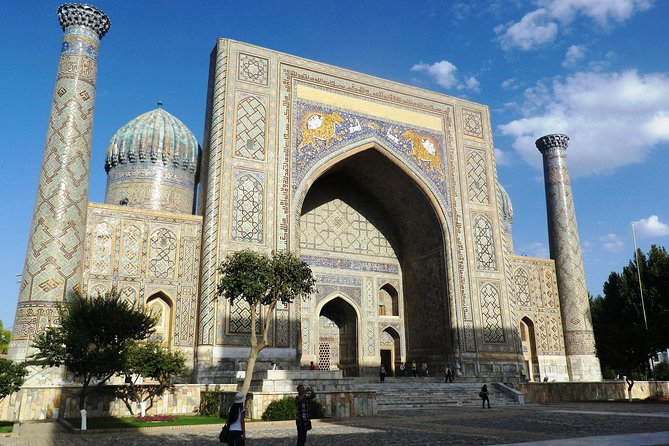
For many people, the Registan is the main event in Samarkand. The audio recognizes its importance and uses the square to explain the wider intellectual and political story of the region.
This is where the tour reaches beyond architecture. The narration connects Samarkand with Al-Khwarizmi, the mathematician whose name influenced the Western word algorithm. That reference places the city within a broader history of science and learning, not only royal display.
I like that approach because it gives the Registan more depth. The square is easy to experience as a grand photographic backdrop. The commentary encourages you to think about the scholars, rulers, and institutions that made this part of Central Asia important.
The Registan can also be the point where a self-guided format feels most limited. A private guide can answer follow-up questions, adjust the pace, or point out a detail based on your interests. This audio tour cannot do that. It gives you a prepared narrative, then leaves you free to look and listen on your own.
That tradeoff is reflected in the price. At $6.99, you are buying a compact introduction, not a full guided visit with personal attention. For many people, that is exactly the right balance, especially if they want background without committing to a longer group tour.
Finishing with the Sher Dor Madrassa
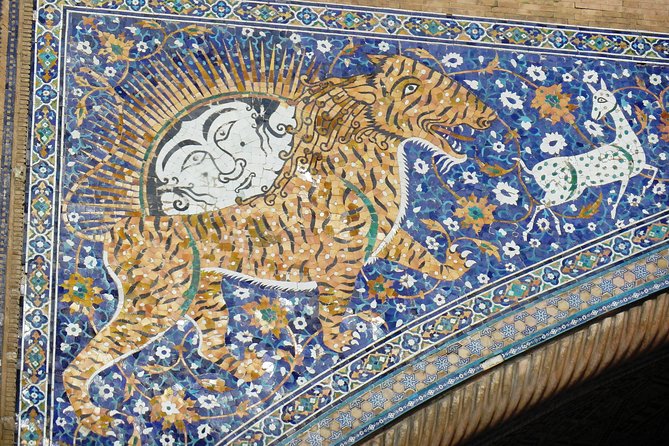
The Sher Dor Madrassa is a particularly good final stop because it has a visual feature that separates it from the nearby Ulugbek Madrassa. Although Sher Dor was built as an imitation of the earlier school, it includes a quirk that has made it popular with photographers.
The madrassa was completed in 1636 under Shaybanid Emir Yalangtush. The audio uses that detail to show how Samarkand’s architecture developed through imitation, adaptation, and political change. Buildings were not isolated creations. Later rulers borrowed earlier forms and added their own marks.
This is a fitting end because it brings together the themes found across the route: religion, scholarship, imperial power, and visual spectacle. The Registan may first catch your eye, but the Sher Dor helps you notice how the individual buildings differ.
Since the end point is on Tashkent Road, you can finish the recording and continue with your own plans. The tour does not arrange a return trip, so you will need to handle transportation yourself if you are not staying nearby.
How the GPS and offline setup affect your visit
The main practical feature is location-based playback. Instead of pressing play for a fixed walking script, you move to designated points and hear the relevant narration there. This lets you spend longer at a stop without losing your place.
Offline access includes the audio, maps, and geographic data. That is important because you do not need a live connection once the material is available in the app. It also means you can focus on the city rather than worry about mobile data while moving between locations.
You do need a smartphone. The phone is not included, and neither are headphones or other personal equipment. The tour uses the VoiceMap application, so you should be comfortable downloading and using an app before setting out.
The only specific usability concern in the supplied feedback is the beginning. Finding the exact point where the tour starts and learning how to stop and restart the recording may take a little patience. Once the controls make sense, the self-guided format becomes much more practical.
What $6.99 really buys you

The price is the strongest argument in favor of this experience. For $6.99 per person, you receive lifetime access to the tour, the VoiceMap application, and offline audio, maps, and geographic data.
That is inexpensive compared with a private guide, but the comparison needs to be fair. You are not paying for transportation, entrance tickets, food, drinks, or a person who can respond to questions. You are paying for a prepared audio route and the freedom to use it again.
Lifetime access also improves the value if you are spending several days in Samarkand or expect to return. You can use the tour when you first see the monuments, then revisit sections later at a slower pace.
The rating supplied for the experience is 3.8 out of 5 from four reviews. That small sample suggests a generally positive but not flawless experience. The praise centers on the idea and content, while the main criticism concerns the app’s initial handling. I would treat this as a good low-cost supplement rather than your only source of information about Samarkand.
Who should choose this tour?
I would recommend it to independent visitors who want historical context but do not want to join a scheduled group. It suits you especially well if you enjoy stopping for photographs, wandering into a market, or taking a tea break without asking a guide to wait.
It is also a good choice for repeat visitors. If you have already seen the Registan, the audio may help you notice the wider connection between the city’s monuments and its daily life.
The format may be less satisfying if you want a detailed, question-and-answer experience. It is also not ideal if you dislike smartphone navigation or expect every practical detail to be handled for you.
Most travelers can participate, and service animals are allowed. The experience is private in the sense that only your own group takes part, but it is not a private guided service with a human guide.
Practical details before you press play
The listed start point is Shah-i-Zinda Street in Samarkand. The route ends on Tashkent Road. Both the start and end locations are provided as map points, so check them before beginning and make sure you understand where to go.
The operating hours are listed as 12:00 AM to 11:59 PM every day, from May 20, 2019, through December 8, 2026. That wide window gives you plenty of flexibility, though the audio tour itself still lasts about one hour.
Confirmation is provided at booking. The experience is non-refundable and cannot be changed for any reason, so choose your date carefully before paying.
Bring your own smartphone, and remember that tickets, transportation, food, and drinks are separate expenses. If you want to spend meaningful time at Shah-i-Zinda, Siab Bazaar, Bibi Khanym Mosque, or the Registan, plan more than one hour for the whole outing.
Should you book The Golden City of Samarkand?
Book it if you want an inexpensive audio companion for Samarkand’s major sights, especially if you value offline access and flexible pacing. The route makes a smart choice of stops, moving from sacred tombs to a working market, a monumental mosque, the Registan, and the distinctive Sher Dor Madrassa.
Skip it if you want a human guide, organized transport, or entrance tickets included. The app may require a little patience at the start, and the one-hour recording cannot cover every detail of a city as layered as Samarkand.
For $6.99, I see it as a useful add-on rather than a complete sightseeing plan. Set it up before you leave, allow extra time around the monuments, and use the freedom to pause whenever Samarkand offers something worth a closer look.
FAQ
How long does The Golden City of Samarkand tour take?
The audio tour lasts approximately one hour.
Where does the tour begin?
It begins on Shah-i-Zinda Street in Samarkand, Uzbekistan.
Where does the tour end?
The tour ends on Tashkent Road in Samarkand.
Which places are included in the route?
The route includes Shah-i-Zinda, Siab Bazaar, Bibi Khanym Mosque, the Registan, and the Sher Dor Madrassa.
Does the tour require an internet connection?
No. Offline access to the audio, maps, and geographic data is included.
What application does the tour use?
The tour uses the VoiceMap application.
Are entrance tickets included?
No. Tickets for museums or other attractions along the route are not included.
Is transportation included?
No. Transportation, food, and drinks are not included.
Just added around the world
- Coba Ruins: Self-Guided Walking Audio Tour in Mexico★ 3.5 · 2 reviews
- Self Guided Driving Audio Tour of Saguaro National Park★ 3.0 · 4 reviews
- Torino Walking Tour with Audio and Written Guide by a Local★ 4.5 · 35 reviews
- Trondheim’s Inner Circle: A Self-Guided Audio Tour★ 4.0 · 15 reviews
- Self-Guided Audio Driving Tour of Mount Lemmon★ 5.0 · 4 reviews
- A Tromsø Introduction: A Self-Guided Audio Tour★ 3.5 · 19 reviews
- Panorama Bus Tour with Audio Guide★ 4.0 · 3 reviews
- Saguaro National Park Self-Guided Audio Tour★ 3.5 · 11 reviews
Self-Guided Tours, compared.

Acropolis Ticket & Optional Self-Guided Audio Tours
Read our review →


Ultimate Acadia National Park Self-Guided Driving Audio Tour
Read our review →

Santorini: Akrotiri Ticket with Optional Self-Guided Audios
Read our review →