
REVIEW · USA AUDIO TOURS
Salt Lake City Self-Guided Walking Audio Tour
Salt Lake City rewards a slow, curious walk. This $14.99 self-guided audio tour links downtown landmarks with stories about Mormon pioneers, Western expansion, Utah politics, and the city’s grandest buildings. I like the freedom to start anytime and pause for photos, and I like the clear route through Temple Square and toward the State Capitol. The main drawback is navigation: the app can be confusing at a few turns, especially around the Capitol.
You get more than 30 audio stories along a route of over 2.5 miles. Most stops take about five minutes, but you can stretch the walk to three hours if you listen to extra material and take your time. The narration is praised for its pleasant voice and useful details, though the audio may not trigger correctly if you begin away from the exact starting point or walk faster than the suggested pace.
Key points to know before you go
- Start at 90 South West Temple Street: The tour begins outside the Visit Salt Lake Center and finishes near 60 North Temple.
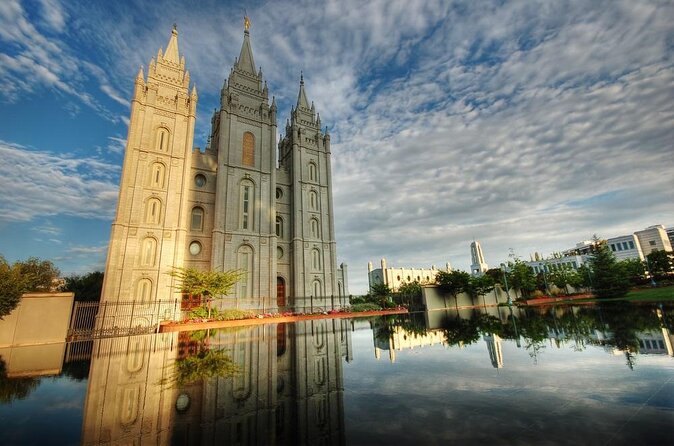
- Temple Square is the heart of the route: You see the Assembly Hall, Tabernacle, Salt Lake Temple, Relief Society Building, and several church institutions.
- Expect more than monuments: Stories cover handcart pioneers, seagulls, women in Utah politics, railroad wealth, and statehood.
- Download before arriving: The Action Tour Guide app and tour content must be downloaded with a strong internet connection.
- Use headphones and follow the route: Audio is designed to begin by GPS as you reach each point, but starting precisely matters.
- The ticket covers narration only: Entry fees, reservations, and attraction passes are not included, although the listed outdoor stops are free to view.
A useful way to see Salt Lake City in two hours
This is not a guided group walk. Nobody meets you at the starting point, and there is no fixed departure time. You open the Action Tour Guide app, go to the first story point, and let the GPS-led narration guide you from stop to stop.
That format suits Salt Lake City well. Downtown is spread out, but the route gathers major sights into one walk. You can stop for pictures, pause for lunch, skip a story, or replay a subject that catches your interest. The tour has lifetime access with no expiry, so you can also use it on a later visit.
The advertised timing is one to two hours, but that is a brisk estimate. The route covers more than 2.5 miles and includes over 30 stories. If you stop often, listen to bonus material, or explore around Temple Square, plan closer to two to three hours.
At $14.99 per person, the price is reasonable if you want structure without paying for a private guide. It is less useful if you prefer to wander with no route at all, or if you expect live answers to questions. Couples can reduce the cost by sharing one tour and splitting headphones, though the access password applies to the number of devices booked.
More Audio Walking Tours in the USA
- Self Guided Classic Freedom Trail Location Aware (GPS) Walking Audio Tour
★ 4.5 · 258 reviews - Cape Cod & Provincetown Self-Guided Driving & Walking Audio Tour
★ 4.0 · 207 reviews - Santa Fe Historic Downtown Smart Phone Audio App Self Guided GPS Walking Tour
★ 4.5 · 112 reviews
Crandall Building and the first downtown stories
The walk begins outside the Visit Salt Lake Center at 90 South West Temple Street. Before the major religious landmarks appear, the opening story gives you a quick look at downtown architecture.
The Crandall Building, with its carved arched entrance, was Salt Lake City’s first skyscraper. Built in the 1890s, it originally housed McCornick Bank and included one of the area’s first elevators. The small detail about women in calico dresses accompanying their husbands simply to ride the new elevator gives the building some human scale.
This is a good opening stop because it keeps the tour from becoming only a lesson in church history. You begin with a city developing modern commercial habits, then move into the people and institutions that shaped Utah.
A short walk brings you to the 25-foot bronze statue of Brigham Young. The narration explains that Young grew up in western New York, in a strict Puritan household, and took two years to study the Book of Mormon before becoming a Mormon. That detail presents him as a deliberate convert rather than rushing through a familiar name.
Pioneer monuments around Temple Square
The next monuments focus on migration and survival. The Handcart Pioneer Monument shows a man and woman struggling with a cart. It honors Mormon pioneers who traveled from Europe to the Salt Lake area in 1856, not the earlier group led by Brigham Young.
That distinction is worth hearing because the monument can be easy to misunderstand when you are looking at it without context. The audio also helps connect local statues with the larger movement of people across the American West.
The Seagull Monument brings a lighter, more memorable story. According to Mormon tradition, crickets attacked the pioneers’ crops in 1848, just as the first settlers expected a successful harvest. After the farmers prayed, seagulls appeared and ate the insects. Gold seagulls on the monument commemorate that event.
You do not need to accept the religious explanation to appreciate the story’s importance. It tells you how early settlers understood a serious food crisis and how the episode became part of Utah’s public identity.
The Assembly Hall, Tabernacle, and Salt Lake Temple
The route then reaches the great buildings around Temple Square. The Salt Lake Assembly Hall, completed in 1882, served as a major gathering place for local church members. Nearby, the Salt Lake Tabernacle dates from 1863 to 1867 and was designed for large Mormon gatherings and events.
The audio gives you a useful sense of sequence. The Tabernacle came first, and the Assembly Hall followed almost two decades later. You are not simply looking at attractive stone buildings. You are seeing the physical growth of a religious community that arrived in the valley with very little and gradually built large public institutions.
The Salt Lake Temple receives its own stop. Look toward the spires and the statue of the angel Moroni, identified in Mormon belief as the angel who led Joseph Smith to the golden tablets connected with the Book of Mormon.
The tour does not require you to enter the buildings to understand their role. Much of the experience is outdoor viewing, which keeps the cost low. Still, remember that the price does not include entry tickets or reservations for any attraction you may want to visit separately.
More Self-Guided Audio Tours in the USA
- Gettysburg Battlefield Self-Guided Driving Audio Tour
★ 4.5 · 910 reviews - Joshua Tree National Park Self-Guided Driving Audio Tour
★ 4.5 · 762 reviews - Ultimate Acadia National Park Self-Guided Driving Audio Tour
★ 4.0 · 521 reviews - Ultimate Lake Tahoe Self-Guided Driving Audio Tour
★ 4.5 · 435 reviews
Temple Square and the early settlement
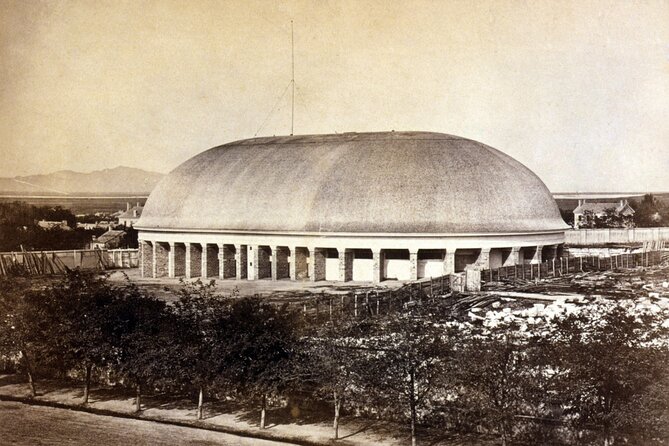
Walking through Temple Square gives the tour its strongest sense of place. Mormon leaders intended this area to be the center of Salt Lake City from the beginning, but the first settlement was far less grand than the manicured religious center you see now.
The narration describes a hard first winter, limited bread, and a measles outbreak. These details correct the easy assumption that the pioneers arrived and immediately created a successful city. Their early years involved hunger, illness, and constant work.
The Relief Society Building adds an important story about women. The Relief Society began in 1842 under Joseph Smith as a women’s organization focused on helping the poor. Its early development also involved an internal struggle within the young religion, giving the stop more substance than a simple architectural description.
The tour then reaches Brigham Young Historic Park. The land once belonged to Young and his family, and the full estate extended almost three blocks north. Carpentry sheds, barns, and orchards of apples, peaches, and pears once filled the property.
This section works best if you enjoy seeing how famous figures lived outside official monuments. The story shifts from public religious buildings to practical domestic life, work areas, and food production.
City Creek Park and the first attempts to farm
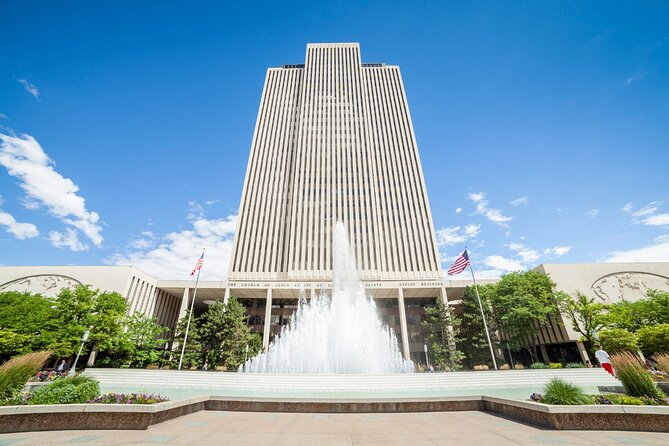
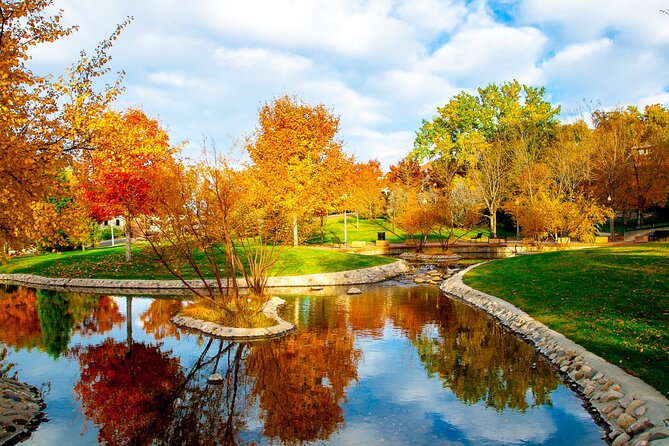
City Creek Park offers a change of pace. You follow the path on the left side of the creek and hear how the pioneers dammed the waterway after settling in the valley.
The purpose was practical. By controlling the creek, they softened ground for crops such as turnips. The story makes clear that the settlers had to adapt their surroundings before they could depend on farming.
This is also one of the places where you should pay attention to the app’s directions rather than walking on autopilot. GPS audio can be less reliable if you move too far from the intended path. The route is designed for a steady walking pace, so stopping for a photo or taking a side trip may require you to pause the tour and resume it manually.
Council Hall and the road to Utah statehood
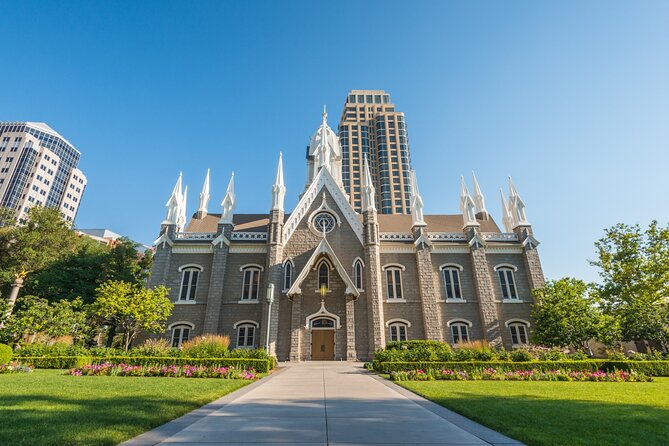
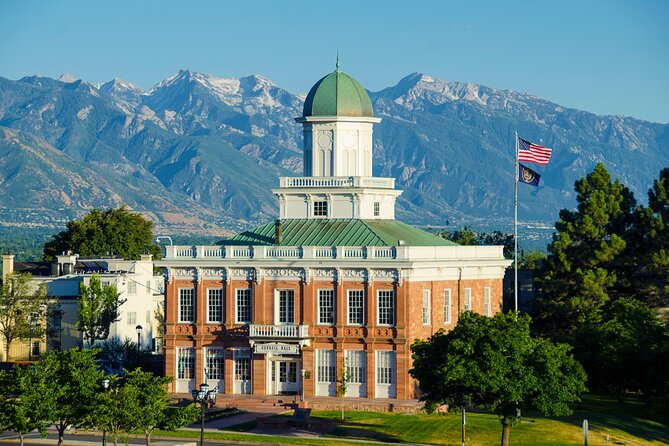
The white building with the green cupola is the former city hall, now known as Salt Lake City Council Hall. It houses the Utah Office of Tourism and the Utah Film Commission, although the building was not always used for those purposes and was not always located where you see it today.
The story becomes more political at the Utah State Capitol. When Mormon pioneers arrived, Utah was a territory rather than a state. From 1850 to 1896, residents petitioned the federal government seven times for statehood.
The tour asks why statehood took so long and connects the delay to the wider political tensions surrounding Utah. This is an important shift in the walk. You move from religious settlement and local monuments into the difficult relationship between Utah and the federal government.
One practical warning belongs here. The audio description of the path around the Capitol could be clearer. You need to understand that the route takes you behind the building. If you are relying only on the spoken directions, this is the section most likely to cause confusion.
Mormon Battalion and Martha Hughes Cannon
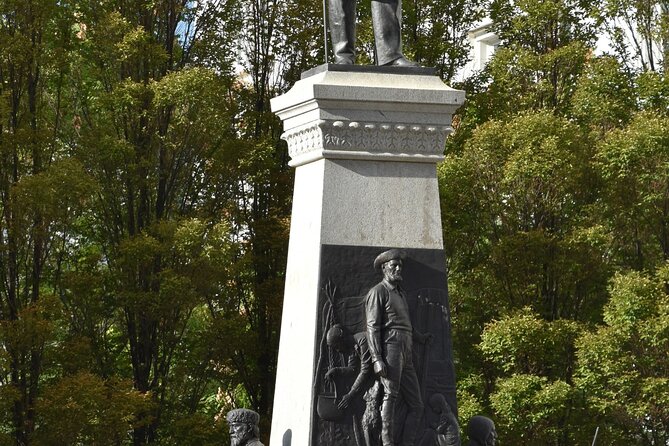
The Mormon Battalion Monument commemorates 500 Mormon volunteers who joined the United States Army during the Mexican-American War. Built in 1927 by Gilbert Riswold, the monument presents different stages of the battalion’s story.
This stop adds military and national context to a route that otherwise focuses heavily on church settlement. It also shows that Mormon history was not separate from American expansion. The volunteers’ service connected the community to a national conflict and the growing United States.
Nearby, the Martha Hughes Cannon statue shifts attention to Utah’s political history and the role of women. Cannon, known to friends as Mattie, was the first female state senator in the United States. She immigrated from England with her family and later worked as a typesetter for a women’s newspaper printed by the Mormon church.
The small story about her walking to work in men’s boots, with her skirt tucked up to avoid mud, makes the statue easier to remember. It also gives you a glimpse of her practical character before the narration turns to her political achievements.
McCune Mansion and the rise of private wealth
The McCune Mansion offers a sharp contrast to the earlier pioneer monuments. This large brick Victorian house was completed around the turn of the twentieth century for Alfred McCune, who made his fortune building parts of the Utah Southern Railroad.
McCune moved in wealthy circles that included J. P. Morgan and William Randolph Hearst. The building reflects a new Salt Lake City, one shaped not only by religious leadership and immigrant labor but also by railroads, business fortunes, and public displays of wealth.
I like this part of the route because it broadens the city’s story. You are no longer looking only at the origin of the settlement. You are seeing what happened after Salt Lake City developed money, transportation links, and ambitious local elites.
The Conference Center, Church History Library, and museum
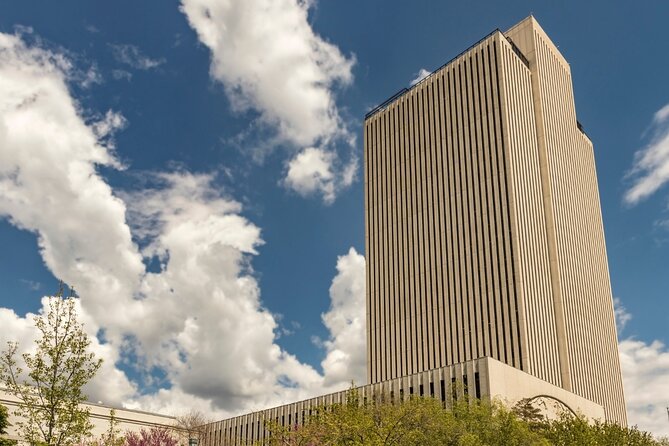
The final stretch returns to the institutions of the Church of Jesus Christ of Latter-day Saints. The Conference Center, completed in 2000, hosts the church’s semiannual general conference each April and October. Members come from around the world to hear church leaders there.
The Church History Library, opened in 2009, preserves documents connected with the church, including material dating to the 1820s. If early writings from figures such as Joseph Smith and Brigham Young interest you, this stop points toward a place where that material is preserved.
The Church History Museum offers interactive exhibits and artifacts related to the pioneer journey. It is a useful add-on if you want more than outdoor viewing, but museum admission is not included in the audio tour price.
The final stop is the FamilySearch Library at 60 North Temple. Its collection includes names of more than three billion people from around the world through books, microfilm, and periodicals. Staff can help you begin genealogy research, making this an especially useful finish for anyone with family connections to Utah or an interest in ancestry.
App setup, timing, and practical concerns
After booking, you receive setup instructions and a password by email and text. Search for audio tour if the message is not easy to find. Download the separate Action Tour Guide app, enter the password, and download the tour while you have strong Wi-Fi or cellular service.
The tour works offline after the download. An iPhone running iOS 15 or later, an Android device using version 9 or later, or an iPad or tablet with GPS and cellular capability is recommended.
Bring earbuds or headphones. The audio is intended to play automatically as you reach each point, which lets you keep your hands free. In practice, you will have a better experience if you begin exactly at the listed starting point and follow the suggested route speed. Some users have found that stories did not begin automatically, and others walked faster than the narration.
The tour operates daily from 6:00 AM to 9:00 PM according to the listed hours. Since access does not expire, you can also split the walk over more than one day or return to hear bonus stories.
Free cancellation is available when you cancel at least 24 hours before the scheduled start time. Changes or cancellations inside that window are not refundable.
Should you book the Salt Lake City audio walk?
Book it if you want a low-cost introduction to downtown Salt Lake City, prefer exploring privately, and enjoy history delivered in short pieces. The strongest parts are the coverage of Temple Square, the unusual stories behind the seagull and handcart monuments, the account of Martha Hughes Cannon, and the look at how railroads changed the city.
Skip it if you want a live guide, perfect turn-by-turn directions, or a very short stroll. The Capitol section needs extra attention, and GPS audio may require patience. Still, at $14.99, the tour gives you a useful route, a pleasant narrator, offline access, and the freedom to go at your own pace. For many first visits, that is a fair deal.
FAQ
How long is the Salt Lake City audio tour?
The walk is advertised as taking about one to two hours, but the route is over 2.5 miles with more than 30 audio stories. If you stop for photos, listen to extra stories, or take breaks, it may take closer to three hours.
Where does the tour start and finish?
It starts outside the Visit Salt Lake Center at 90 South West Temple Street. The route finishes at 60 North Temple near the FamilySearch Library.
Is a guide provided at the meeting point?
No. This is a private, self-guided activity. Nobody meets you at the starting point, and you begin the tour through the Action Tour Guide app.
Do I need an internet connection during the walk?
You need strong Wi-Fi or cellular service to download the app and tour content before starting. After the download, the tour works offline.
Are attraction tickets included?
No. The price includes the audio tour and app access, but attraction passes, entry tickets, and reservations are not included.
Can I pause the tour or use it on another day?
Yes. The tour has lifetime access with no expiry. You can pause it, take side trips, return on another day, and use it again on future visits.
Just added around the USA
- Self Guided Driving Audio Tour of Saguaro National Park★ 3.0 · 4 reviews
- Self-Guided Audio Driving Tour of Mount Lemmon★ 5.0 · 4 reviews
- Saguaro National Park Self-Guided Audio Tour★ 3.5 · 11 reviews
- A Self Guided Audio Tour in Tombstone★ 4.0 · 11 reviews
- Catskills Scenic Byway Self-Guided Driving Audio Tour★ 4.0 · 9 reviews
- Big Bend National Park Self Guided Audio Tour Guide★ 5.0 · 12 reviews
- Self-Guided Audio Driving Tour in Catskills Scenic Byway★ 4.5 · 7 reviews
- Shiloh Battlefield Self-Guided Driving Audio Tour★ 4.0 · 9 reviews
Self-Guided Tours, compared.
Acropolis Ticket & Optional Self-Guided Audio Tours
Read our review →


Ultimate Acadia National Park Self-Guided Driving Audio Tour
Read our review →

Santorini: Akrotiri Ticket with Optional Self-Guided Audios
Read our review →
Browse the lists this tour appears in