
REVIEW · RIGA AUDIO TOURS
Riga’s Architecture: A self-guided audio tour of the city’s art nouveau history
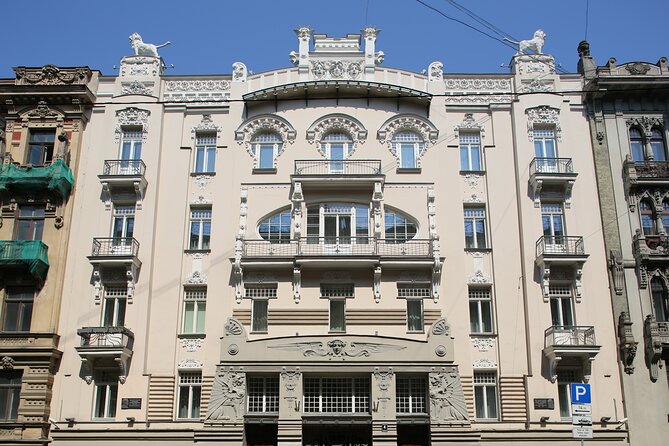
Riga rewards people who look up. This short audio walk introduces you to the city’s remarkable Art Nouveau district, where ornate façades, inventive details, and competing architectural ideas fill the streets around Alberta iela. I like the tour’s clear, manageable storytelling and its focus on Mikhail Eisenstein, whose dramatic buildings are among Riga’s most memorable sights. I also like that the app works offline, so you can follow the route without relying on mobile data.
The main drawback is its fixed, non-refundable booking policy. You also need your own smartphone and headphones, and there is no live guide to answer questions or adjust the pace. Still, at $5.20 per person for lifetime access in English, this is an inexpensive way to give a short walk some useful historical shape.
Key points to know before you go
- Riga has more than 800 Art Nouveau buildings, giving this short route an unusually strong concentration of architectural sights.
- The walk takes about 30 to 45 minutes, making it easy to fit into a busy day in Riga.
- The route begins at the Latvian National Museum of Art and ends at Alberta iela 12.
- Mikhail Eisenstein’s decorative work receives special attention, including the striking buildings at Elizabetes 10b and Alberta 2a.
- The tour explains National Romanticism, a Latvian interpretation of Art Nouveau that feels more restrained and regional.
- Offline maps, audio, and geodata are included, but you must bring your own phone and headphones.
Why Riga is such a good city for Art Nouveau
Riga is one of Europe’s best cities for seeing Art Nouveau without spending the day inside museums. More than 800 buildings use the style, and a large concentration sits in the central district near Alberta iela. That makes the city especially rewarding for a walking tour based on façades rather than interiors.
Art Nouveau is not one single look. Some buildings are covered in theatrical masks, figures, animals, flowers, and heavy ornament. Others use simpler lines, rougher textures, and shapes connected to Latvian identity. A good introduction helps you recognize those differences instead of treating every decorated building as the same.
This tour focuses on that basic visual skill. You learn how to identify Art Nouveau, then apply the idea at a sequence of important addresses. I find that approach more useful than a string of dates and architect names. Once you know what to look for, the buildings begin to make more sense.
The route also gives you a small piece of Riga’s cultural story. The city’s architects were working during a period when local identity was becoming increasingly important. Their buildings were not only fashionable European designs. Some also searched for a specifically Latvian architectural voice, later known as National Romanticism.
More History Audio Tours in the world:
- Colosseum, Roman Forum & Palatine Hill with Audioguide App
★ 4.4 · 6,291 reviews - Venice: St. Mark Basilica Ticket, Audioguide+History Gallery
★ 3.9 · 4,780 reviews - Rome: Colosseum, Ancient Rome Tour or AudioGuided Tour
★ 4.4 · 2,879 reviews
Starting at the Latvian National Museum of Art
The tour begins at the Latvian National Museum of Art on Jaņa Rozentāla laukums. This is a practical starting point because it places you close to the Art Nouveau district and gives you a clear public landmark for finding the first audio point.
You do not need to enter the museum for this experience. Museum admission is not included, and the route is designed as an outdoor walk. If you have extra time, the museum may be worth visiting separately, but the audio tour itself begins outside.
At the start, the audio introduction sets up the main question: how can you tell an Art Nouveau building from another ornate historic structure? That is a useful lesson in Riga, where façades from different periods can appear close together.
Because the walk is self-guided, you can begin when it suits you during the day. The stated operating period runs from July 10, 2020 through June 18, 2026, with access listed around the clock. In practice, daylight will make architectural details easier to see, especially high above street level.
Elizabetes 10b and the drama of Mikhail Eisenstein
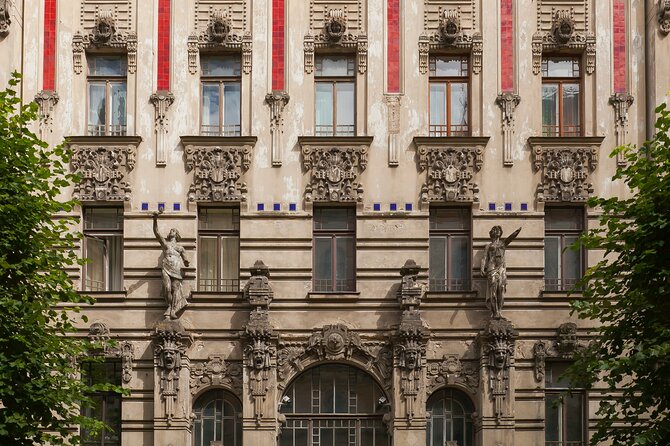
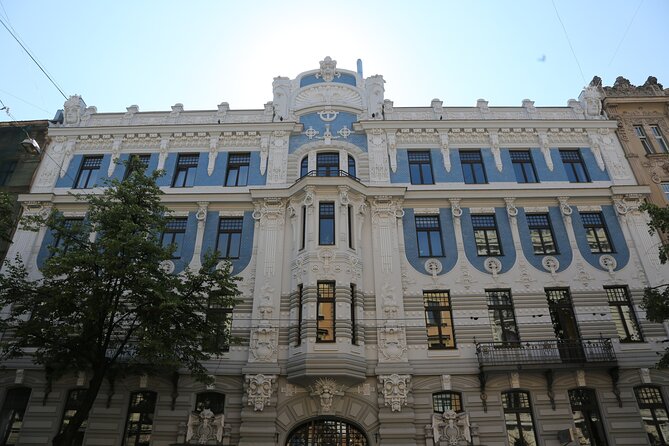
The first major stop is Elizabetes 10b, one of the addresses tied to Mikhail Eisenstein. His work is known for bold decoration, and this stop gives the tour a chance to explain how Art Nouveau can turn an apartment building into a theatrical street scene.
Look up carefully here. The details that matter may sit around windows, entrances, upper floors, and rooflines. The audio helps direct your attention to the parts that a quick glance might miss. That guidance matters because Riga’s façades can be visually crowded. Without some context, you may notice only that a building looks fancy.
Eisenstein is an interesting figure for another reason. His son, Sergei Eisenstein, became a legendary Soviet filmmaker. The connection gives the architectural discussion a human thread and links Riga’s decorative streets with a much broader cultural story.
I like this stop because it turns an architect’s name into something visible. You are not just memorizing Mikhail Eisenstein. You are matching his name with a particular taste for theatrical ornament and expressive façades.
The limitation is that the tour only stops briefly at each location. If you want to study every sculptural feature or photograph each angle, the audio may move faster than you do. You can pause the tour, but the experience works best when you treat it as a guided introduction rather than a full architectural survey.
Alberta 2a and Riga’s most decorative side
The route continues to Alberta 2a, another important Eisenstein address. This section is likely to appeal most to people who enjoy ornament, symbolism, and buildings that make no attempt to be quiet.
The tour explains the incredibly decorative work associated with Mikhail Eisenstein. That wording matters because his façades are not simply decorated with a few floral touches. The style can feel crowded, expressive, and almost theatrical. Faces and sculptural elements draw your eye across the building, creating a strong contrast with more restrained Art Nouveau designs elsewhere in the city.
This is a good place to use the app’s pause function. The audio gives you the meaning and background, but your own eyes need time to inspect the building. You might find that the most enjoyable rhythm is to listen to a section, stop the recording, then spend a few minutes looking before continuing.
The street setting also helps you understand why Riga is considered an Art Nouveau metropolis. You are seeing these buildings as part of an urban neighborhood, not as isolated objects in a museum. Their scale, spacing, and repeated façades show how an entire district adopted the style.
More Self-Guided Audio Tours in the world:
- Athens: Acropolis Ticket & Optional Self-Guided Audio Tours
★ 4.1 · 2,542 reviews - Gettysburg Battlefield Self-Guided Driving Audio Tour
★ 4.5 · 910 reviews - Joshua Tree National Park Self-Guided Driving Audio Tour
★ 4.5 · 762 reviews - Ultimate Acadia National Park Self-Guided Driving Audio Tour
★ 4.0 · 521 reviews
Alberta 4 and the value of comparing façades
At Alberta 4, the tour continues its close look at Riga’s architectural variety. The route is short, but the addresses are chosen to let you compare different approaches to the same broad movement.
That comparison is one of the tour’s best features. Art Nouveau is easier to understand when you see several buildings in succession. One address may emphasize ornamental figures, while another uses more orderly lines or a different treatment of windows and entrances.
I would not rush this section. The route takes only 30 to 45 minutes in total, but the audio time is not the same as the amount of time you may want for looking. Add a little extra time if photography matters to you.
You should also expect city sounds and normal street activity. This is not a controlled museum experience. That is part of the appeal, since the buildings remain connected to everyday Riga, but it can make listening less comfortable if you do not have headphones.
Alberta 11 and the shift toward National Romanticism
At Alberta 11, the tour moves toward one of the most useful ideas in the experience: National Romanticism. This was a Latvian interpretation of Art Nouveau that looked for a more local architectural identity.
The distinction is important. If you walk through Riga expecting every Art Nouveau building to be covered in the same kind of decoration, you will miss the point. National Romantic buildings can feel sturdier and more connected to regional traditions. Their shapes and materials may suggest local culture rather than the lighter, more playful decoration often associated with Art Nouveau.
The audio gives you a framework for seeing that shift. You can compare the building at Alberta 11 with the more theatrical Eisenstein examples you have just encountered. The route becomes less about spotting pretty details and more about understanding why architects made different choices.
This is also where the tour provides more than a basic sightseeing checklist. You are being shown how architecture reflects politics, culture, and a search for identity. The Dutch-language rating describes the narration as clear, passionate, and connected to history and politics. That fits the tour’s wider value: it treats architecture as part of Riga’s public life, not just decoration.
Alberta 13 and the residential character of the district
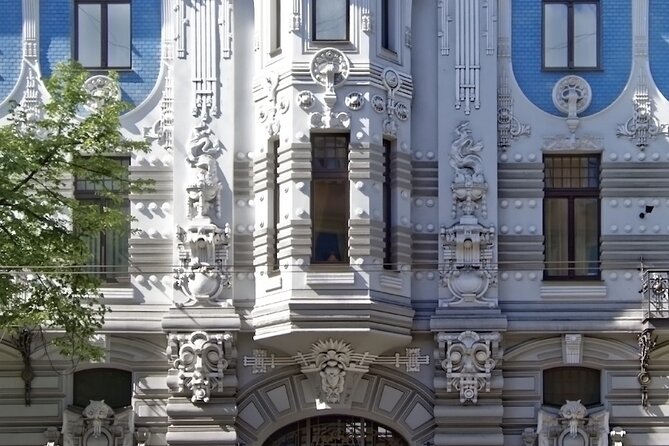
The next stop is Alberta 13. This address continues the walk through one of Riga’s most concentrated architectural areas and helps you see the buildings as residential spaces.
The tour also includes the courtyard of one of Riga’s most impressive residential buildings. Courtyards are easy to miss on a normal walk because the street façade gets all the attention. If the entrance is accessible during your visit, the audio directs your attention inward, where the relationship between private living space and public street becomes clearer.
You should keep expectations realistic. The supplied details do not promise access to every interior or courtyard at all times. The tour is primarily an outdoor experience, and no entrance fees are included. Treat the courtyard reference as an architectural feature to look for, not a guarantee that every interior door will be open.
That small qualification is important. Self-guided audio tours give you freedom, but they cannot open locked doors or control building access. The upside is that you can continue without waiting for a group. The downside is that some details may be visible only from outside.
Ending at Alberta 12
The walk ends at Alberta 12, keeping you in the heart of the Art Nouveau district. This is a convenient finish because you can continue exploring the surrounding streets on your own, take photographs, or simply stop the audio and enjoy the architecture at your own pace.
The final stop completes the route’s progression from basic identification to stylistic comparison. By this point, you have heard about Art Nouveau ornament, Mikhail Eisenstein’s work, Riga’s residential architecture, and National Romanticism.
Do not think of the ending as a formal exit. There is no live guide dismissing the group and no transport back to your hotel. You finish in the city, with central Riga around you. That makes this a useful first walk, especially if you want to keep exploring after the audio ends.
What the $5.20 price really gets you
At $5.20 per person, the main value is not the length of the walk. Thirty to 45 minutes is brief. The value comes from having a ready-made route, spoken interpretation, offline maps, and lifetime access in English through the VoiceMap app.
A live walking tour would normally give you the chance to ask questions and respond to the group’s interests. This audio experience cannot do that. But it also avoids fixed departure times and group pacing. You can start alone or with your own group, pause whenever you want, and revisit the audio later.
The lifetime access is useful if you want to repeat the route or share the app across a longer Riga visit, within the service’s own access terms. Once downloaded, the app also provides access to other self-guided tours, which may increase the value if you plan to use it beyond this one walk.
The price is especially fair for a short stay. If you have only a few hours in Riga, the route gives you an efficient introduction without committing to a long excursion. If you already know architectural history well, you may find the content too introductory.
App setup, timing, and practical limits
You receive access through the VoiceMap app for Android and iOS. Audio, maps, and geodata are available offline, which is one of the strongest practical features. Download what you need before setting out, then you can follow the route without depending on a live connection.
Bring your own smartphone and headphones. Neither is supplied. Headphones are strongly useful because the route takes place on city streets, where traffic and other sounds may compete with the narration.
The booking confirmation arrives at the time of booking. The experience is listed as private, meaning only your own group participates, but this does not mean a private guide joins you. It is still a self-guided activity.
The route is near public transportation, and most people can participate. No transportation, food, drinks, museum tickets, or attraction entry fees are included. Plan the walk as an outdoor city activity, not as a package with refreshments or indoor admissions.
The non-refundable policy deserves attention. You cannot change or cancel the experience for a refund. Since the cost is low, the financial risk is limited, but you should wait until your Riga plans are firm before booking.
Who will like this Riga audio walk
I would choose this tour if you enjoy architecture but do not want a long lecture. The narration gives you enough information to understand what you are seeing, then leaves room to look around. That balance is one of its strongest qualities.
It also suits you if you are traveling under time pressure. The route is short, close to public transportation, and easy to fit between other central Riga sights. The audio can help you make better use of a free half-hour instead of wandering past the same façades without context.
Independent visitors will appreciate the control. You can stop for photos, replay a section, or move on quickly. Families and small groups may also find the private format easier than joining a fixed walking group.
You may want a different experience if you prefer detailed architectural analysis, interior access, or live conversation. The tour does not include museums or attraction tickets, and there is no guide to answer follow-up questions. It is best viewed as a well-priced introduction, not the final word on Riga’s architecture.
Should you book Riga’s Art Nouveau audio tour?
Book it if you want a short, inexpensive way to understand Riga’s most famous architectural district. The best reasons are the focused route, the attention to Mikhail Eisenstein, the explanation of National Romanticism, and the offline app access.
Skip it if you already know Riga’s Art Nouveau buildings well or strongly prefer a live guide. For everyone else, $5.20 is a modest price for a useful introduction that can change the way you look at the city’s façades. Bring headphones, allow extra time for photographs, and remember that the tour is only the beginning of your walk through Riga’s remarkable central streets.
FAQ
Where does the tour begin?
It begins at the Latvian National Museum of Art, Jaņa Rozentāla laukums 1, in Riga’s Centra district.
Where does the tour end?
The tour ends at Alberta iela 12, in Riga’s Centra district.
How long does the audio tour take?
The approximate duration is 30 to 45 minutes.
Is the tour available offline?
Yes. The VoiceMap app includes offline access to the audio, maps, and geodata.
Are museum tickets or attraction fees included?
No. Tickets and entrance fees to museums or other attractions along the route are not included.
Do I need to bring my own phone and headphones?
Yes. A smartphone and headphones are not included, so you need to provide both.
Just added around the world
- Coba Ruins: Self-Guided Walking Audio Tour in Mexico★ 3.5 · 2 reviews
- Self Guided Driving Audio Tour of Saguaro National Park★ 3.0 · 4 reviews
- Torino Walking Tour with Audio and Written Guide by a Local★ 4.5 · 35 reviews
- Self-Guided Audio Driving Tour of Mount Lemmon★ 5.0 · 4 reviews
- Trondheim’s Inner Circle: A Self-Guided Audio Tour★ 4.0 · 15 reviews
- A Tromsø Introduction: A Self-Guided Audio Tour★ 3.5 · 19 reviews
- Panorama Bus Tour with Audio Guide★ 4.0 · 3 reviews
- Saguaro National Park Self-Guided Audio Tour★ 3.5 · 11 reviews
Self-Guided Tours, compared.

Acropolis Ticket & Optional Self-Guided Audio Tours
Read our review →


Ultimate Acadia National Park Self-Guided Driving Audio Tour
Read our review →

Santorini: Akrotiri Ticket with Optional Self-Guided Audios
Read our review →
Browse the lists this tour appears in