
REVIEW · POLAND AUDIO TOURS
The Birthplace of Poland: A Self-Guided Audio Tour of Poznań
Poland’s story begins beside the river. This affordable audio walk leads you across Cathedral Island and into Śródka, linking early Polish rulers, old churches, Prussian fortifications, and modern museums in about 45 minutes to 1 hour 15 minutes. I like the way the route joins major sights with smaller details, especially Mieszko’s palace remains beneath the Church of Our Lady in Summo. I also like the freedom to pause, backtrack, or stop for a closer look without holding up a group.
The main drawback is the technology. GPS-triggered audio can be excellent when it works, but one technical problem can leave you unsure where to stand or what to see. You need your own smartphone and headphones, and you should download everything before setting out.
Key points at a glance
- Mieszko’s palace lies beneath a church: The Church of Our Lady in Summo covers the remains of an early palace and chapel.
- The route crosses the Jordan Bridge: You’ll hear how this important link between Cathedral Island and Śródka was built, destroyed, and rebuilt.
- It covers two distinct districts: Cathedral Island carries Poland’s earliest religious and political story, while Śródka once operated independently.
- The Srodka mural adds a modern touch: This large wall painting gives the walk a change of pace after the churches and old fortifications.
- You pay for guidance, not admission: The $8.99 price includes the English audio tour, app access, maps, and geodata, but not museum tickets.
- You set the pace: The route is private by default because only your group uses the self-guided tour.
Why Cathedral Island matters to Polish history
Cathedral Island, known in Polish as Ostrów Tumski, is more than an attractive old quarter beside the river. It is the place where the tour connects the beginnings of the Polish state with the churches, palaces, and defensive works that followed.
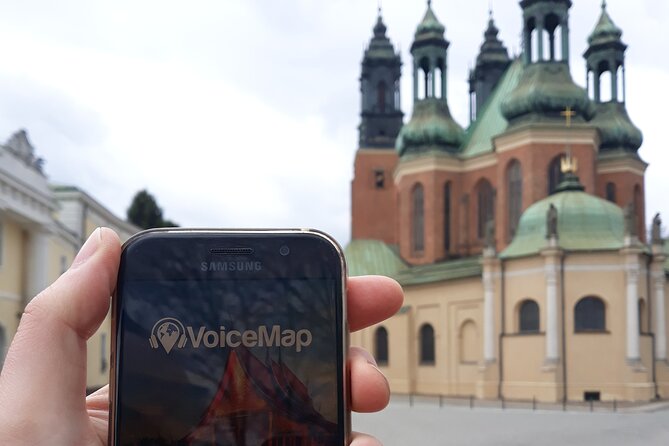
The walk starts beside a scale model of the island at Ostrów Tumski 9. This is a useful meeting point because you can first get your bearings from the model before the audio begins. The introduction also explains how VoiceMap works, including the location-based playback system.
I like this opening because it gives you a simple map in front of you before the history starts coming at you. The route is not just a string of dates. It shows how religious power, royal authority, transport links, and urban neighborhoods developed beside one another.
The audio runs in English and uses your phone’s location to trigger the next section. In practice, that means you can keep your eyes on the buildings rather than checking a printed route at every corner. Still, I would download the audio, maps, and geodata before walking. Offline access is included, which matters if your signal drops or you prefer not to use mobile data.
More Self-Guided Audio Tours in Poland:
- Gdansk Scavenger Hunt and Highlights Self Guided Audio Tour
★ 5.0 · 6 reviews - Athens: Acropolis Ticket & Optional Self-Guided Audio Tours
★ 4.1 · 2,542 reviews - Gettysburg Battlefield Self-Guided Driving Audio Tour
★ 4.5 · 910 reviews
Under the Church of Our Lady in Summo
One of the most striking early stops is the Church of Our Lady in Summo. From the outside, it may look like one more historic church along a route filled with religious buildings. The audio gives it much greater weight by explaining what lies below.
Beneath the church are substantial remains of Mieszko’s palace and palace chapel. That detail changes the way you see the site. You are not only looking at a medieval church. You are standing above the remains of the center of early political and religious life in Poland.
The tour does not include entrance tickets, so you should think of this as an exterior interpretation unless you separately arrange access to an attraction. The audio helps you understand the significance of the building without turning the walk into a museum visit.
I especially like this stop for visitors who want context. A guide standing beside you could point out the same connection, but the audio lets you hear it at your own speed and replay it later.
Poznań Cathedral and the Archbishop’s Palace
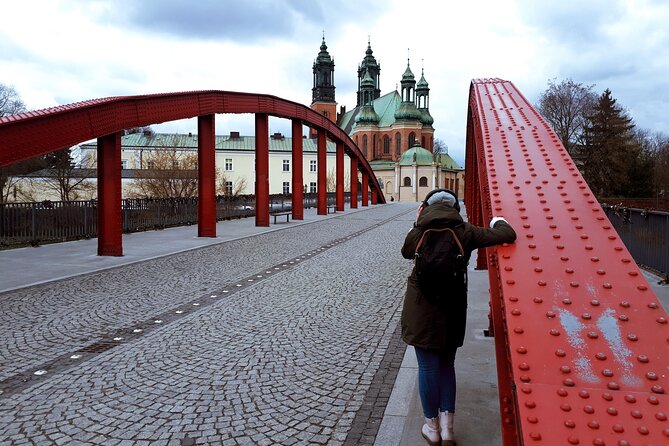
The route then passes Poznań Cathedral, described as Poland’s oldest cathedral. This is the core religious landmark of Cathedral Island, and the walk gives you a chance to place it within the larger story of the district.
You’ll hear about the cathedral as you continue, rather than stopping for a long formal lecture. That suits the format. You can look at the building, listen to the explanation, and move on when you are ready.
Next comes the Archbishop’s Palace. Its story is not a simple tale of one building surviving unchanged. The palace went through several versions, and the audio uses those changes to explain how the area developed over time.
That is one of the useful strengths of this walk. Buildings are not treated as frozen objects. You get a sense that the district has been rebuilt, altered, and adapted repeatedly. If you enjoy architecture, the palace is likely to reward close attention. If you mainly want interior visits, remember that entrance fees and museum admissions are not part of the $8.99 price.
Crossing the Jordan Bridge into Śródka
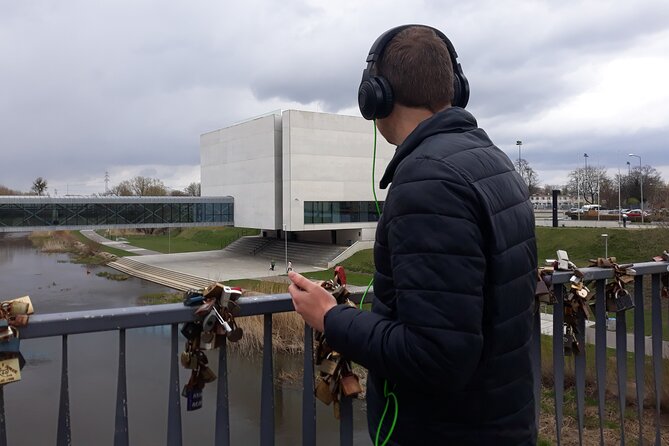
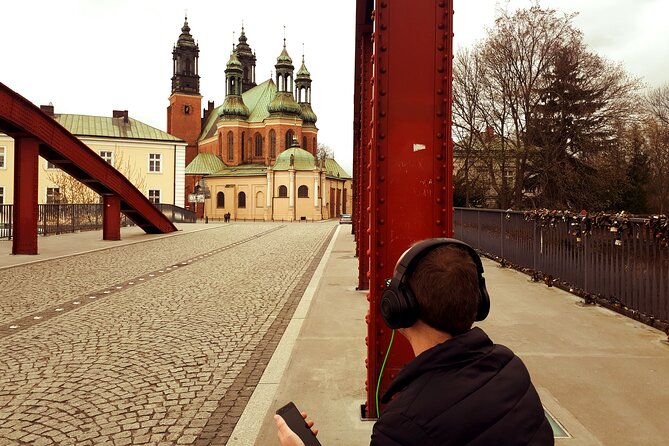
The Jordan Bridge provides the route’s clearest physical transition. You leave Cathedral Island and cross toward the Śródka District, while the audio explains the bridge’s troubled past.
The bridge was built, destroyed, and rebuilt before it finally restored the connection between the two areas. That history gives the crossing a practical meaning. You are not simply walking over water. You are following a link that has been lost and restored more than once.
I like the way this part makes the geography easy to understand. Cathedral Island and Śródka are close together, but the bridge shows how a short gap can shape the life of a neighborhood. You can also pause here if you want a moment to take in the river and reset before the next part of the walk.
The route is estimated at 45 minutes to 1 hour 15 minutes, but the self-guided format means your actual time can vary. If you stop to take photographs, enter a museum, or sit for a break, you will need longer. The audio itself is designed to be flexible rather than tightly timed.
A few more audio tours around Poland worth a look
- Wroclaw: E-Car Tour and Audio Guide
★ 4.6 · 1,738 reviews - Krakow: Day or Night Vistula River Cruise with Audio Guide
★ 4.5 · 1,303 reviews - Krakow: Hop-On Hop-Off Bus Tour with Audio Guide
★ 3.6 · 703 reviews - Krakow: Wawel Hill Audioguide Tour
★ 4.3 · 582 reviews
Śródka, once separate from Poland
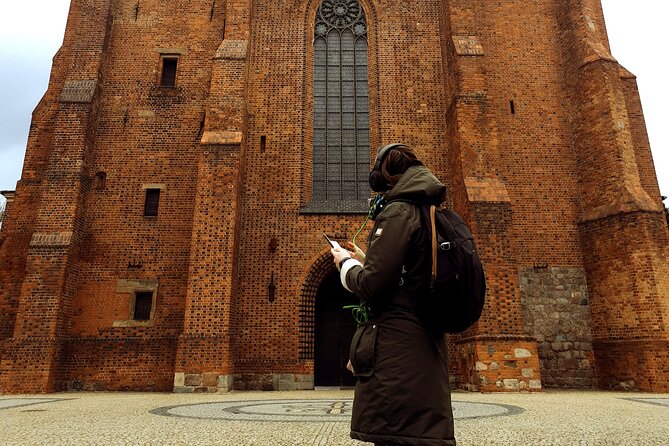
Śródka adds a different layer to the tour. At one point, the district was independent from the rest of Poland. That fact is easy to miss if you move through the area only as a path between the island and the city center.
The audio explains the district while you walk, helping you notice its separate identity. I find this sort of detail valuable because it gives a neighborhood a political and social story, not just a collection of attractive streets.
After the grand cathedral buildings, Śródka offers a change of scale. The route feels less focused on royal and church power and more focused on how a local district developed. You should listen carefully here because the point is not one famous monument. It is the relationship between the neighborhood and the larger city.
The Srodka mural and Saint Margaret Church
The Srodka mural is one of the route’s most memorable visual stops. It is described as one of the first wall paintings of this type in Poland, giving the walk a strong modern feature after its concentration on ancient and medieval sites.
The mural also helps break up the rhythm of churches and old defensive structures. I like having a large, contemporary artwork in the middle of a history walk. It shows that Śródka is not being presented only as a preserved past.
The tour then passes Saint Margaret Church. As with the other churches, the audio provides an explanation while you walk rather than requiring a formal guided visit. You can decide how much time to spend looking at the exterior and whether to explore further on your own.
This is a good section for visitors who prefer variety. You get religious architecture, local district history, a large public artwork, and a walk through the neighborhood without needing to join a scheduled group.
Brama Poznania and the value of paying extra
The route continues past Brama Poznania, also called the Porta Posnania Heritage Center. This is a modern museum created in 2014 to explain the history of Cathedral Island and Śródka.
The audio tour does not include admission, but Brama Poznania may be worth considering if you want to spend more time with the area’s story. The self-guided walk gives you an outdoor framework. A museum visit can add displays and a more concentrated presentation.
You do not need to enter the museum to complete the audio route. That is helpful if you are keeping to a tight schedule or prefer to limit paid admissions. On the other hand, the short outdoor tour can serve as a useful introduction before deciding if you want a longer museum visit.
At $8.99 per person, the experience is priced as a low-cost orientation rather than a full day of sightseeing. I think that is fair. You are paying for the route design, recorded explanations, GPS guidance, and lifetime access, not for a guide, transport, or attraction tickets.
Prussian defenses at the Cathedral Lock
The Cathedral Lock brings military history into the walk. It is a 19th-century part of the Prussian fortification system, a reminder that Poznań’s strategic importance continued long after the earliest Polish rulers.
This stop broadens the story beyond churches and bishops. You see how later powers shaped the city and used its position for defense. The route becomes a layered timeline: early Polish statehood, church authority, neighborhood independence, and Prussian military planning.
The lock is also a good example of why the audio format can work well. A fortification element may not explain itself to someone walking past. A short spoken account gives you the reason to stop and look.
Genius Loci and the surviving walls
The tour passes the Genius Loci museum, a modern institution focused on the remains of the thousand-year-old borough walls. It also uses 3D immersive films to present the site.
Again, admission is separate. The route tells you why the museum matters, but you should allow extra time and budget if you want to go inside. The museum is especially relevant if you like archaeology, old defenses, or visual reconstructions of places that have changed over time.
I appreciate that the tour includes both the physical remains and the newer ways of explaining them. You get the old walls outdoors and the option of 3D films indoors. That combination helps link what survives in front of you with what the district may have looked like in earlier periods.
Ending at the Archdiocese Museum
The walk ends in front of the Archdiocese Museum in Poznań, at Jana Lubrańskiego 1, beside the Lubrański Academy. This is a fitting final point because the museum and academy played an important role in Poznań and across Poland from the 1500s through the 1700s.
The route does not take you inside, and admission is not included. Still, the final stop gives the tour a clear ending rather than leaving you somewhere without context.
I would treat the endpoint as a useful place to continue exploring on your own. You can decide if the museum fits your schedule, or simply finish the walk and make your way onward by public transport or on foot.
How the VoiceMap format works
You receive lifetime access to the English tour through the VoiceMap app for Android and iOS. The app uses GPS to play the correct guidance as you reach each part of the route, and offline access covers the audio, maps, and geodata.
That setup gives you several practical advantages:
- You can pause and resume the walk.
- You can stop for food, photographs, or a museum visit.
- You can repeat the tour later because access is not limited to one day.
- Only your group participates, so you do not need to match another group’s pace.
The weak point is dependence on your phone. A technical problem can make the route confusing, especially at the start. I would install the app, download the tour, check the starting point, and test your headphones before leaving. If something goes wrong, VoiceMap support can be contacted by telephone or email, and a support request has been resolved quickly in at least one case.
The narration is another plus. The audio is designed to sound like a guide leading you through the area, with a pleasant voice and a clear interest in Poznań’s past. That does not replace the chance to ask questions, so anyone who prefers live conversation may find a scheduled walking tour more satisfying.
Who should choose this tour?
I would recommend it for independent visitors who want a low-cost introduction to Cathedral Island and Śródka. It suits solo visitors, couples, and small private groups who prefer to stop when they choose.
It is also a good fit if you have limited time in Poznań. In under 90 minutes, you get a route linking the cathedral, Archbishop’s Palace, Jordan Bridge, Śródka, the mural, Saint Margaret Church, Brama Poznania, the Cathedral Lock, Genius Loci, and the Archdiocese Museum.
I would be more cautious if you dislike phone-based tours or want detailed answers to personal questions. The tour is in English only, and the experience depends on your own smartphone and headphones.
The route is near public transportation, and the activity information says most people can participate. No transportation, food, or drinks are included. You should also note that the purchase is non-refundable and cannot be changed, so check your plans before paying.
Should you book it?
Book this tour if you want flexible historical orientation for $8.99, especially if you plan to explore Cathedral Island and Śródka independently. The strongest parts are the connection between Mieszko’s palace remains and the early Polish state, the story of the rebuilt Jordan Bridge, and the mix of old churches, modern museums, and public art.
Skip it if you need a live guide, guaranteed technical simplicity, or included museum entry. For everyone else, download the route in advance, bring headphones, and allow extra time beyond the stated walking duration if you want to visit Brama Poznania, Genius Loci, or the Archdiocese Museum.
FAQ
Where does the audio tour start?
It starts in front of the scale model of Ostrów Tumski at Ostrów Tumski 9, 61-109 Poznań, Poland.
Where does the tour end?
It ends in front of the Archdiocese Museum in Poznań, at Jana Lubrańskiego 1, beside the Lubrański Academy.
How long does the tour take?
The estimated duration is about 45 minutes to 1 hour 15 minutes.
What language is available?
The tour is offered in English.
What does the price include?
The price includes lifetime access to the self-guided audio tour, the VoiceMap app for Android and iOS, and offline access to the audio, maps, and geodata.
Are museum tickets included?
No. Entrance fees for museums and other attractions along the route are not included.
Do I need my own phone and headphones?
Yes. A smartphone and headphones are not provided.
Can I pause the tour?
Yes. Since it is self-guided, you can stop and continue at your own pace.
Is the booking refundable?
No. The experience is non-refundable and cannot be changed after booking.
Just added around Poland
- Wawel Hill Audio-Guided Tour★ 3.5 · 19 reviews
- Krakow: Vodka Factory Museum – Entrance Ticket and Audioguide★ 5.0 · 3 reviews
- Krakow Jewish Ghetto and Quarter Audio Guided Walking Tour★ 4.5 · 9 reviews
- Wawel Hill Audio Guided Tour★ 3.0 · 2 reviews
- Krakow Walking Tour with Audioguide on Your Smartphone★ 4.0 · 5 reviews
- Gdansk Scavenger Hunt and Highlights Self Guided Audio Tour★ 5.0 · 6 reviews
- Malbork Castle Regular Audioguided Tour★ 4.5 · 15 reviews
- Krakow: Old Town Audio-Guided Walking Tour with Headset★ 4.5 · 12 reviews
Self-Guided Tours, compared.

Acropolis Ticket & Optional Self-Guided Audio Tours
Read our review →


Ultimate Acadia National Park Self-Guided Driving Audio Tour
Read our review →

Santorini: Akrotiri Ticket with Optional Self-Guided Audios
Read our review →
Browse the lists this tour appears in