

REVIEW · USA AUDIO TOURS
Plymouth Pilgrims Self-Guided Walking Audio Tour
History sounds better on foot. Plymouth’s Pilgrim landmarks are spread through town, and this self-guided audio tour connects them with more than 24 stories, offline maps, and location-triggered narration. You use your own phone, start when you like, and pause for photos, food, or museum visits.
I like the flexible pace and the fact that your purchase gives you lifetime access with no expiry. I also like the low price, especially for a couple sharing one set of earbuds. The main drawback is the technology: several people have had trouble getting the app to trigger automatically, and the route may feel long or confusing if you miss the starting point or ignore the map cues.
Key points to know before you go

- More than 24 audio stories connect Plymouth’s best-known Pilgrim landmarks.
- Lifetime access lets you return to the tour on another day or another trip.
- Offline maps and audio mean you can continue without cellular service after downloading everything.
- No guide meets you, so you need to install the Action app and enter your password before arriving.
- The route is over one mile, but the full experience can take two to three hours with stops and side visits.
- The $14.99 price is fair for flexibility, though some people may find the content too brief for the cost.
Getting started at Plymouth Visitor Information Center

The tour begins at 136 Water Street, near the Plymouth Visitor Information Center. This is a sensible place to get oriented, especially if you are arriving from Boston, Cape Cod, or another New England destination.
You will not meet a guide here. After booking, you receive setup instructions and a password by email and text. Search for audio tour in both places if the message does not appear quickly.
Download the separate Action tour app while you have strong Wi-Fi or cellular service. Enter the password, download the tour, and open it once you reach the starting point. The audio should begin when you enter the first story location.
That preparation matters. One person could not download and activate the tour at all, while another had to start several stops manually. The safest plan is to install the app before leaving home, confirm that the tour appears, and test the audio before you begin.
The opening section includes background information before you reach the main sights. This gives the walk some context, but it also means the first landmark does not arrive immediately. If someone in your group has limited walking stamina, pay attention to the route and steep sections later in the day.
More Audio Walking Tours in the USA
- Self Guided Classic Freedom Trail Location Aware (GPS) Walking Audio Tour
★ 4.5 · 258 reviews - Cape Cod & Provincetown Self-Guided Driving & Walking Audio Tour
★ 4.0 · 207 reviews - Santa Fe Historic Downtown Smart Phone Audio App Self Guided GPS Walking Tour
★ 4.5 · 112 reviews
Mayflower II and the Pilgrim waterfront
Mayflower II is a reproduction of the ship that carried the Pilgrims to the New World in 1620. Built in Devon, England, in 1955 and 1956 through a partnership involving Warwick Charlton and Plimoth Plantation, the ship gives the story a physical center.
The audio tour helps place the vessel in its larger setting. You can understand why the ship matters before deciding if you want to pay for admission and go aboard. Entry to attractions is not included in the $14.99 price, so check separately if you want to visit the ship rather than simply hear about it from outside.
This part of Plymouth can be a highlight because the story becomes less abstract. A ship, a harbor, and the route toward Plymouth Rock give you something concrete to picture. The tradeoff is that the audio experience alone will not replace a ship visit or museum admission.
Mayflower Society House and Plymouth Rock
The Mayflower Society House sits across the street and uphill from Plymouth Rock. The house was originally built by Edward Winslow’s great-grandson, and its story reaches through several generations of Plymouth families.
The narration covers the Winslow family’s Loyalist position during the Revolutionary era, the wedding of Ralph Waldo Emerson and Lydia Jackson, and the 1898 restoration by architect Joseph Everett Chandler. It also explains how the house served as a Red Cross headquarters during World War II.
This is one of the tour’s better reminders that Plymouth’s story did not end in 1620. The town’s buildings continued to serve changing families and public needs long after the Pilgrim era.
A short distance away, Plymouth Rock marks the traditional landing place of William Bradford and the Mayflower Pilgrims in December 1620. The rock itself is modest, and the setting can feel more ceremonial than dramatic. The audio helps by explaining why this particular object became such a powerful national symbol.
You can spend about ten minutes at each of these stops, but do not treat that as a strict rule. The app lets you pause, replay, or skip sections. You can also return on another day because access never expires.
Massasoit Statue and Brewster Gardens

The Massasoit Statue represents the Pokanoket leader Massasoit welcoming the Pilgrims around the time of the first Thanksgiving. Sculptor Cyrus Edwin Dallin completed it in 1921 for the three hundredth anniversary of the Pilgrims’ arrival.
This stop deserves careful listening because public memorials often simplify history. The statue presents one version of the relationship between the Pokanoket people and the newcomers. The audio gives you a chance to consider the symbolism instead of simply taking the monument at face value.
The route then continues toward Brewster Gardens, named for William Brewster, one of the original Mayflower passengers. The gardens provide a change of pace from monuments and formal historic buildings. You are still following the story, but the setting becomes more relaxed and open.
At the Pilgrim Maiden statue, sculptor Henry Hudson Kitson’s 1922 bronze honors the English women who came to the colony. Nearby, a stainless steel sculpture recognizes Plymouth’s immigrant settlers from 1700 to 2000.
Together, these stops widen the focus beyond a small group of male Pilgrim leaders. They also show how later generations chose to remember Plymouth. The audio format works well here because you can listen while looking closely at the monuments rather than stopping for a long lecture.
More Self-Guided Audio Tours in the USA
- Gettysburg Battlefield Self-Guided Driving Audio Tour
★ 4.5 · 910 reviews - Joshua Tree National Park Self-Guided Driving Audio Tour
★ 4.5 · 762 reviews - Ultimate Acadia National Park Self-Guided Driving Audio Tour
★ 4.0 · 521 reviews - Ultimate Lake Tahoe Self-Guided Driving Audio Tour
★ 4.5 · 435 reviews
Burial Hill and the oldest surviving house

Burial Hill, also called the Old Burial Ground, is one of the most important historical stops on the route. Established in the seventeenth century, it contains the graves of several Pilgrims and founding settlers of Plymouth Colony.
This is a place for slower walking and quiet attention. The hill is also one of the route’s more demanding sections. One person specifically warned about a very steep climb near the end of the walk, so you should plan your energy rather than assume the route is flat.
The Richard Sparrow House, built around 1640, is identified as the oldest surviving house in Plymouth. Richard Sparrow arrived in Plymouth in 1636 and worked as an English surveyor. The house gives the audio story a domestic scale: instead of focusing only on grand public symbols, you get a sense of how early residents lived and built their homes.
Admission to the house is not included. If it is open and you want to go inside, plan for an additional ticket or reservation if required. The audio tour is useful even if you remain outside, but an exterior stop cannot offer the same detail as an interior visit.
Plimoth Grist Mill and Pilgrim Hall Museum

The Plimoth Grist Mill is a working reconstruction of the original Jenney Grist Mill, built on the site of the first mill. It connects Plymouth’s early settlement story with the practical work of grinding grain.
That practical detail matters. The Pilgrim story can become dominated by voyages, religious ideals, and political memory. A mill brings you back to food, labor, and the basic machinery needed to maintain a colony.
Pilgrim Hall Museum, at 75 Court Street, is the oldest public museum in the United States in continuous operation. It opened in 1824 and offers a more traditional indoor setting for Plymouth’s story.
The tour does not include museum admission, so you need to decide if the $14.99 audio experience is enough or if you want to add paid attractions. The best approach is to use the app as a town orientation tool, then choose one or two museums or historic houses that match your interests.
This is also where the tour’s value depends on your plans. If you only want a quick walk past the major sights, $14.99 may feel high. If you plan to return later, use the bonus stories, or spread the route across multiple visits, the lifetime access makes the price easier to justify.
National Monument to the Forefathers and Hedge House

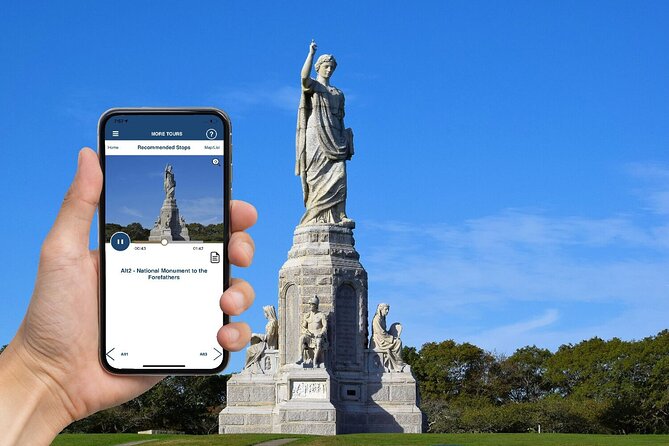
The National Monument to the Forefathers is one of the route’s most striking landmarks. Dedicated in 1889, it honors the ideals later associated with the Mayflower Pilgrims. It is considered the world’s largest solid granite monument.
The monument is grand in scale, but its message reflects nineteenth-century ideas about how the Pilgrims should be remembered. The audio helps you place the monument in that later period of commemoration instead of treating it as a direct relic from 1620.
Hedge House, also called the Plymouth Antiquarian House, was built in 1809 for William Hammatt, a New England sea captain. The Hedges, a family of entrepreneurs, bought it in 1830 and lived there until 1919.
Like the Mayflower Society House, this stop shows Plymouth as a lived-in town with changing fortunes. The house is not a Pilgrim-era building, but it adds useful context about the town’s maritime and commercial past.
The route also refers to an interpretive center with exhibits on the Pilgrims, faith and values, abolitionists and slavery, family life, and society. These themes are useful because they push the story beyond a simple celebration of the colony. As with the other attractions, entry is not included.
Jabez Howland House, Long Beach, and the final stretch

The Jabez Howland House contains an older section built in 1667 by Jacob Mitchell. Jabez Howland, son of Mayflower passengers John Howland and Elizabeth Tilley Howland, later purchased the home.
This is another stop that connects a famous passenger list with a real family and a surviving building. If the house is open, an interior visit would add more than the audio alone, but the tour still gives you the basic reason the building matters.
Long Beach is a barrier beach, a peninsula between the open ocean and the mainland coast. It is a different kind of stop from the historic houses and monuments, offering a coastal setting near the end of the experience.
The route finishes at Plimoth Patuxet Museums, 137 Warren Avenue. The supplied hours show daily access from 6:00 AM to 9:00 PM for the stated operating period, but the museum’s own admission schedule may differ. The audio tour does not include entry to Plimoth Patuxet Museums.
The route information contains several stops beyond the core waterfront walk, including Long Beach and the museum area. For that reason, you should allow two to three hours rather than assuming you can finish in a brisk hour. The exact timing depends on how often you pause, which attractions you enter, and how reliably the app triggers each story.
How the app works in real use
The best feature is hands-free playback. Once you enter a story location, the next section should begin automatically, and the audio cues point you toward the following stop.
The app also includes bonus stories for subjects you want to explore further. You can pause for food, photos, or a side visit, then continue later. You can use the tour over multiple days and on future trips, which is unusual for a short walking product.
The weak point is navigation. One person had trouble locating roughly half the landmarks, and another had to restart the audio manually. If a story does not begin, close and relaunch the app, check that you are at the designated starting point, and confirm that GPS is active.
Use headphones or earbuds, especially if you want to hear every story clearly. The recommended devices are an iPhone with iOS 15 or later, an Android device running version 9 or later, or an iPad or tablet with GPS and cellular connectivity.
The password can be used on the same number of devices as the number of people booked. For a couple, splitting one set of headphones can reduce the cost, but separate devices are more convenient if you want to pause or replay independently.
Is $14.99 a good price?
At $14.99 per person, the price sits between a cheap map-based walk and a fully guided paid tour. You are paying for narration, route planning, offline access, and the freedom to start without matching a guide’s schedule.
The value is strongest if you want flexibility. You can begin any time during the stated daily access window, take breaks, return later, and use the tour again without buying another ticket.
The value is weaker if you expect polished turn-by-turn navigation every time or a long, highly detailed lecture at every stop. Some people found the content too short for the price and felt it should cost closer to $7.
For two people, the ability to share one tour with split headphones helps. For a larger group, the cost rises because the password is limited to the number of booked devices. Attraction admission, reservations, and museum tickets are extra.
Free cancellation is available if you cancel at least 24 hours before the start time. Changes or cancellations inside that window are not accepted for a refund.
Who should book this Plymouth walk?
I would choose this tour if you want to explore alone, dislike fixed departure times, or are visiting during the off-season when museums and attractions may be closed. The audio can still give you a strong sense of Plymouth when many indoor sites are unavailable.
It also suits couples and families who need frequent breaks. You can stop for snacks, skip a subject, or spend longer at a favorite monument without holding up a group.
I would be more cautious if you have trouble with smartphone setup, need a fully guided experience, or want a short flat walk. The steep hill and the route’s spread make it less suitable for anyone who cannot comfortably manage uneven or uphill walking.
Should you book the Plymouth Pilgrims Self-Guided Walking Audio Tour?
Book it if freedom and lifetime access matter more to you than a live guide. Download everything before you arrive, start at 136 Water Street, bring earbuds, and give yourself two to three hours.
Skip it if you want admission to the historic houses and museums included, or if app problems would spoil the day. For most self-directed visitors, $14.99 is reasonable when used as a flexible introduction to Plymouth, but it is not a replacement for every indoor attraction.
FAQ
How much does the Plymouth Pilgrims Self-Guided Walking Audio Tour cost?
The tour costs $14.99 per person. Attraction admission, entry tickets, and reservations are not included.
How long does the walking tour take?
The route is over one mile and includes more than 24 audio stories. The stated completion time ranges from about one to three hours, so allowing two to three hours is the safer plan if you pause for photos or side visits.
Where does the tour start?
The starting point is 136 Water Street, Plymouth, Massachusetts 02360, near the Plymouth Visitor Information Center.
Where does the tour end?
The stated end point is Plimoth Patuxet Museums at 137 Warren Avenue, Plymouth, Massachusetts 02360.
Is a guide included?
No. This is a private, self-guided activity. No one meets you at the starting point, and the audio begins through the Action app when you reach each story location.
Does the tour work without cellular service?
Yes. You must download the app and tour while connected to strong Wi-Fi or cellular service. After the download, the audio and offline maps are designed to work without a signal.
What devices are recommended?
An iPhone running iOS 15 or later, an Android device running version 9 or later, or an iPad or tablet with GPS and cellular connectivity is recommended.
Can I use the tour more than once?
Yes. The tour provides lifetime access with no expiry. You can use it on another day, during another trip, or across several visits.
Can I cancel for a refund?
Yes, if you cancel at least 24 hours before the experience start time. Cancellations or changes made less than 24 hours before the start time are not eligible for a refund.
Just added around the USA
- Self Guided Driving Audio Tour of Saguaro National Park★ 3.0 · 4 reviews
- Self-Guided Audio Driving Tour of Mount Lemmon★ 5.0 · 4 reviews
- Saguaro National Park Self-Guided Audio Tour★ 3.5 · 11 reviews
- A Self Guided Audio Tour in Tombstone★ 4.0 · 11 reviews
- Catskills Scenic Byway Self-Guided Driving Audio Tour★ 4.0 · 9 reviews
- Big Bend National Park Self Guided Audio Tour Guide★ 5.0 · 12 reviews
- Self-Guided Audio Driving Tour in Catskills Scenic Byway★ 4.5 · 7 reviews
- Shiloh Battlefield Self-Guided Driving Audio Tour★ 4.0 · 9 reviews
Self-Guided Tours, compared.

Acropolis Ticket & Optional Self-Guided Audio Tours
Read our review →


Ultimate Acadia National Park Self-Guided Driving Audio Tour
Read our review →

Santorini: Akrotiri Ticket with Optional Self-Guided Audios
Read our review →
Browse the lists this tour appears in