
REVIEW · PHILADELPHIA AUDIO TOURS
Historic Sites of Philadelphia Self-Guided Walking Audio Tour
Philadelphia’s Revolution is still under your feet. This $9.49 self-guided audio tour links Elfreth’s Alley, the Liberty Bell, Independence Hall, Carpenters’ Hall, and several less obvious Revolutionary sites in about one to one and a half hours. You follow the route through the WalknTours app, with no human guide and no fixed group schedule.
I like the freedom to pause, wander, and resume when you wish. I also like the price, especially for a private group, since you pay per person without committing to an expensive guided walk. The main drawback is that the commentary is delivered through your phone, so earbuds are important, and some people may find the narration too brief.
I would choose this tour as a quick first look at Philadelphia’s historic core. It gives you a clear route and plenty of famous landmarks, though it works best as an introduction rather than a full treatment of the city’s past.
What makes this Philadelphia walking tour useful
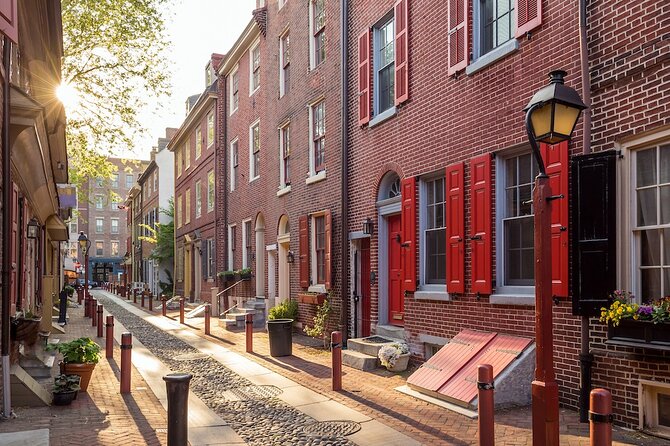
- Begin on Elfreth’s Alley, one of the city’s most atmospheric reminders of 18th-century Philadelphia.
- Follow Revolutionary figures beyond the usual names, including Haym Solomon, George Clymer, and Alexander Hamilton.
- See the Liberty Bell and Independence Hall from outside without paying an entrance fee for the walking tour.
- Pause the route whenever you wish, a useful feature if you want to stop for food, photos, or nearby sights.
- Finish at City Tavern, where the route connects the city’s Revolutionary story with its old dining and meeting culture.
- Use the app’s directional arrow, which guides you from stop to stop without requiring a live guide.
Starting at Elfreth’s Alley, Philadelphia’s oldest-looking street

The tour begins at the Elfreth’s Alley Museum, at 126 Elfreth’s Alley. This narrow lane is named for Jeremiah Elfreth, an 18th-century blacksmith, and it gives you an immediate sense of how compact colonial Philadelphia could feel.
Much of modern Philadelphia has changed, but Elfreth’s Alley has retained its historic character and is designated a National Historic Landmark. It is a smart starting point because you begin with a street rather than a grand monument. You can picture ordinary residents, craftspeople, and families living in the city during the period leading into the American Revolution.
At the starting point, you press start in the WalknTours app and put your phone away. The route is designed to guide you as you walk, with an arrow showing the direction of the next stop if you lose track. That makes the tour less awkward than constantly checking a map.
The walk takes about one to one and a half hours, but your actual pace depends on how long you spend at each place. You can stop for photographs, pause the audio, or briefly leave the route and return later. One person used that flexibility to explore Reading Market and Chinatown before coming back to the tour, which shows how well the format can fit into a loose sightseeing day.
More Audio Walking Tours in the USA
- Self Guided Classic Freedom Trail Location Aware (GPS) Walking Audio Tour
★ 4.5 · 258 reviews - Cape Cod & Provincetown Self-Guided Driving & Walking Audio Tour
★ 4.0 · 207 reviews - Santa Fe Historic Downtown Smart Phone Audio App Self Guided GPS Walking Tour
★ 4.5 · 112 reviews
Betsy Ross and the stories behind familiar symbols
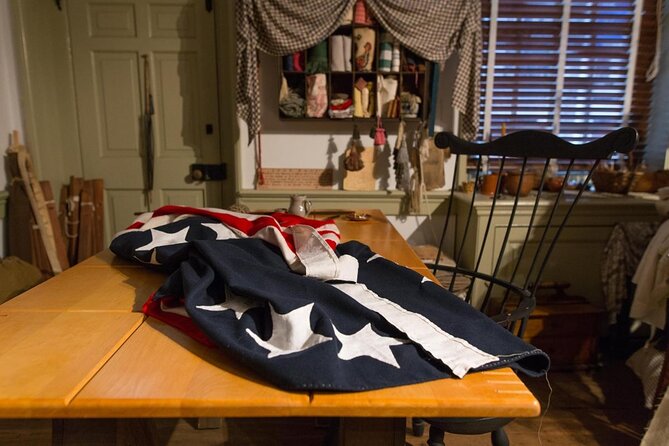
One stop takes you outside the Betsy Ross House. The narration tells the familiar story of Ross meeting George Washington and designing the American flag. The stop is short, so you should think of it as a quick orientation rather than a full museum visit.
The experience does not include entrance tickets. You can look into optional admission at individual sites, but the tour itself stays outside. That keeps the price low, though it also means you will not receive the fuller exhibits, rooms, and staff interpretation available inside some landmarks.
The Betsy Ross stop works best if you like seeing famous names in their physical setting. It also helps connect the domestic streets around Elfreth’s Alley with the larger political story unfolding nearby. Families may appreciate the straightforward flag story, although younger children could lose interest if they expect a longer activity at each location.
Benjamin Franklin’s grave and Haym Solomon’s synagogue
The route continues to Benjamin Franklin’s grave. Franklin’s role in the Revolution reaches beyond his public reputation as a printer, inventor, and statesman. The narration points to his work with France, an important part of the American war effort.
The stop is brief, about five minutes in the listed schedule. That is enough for the main idea, but not enough for a full biography. I would treat it as a prompt to notice Franklin’s importance and then save a longer visit for another Philadelphia attraction if you want more detail.
The tour also pauses outside the synagogue known as the Synagogue of the Revolution. Here you hear about Haym Solomon, who helped finance the Revolutionary cause. This is one of the more useful parts of the route because it moves beyond the standard Washington, Franklin, and Jefferson lineup.
Solomon’s story gives the tour a broader view of the Revolution. Political independence depended on money, credit, trade, and support from people who were not always the figures pictured in schoolbook scenes. The stop is still concise, but it adds a welcome human and financial angle.
Washington’s Philadelphia home at the President’s House

At the President’s House site, the narration explains that George Washington lived here. The stop also introduces one of his unusual nicknames, Town Killer, a detail included to make the famous general feel less predictable.
This is the kind of small fact that can make an audio walk more enjoyable. Instead of simply pointing at a major name, the narration tries to give you a story to remember. The tour calls its broader theme the rebels of the Revolution, and Washington fits that theme as a military and political leader who operated in a city full of argument and uncertainty.
Again, the stop is viewed from outside. If you want to go indoors at any location, you will need to arrange admission separately. The tour gives you a route through the historic district, not a package of museum entries.
More History Audio Tours in the USA
- Savannah’s Historical District: A Self-Guided Audio Tour
★ 4.5 · 69 reviews - Self-Guided Walking Audio Tour of Historic Santa Fe
★ 4.5 · 43 reviews - Salida History Audio Tour l A Self-Guided Wild West Experience
★ 5.0 · 41 reviews - Historic Bar Harbor Self-Guided Walking Audio Tour Guide
★ 4.5 · 38 reviews
The Liberty Bell and Independence Hall
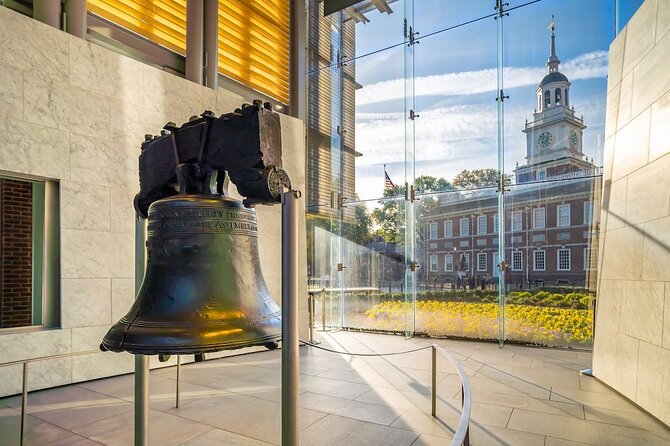
The Liberty Bell Center is one of the route’s most recognizable stops. You can see the bell for free, although the walking tour itself does not include interior admission. The narration points out that the bell was hidden in Allentown during the Revolution and became a symbol of liberty after the war.
That timing matters. The Liberty Bell is often treated as if its modern meaning was fixed from the beginning, but its role developed over time. The audio stop gives you a short explanation of that change while putting you beside one of the country’s best-known objects.
Next comes Independence Hall. This is the core political setting of the walk, where the Declaration of Independence and the United States Constitution were debated and adopted. The name Independence Hall was associated with the Marquis de Lafayette, who called the state house the Hall of Independence during a visit.
The tour remains outside, so you will need a separate ticket to enter. That is the biggest practical limitation for someone who wants a full Independence Hall experience. Still, seeing the building in sequence with the Liberty Bell, Signer’s Garden, and Carpenters’ Hall gives you a useful sense of how closely the major sites sit together.
Signer’s Garden and the risks of independence
In Signer’s Garden, you see a statue honoring the people who signed the Declaration of Independence and accepted the risks that came with open rebellion against Britain.
The central statue depicts George Clymer, a local merchant and politician. Including Clymer helps shift attention away from the most famous founders. He was part of the local political and commercial world that made Philadelphia such an important center during the Revolution.
This stop is small, but it helps you think about independence as a decision made by real people, not just an abstract national event. The route uses the statue as another chance to introduce a lesser-known figure without adding a long detour.
Carpenters’ Hall, the birthplace of liberty
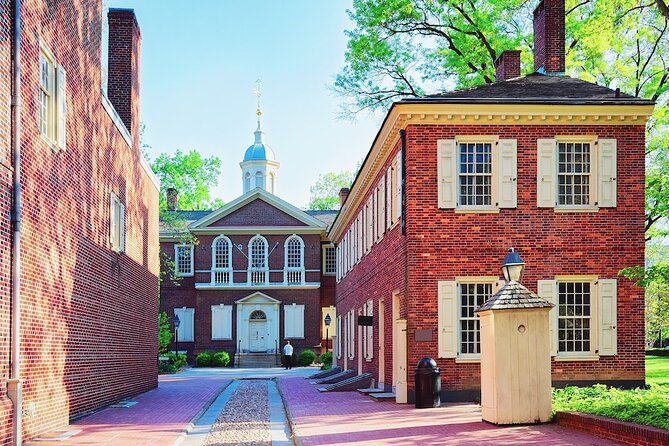
Carpenters’ Hall is one of the most rewarding stops for anyone who enjoys political backstory. The building was created for, and remains owned by, the Carpenters Company of Philadelphia, the oldest craft guild in the United States.
It is also known as the Birthplace of Liberty. The tour tells the story of the meeting held here, where colonial leaders discussed resistance and boycotts against Britain. The narration also touches on the surprising possibility that Quebec might have joined the original American colonies.
That Quebec detail gives the stop some spark. It reminds you that the map of the United States was not inevitable in the 1770s. Political choices, military events, and local loyalties could have produced a very different country.
Carpenters’ Hall is free to enter, but the audio tour does not include a guided interior visit. You can decide on the spot if you want to go inside. This is a good example of the tour’s value: it points you toward places you might otherwise walk past, while leaving the final timing and admission choices to you.
Alexander Hamilton’s financial Philadelphia
The final section turns toward Alexander Hamilton and the financial side of the new nation. At the First Bank of the United States, you hear how Hamilton argued that a national bank could improve the country’s credit and organize the government’s financial business under the new Constitution.
The bank operated from 1791 to 1811 and was a major part of Hamilton’s fiscal program. This stop adds variety after the military and political sites. You are no longer hearing only about battles, declarations, and flags. You are hearing about debt, banking, and how a new government might survive financially.
The route also shows where Hamilton once lived. The narration includes the scandalous affair with Maria Reynolds, which damaged his career. It is a sharp change of tone from the formal story of national finance, and that contrast helps keep the walk from feeling like a list of monuments.
The final location is connected with the founding fathers’ meals and meetings. The tour ends at City Tavern on South 2nd Street, a fitting place to close a route about politics, debate, and social life in Revolutionary Philadelphia.
How the app works on the street
The tour is designed for independent use. You do not walk with a guide or a larger public group. Only your own party participates, which can be useful if you prefer a quiet pace or want to stop often.
The app’s main advantage is control. You can pause the narration, repeat a section, or take a break without holding up anyone else. The route also works well for a short visit because you can complete it in roughly an hour, then continue exploring nearby.
Bring charged phones and earbuds. One practical issue is that the audio is harder to follow without earbuds, especially on a city street. Earbuds are not supplied, so arrange them before starting. The commentary is meant to be heard while walking, and the phone can remain in your pocket once the route is underway.
The directional arrow is helpful, but you should still pay attention to your surroundings. The tour is app-guided, not human-guided, so there is no person nearby to answer questions or correct you if you miss a turn.
Price, timing, and who gets the best value
At $9.49 per person, this is a modest way to organize a historic-district walk. The value comes from the route and narration rather than from admission benefits. You are paying for the audio experience, app navigation, and freedom to use the tour on your own schedule.
I think the price works especially well for:
- A couple or family that wants a private experience
- A first visit with only a short amount of time in Old City
- People who dislike fixed departure times
- Visitors who want to combine history with food stops and nearby neighborhoods
- Independent walkers who are comfortable using an app
The value is weaker if you already know Philadelphia’s main Revolutionary sites or want detailed historical interpretation at every stop. Some descriptions are brief, and the audio may feel basic if you are looking for obscure facts or long explanations.
The tour is offered in English and is near public transportation. Most people can participate, according to the available tour information. It is generally booked about five days ahead, so a little planning is sensible even though the format is flexible.
Free cancellation is available if you cancel at least 24 hours before the scheduled start time. Cancellations made within 24 hours are not refunded, and late changes are not accepted.
How this walk compares with exploring alone
You can certainly walk through Philadelphia’s historic district without a tour. The advantage here is that the app gives your route a beginning, middle, and end. You do not need to research every address before arriving, and the narration gives context as you move between sites.
The tradeoff is depth. A human guide could answer questions, adjust the pace, and add local detail based on your interests. This tour cannot do that. Its strength is simple independence, not a long, layered lecture.
I also like that you can customize the day around it. Stop for food, visit Reading Market or Chinatown, look inside a free site, or pause for photographs. Then return to the route when you are ready. That makes the experience less rigid than a standard scheduled walk.
Should you book the Historic Sites of Philadelphia Self-Guided Walking Audio Tour?
Book it if you want an inexpensive, flexible introduction to Old City and the Revolution. You will see major landmarks, hear about figures such as Franklin, Washington, Hamilton, and Haym Solomon, and uncover a few less common details, including Washington’s nickname and the possible role of Quebec in the early colonial story.
Skip it if you want a live guide, long explanations, or included entrance tickets. Also skip it if you do not want to listen through a phone and earbuds.
For most first-time visitors with 60 to 90 minutes available, I think the tour is a practical choice. Start with charged phones, bring earbuds, and keep a little extra time for the places that catch your interest. The low price and pause-anytime format make it easy to fit into a larger Philadelphia day.
FAQ
How much does the Historic Sites of Philadelphia Self-Guided Walking Audio Tour cost?
The price is $9.49 per person. Group discounts are available.
How long does the walking tour take?
The estimated duration is about one hour to one and a half hours.
Where does the tour begin?
The tour begins at the Elfreth’s Alley Museum, located at 126 Elfreth’s Alley, Philadelphia, Pennsylvania 19106.
Where does the tour end?
The tour ends at City Tavern on South 2nd Street in Philadelphia.
Is this a guided tour with a live guide?
No. It is a solo walking tour navigated through the WalknTours app. There is no human guide.
Are entrance tickets included?
No. The tour takes you outside the listed sites. Some locations, including the Liberty Bell Center and Carpenters’ Hall, can be visited free of charge, while Independence Hall requires a separate ticket if you want to enter.
What language is the tour offered in?
The tour is offered in English.
Can I pause the audio tour?
Yes. The app allows you to pause and continue at your own pace. You can also leave the route temporarily and return to it later.
What is the cancellation policy?
You can receive a full refund if you cancel at least 24 hours before the scheduled start time. Cancellations or changes made less than 24 hours before the start time are not accepted and are not refunded.
More Self-Guided Audio Tours in the USA
- Gettysburg Battlefield Self-Guided Driving Audio Tour
★ 4.5 · 910 reviews - Joshua Tree National Park Self-Guided Driving Audio Tour
★ 4.5 · 762 reviews - Ultimate Acadia National Park Self-Guided Driving Audio Tour
★ 4.0 · 521 reviews - Ultimate Lake Tahoe Self-Guided Driving Audio Tour
★ 4.5 · 435 reviews
Just added around the USA
- Self Guided Driving Audio Tour of Saguaro National Park★ 3.0 · 4 reviews
- Self-Guided Audio Driving Tour of Mount Lemmon★ 5.0 · 4 reviews
- Saguaro National Park Self-Guided Audio Tour★ 3.5 · 11 reviews
- A Self Guided Audio Tour in Tombstone★ 4.0 · 11 reviews
- Catskills Scenic Byway Self-Guided Driving Audio Tour★ 4.0 · 9 reviews
- Big Bend National Park Self Guided Audio Tour Guide★ 5.0 · 12 reviews
- Self-Guided Audio Driving Tour in Catskills Scenic Byway★ 4.5 · 7 reviews
- Shiloh Battlefield Self-Guided Driving Audio Tour★ 4.0 · 9 reviews
Self-Guided Tours, compared.

Acropolis Ticket & Optional Self-Guided Audio Tours
Read our review →


Ultimate Acadia National Park Self-Guided Driving Audio Tour
Read our review →

Santorini: Akrotiri Ticket with Optional Self-Guided Audios
Read our review →
Browse the lists this tour appears in