
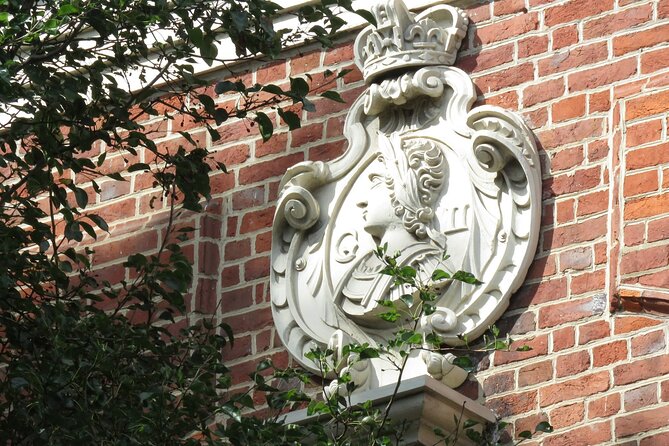
REVIEW · PHILADELPHIA AUDIO TOURS
The Road to Revolution: A Self-Guided Audio Tour in Philadelphia
Philadelphia’s streets still carry the arguments that shaped America. This self-guided walk connects Elfreth’s Alley with Independence Hall while explaining the people, buildings, and political disputes behind the city’s revolutionary story. I especially like the architecture-focused storytelling and the way the tour brings figures such as Benjamin Franklin and Alexander Hamilton down to human scale. The price, $11.99 per person, is also fair for roughly two to two and a half hours of audio, maps, and offline access.
I also like that you can take the tour at your own pace, with no group to keep up with and no live guide to schedule around. The main drawback is practical rather than historical: the tour depends on the VoiceMap app and a valid redemption code, and one customer reported being unable to activate it and being asked to pay twice. Check your code before setting out and contact VoiceMap support quickly if something goes wrong.
Key points to know before you go
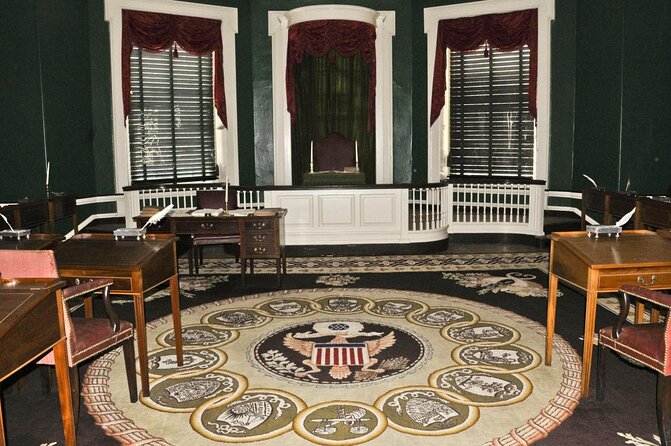
- Starts at Elfreth’s Alley: Begin on America’s oldest continuously inhabited street, then walk toward the heart of Old City.
- Architecture matters here: The narration explains building materials, styles, and construction alongside the better-known political stories.
- Major revolutionary sites come one after another: Christ Church, Carpenters’ Hall, Congress Hall, the Liberty Bell, and Independence Hall all appear along the route.
- Benjamin Franklin gets a central role: Franklin Court, Old City Hall, and the founding of the government help frame his unusual public life.
- You walk independently: The VoiceMap app supplies audio, maps, and geodata offline, but you provide the phone and headphones.
- Admissions are separate: The tour takes you past attractions but does not guide you inside them or include entry tickets.
Starting on Elfreth’s Alley in Old City
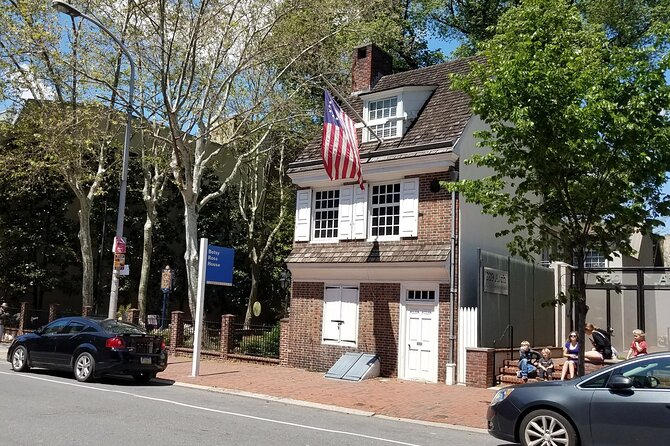
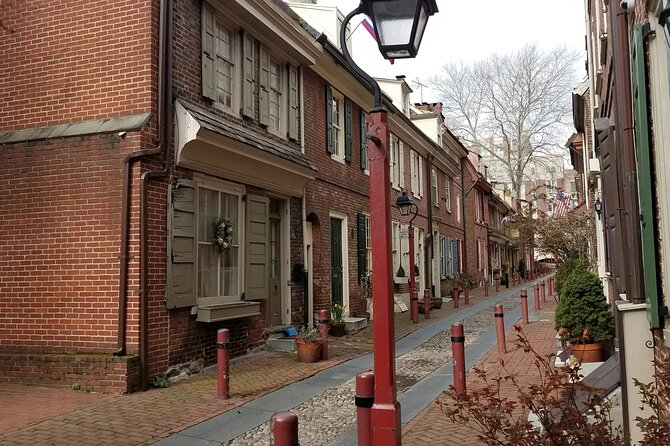
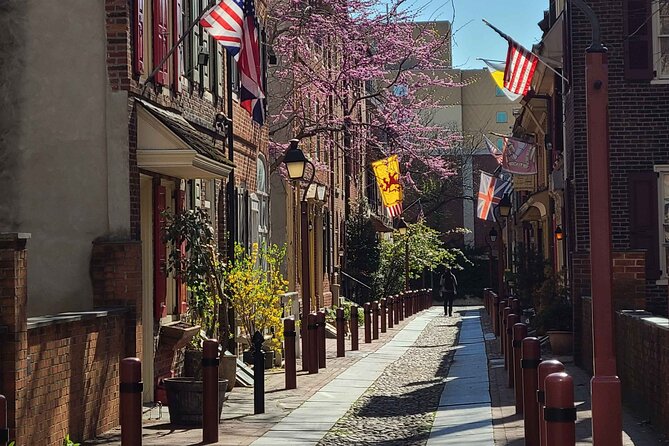
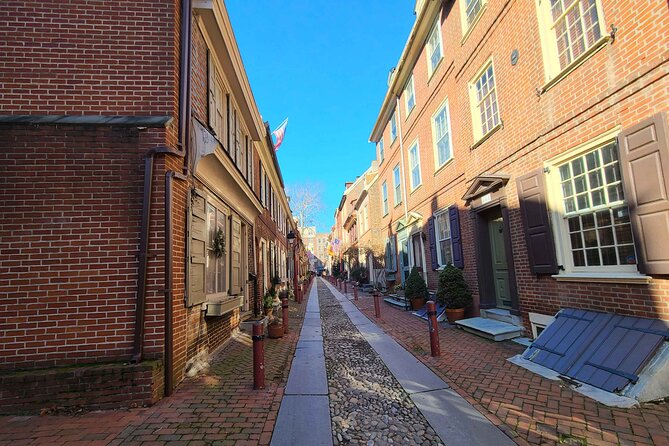
The tour begins at the Elfreth’s Alley Museum, at 126 Elfreth’s Alley. This is a fitting starting point because the street itself introduces one of the tour’s main ideas: ordinary buildings can tell large stories.
Elfreth’s Alley is described as the oldest continuously inhabited street in America. As you begin here, the setting helps you picture Philadelphia before it became the stage for independence and constitutional government. The audio looks at the people who lived and worked in the city, not only the famous names printed in schoolbooks.
You should allow a little time to get oriented before pressing play. The starting point is in Old City, and the tour is designed for an individual group rather than a shared walking party. That gives you room to pause, listen again, or take in a building without holding up anyone else.
The route lasts about two to two and a half hours. Since the tour is delivered through an app, your pace will affect the final time. You can walk briskly, stop for photographs, or spend longer looking at a façade while the narration continues.
More Self-Guided Audio Tours in the USA
- Gettysburg Battlefield Self-Guided Driving Audio Tour
★ 4.5 · 910 reviews - Joshua Tree National Park Self-Guided Driving Audio Tour
★ 4.5 · 762 reviews - Ultimate Acadia National Park Self-Guided Driving Audio Tour
★ 4.0 · 521 reviews
Christ Church and the people behind the famous names
One of the early stops is Christ Church, a landmark connected with George Washington, Betsy Ross, and Deborah Franklin. The value here is not just the famous association. The church helps show how the city’s religious and civic life overlapped with the political world taking shape around it.
I like the way this kind of stop can shift your attention from broad national events to individual lives. Washington is not only a general and president. Betsy Ross is not simply a flag-making legend. Deborah Franklin brings attention to the women and families who formed part of Philadelphia’s public story, even when the usual account focuses on men in government.
The tour’s narrator also pays attention to architecture. Materials, building methods, and styles can reveal when a structure was built and what its owners valued. That makes the walk useful for visitors who enjoy old streets and façades but want more than a date and a name attached to each one.
You will see the exterior of Christ Church as part of the route. The audio does not guide you through the church, and admission is not included if you decide to enter.
Franklin Court and the complicated life of Benjamin Franklin
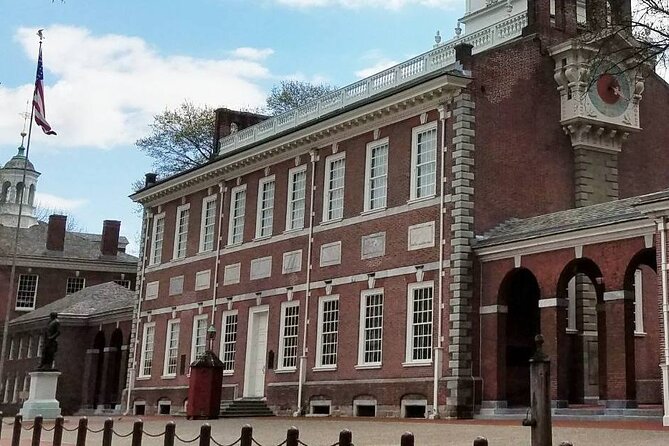
Fragments of Franklin Court mark the area where Benjamin Franklin spent the last years of his life. The remains and open sections can require a little imagination, which is exactly where the narration helps. Rather than presenting Franklin as a marble statue, the tour places him within the city he helped shape.
Franklin’s role reaches far beyond one building. He signed the Constitution of the United States, the Declaration of Independence, the Treaty of Alliance, and the Treaty of Paris. The tour uses that remarkable record to connect the American Revolution with the later creation of the government.
That broad sweep gives the walk a useful structure. You are not hearing isolated stories about separate monuments. You are following Philadelphia from its early development through independence and into the creation of a new political system.
The audio also looks at the people around Franklin and the practical world in which he lived. This helps balance the usual heroic version of the period. You get a sense of public ambition, private problems, and the difficult choices behind the polished names.
Carpenters’ Hall and the first arguments of independence
Carpenters’ Hall was the first craft guild in America and the home of the First Continental Congress. It is one of the route’s clearest examples of how a trade organization became part of a national political story.
The building links daily work with public power. Skilled craftspeople needed a place to organize, but the hall also became a setting for serious debate at a moment when relations with Britain were breaking down. The audio explains that connection rather than treating the building as a simple photo stop.
This is a good place to slow down and look at the structure itself. The tour is especially strong when it connects design and construction to the people who used a building. You may find that the architectural details become easier to notice once you understand the hall’s civic role.
As with the other attractions, you are not receiving an indoor guided visit. The tour takes you through the surrounding historic district and explains what happened there, while any entry costs remain your responsibility.
Same place, a different route to walk:
- Los Angeles: Hop-On Hop-Off Bus Tour with Audio Guide
★ 3.7 · 2,030 reviews - City Sightseeing Hop-On Hop-Off Bus Tour with Audio Guide
★ 3.0 · 1,083 reviews - Medieval Torture Museum Ticket with Audio Guide and Ghost Hunting
★ 5.0 · 962 reviews - San Francisco: Alcatraz, Ferry & Audio Tour w/ Night Option
★ 4.4 · 617 reviews
Hamilton, the First Bank, and a political split
The First Bank of the United States brings Alexander Hamilton into the story. Created through Hamilton’s financial program, the bank helped spark the beginning of the two-party system. That makes this stop useful for understanding that the early republic was never politically simple.
The tour also covers Hamilton’s time in Philadelphia and a scandal connected with him. That personal episode matters because it shows the founders as real people with reputations, ambitions, and flaws. The result is more interesting than a tidy procession of heroic portraits.
I particularly like this balance between public achievement and private difficulty. It gives you a better sense of why political history can be so personal. The people arguing over banks, government power, and the future of the country were not distant symbols. They were ambitious individuals making choices under pressure.
The First Bank’s design also supports the tour’s architectural angle. A building can express authority before anyone explains its purpose. Here, the style and setting help you understand why a financial institution could become such a visible symbol of national power.
The Merchants Exchange and Philadelphia’s commercial heart
The route passes the Merchants Exchange Building, another stop that connects architecture with the city’s growth. Its story helps explain Philadelphia’s beginnings as a place of trade, business, and civic organization.
This section is valuable because revolutionary history did not happen in a vacuum. Political decisions were tied to commerce, finance, shipping, property, and work. The buildings around you were part of the machinery that made Philadelphia important long before and during independence.
The audio format works well here because you can look outward while listening. Instead of standing inside a museum gallery, you are moving through the streets where business and politics occupied the same compact district.
You should not expect each stop to be a long formal presentation. The route is built as a continuous walk, so the narration moves you from one building to the next. Keep your headphones on and pay attention to the map so you do not miss the next location.
The Second Bank and a Greek-inspired statement
The Second Bank of the United States looks Grecian in style, and the tour uses it to show how architecture could communicate ideas about the young nation. Classical forms suggested order, permanence, and civic importance.
This is one of the best examples of the tour’s central promise. You are not only told what happened in a building. You are encouraged to read the building itself. Its appearance becomes part of the political story.
The stop also creates a useful contrast with the First Bank. Seeing both institutions in the same walk lets you consider how finance, government, and public image were expressed through architecture.
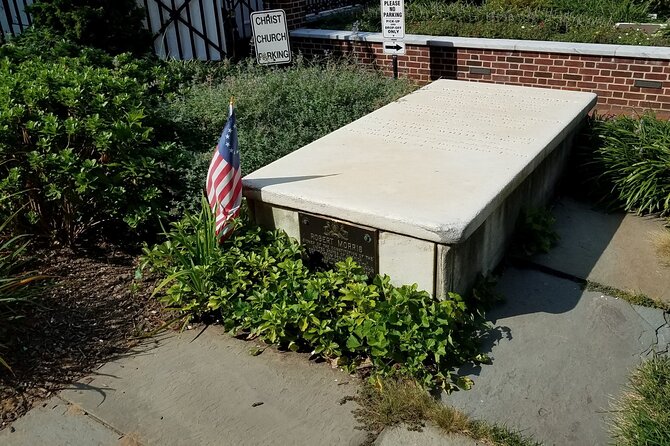
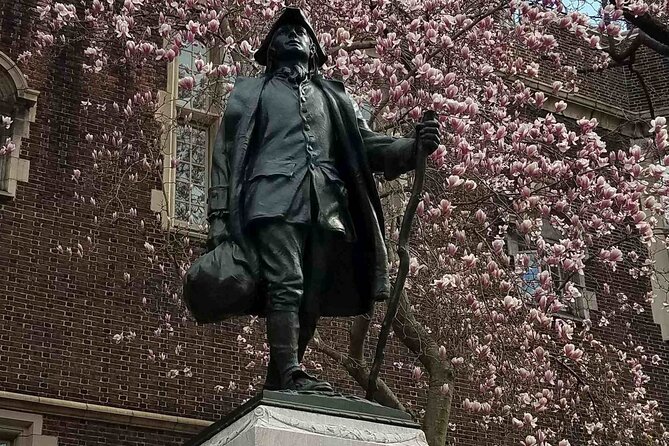
The route then passes a statue of Robert Morris. The narration introduces Morris and explains why the statue is controversial. That detail adds needed friction to the walk. Not every historical figure is easy to celebrate, and the city’s monuments can raise questions as well as preserve memory.
Library Hall, Old City Hall, and the work of government
Library Hall and Old City Hall add another layer to Philadelphia’s early civic life. These stops connect education, public institutions, law, and government with the city’s political development.
The audio continues to place buildings in context rather than treating them as unrelated sights. As you move through Old City, you begin to see how close together the major institutions were. Political debate, commerce, worship, and private life all occupied the same streets.
Old City Hall also brings the American Revolution and the founding of the government back into focus. This is where the tour’s wider story becomes especially clear. Independence was not the end of the work. The founders still had to decide how a new country would operate.
Franklin’s role returns here, tying together the city’s early period, the Revolution, and the formation of the government. If you prefer history that shows connections instead of isolated facts, this part of the walk will likely be one of the most satisfying.
Congress Hall and the final approach to Independence Hall
Congress Hall is another major political stop. The building helps explain Philadelphia’s role in the early national government and gives the final section of the route a strong sense of purpose.
From here, the walk heads toward the President’s House Site. The tour wraps up at the site, where you can see several landmarks linked with the American Revolution. The placement is effective because you are now close to the places most associated with American independence, but you have already heard about the less obvious streets, financial institutions, guilds, and personal scandals that shaped the period.
The final stretch includes the Liberty Bell. The narration explains the bell’s story and what it commemorates. You also finish at Independence Hall, at 520 Chestnut Street, where the tour ends in front of the building.
This is a satisfying endpoint for a walk that began on Elfreth’s Alley. You move from an early residential street through churches, banks, guild halls, civic buildings, and revolutionary landmarks. The route gives you a physical sense of Philadelphia’s compact historic center.
Remember that the audio tour does not guide you inside Independence Hall, the Liberty Bell site, or any other attraction. If you want to enter, you will need to arrange and pay for that separately.
What the $11.99 price really gives you
At $11.99 per person, this is a low-cost way to add structure to a visit around Old City. You receive lifetime access in English, plus the VoiceMap app for Android and iOS. Offline audio, maps, and geodata are included, which matters if you do not want to rely on a constant mobile connection while walking.
The value is strongest if you want historical context but do not need a live guide. You can share the experience only with your own group, pause when you like, and fit it around other Philadelphia plans.
The price does not cover a smartphone, headphones, food, drinks, transportation, or attraction admissions. Those exclusions are reasonable for an audio walk, but you should arrive prepared with a charged phone and headphones.
The main caution is the activation process. One customer had trouble with the receipt code, was asked to pay again, and never received the tour. Alicia from VoiceMap responded that support is available by phone and email and that the correct redemption code had been sent by email and text message. I would save both messages before arriving and contact support rather than paying a second time.
Who should choose this Philadelphia walk?
I would choose this tour if you like moving through a city while listening to a clear story. It suits independent visitors who want control over timing and who enjoy architecture as much as famous events.
It is also a good match for anyone who wants more than the standard founding-father version of Philadelphia. The route includes women, tradespeople, financiers, religious figures, controversial monuments, and the private troubles of major political leaders.
Families and small groups may appreciate the flexible format, though each person who wants to listen will need access to the necessary phone and headphones. History-minded visitors should plan on two to two and a half hours, with extra time if they want to enter attractions along the way.
I would skip it if you want a live guide who can answer questions on the spot or lead you through museum interiors. This is a narrated walk, not a ticketed attraction tour.
Should you book The Road to Revolution?
Book it if you want an affordable, self-paced introduction to Philadelphia’s Old City and enjoy stories that connect buildings with politics and personal lives. The strongest feature is its mix of architectural detail and revolutionary history, especially the way it presents Franklin, Hamilton, Morris, and the city’s early institutions as complicated people and places.
Before you start, download the VoiceMap app, confirm your redemption code, bring headphones, and remember that admissions are separate. If those limits suit you, $11.99 buys a useful two-hour framework for walking from Elfreth’s Alley to Independence Hall.
FAQ
How long does the audio tour take?
The tour takes approximately two to two and a half hours.
Where does the tour start?
It starts at the Elfreth’s Alley Museum, 126 Elfreth’s Alley, Philadelphia, Pennsylvania 19106.
Where does the tour end?
The tour ends in front of Independence Hall at 520 Chestnut Street, Philadelphia.
What language is the tour offered in?
The tour is offered in English.
Is admission to the historic attractions included?
No. The tour does not guide you through the museums or other attractions mentioned along the route. If you enter them, you must pay separately.
What do I need to use the tour?
You need your own smartphone and headphones. The VoiceMap app provides offline access to the audio, maps, and geodata.
Just added around the USA
- Self Guided Driving Audio Tour of Saguaro National Park★ 3.0 · 4 reviews
- Self-Guided Audio Driving Tour of Mount Lemmon★ 5.0 · 4 reviews
- Saguaro National Park Self-Guided Audio Tour★ 3.5 · 11 reviews
- A Self Guided Audio Tour in Tombstone★ 4.0 · 11 reviews
- Catskills Scenic Byway Self-Guided Driving Audio Tour★ 4.0 · 9 reviews
- Big Bend National Park Self Guided Audio Tour Guide★ 5.0 · 12 reviews
- Self-Guided Audio Driving Tour in Catskills Scenic Byway★ 4.5 · 7 reviews
- Shiloh Battlefield Self-Guided Driving Audio Tour★ 4.0 · 9 reviews
Self-Guided Tours, compared.
Acropolis Ticket & Optional Self-Guided Audio Tours
Read our review →


Ultimate Acadia National Park Self-Guided Driving Audio Tour
Read our review →

Santorini: Akrotiri Ticket with Optional Self-Guided Audios
Read our review →
Browse the lists this tour appears in