
REVIEW · PALM SPRINGS AUDIO TOURS
Palm Springs and Joshua Tree Self-Guided Driving Audio Tours
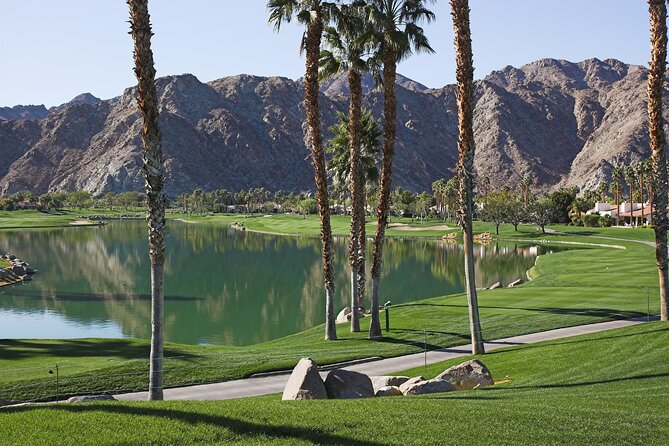
Desert roads come with plenty of stories. This two-part audio tour turns a rental car into your own small tour bus, linking Palm Springs architecture, Hollywood lore, desert trails, and Joshua Tree’s strange rock formations. I especially like the location-triggered narration and the freedom to stop for hikes, food, photos, or a sunset without waiting for a group.
The price is $24.99 per car for up to four people, which is strong value if you fill the vehicle. You also get lifetime access, so you can split Palm Springs and Joshua Tree across different days or reuse the tours on another trip. The main catch is the app: you need to download everything before setting out, and the map and directions may require more attention than a standard navigation app.
Key points to know before you go
- Two separate desert drives: Palm Springs takes about two to three hours, while the Joshua Tree route can be treated as a much longer park outing.
- More than 35 audio stories per tour: Expect history, architecture, celebrity tales, geology, hiking notes, and local oddities.
- Built for your own schedule: Pause, skip stops, take detours, or spread the experience over several days.
- Download before leaving: The tours work offline, but you need strong Wi-Fi or cellular service during setup.
- Best for a group with a navigator: Audio directions are useful, but the app’s map is not always as easy to follow as Google Maps.
- Celebrity homes are mostly private: You will often see gates, hedges, or walls rather than the houses themselves.
How the two-part tour works
You buy one product covering both Palm Springs and Joshua Tree. The tour runs through the Action Tour Guide app, not a standard booking app. After purchase, you receive setup instructions and a password by email and text. Search for audio tour if the messages do not appear quickly.
Download the chosen route while you have a strong signal. Once you reach the starting point, the app uses your phone’s GPS to play stories as you approach each stop. The narration is designed for hands-free listening through your car stereo by Bluetooth, USB, or AUX.
The tour is private, so only your group participates. That matters if you dislike fixed departure times or a guide squeezing everyone into a single itinerary. You can stop anywhere, pause the audio, and return later.
The advertised total driving time is roughly three to five hours, but that figure covers the core routes rather than a full day of hiking and sightseeing. Joshua Tree alone deserves more time if you want to walk several trails, visit Keys View, or stay for the stars. One useful feature is lifetime access with no expiry, so you do not need to force both routes into one busy day.
More Self-Guided Audio Tours in the USA
- Gettysburg Battlefield Self-Guided Driving Audio Tour
★ 4.5 · 910 reviews - Joshua Tree National Park Self-Guided Driving Audio Tour
★ 4.5 · 762 reviews - Ultimate Acadia National Park Self-Guided Driving Audio Tour
★ 4.0 · 521 reviews
Palm Springs begins with architecture and celebrity lore
The Palm Springs route starts at the Palm Springs Visitor Center at 2901 North Palm Canyon Drive. This is a practical launch point, but it is not necessarily the most natural beginning if you are approaching Joshua Tree from the east or south. One useful tip is to pay close attention to the selected starting point and direction in the app.
The first section introduces Palm Springs as a desert resort shaped by Hollywood and modern architecture. The Movie Colony is the early highlight. Frank Sinatra, Dinah Shore, Cary Grant, David O. Selznick, Jack Benny, and Tony Curtis all had homes in the area.
The neighborhood grew around the El Mirador Hotel, opened in 1928 with an Olympic-size pool, tennis courts, stables, and a bell tower. The audio explains how movie stars first came for privacy and then hired architects such as Richard Neutra, Albert Frey, and Donald Wexler to build permanent desert homes.
That context is more useful than a simple list of famous names. You begin to understand why Palm Springs looks the way it does: clean lines, broad windows, shade, and indoor-outdoor living adapted to intense heat.
The Kaufmann House detour and Palm Springs privacy
A short detour offers views of the Kaufmann Desert House and the former Liberace House. The detour adds about five minutes, so I would take it unless you are running late.
The Kaufmann House is one of the most important stops on the route. Edgar Kaufmann, who had commissioned Frank Lloyd Wright’s Fallingwater in Pennsylvania, hired Richard Neutra for this Palm Springs retreat. The home shows Neutra’s skill with open, adaptable rooms and modern forms suited to the desert.
Keep your expectations realistic. The home is beyond a gate, and most Palm Springs celebrity residences are screened by walls, fences, hedges, or private property. This is a drive-by architecture tour, not a chance to walk through star homes.
The tour includes an important correction about the house at 1326 North Rose Avenue, often labeled as Marilyn Monroe’s home. Local knowledge casts doubt on that claim. That small warning is useful because it keeps the celebrity material from sounding too certain.
Palm Springs oddities, monuments, and desert routes
Robolights is one of the route’s stranger stops. Park near East Granvia Valmonte and North Arquilla Road, then look for colorful sculptures among the trees. You get about ten minutes of audio guidance here, and the stop works well as a quick break from the car.
The Walk of the Stars follows, with about 450 stars honoring people connected to Palm Springs. The names include movie figures, but also humanitarians, architects, artists, soldiers, athletes, and civic pioneers. It offers a broader picture of the city than a tour focused only on Hollywood.
The route then leaves central Palm Springs for the Coachella Valley and Palm Springs International Airport. The airport began as a World War II Army Air Corps training field, chosen for the area’s steady weather and mountain protection. After the war, it became a civilian airport.
At Desert Memorial Park, the narration tells the story of Frank Sinatra’s burial arrangements, including whiskey, a lighter, cigarettes, and ten dimes. The dimes connect to a 1963 incident, giving the stop a bit of old Hollywood mystery without requiring a long visit.
More Driving Audio Tours in the USA:
- Ultimate Lake Tahoe Self-Guided Driving Audio Tour
★ 4.5 · 435 reviews - Scenic Newport, RI Self-Guided Driving Audio Tour
★ 4.5 · 325 reviews - Arches National Park Self-Guided Driving Audio Tour
★ 4.5 · 288 reviews - Yellowstone National Park Self-Guided Driving Audio Tour
★ 4.5 · 249 reviews
Hiking options near the palms
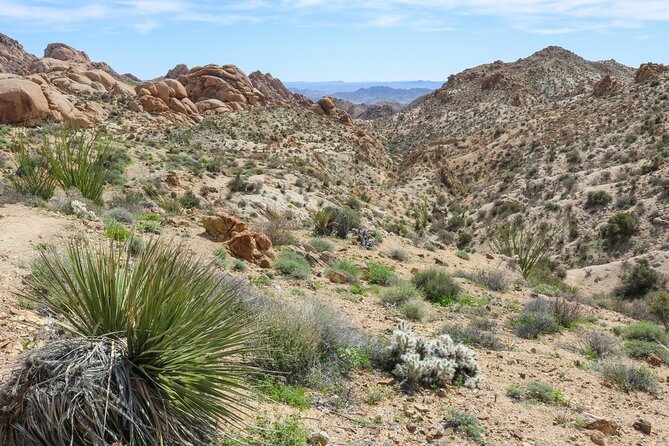
The Palm Springs route includes several hikes, but the audio tour does not turn them into required stops. That is a strength. You can choose a short walk or save the trails for another day.
Willis Palm Trail is a moderately strenuous four-mile hike with about 500 feet of elevation gain. Allow roughly three hours if you take the full route. Spring can bring desert flowers, birds, and wildlife.
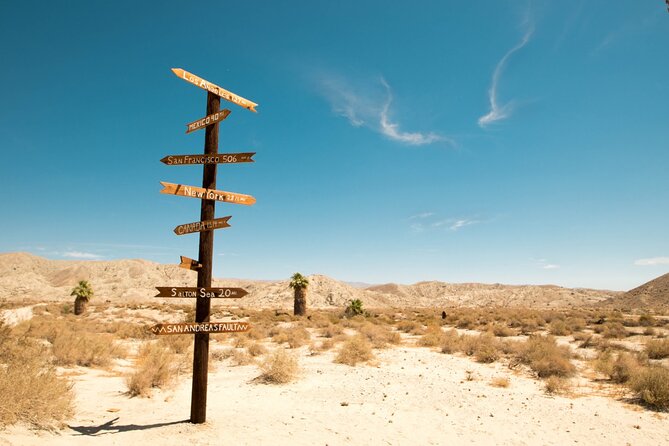
Pushawalla Palms Trail covers about 4.5 miles with 700 feet of elevation gain. Its appeal is the ridge along the San Andreas Fault and the palm oases where underground water reaches the surface. This is a better choice if you want a more active outing and broad views.
Thousand Palms Oasis Preserve offers easier walking trails and lush pockets of palms. The visitor center is closed during renovation after storm damage, but the trails are open from sunrise to sunset. Conditions can change, so treat the audio as an orientation rather than a current park notice.
Further along, Palm Canyon Trail runs about two miles out and back with a 200-foot climb. Andreas Canyon is shorter, a one-mile loop with about 175 feet of elevation gain. Andreas includes palms, rock formations, a creek, and rock grinding marks associated with the Cahuilla people.
Moorten Botanical Garden adds a compact, cultivated stop for desert plants. Chester Moorten, known as Cactus Slim, and Patricia Moorten created it in the 1940s. The audio connects the garden to his film career and his need for dry desert air after developing tuberculosis.
The Palm Springs Aerial Tramway is another optional addition. Its rotating tram car climbs 2.5 miles through Chino Canyon toward Mount San Jacinto State Park. At the top, you will find restaurants, a gift shop, and hiking trails. The tram is not included in the tour price, so check admission separately.
Pioneertown adds a Wild West detour
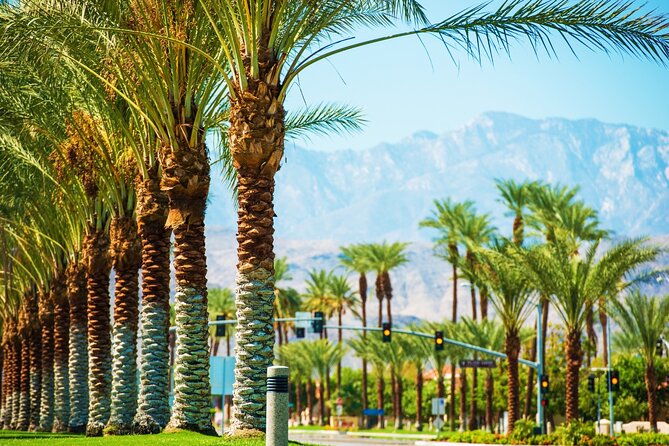
Pioneertown shifts the mood from modern design to movie-set western. Hollywood figures including Dick Curtis, Roy Rogers, and Dale Evans helped create it in 1946 on 32,000 acres.
The town was built as a working film setting, vacation spot, and place for second homes. It is a worthwhile detour if you want more than Palm Springs architecture and resort history. It also helps connect the region’s desert identity with its long relationship to film and television.
Joshua Tree starts with two deserts meeting

The Joshua Tree route begins at the Joshua Tree Visitor Center. Before entering the national park, you pass through the town of Joshua Tree, where shops and restaurants offer places to pick up food or a souvenir.
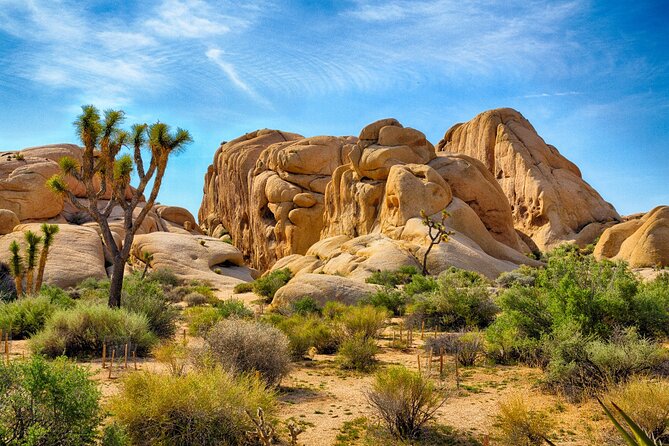
Inside the park, the route explains the meeting of two desert environments and points out the park’s namesake trees. The audio makes the drive more than a sequence of pullouts by explaining what you are seeing as the scenery changes.
Samuelson’s Rock is reached by a moderate 3.3-mile trail. John Samuelson etched personal declarations into the rocks nearly a century ago, creating one of the park’s more unusual human-made sights.
Willow Hole requires a longer seven-mile trail. The willow trees and water make the destination seem almost impossible in such a dry setting. If you want to include this walk, plan extra time beyond the basic tour estimate.
Hemingway Buttress is a popular climbing area with large boulders that also invite scrambling. You do not need to be a climber to appreciate the formation, but use care around uneven rocks and do not treat the audio description as a safety briefing.
The easiest Joshua Tree stops offer the best return

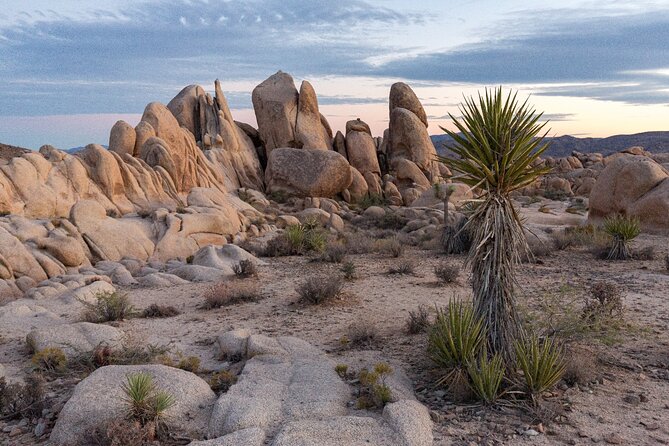
Hidden Valley Nature Trail is an easy one-mile walk and one of the most efficient stops in the park. The route connects the trail to a Wild West gang hideout and points out the striking desert scenery.
Intersection Rock acts as a visual center in the park and is also a major climbing area. The audio gives some of the climbing routes colorful names, adding personality to the stop even if you never touch the rock.
Cap Rock has a short quarter-mile trail with information about local plant life. Its unusual boulder formation makes it a quick photo stop.
The route continues through Lost Horse Valley and Queen Valley, both tied to mining and Old West stories. An abandoned mine in Queen Valley connects the search for gold to violence and murder. The tales make the drive more memorable, though you should not expect long walks at every stop.
Skull Rock is easy to reach from the roadside. Its granite shape resembles a human skull, and a nearby two-mile trail offers a longer option. This is one of the park’s most convenient stops because you can see the main formation without committing to a major hike.
Sky’s the Limit Observatory and Nature Center adds a night-sky angle. Joshua Tree is known as a dark-sky area, so staying after sunset can reward you with much better stargazing than you would get in a city.
The main route ends at the Oasis Visitor Center in Twentynine Palms. A southern detour continues through the rest of the park and exits at the south gate. That option can turn the tour into a full-day drive, especially if you stop often.
The General George S. Patton Memorial Museum is another optional addition. It sits on the former Camp Young site, part of the World War II Desert Training Center, and includes historic artifacts and actual tanks.
Price, app limits, and practical value
At $24.99 per vehicle for up to four people, the cost is modest. A full car pays less per person than a traditional guided tour, and you keep the flexibility to choose your own stops.
The best value comes when you use both routes and spread them over more than one day. The lifetime access is especially helpful if you want a relaxed Palm Springs outing and a separate Joshua Tree day.
The app is the weak link. One user found that the Palm Springs portion did not appear correctly, while another nearly quit because the interface was confusing. These problems are avoidable in many cases: download both routes fully, confirm the password, launch the correct version, and test the audio before driving away.
CarPlay support is limited. Audio can play through the car, but the map may not appear in the way you expect on the dashboard. One person found Joshua Tree easier to follow than Palm Springs, and another noted that the GPS could struggle after taking an off-route spur.
I recommend having one person handle the phone while the driver watches the road. If you are driving alone, stop before checking the map. The narration is clear, well paced, and animated, but you should not rely on it as a full replacement for navigation.
Free cancellation is available up to 24 hours before the scheduled start time. Inside that window, the payment is not refunded.
Who should book this desert audio tour?
Book it if you want history and context without joining a group. It suits couples, families, and friends sharing a rental car, especially if you like choosing your own pace.
It is also a good fit for repeat visitors. You can listen to the stories on one trip, return for the hikes later, and skip the stops that do not interest you.
Skip it if you need polished turn-by-turn navigation, full CarPlay mapping, or a guide physically pointing out every house. It is also not ideal if your main goal is to enter celebrity homes, since most are private and hidden from view.
FAQ
How much does the Palm Springs and Joshua Tree audio tour cost?
The price is $24.99 per group of up to four people. You purchase one tour for the car rather than paying separately for each person.
How long does the tour take?
The core Palm Springs route takes about two to three hours. The two routes together are generally described as taking about three to five hours, but hiking, detours, meals, and sunset stops can make Joshua Tree a full-day outing.
Does the tour expire?
No. The tour provides lifetime access with no expiry, so you can use it on different days or future trips.
What language is offered?
The audio tour is offered in English.
Where does the Palm Springs route begin?
The Palm Springs route begins in the parking lot of the Palm Springs Visitor Center at 2901 North Palm Canyon Drive.
Where does the Joshua Tree route begin?
The Joshua Tree route begins at the Joshua Tree Visitor Center.
Do I need cellular service inside the parks?
You need strong Wi-Fi or cellular service to download the tour before starting. After the download is complete, the tour works offline.
Does anyone meet me at the starting point?
No. This is a private, self-guided activity. You go to the starting point, open the app, and follow the GPS-triggered stories.
Can I pause or skip parts of the tour?
Yes. You can pause the tour, take breaks, skip stops, explore side routes, and return to the audio later.
Are park admission fees included?
No. Park passes and other admission fees are not included in the tour price.
Is the tour compatible with a car stereo?
You can connect your phone by Bluetooth, USB, or AUX. Audio playback works with Apple CarPlay, but mapping support on CarPlay is limited. Android Auto support is still forthcoming.
Should I download the app before reaching Palm Springs?
Yes. Download the separate Action Tour Guide app and the tour content while you have a strong signal. You will also need the password sent by email and text.
Should you book it?
I would book this tour if you want an affordable, flexible way to connect Palm Springs and Joshua Tree. The strongest parts are the clear narration, the architecture and desert stories, the offline access, and the freedom to build your own day.
Just prepare the app before leaving, assign a navigator, and allow more time than the basic estimate if you want to hike. If you treat it as a story-rich road companion rather than a perfect navigation system, it offers very good value.
Just added around the USA
- Self Guided Driving Audio Tour of Saguaro National Park★ 3.0 · 4 reviews
- Self-Guided Audio Driving Tour of Mount Lemmon★ 5.0 · 4 reviews
- Saguaro National Park Self-Guided Audio Tour★ 3.5 · 11 reviews
- A Self Guided Audio Tour in Tombstone★ 4.0 · 11 reviews
- Catskills Scenic Byway Self-Guided Driving Audio Tour★ 4.0 · 9 reviews
- Big Bend National Park Self Guided Audio Tour Guide★ 5.0 · 12 reviews
- Self-Guided Audio Driving Tour in Catskills Scenic Byway★ 4.5 · 7 reviews
- Shiloh Battlefield Self-Guided Driving Audio Tour★ 4.0 · 9 reviews
Driving Audio Tours, compared.


Ultimate Acadia National Park Self-Guided Driving Audio Tour
Read our review →

Browse the lists this tour appears in