

REVIEW · MILAN AUDIO TOURS
Self Guided Tours In Milan With 100 Captivating Audio Stories
Let Milan tell its stories at street level. This browser-based audio tour gives you 100 location-based stories for only $3.60, covering famous sights such as the Duomo, Galleria Vittorio Emanuele II, and Castello Sforzesco, along with quieter churches and lesser-known squares. I especially like the freedom to start whenever you want and pause whenever a café, shop, or side street catches your eye.
I also like that you need no app download. The audio opens through your phone’s browser, and a couple using it found the stories easy to access and useful for seeing Milan’s main sights. The main drawback is practical: there is no offline access, and some stops are repeated or contain descriptions that appear mismatched, so you should treat this as a flexible story collection rather than a perfectly ordered walking route.
Key points to know before you go

- Just $3.60 per person: A very low-cost way to add context to independent sightseeing.
- One hundred audio stories: The collection reaches well beyond the Duomo and central shopping streets.
- Works in your browser: No app download is required, but you need your own phone, headphones, and an internet connection.
- Use it in short bursts: The listed stories range from about 10 to 20 minutes, while the overall experience can last from one to eight hours.
- Good for private exploring: There is no group, meeting time, or physical guide, so your day remains your own.
- Check each story title: Repeated entries for Brera, Porta Nuova, Parco Sempione, and Piazza Gae Aulenti may represent separate recordings, but the route details are not always clear.
What this Milan audio tour really offers
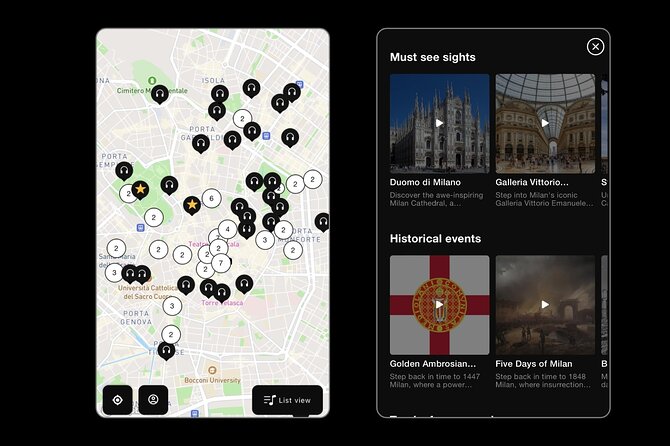
This is not a traditional guided walk. Nobody gathers you at a meeting point, counts heads, or leads you from one monument to the next. Instead, you receive access to a web app with a map and a large library of narrated stories tied to places around Milan.
That difference matters. If you want a polished route with a human guide, timed entries, and answers to spontaneous questions, this is not the right product. If you prefer to wander, stop for lunch, visit a museum, or split sightseeing over several days, the format is much more useful.
The stories combine voice narration with soundscapes. That should give major sights a bit more atmosphere than reading a plaque, though the supplied information does not specify the narrators, recording lengths, or languages available. I would check the language option before booking if that affects your plans.
You activate access by entering the last five digits of your phone number in the promo code field at App.trales.io. You do not need to download anything. Since offline use is not included, make sure your phone can reach the web while you are out in the city.
More Self-Guided Audio Tours in Italy
- Naples: Pompeii Self Guided Audio Tour
★ 3.9 · 211 reviews - Matera: Sassi di Matera Historical Self-Guided Audio Tour
★ 3.6 · 183 reviews - Self Guided Audio Tour-Coliseum & the Gladiator’s Legends
★ 3.5 · 49 reviews
Start with the Duomo and Galleria
The most natural first session begins at the Duomo di Milano. The cathedral story focuses on the building’s scale, faith, architecture, and the human effort behind its creation. A listed time of 20 minutes gives you enough room to listen while looking up at the facade, studying the many details, and taking in the square.
The Duomo story is likely to be most useful outside the cathedral itself, since admission to the building is not included. The listing marks the stop as free, but that refers to the audio stop and the surrounding public area, not necessarily every part of the cathedral complex. If you want to go inside or visit the roof, arrange those tickets separately.
Next comes Galleria Vittorio Emanuele II, also listed with a 20-minute story. The covered arcade is one of Milan’s easiest places to appreciate the city’s connection between commerce, design, and public life. The narration focuses on the gallery’s history and its link to Italy’s first king.
These two stops work well together. The Duomo gives you Milan’s grand religious center, while the Galleria shifts the mood toward elegant shops, cafés, and architecture. You can listen to both in less than an hour, then continue toward Piazza della Scala and the nearby fashion streets.
Brera, La Scala, and Milan’s central streets
Brera receives more than one listing, which suggests that the audio collection may contain separate stories for the district or for different points along Via Brera. The area is a good match for a self-guided format. You can walk slowly, glance into galleries and shops, and use the narration when you reach a location that interests you.
The Brera material connects art and older Milanese streets. I would not treat the two Brera entries as two entirely different neighborhoods. Instead, open each one when you are in the area and see if the titles or map points give you different angles.
Piazza della Scala adds a story about Teatro alla Scala and Milan’s musical life. The square is close to the Galleria and Piazza del Duomo, so you can group these stops without wasting much time. The short 10-minute format also makes it easy to listen without committing to a full morning.
Corso Vittorio Emanuele II and Piazza San Babila continue the central-city route. Piazza San Babila is presented through its changing role over the centuries, while the Corso entry is meant to cover a monument called the Victor Emmanuel II National Monument. That description appears to refer to Rome rather than Milan. I would regard this particular entry as a content error and avoid relying on it for Milan sightseeing.
Via Monte Napoleone and the Quadrilatero della Moda offer a different side of the city. Here the focus is luxury, fashion, designer boutiques, and the price of Milanese real estate. You do not need to shop to enjoy the walk. The stories can help explain why these streets matter, while window-shopping costs nothing.
Castello Sforzesco and Parco Sempione
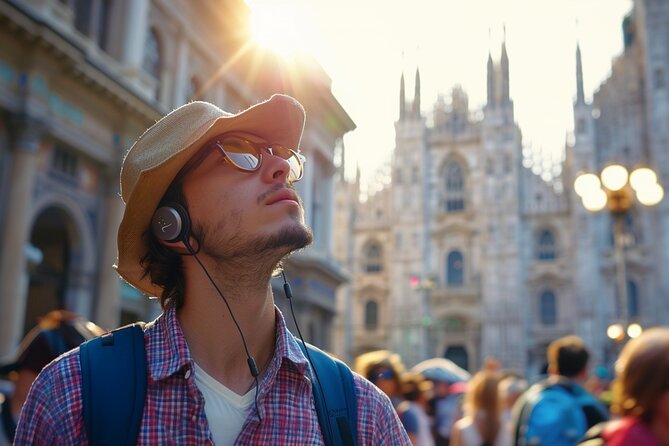
Castello Sforzesco receives a 10-minute story about its fortress, power, and past. The castle is one of the major public sights on the route, and the audio should be most useful as you walk around the outer spaces and courtyards.
The listing does not include admission to any museum inside the castle. That is important because the fortress complex can easily become a longer visit if you decide to see its collections. Use the audio story as an introduction, then decide if you want to pay for additional entries.
Parco Sempione appears twice as well. The park gives you a welcome break from stone streets and shopping areas, and the short narration can add a bit of purpose to a walk through the greenery. One Parco Sempione story may be a duplicate, or the two entries may point to different locations. Check the map before playing both.
Arco della Pace, described through the historic Porta Sempione, makes a natural companion to the castle and park. The story covers the gate’s place in Milan’s architecture and past. This section of the tour is among the easiest to enjoy at your own pace because it combines large public spaces with short audio chapters.
More Self-Guided Audio Tours in Milan:
- Athens: Acropolis Ticket & Optional Self-Guided Audio Tours
★ 4.1 · 2,542 reviews - Gettysburg Battlefield Self-Guided Driving Audio Tour
★ 4.5 · 910 reviews - Joshua Tree National Park Self-Guided Driving Audio Tour
★ 4.5 · 762 reviews - Ultimate Acadia National Park Self-Guided Driving Audio Tour
★ 4.0 · 521 reviews
Leonardo, old churches, and the city’s religious side
Santa Maria delle Grazie is included with a story about the church and Leonardo da Vinci’s Last Supper. This is one of the most important stops in the collection, but the audio does not include admission to the painting. The Last Supper requires its own ticket, and the information provided here does not state that a ticket can be arranged through the tour.
Even if you are not entering, the story can give you context for the church and the famous painting. If you have a reserved visit, allow time for security and the fixed entry schedule. The self-guided audio is flexible, but the artwork itself is not.
The church collection is a strong feature of this product. San Maurizio al Monastero Maggiore is described through its historic setting and artwork. Santa Maria presso San Satiro focuses on its famous architectural illusion, making it one of the more distinctive stories in the lineup. San Marco, Santa Maria della Passione, San Fedele, San Babila, San Giorgio al Palazzo, and Santa Maria Incoronata add more stops for visitors who enjoy architecture, religious art, and quiet interiors.
The basilicas offer still more variety. Sant’Ambrogio is tied to Milan’s identity and faith. San Lorenzo Maggiore, Sant’Eustorgio, and the Colonne di San Lorenzo bring ancient columns, early Christian buildings, and later changes into the same southern part of the city.
You should not expect every church to be open at the moment you arrive. The experience gives you audio access, not guaranteed interior access. Still, the large number of church stories makes this a good choice if you enjoy building a day around architecture instead of racing from one headline sight to another.
Medieval squares and Milan’s public life
Piazza Mercanti offers a short story about medieval merchants and craftsmen. It is a compact stop near the Duomo, so it fits neatly into a central walking session. The square provides a useful contrast to the polished Galleria and the broad cathedral plaza.
Piazza Missori covers the Palazzo dell’INPS and its architect, Marcello Piacentini. Piazza Affari moves into modern finance, focusing on the Italian stock exchange and Mezzanotte Palace. Together, these stops show how Milan’s public spaces changed from trade and civic life to national administration and business.
The University of Milan adds a story about education and innovation. These may not be the first stops you choose on a short visit, but they help the audio collection move beyond famous monuments. If you have only two hours, prioritize the Duomo area, Brera, the Galleria, and the castle. If you have most of a day, these shorter chapters can fill in the gaps between major sights.
Porta Ticinese and the southern route
Porta Ticinese, the Colonne di San Lorenzo, San Lorenzo Basilica, and Sant’Eustorgio form a useful group south of the center. Porta Ticinese is presented as a historic neoclassical gateway. The Colonne di San Lorenzo story focuses on the ancient Corinthian columns and their survival through time.
This cluster gives you a different feel from the Duomo district. The stories concern older layers of Milan, religious buildings, and the remains of earlier city life. Since each chapter is listed at about 10 minutes, you can listen selectively rather than giving every stop equal weight.
The practical issue is route planning. The experience does not provide a clearly stated single loop, and its total duration ranges from one to eight hours. You should use the map to group nearby locations instead of following the stops in numerical order. That will save time and reduce unnecessary backtracking.
Porta Nuova, Bosco Verticale, and modern Milan

The northern and eastern part of the collection turns toward contemporary Milan. Porta Nuova is covered twice, with stories about the district’s economy, innovation, and skyscrapers. Piazza Gae Aulenti also appears twice, with the same wording in the supplied details.
Bosco Verticale is one of the most distinctive modern stops. The story presents the residential towers as a vertical forest designed by Boeri Studio. Piazza Gae Aulenti adds a look at the newer urban center and its elevated public space.
These stops are useful because they prevent the tour from becoming an entirely medieval and Renaissance history lesson. Milan is also a city of business, design, high-rise construction, and modern public spaces. I would schedule Porta Nuova separately from the Duomo rather than trying to walk between every central and northern stop in one push.
Cimitero Monumentale adds another unusual option. It is described as an open-air museum where sculpture and Milanese history meet. The information does not give opening hours or entry rules, so check those independently if you plan to go inside. The audio story should work best as a reason to include the cemetery, not as a substitute for practical admission details.
Milano Centrale closes out the northern group with a story about the station’s architecture and role in travel. This is a sensible stop if you are arriving or departing by train, or if your accommodation is nearby. It can also help you understand the building before you rush to a platform.
Timing, technology, and the $3.60 price
At $3.60 per person, the value is clear if you want basic interpretation without paying for a private guide. A couple pays less than the cost of many city coffee stops, while a family can use the same low price to add stories across several days.
The price does not cover a phone, headphones, admission tickets, or offline access. You need to bring your own equipment, and the audio experience will depend on your battery, connection, and comfort with using a browser outdoors.
The tour can last from one to eight hours. That is not a fixed route time. It means you can use a few stories during a short break in Milan, or build several walking sessions around the full collection. One person used it for a couple of hours during time off on a business trip and found that it helped provide a quick understanding of the city. That is exactly where this product makes the most sense: short, independent orientation.
The experience is private because only your group participates, but there is no physical guide. That keeps the price low and removes schedule pressure. It also means you must choose the route, watch the map, and decide which stories deserve your time.
Who should use this audio guide?
I would recommend it to solo visitors, couples, families, and people with limited free time. It is particularly useful if you dislike group tours or want to stop often without holding up other people.
It also suits repeat visitors who have already seen the Duomo and want a few stories about churches, financial squares, modern architecture, or the Monumental Cemetery. The 100-story format lets you pick topics instead of following one fixed narrative.
I would be more cautious if you have hearing impairment, since the experience is not recommended for people with hearing difficulties. It is also a weaker choice if you need a fully edited route, offline files, or a guide who can answer questions immediately.
The non-refundable policy deserves attention before purchase. Once booked, the experience cannot be canceled or amended for a refund. Since the cost is low, the financial risk is modest, but you should still be sure your dates and phone access are settled.
Should you book this Milan audio tour?
Book it if you want cheap, flexible context while exploring Milan independently. The strongest parts are the wide range of locations, browser access, short audio chapters, and coverage of both famous sights and less obvious churches and squares.
Do not book it expecting a perfect, linear walking route or admission to Milan’s major attractions. The repeated stops and the Rome-related description for Corso Vittorio Emanuele II show that you should use your judgment and check the map as you go.
For a first visit, I would use it in sections: Duomo and Galleria first, Brera and La Scala next, then Castello Sforzesco and Parco Sempione. Save the southern churches, Porta Nuova, and Cimitero Monumentale for extra time. At $3.60, it is an inexpensive way to make independent wandering more meaningful, provided you are comfortable supplying the route planning and technology yourself.
FAQ
How much does the Milan audio tour cost?
The price is $3.60 per person.
How long does the experience last?
The approximate duration is one to eight hours, depending on how many stories and locations you choose.
Do I need to download an app?
No. The audio guide works directly through your web browser.
How do I activate the audio guide?
After booking, enter the last five digits of your phone number in the promo code field at App.trales.io.
Is offline access included?
No. Offline access is not included.
What equipment do I need?
You need to bring your own smartphone and headphones.
Does the tour include entry to the Duomo or the Last Supper?
The experience provides audio stories about these locations, but admission tickets are not included.
Is there a physical guide?
No. This is a self-guided experience with a web app, map, voice narration, and soundscapes.
Can I start whenever I want?
Yes. The experience is designed to start anytime and offers pause and resume features.
Is the tour suitable for people with hearing impairment?
It is not recommended for people with hearing impairment because the experience depends on audio narration.
Just added around Milan
- Milan Walking Tour with Audioguide on Your Smartphone★ 5.0 · 6 reviews
- Milano Walking Tour with Audio and Written Guide by a Local★ 4.5 · 13 reviews
- Mysteries of Milan: Uncover the city’s lesser-known tales on this audio tour★ 4.5 · 2 reviews
- Milan: Museum of the 900 Fast-Track Entry Ticket & Audio Guide★ 4.0 · 12 reviews
- Milan: Sforza Castle Entry Ticket & Audio Guide★ 3.5 · 13 reviews
- Audio Guide for the Duomo – Milan Cathedral (no ticket)★ 4.0 · 5 reviews
- Best of Milan audio tour: From the gorgeous Duomo to Castello Sforzesco★ 5.0 · 2 reviews
- Milan: Palazzo Citterio Entry Ticket & Audio Guide App★ 3.9 · 15 reviews
Self-Guided Tours, compared.
Acropolis Ticket & Optional Self-Guided Audio Tours
Read our review →


Ultimate Acadia National Park Self-Guided Driving Audio Tour
Read our review →

Santorini: Akrotiri Ticket with Optional Self-Guided Audios
Read our review →
Browse the lists this tour appears in