
REVIEW · LAS VEGAS AUDIO TOURS
Las Vegas Strip Self-Guided Walking Audio Tour
The Strip rewards curious walkers. This self-guided audio tour pairs more than 35 location-triggered stories with offline maps, so you can move at your own speed without joining a group or following a guide’s flag. I like the freedom to pause for a casino, snack, photo, or shelter from rain, and I like the mix of famous sights with odd details, such as why the Strip sits in Paradise rather than Las Vegas. The main drawback is sound: traffic, crowds, music, and casino entrances can make audio hard to hear unless you use earbuds and stay near your phone.
You begin at the Tropicana Las Vegas and cover more than four miles before returning to the meeting point. The route is advertised at one to two hours, which means you will need to walk at a steady pace if you want to finish in one outing. At $14.99, the value is strong for a couple or small group if the purchase works across your booked devices, but confirm the final pricing because the details describe the cost both per person and per car.
Five useful things to know before you walk
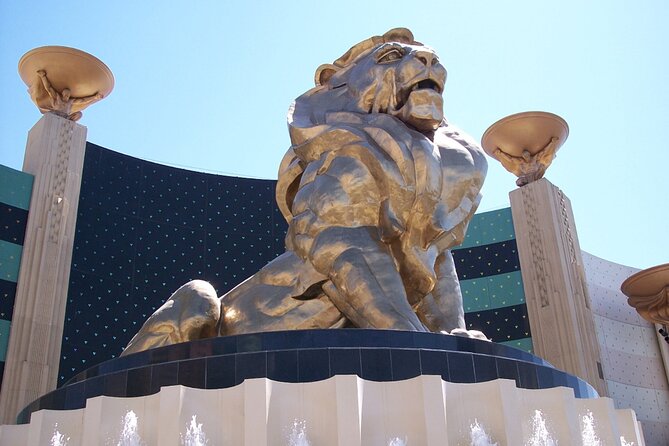
- Leo the Lion begins the route: The 45-foot MGM sculpture weighs 50 tons and gives the tour an immediate sense of scale.
- The route covers over four miles: More than 35 audio stops make this a brisk walk, especially if you stop for photos.
- Offline access matters: Download the tour over strong Wi-Fi or cellular service before arriving.
- Stories trigger by location: The app is hands-free once you reach each point, but headphones make the narration easier to hear.
- You get lifetime access: Pause, restart, skip stops, or reuse the tour on a later Las Vegas visit without an expiry date.
Starting with Leo, MGM’s giant bronze mascot
The tour opens near the Tropicana and leads you toward Leo the Lion, the huge MGM Grand sculpture. At 45 feet tall and 50 tons, Leo is not a small roadside decoration. He is one of the largest bronze sculptures in the United States, and the opening story gives you a useful bit of movie history before you get swept into the resort corridor.
Leo represents the real lion used in the Metro-Goldwyn-Mayer film logo from 1957 through 2021. The newer logo uses computer imagery, but it keeps the familiar look and famous roar. This is the kind of short story that works well on a walking tour: you can look at the object in front of you while learning why it matters.
The first story is listed as about 30 minutes, but the full route has many stops and is described as taking one to two hours. Treat the timing as an estimate, not a promise. Photos, casino entrances, crosswalks, and short breaks can add time quickly.
More Audio Walking Tours in the USA
- Self Guided Classic Freedom Trail Location Aware (GPS) Walking Audio Tour
★ 4.5 · 258 reviews - Cape Cod & Provincetown Self-Guided Driving & Walking Audio Tour
★ 4.0 · 207 reviews - Santa Fe Historic Downtown Smart Phone Audio App Self Guided GPS Walking Tour
★ 4.5 · 112 reviews
Learning why the Strip is not in Las Vegas
One of the tour’s better early facts is also one of the easiest to miss when you are focused on casinos. The Strip is not technically within the city of Las Vegas. It sits in Paradise, an unincorporated town that remained outside city government until 1950.
That detail gives the street a little more context. You are walking through a famous entertainment district, but its legal identity differs from the name used around the world. The audio uses the fact as a doorway into the area’s growth and its unusual relationship with the city.
This is also where the audio format has a practical advantage. You can keep looking around instead of reading a guidebook. The app plays stories when you reach the correct location, and the route instructions tell you where to go next.
MGM Grand and Planet Hollywood: change comes quickly
The MGM Grand casino opened at its current location in 1993, during a major period of Strip development. Its 6,852-room hotel is among the largest in the world, so the scale here is almost comical. The audio helps turn a huge resort into a point in the story of Las Vegas growth.
Next comes Planet Hollywood Resort and Casino, operating in its current form since 2007. The site once held the Aladdin, which ran from 1966 to 1997. This is a useful pattern throughout the walk: the buildings look permanent, but the names, owners, and themes change often.
If you want a detailed architectural tour, this experience may feel light in places. The stories focus on memorable facts, colorful personalities, and major changes rather than every design detail. That makes the route easy to follow, but it also explains why one purchaser felt the tour did not reveal enough secrets beyond what could be found online.
Paris, Horseshoe, Flamingo, and Harrah’s
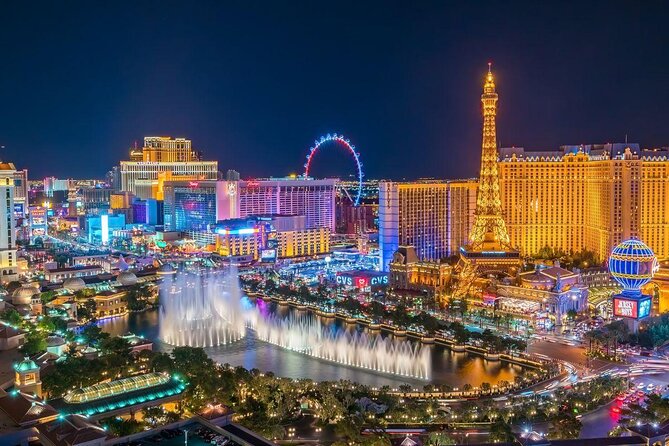
Paris Las Vegas gives you the Strip’s classic trick of shrinking a whole city into a resort facade. You will hear about the Eiffel Tower, Arc de Triomphe, La Fontaine des Mers, and architectural touches borrowed from the Louvre, Musée d’Orsay, and Paris Opera House. The resort opened in 1999 and was linked to French cinema figure Catherine Deneuve.
The next stop, Horseshoe Las Vegas, carries a different kind of history. It opened in 2023 on the former Bally’s site, which had previously been the location of the old MGM Grand. The name recalls Binion’s Horseshoe on Fremont Street and Benny Binion, a major figure in early Las Vegas gambling.
At the Flamingo, the tone shifts to the birth of the modern resort Strip. Opened in 1946, it is the oldest continuously operating resort on the Strip. Its Art Deco style drew from Miami Beach, while its fine dining, polished dealers, entertainment, and formal casino dress helped set a new standard for Las Vegas luxury.
Harrah’s occupies the former Holiday Inn and Casino site. The audio points out that the earlier casino was one of the few on the Strip run by a woman. It is a short detail, but it adds welcome variety to a route otherwise filled with corporate resort history.
More Self-Guided Audio Tours in the USA
- Gettysburg Battlefield Self-Guided Driving Audio Tour
★ 4.5 · 910 reviews - Joshua Tree National Park Self-Guided Driving Audio Tour
★ 4.5 · 762 reviews - Ultimate Acadia National Park Self-Guided Driving Audio Tour
★ 4.0 · 521 reviews - Ultimate Lake Tahoe Self-Guided Driving Audio Tour
★ 4.5 · 435 reviews
Venetian, Mirage, Caesars, and Bellagio
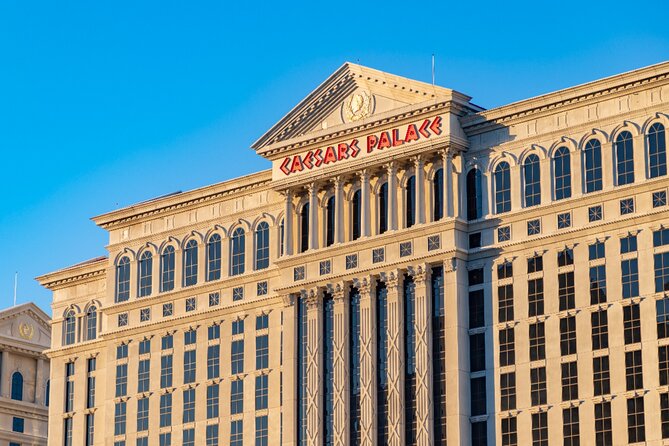
The Venetian occupies the former Sands site, once a favorite place for Frank Sinatra and the Rat Pack. The resort’s scale and Venetian theme are easy to recognize, but the audio ties the building to the entertainment culture that helped make Las Vegas famous.
The Mirage marks another turning point. When it opened in 1989, it hinted at the mega-resort future that soon took over the Strip. Its financing story is especially unusual. Michael Milken helped fund the project through $525 million in bonds, then faced indictment on racketeering and securities fraud charges eight months before the resort opened. Steve Wynn still credited him with helping change Las Vegas.
Caesars Palace takes you back to 1966. Jimmy Hoffa attended the grand opening, and the Teamsters helped finance construction. The story is a reminder that casino development was connected to powerful unions, businessmen, entertainers, and political figures.
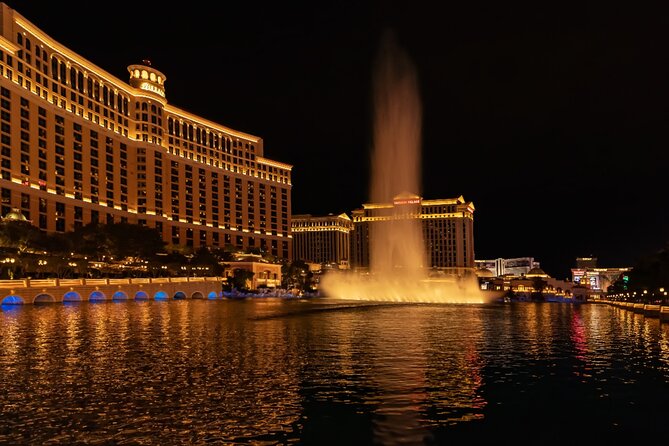
Bellagio opened in 1998 and takes its name from the village on Italy’s Lake Como. Developer Steve Wynn first imagined a French-Alpine resort with a 50-acre lake and an island called Beau Rivage. A visit to Lake Como changed that idea, leading to the Italian theme you see today.
These stops are among the strongest parts of the tour because they connect buildings to people and decisions. You are not only being told what a resort is called. You are hearing why it looks that way and what existed before it.
ARIA, CityCenter, and a more modern Strip
ARIA opened in 2009 with a goal of bringing high technology into a district known for old-school casino habits. Its rooms were designed to respond when you enter, switching on lights, television, music, curtains, and climate controls. When you leave, the system shuts down to save power.
The technology story works best when you view ARIA as part of a larger change. Older resorts leaned on spectacle and themed architecture. ARIA pushed toward automation and modern design, showing how the Strip keeps remaking itself.
The nearby CityCenter, also called the ARIA Campus, includes ARIA, Waldorf Astoria, Vdara, Veer Towers, The Shops at Crystals, and a large shopping mall. You get a sense of how a resort district can function almost like a small city, with hotels, residences, retail, and casinos joined in one area.
The Waldorf Astoria stop adds a quick comparison with the famous New York hotel. The Las Vegas property shares the name but not the same long history. The story touches on the New York hotel’s links to figures such as Frank Costello and Fulgencio Batista.
Park MGM and New York-New York
Park MGM is the only fully smoke-free casino on the Strip, according to the tour content. That fact makes it worth noticing even if you do not enter. It also marks a contrast with the older casino culture, where smoke, formal dress, and round-the-clock gambling helped define the mood.
New York-New York is one of the most playful examples of Las Vegas imitation. Its facade brings together versions of the Lever House, Empire State Building, Chrysler Building, Brooklyn Bridge, Grand Central Terminal, and other New York landmarks. The casino front also includes fiberglass replicas of the New York Public Library, Statue of Liberty, Ellis Island Center, and more.
The tour also covers a stamp scandal linked to the resort in 2010. The supplied information does not spell out the full details, so expect this portion to act as a teaser rather than a complete investigative account.
This section is especially enjoyable if you like architecture with a wink. It is also a good place to pause and look up, since many details sit high above street level.
Excalibur, Luxor, and Mandalay Bay
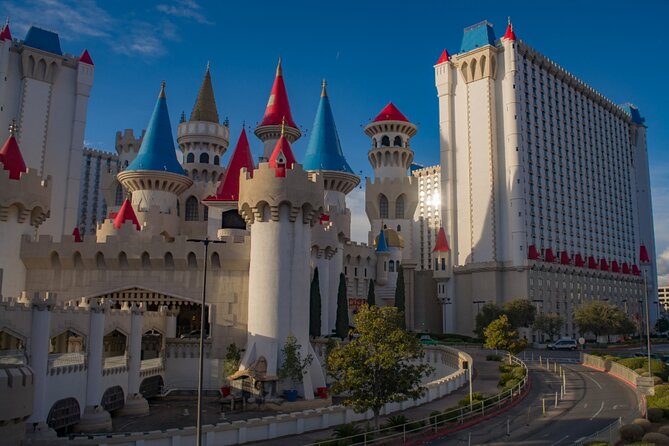
Excalibur brings the fantasy theme, with a castle facade named for King Arthur’s sword. Rumors of demolition have circulated, but the building remains part of the Strip route. The audio treats the resort with a light touch, which suits its cartoon-like appearance.
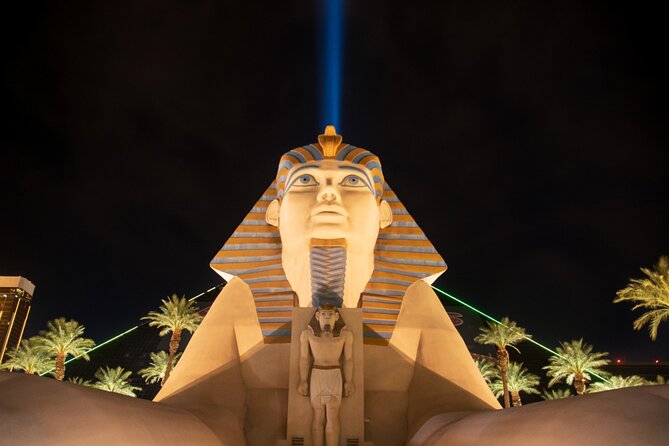
Luxor opened in 1993 and takes its name from the ancient Egyptian city. The resort has lost some of its earlier shine, but its pyramid shape and Sky Beam remain hard to miss. The beam shoots upward from the pyramid peak and can be seen across the Las Vegas Valley.
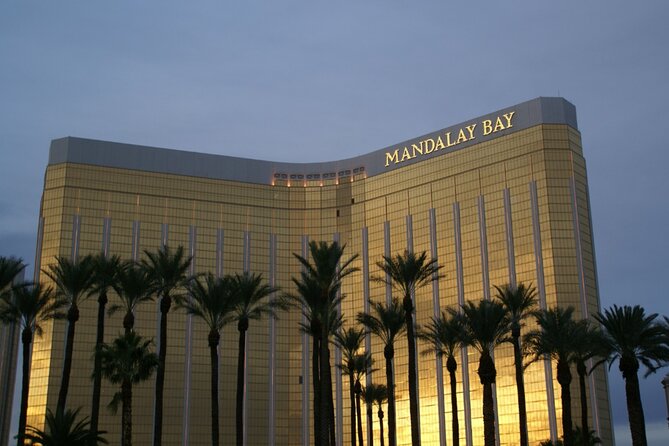
Mandalay Bay closes the listed itinerary. During planning, the project was called Project Paradise, and the owners tested many names before choosing Mandalay Bay. The name refers to Mandalay, Myanmar’s second-largest city, even though Mandalay is far from any bay. It is a fitting final story for a tour built around themed places and surprising names.
What the app does well, and where it can frustrate you
The Action Tour Guide app is the heart of the experience. After booking, you receive setup instructions and a password by email and text. Search for audio tour if the message is not easy to find.
Download the separate app before you arrive. This step matters. The tour works offline after the route is downloaded, but you need a strong Wi-Fi or cellular connection during setup. Use an iPhone with iOS 15 or later, an Android device running version 9 or later, or an iPad or tablet with GPS and cellular service.
Location-triggered narration is convenient. You do not need to keep tapping the screen, and you can pause whenever you want. You can also skip a story, take a side excursion, or return on another day because access does not expire.
The weak point is the Strip itself. Loud music, cars, crowds, and casino noise can bury narration. Bring headphones or earbuds, and keep the written text available in the app if the sound becomes difficult. One useful workaround is to share a single tour between two people by splitting headphones, though separate devices are allowed according to the number of people booked.
Price, timing, and who gets the best value
The listed price is $14.99, but the details describe the purchase as being priced per car rather than per person. They also say the same password can be used on the number of devices matching the booking. Because those details do not perfectly match, check the final checkout terms before paying.
At the advertised price, the tour is inexpensive compared with a private guide or bus excursion. It is particularly good value if you want freedom, already plan to walk the Strip, and enjoy short stories rather than a long lecture.
The four-plus-mile route is the bigger consideration. One to two hours is a brisk pace, and you may not want to walk the whole distance in hot weather or while carrying shopping bags. The route is near public transportation, and you can pause or split the experience across multiple days.
The activity is private because no other group joins you. Still, it is not a private guide service. Nobody meets you at the start, and you are responsible for starting the app, following the route, and handling technical issues.
Should you book the Las Vegas Strip audio tour?
Book it if you want a low-cost introduction to the Strip with control over your timing. It suits independent visitors, couples, families who dislike fixed schedules, and anyone who prefers facts about resort history, design, financing, and famous names.
Skip it if you want backstage access, casino tours, long personal stories, or detailed local secrets at every stop. You can also skip it if you dislike walking several miles while listening through city noise.
My best advice is to download the route before leaving your hotel, use earbuds, start early or late in the day, and treat the one-to-two-hour estimate as a fast walking target. Used that way, the tour gives you a useful framework for understanding why the Strip looks so strange, changes so often, and remains far more interesting than a row of casino entrances.
FAQ
Where does the Las Vegas Strip audio tour start?
It starts at Tropicana Las Vegas, a DoubleTree by Hilton Hotel, at 3801 Las Vegas Boulevard South.
Where does the tour end?
The activity ends back at the starting meeting point.
How long is the walking route?
The route is more than four miles long and takes about one to two hours, depending on your walking pace and stops.
How many audio stories are included?
The tour includes more than 35 audio stories that play as you reach the related locations.
Does the tour work without mobile data?
Yes. You must download the tour while connected to strong Wi-Fi or cellular service. After downloading, the maps and audio work offline.
Do I need to meet a guide?
No. This is self-guided, and no one meets you at the start. You open the Action Tour Guide app onsite, reach the first story point, and follow the audio directions.
Does access expire?
No. The tour offers lifetime access with no expiry date. You can pause it, use it on another day, or take it again on a later trip.
Just added around the USA
- Self Guided Driving Audio Tour of Saguaro National Park★ 3.0 · 4 reviews
- Self-Guided Audio Driving Tour of Mount Lemmon★ 5.0 · 4 reviews
- Saguaro National Park Self-Guided Audio Tour★ 3.5 · 11 reviews
- A Self Guided Audio Tour in Tombstone★ 4.0 · 11 reviews
- Catskills Scenic Byway Self-Guided Driving Audio Tour★ 4.0 · 9 reviews
- Big Bend National Park Self Guided Audio Tour Guide★ 5.0 · 12 reviews
- Self-Guided Audio Driving Tour in Catskills Scenic Byway★ 4.5 · 7 reviews
- Shiloh Battlefield Self-Guided Driving Audio Tour★ 4.0 · 9 reviews
Self-Guided Tours, compared.
Acropolis Ticket & Optional Self-Guided Audio Tours
Read our review →


Ultimate Acadia National Park Self-Guided Driving Audio Tour
Read our review →

Santorini: Akrotiri Ticket with Optional Self-Guided Audios
Read our review →
Browse the lists this tour appears in