REVIEW · USA AUDIO TOURS
Houston Self-Guided Audio Tour
Houston rewards curiosity. This low-cost audio tour links ten very different places, from children’s science exhibits and Holocaust history to NASA and street art. I like the six-day access and the freedom to choose your own route. I also like the price: at $6, the audio commentary can add useful context without the cost of a private guide. The main drawback is that this is not a guided outing with transport. You must arrange your own route, admission tickets, headphones, and internet connection.
The format suits independent planners who want background stories but dislike fixed schedules. You receive a SoundCloud playlist and a Google My Maps itinerary, then choose what to hear and when. I would check the language before setting out, though. A reported problem involved audio that was partly in Portuguese and partly in French after Portuguese was requested, so language selection deserves attention.
Six things to know before you buy

- Ten stops cover a very spread-out Houston: The route reaches museums, parks, the zoo, the Waterwall, the flight museum, and the NASA area.
- Six-day access gives you breathing room: You can split the stops across several days instead of rushing through Houston in one long outing.
- The $6 price buys commentary, not admission: Entry fees, transport, food, headphones, and internet are separate.
- You control the route: This is not GPS-guided, and it does not automatically tell you the next stop.
- The former Graffiti Building is now a memorial stop: The building was demolished in June 2025 for the I-45 expansion, but its story remains part of the audio experience.
- You need a working phone setup: Bring a fully charged smartphone, headphones, and internet access, and open the map in a web browser rather than the Google Maps app.
What this Houston audio tour really is

Think of this purchase as a portable set of short audio introductions, not a traditional sightseeing tour. Each of the ten stops has about 20 minutes of commentary, for roughly three hours of listening time. Your actual day can last three to nine hours, depending on travel, museum visits, meals, and the amount of time you spend at each place.
The key point is you are not being led around Houston. There is no pickup, drop-off, vehicle, or person waiting at the next attraction. You start and finish wherever you wish, and only your group uses the audio access. That makes the experience private, but it also places the planning work in your hands.
The suggested order moves through some of Houston’s best-known cultural and scientific sites. It is not a compact walking route. You will need to plan transportation between locations, especially for the NASA area and the Lone Star Flight Museum. Public transportation is available near the experience, but the information supplied does not promise a single easy transit connection between all ten stops.
At $6 per person, the value is straightforward. If you visit only one or two free stops, the commentary costs little. If you use all ten audio tracks over six days, the price is especially modest. The catch is that several attractions charge their own admission, so the total cost can rise quickly if you try to enter every museum, zoo, and special exhibit.
More Self-Guided Audio Tours in the USA
- Gettysburg Battlefield Self-Guided Driving Audio Tour
★ 4.5 · 910 reviews - Joshua Tree National Park Self-Guided Driving Audio Tour
★ 4.5 · 762 reviews - Ultimate Acadia National Park Self-Guided Driving Audio Tour
★ 4.0 · 521 reviews
Your two digital tools: SoundCloud and Google My Maps
Before your selected date and start time, you receive two private links through the booking platform’s messaging system. One opens a SoundCloud playlist containing the audio tracks. The other opens an interactive Google My Maps page with the ten stops marked by headphone icons.
The SoundCloud playlist is simple. Open it in Safari, Chrome, or another web browser, scroll through the attractions, and tap the track you want. You can listen ahead of time to decide which places matter most, then play the matching track when you arrive.
The map takes a little more care. It should be opened in a web browser, not the Google Maps app. You can tap a headphone icon or select the tour title below the map to see the full list. A popup then links to that stop’s audio guide.
This setup has one useful advantage: you can plan before leaving your hotel. It also has a clear weakness. The map does not automatically guide you from one stop to the next, and the audio does not function as GPS navigation. You will need to check directions yourself and select each track manually.
I would open both links before your first outing. Confirm that the playlist loads, check that the requested language is correct, and make sure the map markers appear. That five-minute check may save you frustration later.
Children’s Museum Houston: learning through play
The first stop introduces Houston’s hands-on approach to education. The Children’s Museum focuses on exhibits where play, problem-solving, creativity, and STEM learning work together.
The audio explains why the displays are designed for active participation rather than quiet observation. It also covers the museum’s educational philosophy, its work with local schools and community organizations, and the research used to shape its exhibits.
You will need to pay admission separately. The 20-minute track is best used as an orientation before you explore. Families may find the commentary useful because it explains the purpose behind exhibits that can otherwise seem like simple games.
If you are traveling without children, this may be an easy stop to skip. The audio still offers a look at Houston’s education programs, but the museum itself is built around hands-on family activity.
Holocaust Museum Houston: memory and present-day responsibility

This stop asks for more time and attention than a quick audio clip can provide. The Holocaust Museum Houston preserves artifacts, survivor accounts, and historical explanations while connecting the past to questions about tolerance, hatred, and human dignity today.
The commentary provides context for the exhibits and explains the role of Houston’s survivor community in creating the institution. It also discusses the museum’s educational work with diverse communities and its focus on human rights.
Admission is not included. I would avoid treating this as a box-checking stop. The 20-minute audio can prepare you for the galleries, but the material deserves a quiet visit at your own pace. If your schedule is tight, give yourself more than the audio time alone.
Same place, a different route to walk:
- Los Angeles: Hop-On Hop-Off Bus Tour with Audio Guide
★ 3.7 · 2,030 reviews - City Sightseeing Hop-On Hop-Off Bus Tour with Audio Guide
★ 3.0 · 1,083 reviews - Medieval Torture Museum Ticket with Audio Guide and Ghost Hunting
★ 5.0 · 962 reviews - San Francisco: Alcatraz, Ferry & Audio Tour w/ Night Option
★ 4.4 · 617 reviews
Museum of Fine Arts, Houston: art across centuries

The Museum of Fine Arts offers a wide sweep, from ancient Greek and Roman objects to Impressionist paintings and modern installations. The audio is designed to help you look beyond labels by discussing artists’ techniques, cultural settings, collecting decisions, and conservation work.
That broad range is both the museum’s strength and its challenge. You cannot see everything in one short visit, so use the track to decide what interests you before entering. Art lovers may want to focus on the Impressionist collection, ancient works, or contemporary pieces rather than trying to cover every gallery.
Admission is separate. The audio adds value if you prefer a little background while looking at art, but it does not replace a full museum guide. You still choose the works you want to study and decide how long to stay.
Houston Museum of Natural Science and the Cockrell Butterfly Center

These two stops sit within Houston’s science museum area and make a sensible pair for one outing. The Houston Museum of Natural Science covers dinosaurs, gems, ancient cultures, paleontology, and scientific research. The audio looks at how specimens were acquired, how dinosaur displays were assembled, and how the museum supports science education.
Admission is not included, and special exhibits may require their own fees. The commentary can help you prioritize the subjects that appeal to you, but you should allow extra time if you want to see the galleries properly.
Next door, the Cockrell Butterfly Center offers a very different setting. Its three-story rainforest conservatory houses exotic butterflies in a controlled tropical environment. The audio explains butterfly life cycles, migration, plant relationships, habitat protection, and the climate controls needed to maintain the space.
This is one of the more distinctive stops because the subject is alive and constantly moving. The track gives you things to watch for, such as feeding behavior and the relationship between butterflies and plants. Admission is separate, so check the cost before planning both attractions around the same visit.
Houston Zoo: conservation beyond the cages

The Houston Zoo is presented as a place where animal care, public education, and conservation work together. The audio discusses rescue stories, breeding programs, habitat design, and international projects.
It also covers the scale of the zoo, which cares for more than 6,000 animals representing about 900 species. Stories about animal intelligence, social behavior, and physical adaptation give you a better way to observe the exhibits than simply moving from enclosure to enclosure.
You pay admission separately. The 20-minute recording is an introduction, not a full zoo route, so you may want to use it at the start and then explore on your own. This stop suits families and anyone who wants a longer, slower visit. It is less useful if you are trying to race through all ten locations in one day.
The Houston Graffiti Building: a memorial after demolition

This stop requires an important update. The former Houston Graffiti Building was demolished in June 2025 as part of the I-45 highway expansion. The audio now works as a historical and cultural memorial at the intersection of Leeland and Emanuel Streets, rather than as a visit to an intact art site.
The story is still compelling. The commentary traces the change from abandoned warehouse to international street-art destination. It also introduces Daniel Anguilu, described as a Mexico City immigrant who became a cultural leader, along with the three young artists who helped create a new public art space.
You hear about the well-known Greetings from Houston mural, tributes to George Floyd and Selena, and the way artists built a shared creative place without waiting for official approval. Admission is free, naturally, but the physical site no longer offers the murals as they once appeared.
This stop is best for anyone interested in Houston’s neighborhoods, public art, and the way development can erase important local landmarks. Set your expectations correctly. You are hearing the story of a place that has disappeared, not entering the former building.
Gerald D. Hines Waterwall Park: Houston’s dramatic free landmark
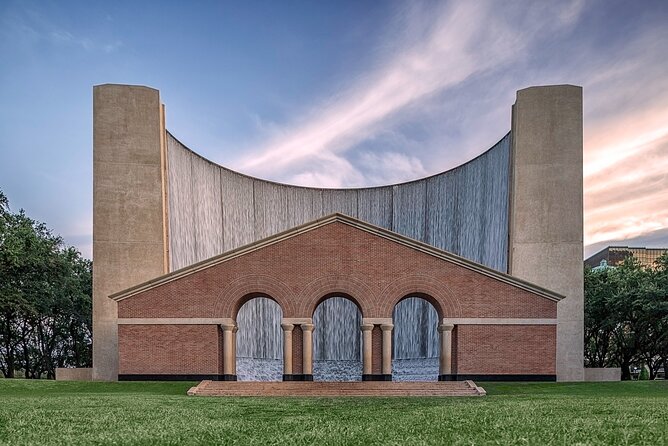
The Waterwall is one of the easiest stops to add to your plans. This 64-foot semicircular fountain sits beside Houston’s business district and costs nothing to visit.
The audio explains the design, the engineering, and the inspiration drawn from Roman aqueducts. It also covers the developer’s effort to create a public oasis among office buildings and describes the proposals, celebrations, and gatherings that shaped the site’s local importance.
This is a good example of where a short audio track can improve a quick stop. You can take in the fountain on your own, but the design details give you a better sense of why this particular structure became so closely linked with Houston.
Since the stop is free, it is also a useful choice if you want to keep the day’s cost down. You can pair it with another nearby plan without committing to a museum ticket.
Lone Star Flight Museum: Texas and the story of flight
The Lone Star Flight Museum turns aviation history into a sequence of restored aircraft, pilot stories, and engineering changes. The audio covers daring flights, military and civilian aviation, aircraft restoration, and the volunteers who preserve these machines.
It also links the museum to Texas’s role in aerospace development. That makes this stop a useful companion to the NASA portion of the experience, though you will need to arrange your own transportation between them.
Admission is not included. Aviation fans may want to spend far longer than the 20-minute track suggests, since the aircraft themselves are the main reason to visit. The audio works best as a frame for the displays, giving you questions to consider while you look at the planes.
Space Center Boulevard and Houston’s NASA connection
The final stop points you toward Houston’s space center area and the mission-control story tied to America’s space program. The audio discusses Apollo-era events, spacecraft design challenges, the scientists and engineers behind the missions, and the people who shaped the program.
It also presents behind-the-scenes Apollo material and the continuing work of space exploration. Keep in mind that this is an audio stop with free access listed for the location itself. Entry to any formal NASA attraction or facility is not included, so do not assume that the $6 purchase provides admission.
This is another stop where planning matters. The NASA area is not a casual walk from central Houston attractions. Treat it as its own outing, and use the audio before or during your visit to set the stage.
Who will get the most from the $6 price
I would recommend this experience to people who like to set their own pace and are comfortable using a phone for directions and audio. It is particularly useful for:
- Independent visitors who want background stories without joining a group
- Families who need breaks and flexible timing
- Repeat Houston visitors looking for cultural stops beyond the usual highlights
- Museum fans who want to choose only a few paid attractions
- Budget planners who can use the free Waterwall and Graffiti memorial alongside paid sites
- People who prefer to spread sightseeing across several days
I would be more cautious if you want a polished day with transport, timed entries, and a guide answering questions in person. You will need to manage every transfer and every ticket yourself.
The language issue also deserves attention. English is offered, and the tour information says multiple languages may be available, but one reported use of the Portuguese option produced a mix of Portuguese and French. Confirm your language before relying on the audio, especially if it is central to your plans.
Practical advice for using the tour well
Bring headphones or earphones, a fully charged phone, and reliable internet access. Audio devices, Wi-Fi, food, and drinks are not supplied.
I would not attempt all ten stops in one rushed day. A better plan is to group the science museums and butterfly center together, give the zoo its own block, and reserve separate time for the NASA and aviation areas. Use the six-day access to build a schedule that matches your interests.
Remember that the purchase is non-refundable and cannot be changed. At $6, the financial risk is low, but you should still check the language, links, phone battery, and admission costs before committing.
Should you book the Houston self-guided audio tour?
Book it if you want cheap, flexible commentary and are happy to plan your own Houston sightseeing. The six-day validity is the strongest feature, especially because the ten stops are spread across very different parts of the city.
Skip it if you expect transportation, live guidance, automatic navigation, or admission to the attractions. The audio can add context, but it cannot replace your own route planning. For a careful independent visitor, $6 is a fair price. For someone seeking a ready-made tour, it may feel too bare-bones.
FAQ
How long does the Houston self-guided audio tour take?
The experience is listed as approximately three to nine hours. Each of the ten audio stops is about 20 minutes, but your total time depends on transportation, museum visits, breaks, and how many attractions you enter.
How long can I use the audio guides?
The private access links remain valid for up to six days, allowing you to split the experience across multiple days.
Is transportation included?
No. Pickup, drop-off, and transportation between attractions are not included. You choose your own starting and ending points.
Are attraction admission fees included?
No. Entry fees are separate wherever they are required. The Houston Graffiti memorial stop and Gerald D. Hines Waterwall Park are listed as free stops.
What do I need to use the tour?
You need a fully charged smartphone, headphones or earphones, and internet access. The audio is accessed through SoundCloud, and the itinerary map is opened in a web browser through Google My Maps.
Is this a GPS-guided tour?
No. It is not GPS-guided. You can choose the order, select your stops, and use the map for planning, but the tour does not automatically direct you to the next attraction.
Just added around the USA
- Self Guided Driving Audio Tour of Saguaro National Park★ 3.0 · 4 reviews
- Self-Guided Audio Driving Tour of Mount Lemmon★ 5.0 · 4 reviews
- Saguaro National Park Self-Guided Audio Tour★ 3.5 · 11 reviews
- A Self Guided Audio Tour in Tombstone★ 4.0 · 11 reviews
- Catskills Scenic Byway Self-Guided Driving Audio Tour★ 4.0 · 9 reviews
- Big Bend National Park Self Guided Audio Tour Guide★ 5.0 · 12 reviews
- Self-Guided Audio Driving Tour in Catskills Scenic Byway★ 4.5 · 7 reviews
- Shiloh Battlefield Self-Guided Driving Audio Tour★ 4.0 · 9 reviews
Self-Guided Tours, compared.

Acropolis Ticket & Optional Self-Guided Audio Tours
Read our review →


Ultimate Acadia National Park Self-Guided Driving Audio Tour
Read our review →

Santorini: Akrotiri Ticket with Optional Self-Guided Audios
Read our review →