REVIEW · SELF-GUIDED TOURS
Hong Kong Self-Guided Audio Tour
Hong Kong rewards curious walkers. This low-cost audio tour links the city’s best-known sights, from Victoria Harbour and the Peak to Lantau Island, while letting you choose the order. I like the $9 price and the freedom to skip places that do not fit your day. The main catch is that transportation and admission fees are yours to arrange.
I also like that you can listen before, during, or after your visit. The audio works online or offline, and the map helps you connect 15 stops spread across Hong Kong. Still, three hours is enough only for a selective taste. Seeing every stop properly would require several days and careful planning.
Key points at a glance

- Fifteen major sights: The route covers harbor views, parks, temples, shopping areas, the Peak, Disneyland, and Lantau Island.
- A $9 planning tool: The low price makes sense if you want background information without paying for a private guide.
- Flexible timing: You can start and finish where you wish, with the tour usable within 72 hours of starting.
- Two useful links: One opens the SoundCloud audio, while the other opens a Google My Maps route with each stop attached.
- Extra costs matter: The Peak Tram, Ngong Ping 360, Disneyland, and other paid attractions are not included.
- Best for independent visitors: You need to handle transport, route choices, timing, and entrance tickets yourself.
What this Hong Kong audio tour really gives you
This is not a traditional walking tour with a guide leading you from one sight to the next. It is a private, self-guided set of audio tracks and map points. You receive access links before your selected travel date, then open the audio on your phone or another device.
The first link leads to a SoundCloud web page. You can play one attraction at a time or listen through the full playlist while planning. The second link opens an interactive Google My Maps route. Each marked point connects to its matching audio track, so you do not have to search through a long list every time you arrive somewhere.
That setup is simple, but it puts the work in your hands. You decide whether to follow all 15 stops, choose only the Kowloon sights, or use the audio as background for a wider Hong Kong trip. You can also listen offline, which is useful if your connection becomes unreliable.
The stated tour length is about three hours, with roughly 10 minutes of audio assigned to each attraction. Think of that as listening time, not total travel time. The stops are spread across Hong Kong Island, Kowloon, and Lantau Island, so reaching them all in one short outing is not realistic.
The access links remain valid for up to six days. The experience itself allows you to start and end within a 72-hour period, giving you room to split the route over more than one day. That flexibility is one of the best reasons to choose this format.
More Self-Guided Audio Tours in the world:
- Athens: Acropolis Ticket & Optional Self-Guided Audio Tours
★ 4.1 · 2,542 reviews - Gettysburg Battlefield Self-Guided Driving Audio Tour
★ 4.5 · 910 reviews - Joshua Tree National Park Self-Guided Driving Audio Tour
★ 4.5 · 762 reviews
Victoria Harbour and Kowloon: the strongest opening
Victoria Harbour is the natural place to begin. The audio explains how this sheltered waterway helped Hong Kong grow from a fishing settlement into an international business center. The subject fits the setting well, since the harbor gives you a quick sense of the city’s scale and geography.
The stop is free to view, but the tour notes that admission is not included. That wording should not concern you as an entry ticket. It mainly means you may have expenses connected with reaching or using certain harbor viewpoints. The audio portion itself is part of your access.
Kowloon Park offers a useful change of pace. In the middle of Tsim Sha Tsui, it traces the area’s shift from military barracks to public park. You get a little urban history along with green space and several park features.
Next comes the Avenue of the Stars, where the audio focuses on Hong Kong cinema and the performers who helped shape it. This is a good choice if film is part of your interest in the city. The stop also gives context for Hong Kong’s influence beyond its own borders.
At the Tsim Sha Tsui Promenade, the subject turns back to the waterfront. You can look across toward Hong Kong Island while learning how the promenade developed as part of the city’s public urban space. I would give this area extra time beyond the 10-minute audio track, since the view is the point.
These four stops work well together. Kowloon Park and the Avenue of the Stars are close to the Tsim Sha Tsui area, while the promenade and harbor help you understand the relationship between the two sides of the city. If you only have half a day, this is the most practical group to choose.
Causeway Bay, Hong Kong Park, and the Peak Tram
Causeway Bay shows another side of Hong Kong. The audio follows its change from a quiet residential district into a major shopping center. You do not need to shop to appreciate the stop, since it helps explain how urban Hong Kong keeps changing its purpose.
Hong Kong Park provides a calmer setting. Its design combines planted areas with modern structures, a tea house, and an aviary. The audio points out the park’s different features, so you can choose what deserves your time rather than treating the stop as a quick pass-through.
The Peak Tram is one of the tour’s more distinctive subjects. Dating from 1888, it offers a short story about engineering and the history of one of Hong Kong’s best-known rides. The tram requires a separate ticket, and transport is not included, so check the cost and operating arrangements before building your day around it.
The Peak itself is the payoff. From this high point, the audio explains how the area changed from an exclusive colonial retreat into a major sightseeing destination. The Peak stop is free in the itinerary, but reaching it may involve the tram or another form of transportation, and any paid viewing facility would be separate.
Do not treat the Peak Tram and Victoria Peak as two unrelated stops. They are best planned as one outing. Allow time for the journey, waiting, views, and return trip. The 10-minute audio track is only the commentary layer.
Nan Lian Garden and Chi Lin Nunnery
Nan Lian Garden introduces classical Chinese garden design in a carefully arranged setting. The audio points to Tang dynasty-style architecture and the ideas behind the garden’s layout. This gives you more to notice than attractive buildings alone, especially if you want cultural background without joining a formal group tour.
Chi Lin Nunnery adds a religious and architectural focus nearby. Its wooden buildings were constructed without a single nail, a detail that gives the stop a clear point of interest. The complex is described as a quiet Buddhist refuge amid the city, so you may want to lower the volume and give the setting room to speak for itself.
Both stops are free, which improves the value of this part of the tour. They also pair naturally because they offer related architectural and religious themes. The audio will take about 10 minutes at each stop, but you should not feel obliged to leave as soon as the recording ends.
This section is especially useful for you if Hong Kong’s temples, gardens, and design traditions matter more than shopping. It is less useful if you are trying to rush through the city’s headline sights in a single morning.
A few more audio tours around the world worth a look
- Barcelona: Sagrada Familia Entry Ticket with Audio Guide
★ 4.6 · 105,312 reviews - Rome: Pantheon Fast-Track Ticket and Official Audioguide
★ 4.5 · 27,353 reviews - Barcelona: Casa Batlló Entry with Self-Audioguide Tour
★ 4.7 · 25,359 reviews - Rome: Colosseum & Forum with Audio Guide App -Optional Arena
★ 4.2 · 24,770 reviews
Ten Thousand Buddhas Monastery: allow extra time
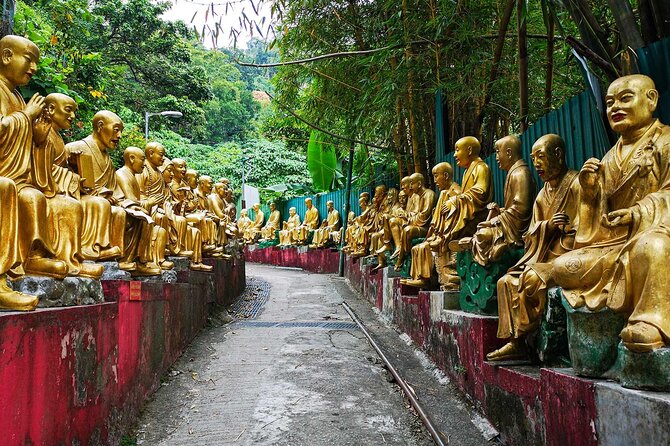
Ten Thousand Buddhas Monastery brings a different visual focus. The audio explains the story behind the complex and its many Buddha statues. The stop is more than a single temple building, so the listed 10-minute recording should be treated as an introduction rather than a complete visit.
The free admission makes it appealing for budget planning. However, the tour does not include transportation, and the attractions are not arranged as one compact walking route. You will need to use the map and work out how this stop fits with your other Kowloon plans.
I would place it on a day devoted to Kowloon rather than trying to squeeze it between Hong Kong Island and Lantau Island. The audio can tell you what to look for, but the experience depends on your own pace and route.
Lantau Island: Disneyland, Po Lin Monastery, and the Big Buddha
Hong Kong Disneyland appears in the audio collection as a cultural adaptation of the Disney theme park idea. The track covers the park’s distinctive features and its adjustments for the Chinese market. This is useful background if you plan to visit, but the park needs its own schedule and separate admission ticket.
At $9, the audio is not meant to replace a Disneyland ticket or a full day inside the park. It works better as an orientation piece or as part of a wider Hong Kong plan. If you are not visiting the park, you can simply skip that track.
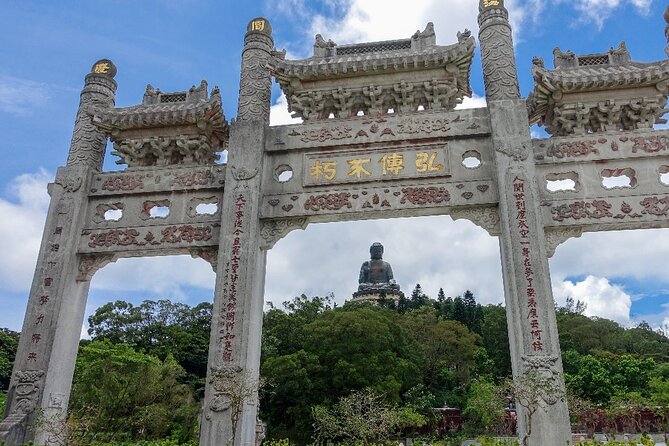
Po Lin Monastery shifts the mood toward Buddhist worship and art. The audio covers its role in Hong Kong’s religious life, along with its history and artistic details. Admission is listed as free, though transport to Lantau Island is not included.
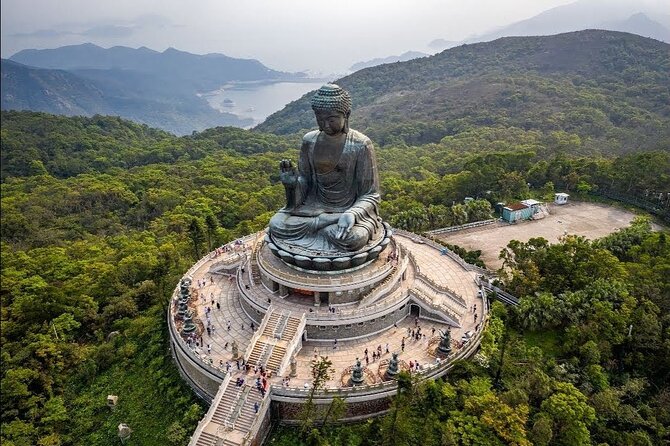
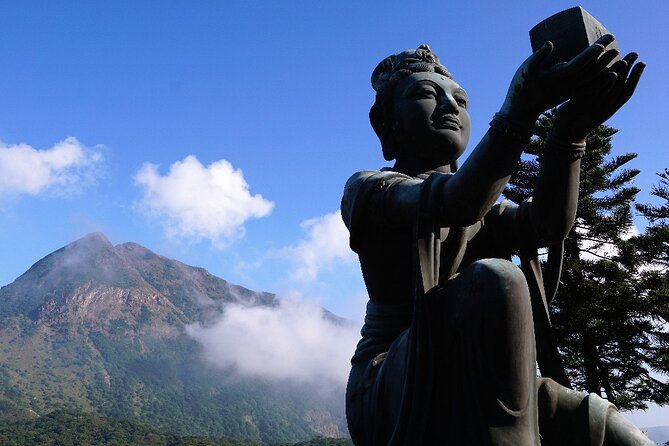
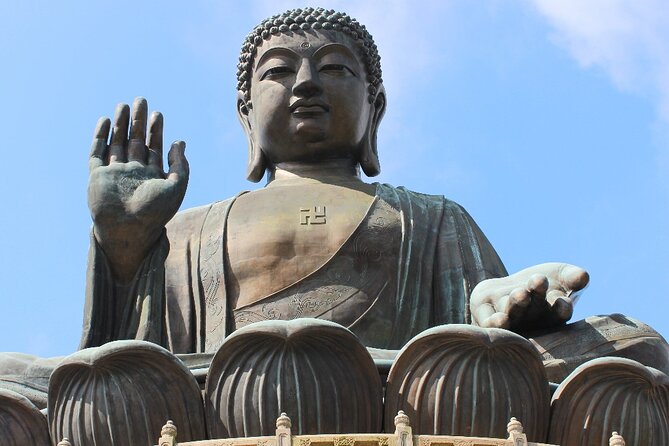
The Tian Tan Buddha, often called the Big Buddha, is one of the city’s most recognizable sights. Here the audio explains the statue’s construction, meaning, and cultural role. This is a stop where context adds real value, since the size and position of the bronze figure are easier to appreciate when you understand why it was built.
Ngong Ping 360 completes the Lantau group. The cable car gives wide views across the island and has its own engineering story. A ticket is not included, so you must budget separately. You can also use the audio without taking the cable car, but the track is most useful if you plan to see or ride it.
These four stops are not a quick add-on to a central Hong Kong visit. They belong to a full Lantau day, with transport and ticket timing planned in advance. The self-guided format helps because you can choose which attractions deserve the most time, but it does not remove the distance between them.
How to use the map and audio without wasting time
Before setting out, open both links. Listen to enough of the playlist to understand the subjects, then mark your priorities on the map. You may decide on a Kowloon day, a Hong Kong Island day, and a separate Lantau day.
Download or save the audio for offline use if you expect to be moving around without a stable connection. The tour says the audio is available in multiple languages, but the supplied details do not name the languages, so check the available options before you rely on one.
Use headphones only when they do not distract you from traffic, crowds, or quiet religious spaces. The message service is there if you need help accessing the tracks or finding information. That support is useful, but it is not the same as having a guide beside you.
The private format means only your own group participates. You gain privacy and control, but you also lose the local conversation and spontaneous answers that come with a live guide. The right choice depends on how much independence you want.
Is $9 good value?
For $9 per person, the tour offers a lot of subject coverage at a small cost. The strongest value comes from the planning feature: you can preview the audio, select your stops, and keep the links for several days. A previous purchaser rated the experience highly for its useful information and the ability to listen before, during, or after visiting.
That praise points to the tour’s real strength. It is not a replacement for transport planning or a full guide service. It is a flexible information layer that can make your own Hong Kong route more meaningful.
The price looks less attractive if you expect a complete three-hour guided route with all transport and tickets included. Those costs remain separate, especially for the Peak Tram, Ngong Ping 360, Disneyland, and any other paid attraction. The non-refundable booking terms also mean you should choose your date carefully.
Who should book this experience?
I would recommend it to independent visitors who enjoy setting their own pace and want background information without a group. It suits people with different interests, since you can focus on film, gardens, temples, city views, shopping districts, or Lantau Island.
It is also a good fit if you have several days in Hong Kong and want a ready-made list of places to consider. The map and audio links reduce planning time, while the 72-hour window lets you spread the experience out.
I would be cautious if you want a guide, hotel pickup, fixed transport, or a tightly organized route. The city’s attractions are far apart, and the tour does not solve that problem for you. You must choose the route and pay for transport yourself.
Should you book the Hong Kong Self-Guided Audio Tour?
Book it if you want an inexpensive, private way to add context to your own Hong Kong sightseeing. The best use is to split the stops across several days, giving Kowloon, Hong Kong Island, and Lantau Island their own plans.
Skip it if you need a live guide or an all-inclusive outing. For everyone else, the $9 fee is easy to justify, especially because you can listen before and after each visit, use the map at your own pace, and ignore any stop that does not suit your schedule.
FAQ
How long does the Hong Kong Self-Guided Audio Tour last?
The tour is designed for about three hours, with approximately 10 minutes of audio assigned to each of the 15 attractions. Travel time between stops is separate.
Can I choose my own starting and ending points?
Yes. Since it is self-guided, you decide where to begin and finish. Both points can be in Hong Kong according to your plans.
How long are the access links valid?
The private access links are valid for up to six days. The experience also allows you to start and finish within 72 hours.
Do I need to download a tracking app?
No. You can listen through secure web links on your device, and no tracking app is required.
Is the audio available offline?
Yes. The audio guide is available online or offline.
What is included with the tour?
You receive a private link to one audio playlist covering 15 attractions and a private Google My Maps link showing the stops and their individual audio guides.
Are admission tickets and transportation included?
No. Entry fees are not included where required, and transportation, including pickup and drop-off, is also excluded. The Peak Tram, Ngong Ping 360, and Hong Kong Disneyland are specifically listed with admission costs not included.
Is this a private activity?
Yes. Only your own group participates, and you explore without a guide-led group.
Just added around the world
- Coba Ruins: Self-Guided Walking Audio Tour in Mexico★ 3.5 · 2 reviews
- Self Guided Driving Audio Tour of Saguaro National Park★ 3.0 · 4 reviews
- Torino Walking Tour with Audio and Written Guide by a Local★ 4.5 · 35 reviews
- Self-Guided Audio Driving Tour of Mount Lemmon★ 5.0 · 4 reviews
- Trondheim’s Inner Circle: A Self-Guided Audio Tour★ 4.0 · 15 reviews
- A Tromsø Introduction: A Self-Guided Audio Tour★ 3.5 · 19 reviews
- Panorama Bus Tour with Audio Guide★ 4.0 · 3 reviews
- Saguaro National Park Self-Guided Audio Tour★ 3.5 · 11 reviews
Self-Guided Tours, compared.

Acropolis Ticket & Optional Self-Guided Audio Tours
Read our review →


Ultimate Acadia National Park Self-Guided Driving Audio Tour
Read our review →

Santorini: Akrotiri Ticket with Optional Self-Guided Audios
Read our review →