
REVIEW · SELF-GUIDED TOURS
Turtle Bunbury’s Dublin: A Self-Guided Audio Tour from a Celebrated Author
Dublin’s stories begin under your feet. Turtle Bunbury’s audio walk turns a short stretch of central Dublin into a lively history lesson, linking St Stephen’s Green, Merrion Square, and Trinity College. I like the clear navigation and the way Bunbury connects Irish figures with surprising international stories, including Wolfe Tone, Bernardo O’Higgins, and the Irishman who fought for Mexico. The tour costs $7.99, so it offers good value if you want context without paying for a private guide.
I also like the offline access to maps, audio, and geodata, which makes this easy to use once you are on the street. The main drawback is that the tour is non-refundable, and the route depends on your phone and headphones. Trinity College and the Book of Kells may also be closed, so part of the final section could need a change of plan.
Key points about this Dublin audio walk

- A compact central route: Walk from Edward Delaney’s Famine Memorial near St Stephen’s Green to Parliament Square at Trinity College.
- A literary and political Dublin: The route includes Oscar Wilde, the Department of the Taoiseach, Leinster House, and the National Museum of Ireland.
- Unexpected international connections: Hear about Bernardo O’Higgins, Irish links to Mexico, Normanized Vikings, and Frenchmen who fought for Ireland.
- Simple self-guided format: Use the VoiceMap app on Android or iOS, with offline audio, maps, and location data.
- Good low-cost value: At $7.99 per person, it costs less than most live guided walks and lets you set your own pace.
- Plan for possible closures: Trinity College and the Book of Kells were listed as subject to temporary closure, so check current access before setting out.
St Stephen’s Green gives the walk a strong opening
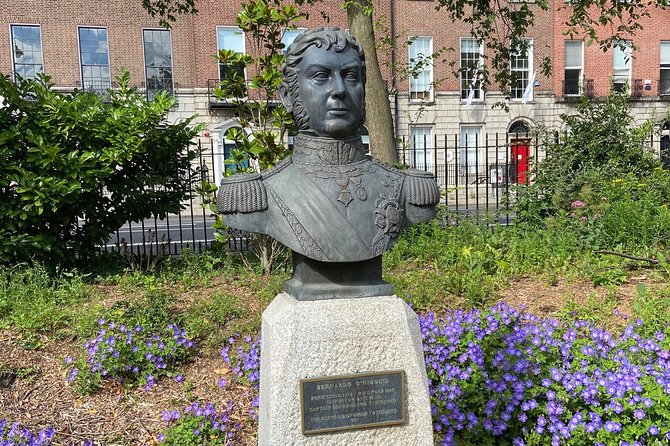
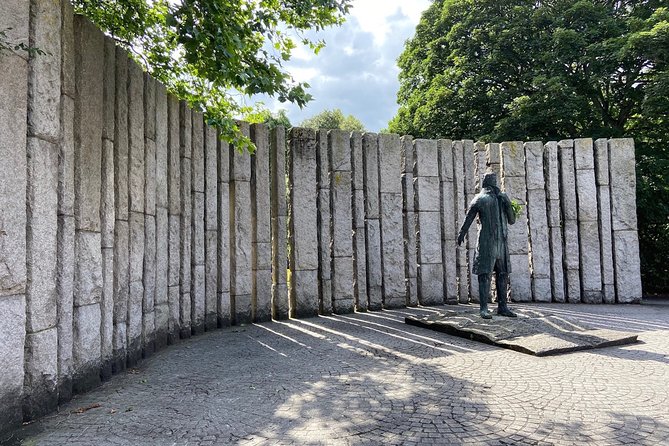
The walk begins near Edward Delaney’s Famine Memorial at 42 St Stephen’s Green, Dublin 2. This is a practical meeting point in central Dublin, close to public transport and easy to reach from many parts of the city.
The opening location gives the tour a serious tone. The memorial anchors the route in one of Ireland’s most painful historical periods before the audio moves into the city’s wider political, social, and literary story. You do not simply begin with a list of dates. You begin with a place that asks you to pay attention.
From the memorial, the tour passes the Huguenot Cemetery. This stop helps widen your view of Dublin. The city’s story was shaped not only by native Irish families, but also by people who arrived from elsewhere and became part of Irish public life.
The audio format works well here because you can look around while listening. You are not trying to keep up with a group or watch a guide at the same time. You can pause the tour if you want to read a sign, take a photograph, or get your bearings.
More Self-Guided Audio Tours in the world:
- Athens: Acropolis Ticket & Optional Self-Guided Audio Tours
★ 4.1 · 2,542 reviews - Gettysburg Battlefield Self-Guided Driving Audio Tour
★ 4.5 · 910 reviews - Joshua Tree National Park Self-Guided Driving Audio Tour
★ 4.5 · 762 reviews
O’Donoghue’s and the many faces of Dublin
The route continues past O’Donoghue’s, a famous Dublin pub, then toward the Merrion Hotel. These places help show how close together Dublin’s everyday social life, old institutions, and formal public buildings can be.
Bunbury’s approach is not limited to the most famous landmarks. He uses the route to introduce characters and connections that you might otherwise miss while walking between larger sights. The result is a street-level tour rather than a checklist of major attractions.
One of the most unusual names connected with the audio is Paddy Hitler. The title alone should give you a sense of the tour’s tone. It is historical, but not stiff. Bunbury uses odd, memorable characters to keep the walk moving and to remind you that the past is often stranger than a standard textbook suggests.
The route also brings in Vikings who became Normans, Frenchmen who fought for Ireland, and Irishmen who fought for Mexico. These stories are especially useful if you want to understand Ireland as part of a wider world rather than as an isolated island.
Government, museums, and the political heart of Ireland
As you continue, the walk passes the Department of the Taoiseach and Leinster House. These stops bring modern Irish government into the route, giving you a chance to connect the city’s older stories with the institutions that shape the country today.
The Department of the Taoiseach is the office of Ireland’s head of government. Leinster House is home to the national parliament. You do not need to enter either building for the stops to be worthwhile. Their location along the route lets the audio explain the political importance of the area while you view the buildings from outside.
The National Museum of Ireland also appears along the way. The tour does not include entrance fees, so you should treat it as an exterior stop unless you choose to return later and visit independently.
That is one of the walk’s practical strengths. It gives you a framework for the area without forcing you to spend the entire day inside attractions. You can finish the audio walk, then decide which museum or historic building deserves more of your time.
Merrion Square brings Oscar Wilde into view
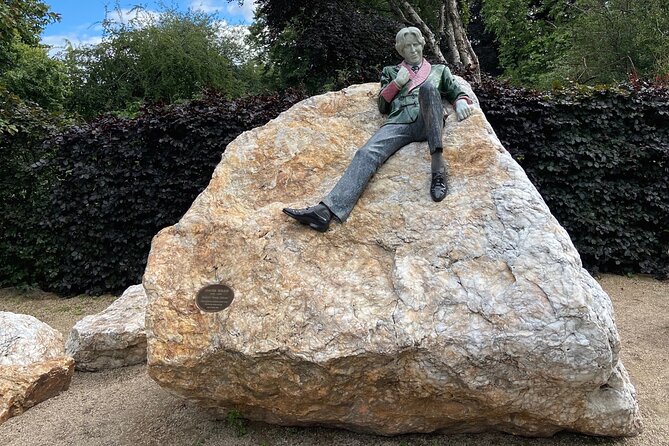
The route passes through Merrion Square, one of the most attractive sections of the walk. It then pauses at the Oscar Wilde Statue and passes Oscar Wilde’s former home.
These stops give the route a strong literary thread. Wilde is one of Dublin’s best-known cultural figures, and seeing both the statue and the house makes his connection with the neighborhood more concrete. The audio can add meaning to what might otherwise be a quick photograph and a short glance.
The square also gives you a natural place to slow down. A self-guided tour does not have to be completed at a strict pace. If the audio has drawn your attention to a detail, take a moment to look around before moving on.
The itinerary includes a playground in the Merrion Square section. That makes the route a little more flexible for families, though the tour itself is still primarily a history walk. Parents can use the stop as a short break while keeping the audio paused.
You will also pass a pharmacy. On its own, that may sound like a minor point, but it reflects the character of the tour. Bunbury is guiding you through a lived-in city, not just from monument to monument. The route includes ordinary street details alongside major national figures.
A few more audio tours around the world worth a look
- Barcelona: Sagrada Familia Entry Ticket with Audio Guide
★ 4.6 · 105,312 reviews - Rome: Pantheon Fast-Track Ticket and Official Audioguide
★ 4.5 · 27,353 reviews - Barcelona: Casa Batlló Entry with Self-Audioguide Tour
★ 4.7 · 25,359 reviews - Rome: Colosseum & Forum with Audio Guide App -Optional Arena
★ 4.2 · 24,770 reviews
Kennedy’s Pub and the value of a flexible pace
Kennedy’s Pub appears later on the route, before the walk reaches Trinity College. The pub is also useful as a practical reference point if you want to pause, rest, or continue listening in a comfortable setting.
The tour description specifically suggests retiring to one of Dublin’s nearby pubs if Trinity College is closed. That advice is sensible. A self-guided audio walk is easiest when you treat it as a flexible plan rather than a race from one GPS point to the next.
The total duration is about one hour to one hour and fifteen minutes. That is long enough to provide a real introduction to this part of Dublin, but short enough to fit around a museum visit, lunch, or another city activity.
You should allow extra time if you plan to stop for photographs, enter an attraction, or listen from a pub. The stated duration is for the audio walk itself, not a full day of sightseeing.
Trinity College provides the grand finish
The walk goes through the grounds of Trinity College and ends at Parliament Square. This is the route’s most famous setting, and it gives the final section a clear sense of arrival.
The tour passes the Museum Building and the Berkeley Library before stopping outside the Book of Kells. These buildings make Trinity one of the most rewarding parts of the route, even if you only view them from outside.
The Book of Kells is a major Dublin attraction, but admission is not included. You will need a separate ticket if you want to visit. The audio tour only brings you to the exterior stop, so factor that additional cost into your plans.
The same warning applies to Trinity College access. The supplied information noted a temporary closure until August 10, 2020, with the possibility of an earlier reopening, a later reopening, or another closure after reopening. That date is historic, so you should check current opening conditions before you go.
If the college grounds or Book of Kells are closed, the tour does not become useless. You can still follow the route and listen to the historical commentary from accessible public areas, then finish nearby. Still, the final section will be less satisfying if you expect to enter the college or see the Book of Kells.
Bunbury’s storytelling gives the tour its personality

Turtle Bunbury is a celebrated Irish author, and the audio is built around his storytelling rather than a dry list of facts. The subjects range widely, from political figures to writers, foreign soldiers, immigrants, and military connections.
The names Bernardo O’Higgins, Maurice Fitzgerald, Wolfe Tone, and Paddy Hitler give the walk a distinctive cast. You are not hearing only the most familiar Dublin figures. You are being introduced to people who help explain how Ireland’s story reached far beyond the streets around Trinity College.
The references to Irishmen who fought for Mexico are especially useful for anyone who likes history with an international angle. They challenge the simple idea that Irish history happened only within Ireland’s borders.
I also appreciate that the tour appears to favor a logical order. The route moves from St Stephen’s Green through Merrion Square and on to Trinity College, so the story follows the physical direction of your walk. That matters with audio tours. If the narration jumps around too much, you spend more energy figuring out where you are than listening.
The available ratings are very strong, with a perfect five out of five from three submitted ratings. The specific praise centers on two qualities: the tour is easy to use, and the information is presented in a logical, entertaining way. Those are exactly the qualities that make a self-guided walk work.
The VoiceMap app keeps the logistics simple
You receive lifetime access in English through the VoiceMap app for Android and iOS. Audio, maps, and geodata are available offline, which is one of the best practical features of the tour.
Download what you need before starting. Once the route is stored on your phone, you do not need to depend on a live data connection for the audio or map information. You still need your own smartphone and headphones, since neither is included.
The route is private in the sense that only your group participates. There is no scheduled live guide and no need to match another group’s pace. That makes it useful for couples, families, and solo visitors who prefer to stop when they want.
You should still keep your phone charged. The supplied information does not promise a charger, battery pack, or replacement device. A charged phone and comfortable headphones are basic equipment for this experience.
The meeting point is listed as open every day, all day, from January 14, 2022, through June 18, 2026. That refers to the published availability window, not guaranteed access to every site on the route. Public buildings and attractions can have separate hours or closures.
Is $7.99 a good price for this Dublin walk?
At $7.99 per person, the tour is inexpensive for a one-hour introduction to central Dublin. You get a prepared route, professional narration, maps, and lifetime access in English.
The value is strongest if you want historical context but do not need a live guide. A private guided walk usually costs more, while a printed walking route cannot provide the same spoken storytelling or location-based direction.
The price does not cover museums, the Book of Kells, food, drinks, transport, a smartphone, or headphones. That keeps the basic cost low, but it also means your final spending depends on what you add.
I would treat this as a low-cost orientation walk. It can help you understand the area before returning to places that deserve more time. It is less suitable if you want a full guided visit inside Trinity College or a museum-focused experience.
The non-refundable policy deserves attention before purchase. You cannot change or cancel the booking for a refund, so check your schedule, phone compatibility, and current access conditions first.
Who should choose this experience?
I would recommend this walk to anyone who wants a short, self-paced introduction to Dublin’s political, literary, and historical center. It suits independent visitors who enjoy exploring with a phone rather than joining a fixed group.
It is also a good fit for repeat visitors. You may already know St Stephen’s Green or Trinity College, but the audio can give familiar streets a new set of connections.
Families can use the flexible format to pause near the Merrion Square playground. Couples and solo visitors may appreciate the freedom to stop at a pub or take photographs without holding up a guide.
I would be more cautious if your main goal is the Book of Kells. The tour only stops outside it, and entry costs extra. I would also hesitate if you dislike listening through headphones or want detailed answers from a person on the spot.
Should you book Turtle Bunbury’s Dublin audio tour?
Book it if you want a well-priced, easy-to-follow walk that links Dublin’s streets with unusual historical characters. The route is compact, the app offers offline support, and the audio adds more than a basic sightseeing map.
Skip it if you need guaranteed entry to Trinity College, the Book of Kells, or another attraction along the route. Also skip it if your plans may change, since the booking cannot be refunded or amended.
For most independent visitors, $7.99 is a fair price for a focused hour of Dublin history. Start at the Famine Memorial, keep your phone charged, check Trinity’s current access before setting out, and leave room for a pub stop at the end.
FAQ
How long does the Dublin audio tour take?
The tour takes approximately one hour to one hour and fifteen minutes.
Where does the tour start?
It starts near Edward Delaney’s Famine Memorial at 42 St Stephen’s Green, Dublin 2, D02 KW58, Ireland.
Where does the tour end?
The tour ends at Parliament Square, Dublin, near Trinity College.
Is the Book of Kells ticket included?
No. Entrance fees to the Book of Kells and other attractions are not included.
Can I use the tour offline?
Yes. The VoiceMap app provides offline access to the audio, maps, and geodata.
What do I need to bring?
You need your own smartphone and headphones. Transportation and food or drinks are not included.
Just added around the world
- Coba Ruins: Self-Guided Walking Audio Tour in Mexico★ 3.5 · 2 reviews
- Self Guided Driving Audio Tour of Saguaro National Park★ 3.0 · 4 reviews
- Torino Walking Tour with Audio and Written Guide by a Local★ 4.5 · 35 reviews
- Self-Guided Audio Driving Tour of Mount Lemmon★ 5.0 · 4 reviews
- Trondheim’s Inner Circle: A Self-Guided Audio Tour★ 4.0 · 15 reviews
- A Tromsø Introduction: A Self-Guided Audio Tour★ 3.5 · 19 reviews
- Panorama Bus Tour with Audio Guide★ 4.0 · 3 reviews
- Saguaro National Park Self-Guided Audio Tour★ 3.5 · 11 reviews
Self-Guided Tours, compared.

Acropolis Ticket & Optional Self-Guided Audio Tours
Read our review →


Ultimate Acadia National Park Self-Guided Driving Audio Tour
Read our review →

Santorini: Akrotiri Ticket with Optional Self-Guided Audios
Read our review →