
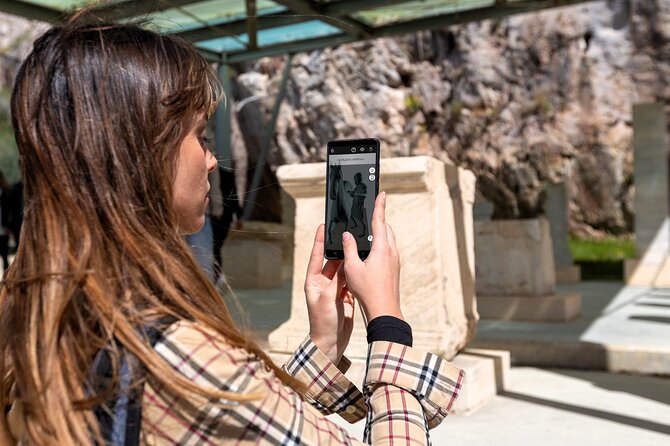
REVIEW · GREECE AUDIO TOURS
Delphi: Self-guided Audiovisual Tour with 3D Representations
Ancient myths come alive at Delphi. This low-cost audio tour adds clear narration, 3D reconstructions, and 360-degree views to one of Greece’s most striking archaeological sites. I especially like the way the digital models help you picture buildings that now survive only in fragments, and the GPS map lets you explore without keeping a guidebook open every few minutes.
The tour costs $8.09 per person, which is good value if you want structure without paying for a private guide. The main catch is that your entrance ticket costs extra, and the app needs internet access to work properly. Installation can also take a little patience, so downloading everything before you reach Delphi is wise.
Key points at a glance
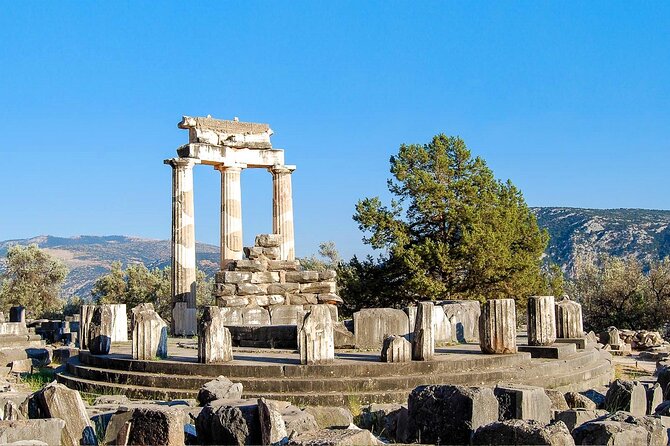
- See lost buildings rebuilt: 3D models show how Delphi’s monuments may have looked in antiquity.
- Follow 16 monuments: Audio narration and written information cover the major points around the sanctuary.
- Use 14 visual reconstructions: 3D models, 360-degree panoramas, and short videos add context to the ruins.
- Listen in eight languages: English, Greek, Spanish, German, French, Italian, Dutch, and Chinese are available.
- Plan for extra admission: The app fee does not include the archaeological site ticket, priced at €12 full fare or €6 reduced fare.
- Allow about 60 to 90 minutes: The advertised route takes roughly one hour, but you can move at your own pace.
Why Delphi benefits from a digital guide
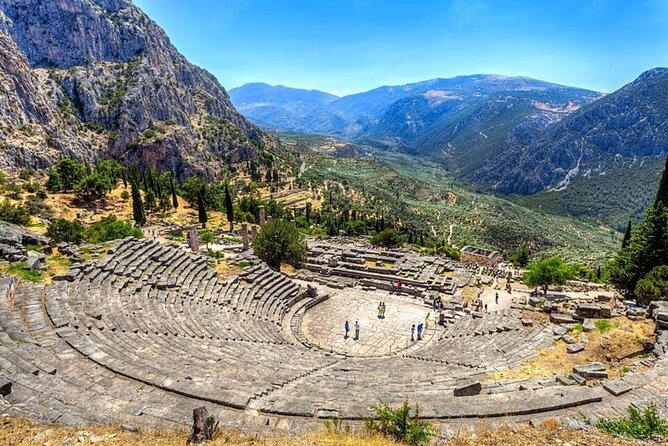
Delphi can be a difficult place to read at first glance. You walk past columns, foundations, stones, and steep paths, but the original sanctuary was far more complete and impressive. The audio tour helps bridge that gap by showing you what is missing, not just what remains.
The central story begins with Zeus sending two eagles from opposite ends of the world. They met at Delphi, marking it as the Omphalos, or navel of the Earth. This myth explains why the site carried such weight for the ancient Greeks. Delphi was not simply a temple complex. It was a place where cities and rulers sought divine advice before major decisions.
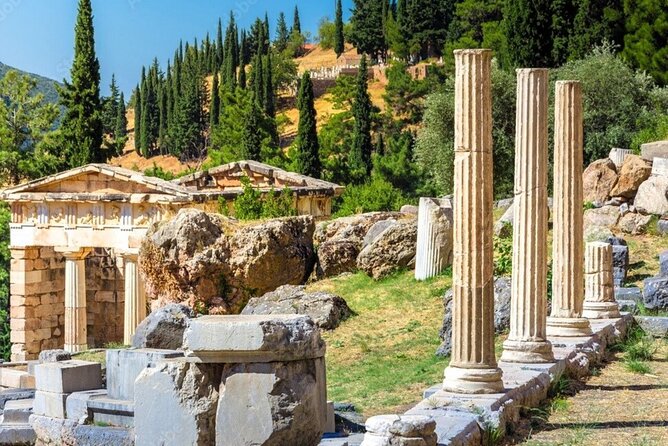
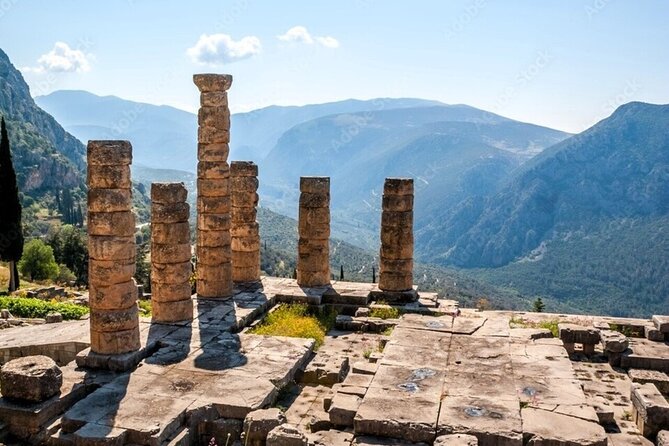
Apollo was worshipped here as the god of light, music, and prophecy. His priestess, Pythia, delivered the famous oracles. The app gives you a useful framework for understanding why Greek communities built treasuries and monuments along the Sacred Way leading to Apollo’s temple.
I like this approach because the stories are tied to the stones in front of you. You are not only hearing about Apollo in the abstract. You are learning why a particular building was placed there, who funded it, and what it once contained.
More Self-Guided Audio Tours in Greece
- Athens: Acropolis Ticket & Optional Self-Guided Audio Tours
★ 4.1 · 2,542 reviews - Santorini: Akrotiri Ticket with Optional Self-Guided Audios
★ 4.1 · 298 reviews - Acropolis & Parthenon Admission Ticket w/ self guided audio tours
★ 3.5 · 172 reviews
Starting near the Athenian Treasury
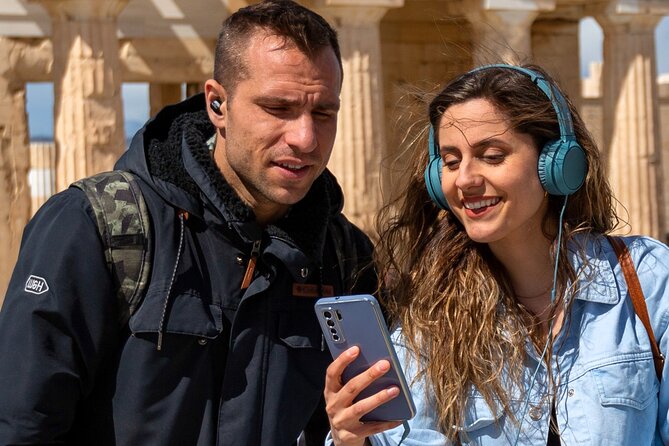
The stated meeting point is the Athenian Treasury at Delphi, while the general instructions direct you to begin at the main entrance. Follow the app’s map and GPS marker when you arrive, since the information identifies the treasury as the start and the activity ends back at that meeting point.
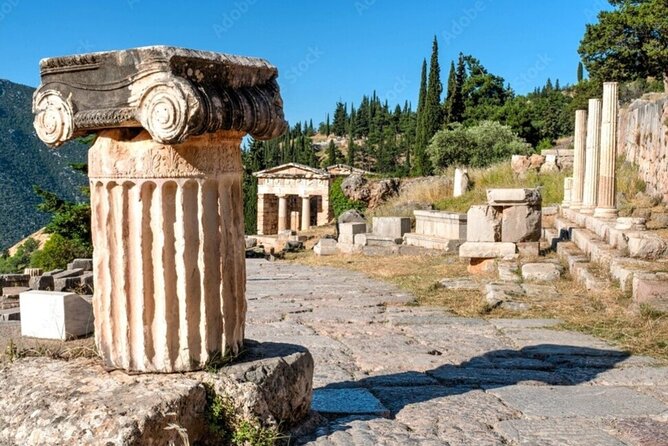
The Athenian Treasury is a small building with a large political message. Athens built it in the late sixth or early fifth century BC. Its construction is linked with the rise of democracy in Athens and with the city’s victory over Persia at Marathon.
Inside, the treasury held military trophies and offerings to Apollo. Ancient Greek cities often built such structures at Delphi to display their success and gratitude. As you walk along the Sacred Way, you can think of it as a public showcase of Greek power, competition, and religious devotion.
This is where the 3D material earns its price. A ruin can be hard to interpret when you only see its base or a few reconstructed stones. A model gives you a sense of the building’s shape and scale, while the narration explains why Athens wanted this particular monument at such a visible point in the sanctuary.
The stop itself is listed at about five minutes, but you can pause the audio and inspect the model for longer. If you are interested in politics, warfare, or ancient city rivalries, this small treasury deserves more attention than its size suggests.
Walking the sanctuary of Apollo
The main Delphi stop is allotted about an hour. This is the heart of the experience and the point where the app’s audio, text, videos, and GPS map work together.
The sanctuary was built at the foot of Mount Parnassos, in a dramatic setting that helped reinforce its sacred role. The site follows the Sacred Way toward Apollo’s temple. Along the route, monuments once proclaimed the wealth and victories of different Greek communities.
The audio content covers 16 monuments, so you get more than a quick explanation of the oracle. The app is designed to guide you from one point to another, with GPS tracking helping you keep your place. That is useful at a site where several paths, terraces, and ruins can blur together.
The 14 monuments with 3D models and 360-degree panoramas are especially helpful. You can rotate views, zoom in on architectural details, and compare the present ruins with a digital version of the past. Short videos add another layer for people who prefer to learn visually rather than through audio alone.
I would use the text as well as the narration. One of the useful features here is flexibility. You can listen while walking, stop to read when a building catches your eye, or replay a section if the site is busy or your attention wanders.
The app also gives historical context for the end of the sanctuary. Christian control brought the operation of the pagan center to an end in the fourth century AD. That final chapter matters because Delphi was not abandoned after a single event. Its role changed as religious power shifted across the Roman world.
The Tholos of Athena Pronaia
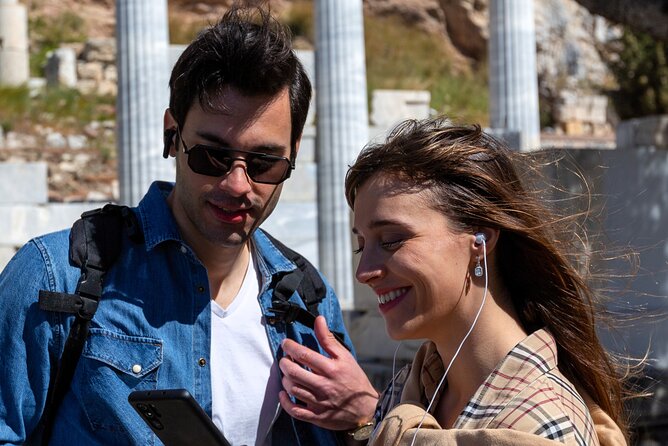
The Tholos of Athena Pronaia is listed as a five-minute stop, but it is one of the most memorable structures in the Delphi area. It was built around 380 BC in the sanctuary of Athena Pronaia and is often regarded as a fine example of Greek architectural design.
Its interest lies partly in the way it combines the Doric, Ionic, and Corinthian orders. These are three major Greek architectural styles, each with its own column forms and decorative language. Seeing them associated with one building helps you understand that ancient architects were not working from a single standard look.
The building was designed by Theodoros of Phokaia in Minor Asia or Phokis. He also wrote a book about it, which gives the monument an unusual connection between construction and architectural theory.
The app’s visual tools are valuable here because the Tholos is famous for its circular form, but the surviving remains do not tell the whole story on their own. A 3D representation can help you understand the original arrangement and the relationship between the columns, roof, and surrounding sanctuary.
The short listed duration should not force you to hurry. If architecture interests you, this is a place to stop, rotate the model, and look closely at how the different orders were combined.
Same place, a different route to walk:
- Athens: Acropolis Ticket with Optional Audio or Live Guide
★ 4.2 · 11,055 reviews - Athens: Cape Sounio & Poseidon Temple Trip with Audio Guide
★ 4.4 · 4,521 reviews - Athens: Acropolis Ticket with Audio Guide
★ 4.0 · 3,575 reviews - From Athens: Delphi Full Day V.R. Audio Guided Tour
★ 4.6 · 3,028 reviews
What the audio and 3D tools really add
A standard audio guide can tell you facts while you walk. This one adds a more visual layer. The 3D models are the most praised feature, and I can see why. They help you picture the original structures rather than treating Delphi as a field of broken stones.
The 360-degree panoramas are useful when you want to examine a monument from different angles. Zooming in also gives you a way to study architectural details that are easy to miss while moving through the site.
The audio narration is described as clear and easy to follow. That matters because Delphi can be information-heavy. You are dealing with myths, city-states, religious customs, architectural terms, and centuries of change. Plain narration keeps the visit from becoming a pile of disconnected names.
The app also includes written information. I would use this when you want more detail than the audio provides, or when you prefer reading at your own speed. One criticism is fair: the content may feel a little brief if you want a full scholarly treatment of every monument.
That limitation is important. This is a practical guide for seeing Delphi, not a replacement for a detailed history book or a live specialist. It gives you a strong base, but it does not promise an exhaustive account of every inscription, excavation, or debate.
Eight languages and the value of self-guided travel
The tour is available in English, Greek, Spanish, German, French, Italian, Dutch, and Chinese. That range makes the experience easier to use for mixed-language groups. Each person can choose a preferred language on their own phone.
You also control the pace. The listed duration is one to one and a half hours, but there is no need to move in lockstep with a group. You can pause for photographs, replay a section, or spend extra time at the Athenian Treasury and Tholos.
That freedom is the main reason I would choose this format over a basic group explanation. You avoid waiting for a large group to gather, and you can focus on the parts of Delphi that interest you most.
The tradeoff is that you are responsible for your own setup. There is no guide at the entrance to solve a download issue, adjust the volume, or explain where to go next. The app uses GPS, but you should still pay attention to the route and keep your phone charged.
Price, admission, and practical value
The app costs $8.09 per person. That is a modest fee for a self-guided visit with audio, written text, GPS mapping, 3D models, panoramas, and videos.
You must also buy admission to the archaeological site. The full ticket is €12, with a reduced ticket of €6. Since the entrance fee is separate, include both costs when planning your budget.
Even with that extra expense, the tour offers good value for independent visitors. A traditional private guide would cost much more, while a printed guidebook may not show the monuments from the same angles. The digital reconstructions are the feature that makes this more than an audio recording.
The value is less clear if you already have a detailed guidebook, a human guide, or strong knowledge of ancient Greek architecture. In that case, the app may repeat information you already know. For most independent visitors, though, the combination of clear narration and visual reconstructions should justify the small extra fee.
Download the app before you reach Delphi
You receive instructions by email after booking. Download the Culture App on an Android or iOS phone, select your language, and allow the tour content to download.
The activity requires internet access to function properly. Since one user found the installation process tricky, I would not wait until you are standing at the entrance. Install the app ahead of time, open the tour, select your language, and check that the content loads before leaving for Delphi.
You also need to bring your own smartphone and headphones. Neither is included. Headphones are helpful if you want to hear every detail without holding the phone to your ear, especially if other people are nearby.
The activity is listed as running daily from 8:00 AM to 8:00 PM during the stated operating period, from August 25, 2023, through June 17, 2026. Confirmation is provided at booking, and the experience ends back at the stated meeting point.
Public transportation is nearby, and no pickup or drop-off service is included. Most people can take part, but the supplied details do not promise special accessibility arrangements, so contact the provider directly if you need specific assistance.
Who should choose this Delphi tour?
I would recommend it most strongly to independent visitors who want context but do not need a live guide. It suits people who like to stop, replay, and explore without a fixed group schedule.
It is also a good match for:
- First-time visitors who find ancient ruins hard to interpret
- Families or mixed groups who need flexible pacing
- Architecture fans interested in Greek building styles
- Visitors who want visual explanations of lost structures
- People who prefer listening and reading in their own language
- Budget-conscious visitors who want more than a basic site walk
You may want another option if you prefer long conversations with a local expert or detailed answers to unusual questions. The app gives you prepared information, not an active discussion. It is also less suitable if you do not want to use your phone during a cultural visit.
Cancellation and booking flexibility
Free cancellation is available if you cancel at least 24 hours before the experience start time. Canceling within 24 hours means no refund, and changes made during that same period are not accepted.
The cutoff follows local time in Greece. That is worth noting if you are arranging several activities around a Delphi visit.
Should you book the $8.09 Delphi audio tour?
I would book it if you are visiting Delphi without a guide and want help picturing the sanctuary as it once was. The clear audio, GPS map, and 3D models address the site’s main challenge: the ruins are impressive, but their original appearance is not always obvious.
The best reason to choose it is the visual material. The Athenian Treasury, the sanctuary of Apollo, and the Tholos of Athena Pronaia make far more sense when you can see reconstructed forms alongside the remains.
Just prepare before arrival. Download the app, confirm your language, bring headphones, make sure your phone has power, and budget separately for the €12 or €6 entrance ticket. If you do that, this inexpensive guide should make Delphi easier to follow and much more rewarding to explore at your own pace.
FAQ
How much does the Delphi audiovisual tour cost?
The tour costs $8.09 per person. The archaeological site entrance ticket is not included and costs €12 at the full rate or €6 at the reduced rate.
How long does the tour take?
The experience lasts about one hour to one and a half hours. The main Delphi stop is listed at one hour, while the Athenian Treasury and Tholos of Athena Pronaia are each listed at about five minutes.
Is the entrance ticket included?
No. You must purchase the Delphi archaeological site ticket separately.
Which languages are available?
The tour is available in English, Greek, Spanish, German, French, Italian, Dutch, and Chinese.
Does the tour include a smartphone or headphones?
No. You need to bring your own smartphone and headphones.
Does the app need internet access?
Yes. The tour requires internet access to function properly. After booking, you receive instructions to download the app and its content.
Where does the tour start and end?
The stated meeting point is the Athenian Treasury in Delphi. The activity ends back at the meeting point.
Just added around Greece
- E-Ticket to Akrotiri with Audio Tour on your Phone★ 5.0 · 2 reviews
- Authentic Santorini: A Self-Guided Audio Tour of Oia★ 4.5 · 3 reviews
- The Palace of the Grand Master E-Ticket with Audio Tour★ 4.0 · 9 reviews
- The Palace of the Grand Master. Self-guided Audio Tour★ 3.5 · 15 reviews
- Acropolis of Lindos E-Ticket with Audio Tour on your Phone★ 4.5 · 8 reviews
- Explore Lindos Acropolis in 3D & Audio★ 4.0 · 4 reviews
- Olympia Archaeological Site & Museum E-Ticket with Audio Tour★ 4.0 · 11 reviews
- Mykonos: Find your (queer) god Self-Guided Audio Tour★ 4.0 · 2 reviews
Self-Guided Tours, compared.

Acropolis Ticket & Optional Self-Guided Audio Tours
Read our review →


Ultimate Acadia National Park Self-Guided Driving Audio Tour
Read our review →

Santorini: Akrotiri Ticket with Optional Self-Guided Audios
Read our review →
Browse the lists this tour appears in