
REVIEW · CRETE AUDIO TOURS
Heraklion Self-Guided Audio Tour
History comes alive around every corner. This $6 self-guided tour gives you a flexible way to explore Heraklion, with audio stories for the Venetian harbor, Koules Fortress, museums, churches, and central squares. I like the low price and the freedom to set your own route. You can finish in about three hours or stretch the visit across six days.
I also like that the tour covers both famous sights and less obvious parts of the city’s past, including Venetian water engineering, Minoan beliefs, Cretan resistance, and Orthodox traditions. The main drawback is that the audio is not GPS-guided. You must open the map, choose each stop, and manage the route yourself. One piece of feedback also described the narration as repetitive and too general, so this is best for casual sightseeing rather than a substitute for a specialist guide.
Key Points to Know
- Nine central Heraklion stops: The route links the Venetian Port, Koules Fortress, Archaeological Museum, churches, fountains, and two other museums.
- Only $6 per person: That is good value if you visit several stops, though admission charges are separate where required.
- Three to nine hours: You can complete the main route in one outing or spread it over several days.
- Your phone does the guiding: You receive a SoundCloud playlist and a Google My Maps itinerary, but you need your own headphones, phone, and internet access.
- English only: The audio is offered in English, and the language cannot be changed after confirmation unless an alternative is requested at least 48 hours in advance.
- A private, self-guided outing: There is no shared group, fixed departure time, hotel pickup, or transport included.
How the $6 Audio Tour Works
Before your chosen travel date and start time, you receive two private links through the booking platform’s messaging system. One opens the audio playlist on SoundCloud. The other opens a Google My Maps route with headphone icons marking the nine attractions.
The links are designed to work in a web browser. You do not need to download a special tour app. Open the SoundCloud link in Safari, Chrome, or another browser, then select the attraction you want to hear. For the map, open the Google My Maps link in your browser rather than the Google Maps app.
That distinction matters. If you normally use Google Maps for sightseeing, it may be tempting to open the link there immediately. The instructions specifically direct you to Google My Maps in a browser, where the custom attraction markers and audio links are displayed.
This is not a GPS-guided tour. The audio will not automatically start when you reach a monument, and it will not tell you when to turn. You choose the next sight, open its audio track, and walk there yourself. I see that as a plus if you dislike being hurried, but it requires a little more attention than an app that tracks your every step.
The suggested audio lasts about 20 minutes per stop. Nine stops therefore give you roughly three hours of listening, before adding museum visits, walking, coffee breaks, and time for photographs. The full outing may take anywhere from three to nine hours, depending on how much time you spend inside the museums and fortress.
More Self-Guided Audio Tours in Greece
- Athens: Acropolis Ticket & Optional Self-Guided Audio Tours
★ 4.1 · 2,542 reviews - Santorini: Akrotiri Ticket with Optional Self-Guided Audios
★ 4.1 · 298 reviews - Acropolis & Parthenon Admission Ticket w/ self guided audio tours
★ 3.5 · 172 reviews
Starting at the Venetian Port
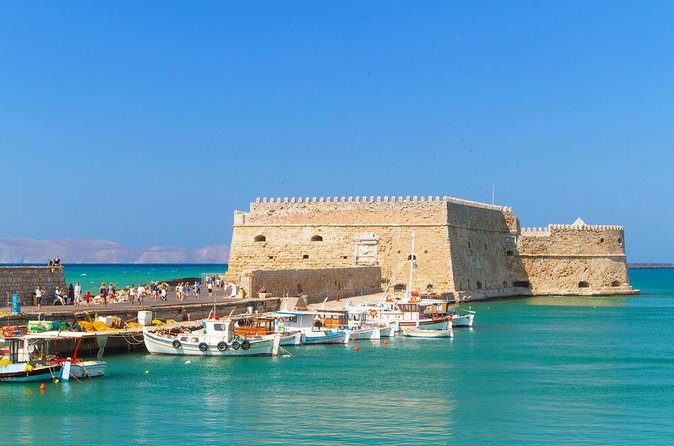
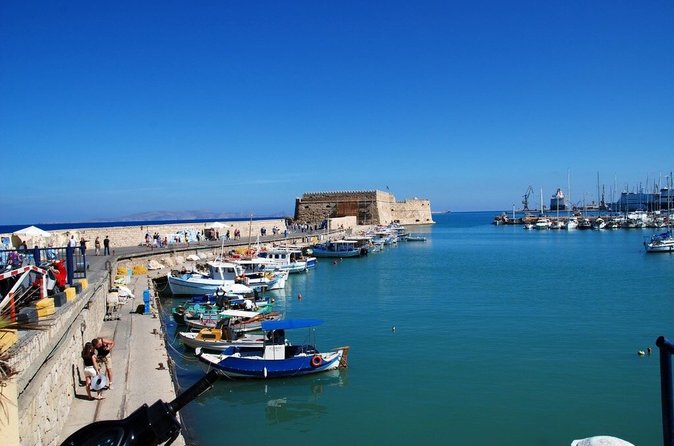
The Heraklion Venetian Port is a strong opening because it sets up the city’s role as a crossroads between eastern and western Mediterranean powers. The narration covers the harbor’s long working life, Venetian engineering, merchant trade, pirate attacks, and the daily work of dock laborers.
The audio also points to stories about secret tunnels, smugglers, and revolutionaries. Treat these as narrated historical themes rather than sights you should expect to enter. The port track is most useful when you are actually looking at the water, old harbor structures, and the defensive setting.
Allow about 20 minutes for the audio portion. Admission is not included, although the port area itself gives you an easy place to begin walking. This is also a practical starting point if you want a quick orientation before moving into the center.
Koules Fortress and the Venetian Sea Wall
Koules, also called Castello del Molo, gives the tour its strongest military setting. The massive fortress guarded the harbor and became a symbol of Venetian power in the eastern Mediterranean. The audio explains its defenses, the lives of soldiers stationed there, and the long Ottoman siege that ended Venetian rule in 1669.
The narration also discusses the fortress as a prison and refers to messages carved into its stone walls. That kind of detail can make the building easier to read as a place of confinement, not just a photogenic block of masonry.
Plan about 20 minutes for the track, plus extra time if you enter. Admission is not included. Because the fortress is a substantial structure, you may want to place it early in your day rather than squeeze it in after several museum visits.
A ghost story about the battlements adds a little atmosphere, though it is clearly the sort of local legend best enjoyed as color rather than proof of anything supernatural.
Five Thousand Years at the Archaeological Museum
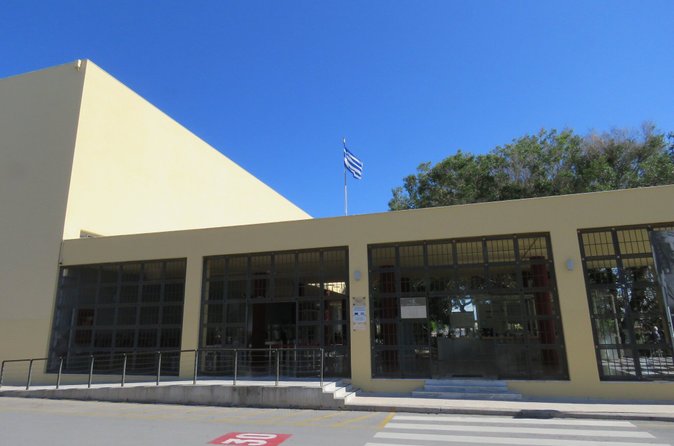
The Heraklion Archaeological Museum is the intellectual center of this route. Its collections span about 5,000 years of Minoan civilization, making it the place where the audio’s ancient-world material has the most weight.
The track discusses the snake goddess figurines, Minoan art, religious ideas, social organization, and technology. It also addresses the Phaistos Disc, whose symbols remain undeciphered. That gives you a useful reminder that archaeology often leaves questions open instead of producing neat answers.
The audio raises theories about the collapse of Minoan palaces and refers to newer discoveries that challenge older interpretations. That is valuable because it encourages you to look at the objects as evidence under discussion, not as a finished story.
Admission is not included, and 20 minutes is only enough for the audio overview. If ancient Crete is your main reason for visiting Heraklion, allow much longer inside the museum. The tour works best here as a framework, helping you decide which objects and themes deserve your attention.
Same place, a different route to walk:
- Athens: Acropolis Ticket with Optional Audio or Live Guide
★ 4.2 · 11,055 reviews - Athens: Cape Sounio & Poseidon Temple Trip with Audio Guide
★ 4.4 · 4,521 reviews - Athens: Acropolis Ticket with Audio Guide
★ 4.0 · 3,575 reviews - From Athens: Delphi Full Day V.R. Audio Guided Tour
★ 4.6 · 3,028 reviews
Agios Titos and the City’s Religious Crosscurrents
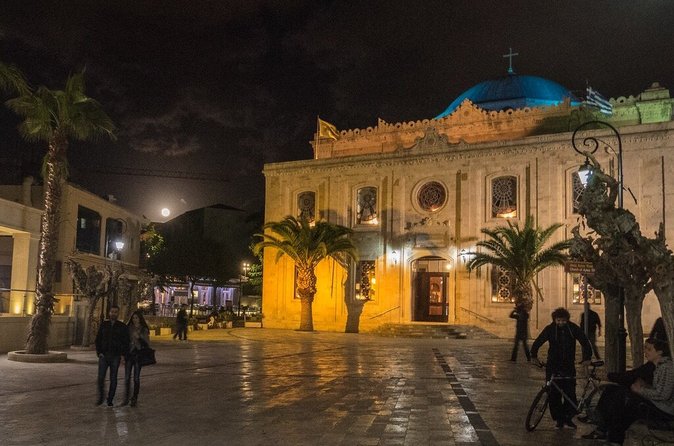
Agios Titos Church offers a change of pace after the port and museum. The audio connects the church with Saint Titus, a companion of Saint Paul, and explains how the building served as a mosque during almost three centuries of Ottoman rule.
The story of Saint Titus’s skull relic returning from Venice to Crete gives the stop a strong human and political angle. You also hear about restoration work and Byzantine features uncovered during that process.
The church admission is free. Set aside about 20 minutes for the audio, but be respectful if services or prayer are taking place. This is a working religious site, not only a monument. Modest clothing and quiet behavior are sensible choices.
This stop is especially useful if you want to understand why Heraklion’s buildings often combine Christian, Ottoman, and Venetian chapters in one place.
Loggia, the Center of Venetian Commerce
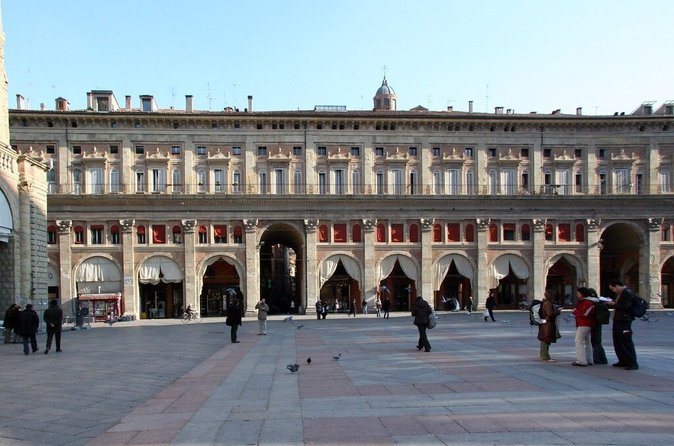
The Loggia once served as a meeting place for Venetian merchants and officials. The audio presents it as the city’s commercial command center, where decisions about trade routes, money, and political influence were made.
Look closely at the columns, arches, and carved details while listening. The narration explains the symbolism and the building’s construction, as well as its survival through earthquakes, wars, and long periods of neglect.
The track also brings in more personal stories, including financial scandals, private affairs, and political meetings linked with the struggle for Cretan independence. Those details help keep the stop from becoming a dry architecture lesson.
Admission is free, and the audio takes about 20 minutes. Because the Loggia sits among central sights, it is easy to pair with the Morosini Fountain and Agios Titos without adding much walking.
The Lions at Morosini Fountain
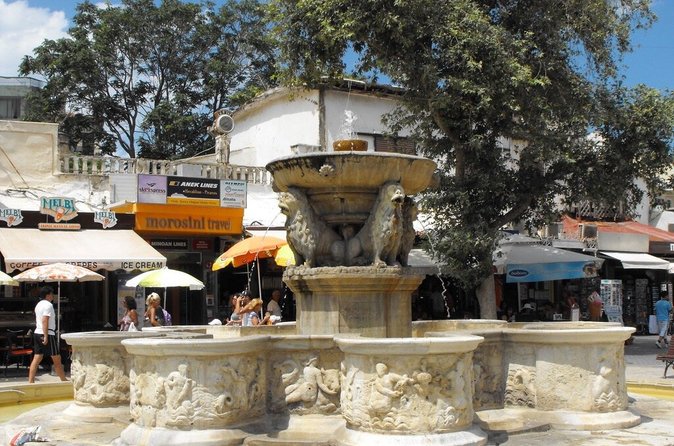
The Morosini Fountain, usually called the Lion’s Fountain, is one of the easiest sights to miss as a historical object because it sits in an active city square. The audio helps you pause and look at its four lions, carved symbolism, and connection to Venetian rule.
The most practical story here concerns water. The fountain was supplied through an aqueduct from Mount Juktas, bringing fresh water into the city and changing daily life in Heraklion. That engineering achievement is more useful to understand than simply admiring the fountain’s decoration.
The narration also refers to chambers beneath the fountain and to romantic legends involving a Venetian nobleman and a local Greek woman. Again, listen for the difference between documented engineering and colorful local tradition.
The stop is free and takes about 20 minutes. It is an excellent place to take a break, since the square gives you a natural pause between indoor attractions.
Cathedral of St. Minas
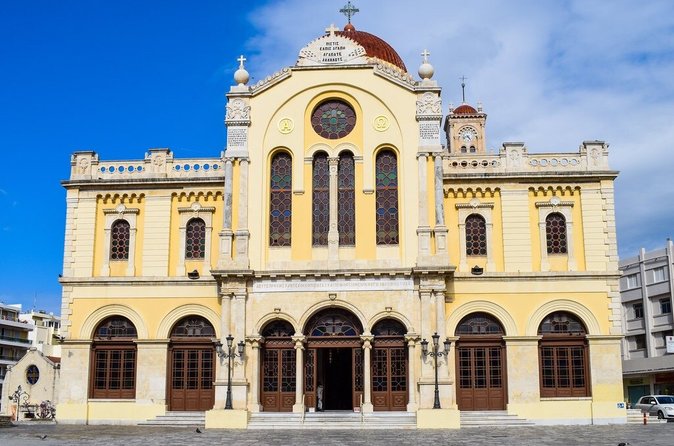
The Cathedral of St. Minas is the largest Orthodox cathedral in Crete and gives the route a strong connection to modern Cretan identity. Its story includes the building’s rise after Ottoman rule, financial support from Cretans living abroad, and the faith that helped sustain the island through conflict.
The audio points out religious symbolism in the icons and discusses Byzantine works that survived periods of political and religious change. It also refers to underground spaces linked with resistance fighters and to the cathedral’s role during World War II.
The church is free to enter, and the suggested audio lasts about 20 minutes. You should give yourself time to look upward and around rather than listening with your eyes fixed on your phone. The value here is not only the facts, but the connection between architecture, worship, and national feeling.
Historical Museum of Crete
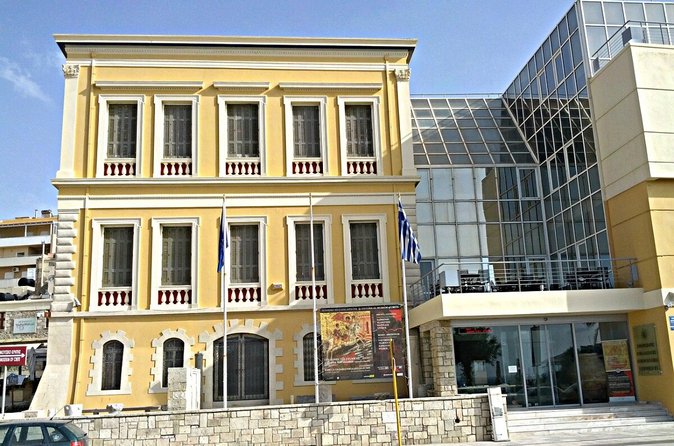
The Historical Museum of Crete moves the story forward into revolution, resistance, and everyday culture. Its material includes weapons and coded messages linked with freedom fighters, accounts of Cretan emigrants in America, and objects connected with local music and weaving.
This stop broadens the tour beyond famous rulers and monuments. You get a sense of how ordinary skills, overseas family networks, and regional traditions shaped the island’s political life.
The audio also covers assassination attempts and diplomatic disputes. That gives you useful context for Crete’s complicated path toward independence and its place in Mediterranean politics.
Admission is listed as free for this tour, and the audio portion is about 20 minutes. The museum deserves more time if you want to examine the objects properly. You should check current opening arrangements separately, since the tour price does not guarantee that every interior will be open when you arrive.
Natural History Museum and Crete’s Wild Side
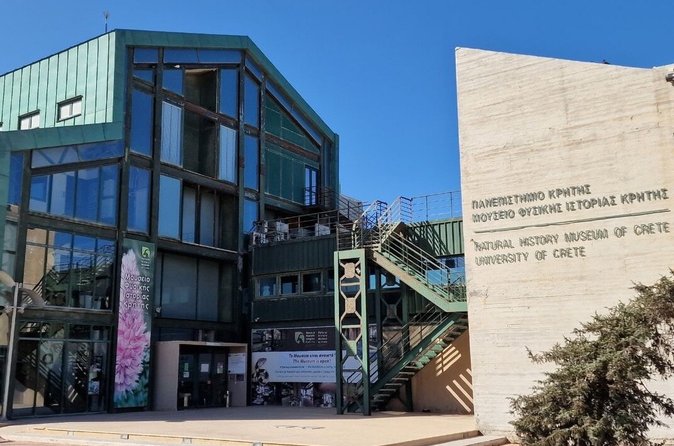
The Natural History Museum of Crete adds science to a route otherwise focused on human history. The audio explains how geological forces, earthquakes, tsunamis, and volcanic eruptions shaped the island and influenced where people settled.
You also hear about species that evolved in isolation, including the Cretan wild goat associated with ancient myths. The museum stop links those natural features with Minoan farming and present-day conservation.
Admission is not included. Allow at least 20 minutes for the audio, with more time if natural science is a major interest for you. This is a good final stop because it widens your understanding of Crete. The island is not only a stage for palaces, churches, and wars. Its geology and wildlife helped shape the human story too.
Is the Content Specific Enough?
The tour promises detailed storytelling, with subjects ranging from Venetian soldiers and harbor trade to Minoan religion and Cretan resistance. That range is appealing, but the actual listening experience may depend on what you want from an audio guide.
If you want a short introduction at each sight, the format should work well. The available feedback includes strong praise for the interesting stories and for helping with Heraklion’s winding streets. That is the tour’s clearest strength: it gives you something to listen for as you walk.
You should be cautious if you expect a tightly researched lecture at every stop. One piece of feedback found the narration repetitive and too vague. Since the guide is self-guided and inexpensive, I would treat it as an orientation tool rather than a replacement for a museum curator, archaeologist, or local historian.
Planning Your Day in Heraklion
I would not try to race through all nine stops. Start with the port and Koules, then visit the Archaeological Museum while your attention is fresh. Afterward, walk through Agios Titos, the Loggia, and Morosini Fountain before continuing to St. Minas and the two museums.
The suggested order is not compulsory. You can start wherever you are, skip a stop, return later, or divide the route across several days. The private links remain valid for up to six days, which is useful if you are staying in Heraklion and want to avoid a long museum-heavy day.
Bring:
- A fully charged smartphone
- Headphones or earphones
- Internet access
- Comfortable walking shoes
- Enough time for museum admission and opening arrangements
There is no pickup or drop-off. Public transportation is nearby, but you arrange all transport yourself. The experience is private, meaning only your own group participates, but there is no live guide to answer questions or adjust the route.
The cancellation terms are strict. The booking is non-refundable and cannot be changed after purchase, so check your date, language, and phone access before paying.
Who Should Book This Tour?
At $6 per person, the price is hard to criticize if you plan to visit several of the nine stops. Even a few useful explanations can make the cost worthwhile, especially when you want a flexible day without joining a scheduled group.
I would choose it if you enjoy walking independently, prefer English audio, and like deciding when to stop for lunch or coffee. It also suits families or couples who want to move at different speeds without losing a guide entirely.
I would skip it if you want live conversation, detailed answers, or automatic navigation. You should also think twice if you dislike managing browser links, playlists, and map markers on your phone.
Final Verdict: A Cheap Way to Add Shape to Heraklion
The Heraklion Self-Guided Audio Tour offers solid value for independent sightseers. Its best qualities are the low price, broad coverage, and freedom to explore over several days. The stories about Venetian waterworks, Minoan civilization, religious change, and Cretan resistance give the city more meaning than a simple walk past monuments.
The tradeoff is equally clear: you do the navigation, pay separate entry fees, and may find some narration too general or repetitive. Book it if you want an inexpensive audio companion and are comfortable setting your own pace. Skip it if you need a live expert or a polished GPS experience.
FAQ
How much does the Heraklion Self-Guided Audio Tour cost?
The tour costs $6 per person.
How long does the tour take?
The estimated duration is three to nine hours. The nine audio stops are each planned for about 20 minutes, but museum visits, walking, and breaks can extend the day.
How many attractions are included?
The tour includes nine attractions in Heraklion.
Which language is offered?
The audio tour is offered in English.
Is this a GPS-guided tour?
No. It is not GPS-guided. You choose the attractions, open the audio tracks, and follow the map yourself.
How do I receive the audio guide?
You receive private access links through the booking platform’s messaging system. One link opens the SoundCloud audio playlist, and the other opens the Google My Maps itinerary.
Do I need to download a special app?
No additional tour app is required. The links are accessed through a web browser, such as Safari or Chrome.
What should I bring?
Bring headphones or earphones, a fully charged smartphone, and internet access.
Are attraction entry fees included?
No. Entry fees are not included where required. The tour information lists Agios Titos Church, Loggia, Morosini Fountain, Cathedral of St. Minas, and the Historical Museum of Crete as free stops. Admission is not included for the Venetian Port, Koules Fortress, the Archaeological Museum, or the Natural History Museum.
Can I split the tour across several days?
Yes. The private access links remain valid for up to six days, and you can choose your own starting point, ending point, order, and pace.
Just added around Greece
- E-Ticket to Akrotiri with Audio Tour on your Phone★ 5.0 · 2 reviews
- Authentic Santorini: A Self-Guided Audio Tour of Oia★ 4.5 · 3 reviews
- The Palace of the Grand Master E-Ticket with Audio Tour★ 4.0 · 9 reviews
- The Palace of the Grand Master. Self-guided Audio Tour★ 3.5 · 15 reviews
- Acropolis of Lindos E-Ticket with Audio Tour on your Phone★ 4.5 · 8 reviews
- Explore Lindos Acropolis in 3D & Audio★ 4.0 · 4 reviews
- Olympia Archaeological Site & Museum E-Ticket with Audio Tour★ 4.0 · 11 reviews
- Mykonos: Find your (queer) god Self-Guided Audio Tour★ 4.0 · 2 reviews
Self-Guided Tours, compared.
Acropolis Ticket & Optional Self-Guided Audio Tours
Read our review →


Ultimate Acadia National Park Self-Guided Driving Audio Tour
Read our review →

Santorini: Akrotiri Ticket with Optional Self-Guided Audios
Read our review →
Browse the lists this tour appears in