
REVIEW · COPENHAGEN AUDIO TOURS
Danish Design Classic and Modern Style Self-Guided Audio Tour
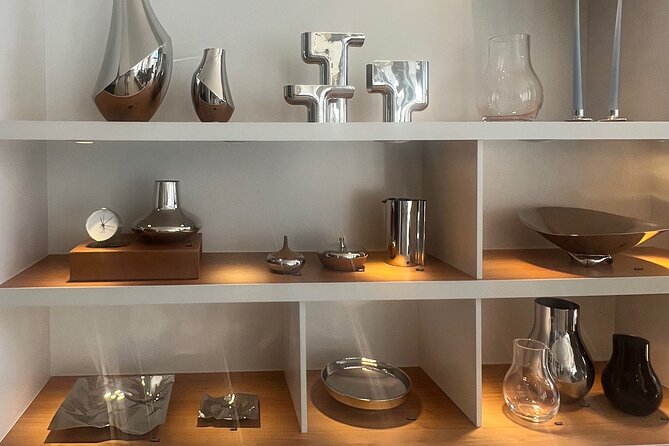
Copenhagen tells its design story in plain sight. This self-guided audio walk links Arne Jacobsen’s SAS Royal Hotel with churches, palaces, museums, and waterfront streets, giving you context as you move through the city. I like the precise GPS guidance and the freedom to pause, wander, or replay sections. I also like the strong historical range, from Viking metalwork to modern Danish furniture. The main catch is the short 70-minute duration: with 16 stops, you will need to keep moving and may only view some places from outside.
At $11.99, this is a modest buy for anyone who wants structure without joining a group. You bring your own smartphone and headphones, while the VoiceMap app supplies the audio, map, and location triggers offline. The route is private by design, but it is not a guided walking tour with a person answering questions or managing your pace.
Key things to know before you go
- Start with Arne Jacobsen: The route begins at the former SAS Royal Hotel, now the Radisson Collection Royal, a key early example of modern Danish design.
- Finish at Designmuseum Danmark: The final stop puts Danish and international design within reach if you want to continue the subject indoors.
- Sixteen points in about 70 minutes: Expect a brisk city walk and short explanations rather than long museum visits.
- GPS works offline: Downloading the audio, map, and geodata gives you more freedom with mobile service.
- The route crosses several eras: You move from Viking objects and Rococo architecture to Art Nouveau and twentieth-century furniture.
- You control the experience: Pause for coffee, take a detour, or repeat a section without holding up a group.
Starting with Jacobsen at the Radisson Collection Royal
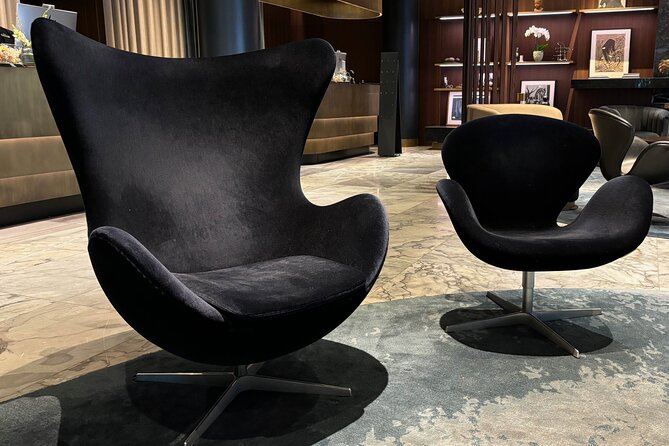
The tour begins at Hammerichsgade 1, outside Arne Jacobsen’s SAS Royal Hotel, now called the Radisson Collection Royal. Completed in 1958, it is the right place to begin because Jacobsen helped define the smooth, simple, practical style often linked with Danish design.
The hotel gives the route a clear starting idea: design is not only about handsome chairs in a museum. It can shape a whole building, its rooms, its furniture, and the way people move through it. The audio commentary adds useful background that you might miss if you simply photographed the exterior and moved on.
The start is also practical. The hotel sits near public transportation, and directions to the meeting point are included. Once you reach the correct place, the GPS tour begins. Bring a fully charged phone and headphones, since neither is supplied.
More Self-Guided Audio Tours in the world:
- Athens: Acropolis Ticket & Optional Self-Guided Audio Tours
★ 4.1 · 2,542 reviews - Gettysburg Battlefield Self-Guided Driving Audio Tour
★ 4.5 · 910 reviews - Joshua Tree National Park Self-Guided Driving Audio Tour
★ 4.5 · 762 reviews
City Hall and the public face of Danish style
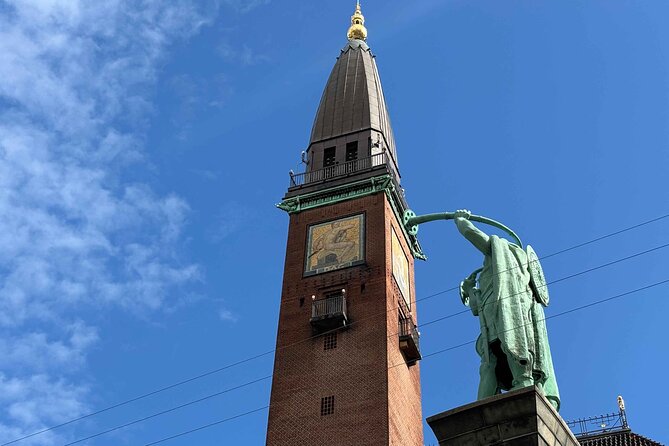
From the modern hotel, the route turns toward Copenhagen City Hall. Completed in 1905, the building is a strong example of National Romantic style, the Scandinavian version of Art Nouveau.
This is a useful contrast with Jacobsen. City Hall is heavier, more decorative, and tied to national identity, while the later hotel favors clean lines and restrained forms. The route works best when you notice those changes rather than treating each building as an isolated photo stop.
You do not need to enter every location for the audio to make sense. This is mainly an outdoor route with points of interest along the way. If you want detailed interiors, museum admission, or time to study architectural details, plan to spend longer than 70 minutes.
Tivoli, the Glyptotek, and early Copenhagen culture
Tivoli Gardens is another early stop. It opened in 1843 and remains one of the world’s first amusement parks. Its elaborate neoclassical entrance shows how public entertainment once used formal architecture to create a sense of occasion.
The route then brings in the Glyptotek, a museum centered on pre-20th-century art. Its collection began with Carl Jacobsen, son of the founder of the Carlsberg brewery, and the museum is known for its winter garden and café. Even if you do not enter, the audio helps place the museum in Copenhagen’s larger story of collecting, display, and public culture.
I would not plan to visit the Glyptotek during the audio walk unless you are willing to pause the route. A museum visit needs more time than this tour allows. The useful choice is to note the location and return later if ancient or pre-20th-century art interests you.
Viking objects at the National Museum
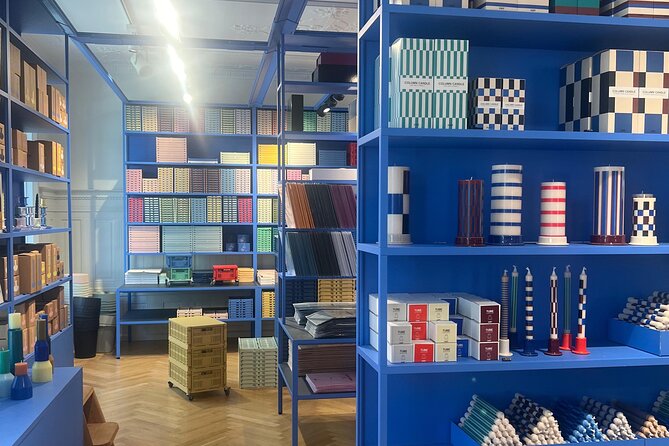
The Danish National Museum gives the route an important change of scale. Danish design did not begin with Jacobsen’s chairs. The Viking objects inside the museum, including finely made gold jewelry, show skilled choices in form, material, decoration, and use long before modern design became a named movement.
That connection is one of the tour’s best ideas. It broadens the subject beyond twentieth-century interiors and makes design feel like an ongoing Danish habit rather than a recent export style.
The museum itself is not described as an architectural highlight, so the value here comes mainly from the objects and the explanation. If you want to see the Viking material, admission is not included and would take you beyond the stated route time.
A few more audio tours around the world worth a look
- Barcelona: Sagrada Familia Entry Ticket with Audio Guide
★ 4.6 · 105,312 reviews - Rome: Pantheon Fast-Track Ticket and Official Audioguide
★ 4.5 · 27,353 reviews - Barcelona: Casa Batlló Entry with Self-Audioguide Tour
★ 4.7 · 25,359 reviews - Rome: Colosseum & Forum with Audio Guide App -Optional Arena
★ 4.2 · 24,770 reviews
Marble Church and Copenhagen’s grander side
Frederik’s Church, usually called the Marble Church, brings you into the Rococo period. It was based on St. Peter’s Basilica in Rome, so its appearance reflects a European taste for grand scale and formal balance.
This stop helps you compare Danish design with styles that arrived through royal, religious, and international channels. It also prevents the route from reducing Copenhagen to simple modernism. The city’s design story includes ambitious churches, court buildings, civic spaces, and carefully planned squares.
The audio can point out why the building matters, but an exterior stop cannot replace time inside. If the church is open and you want to study the interior, you will need to pause the app and adjust your timing.
A cluster of royal and artistic buildings
Several stops gather around central Copenhagen and show how power, art, and design overlap. The Royal Danish Theater is a Neo-Baroque building now used mostly for the Royal Danish Ballet. Charlottenborg Palace, once a private mansion for a king’s brother, now houses the Royal Danish Academy for the Fine Arts.
These places make the route feel less like a single designer biography and more like a walk through changing taste. A palace can become an academy. A theater can shift its main use. Buildings continue to serve the city even as public preferences change.
Kongens Nytorv, or King’s Square, acts as one of the city’s major hubs. It is a useful orientation point in the middle of the route, and the audio helps connect nearby buildings rather than treating them as unrelated sights.
The Alexander Nevsky Church adds another visual note. It is Copenhagen’s only Russian Orthodox church, with a patterned facade and golden towers. It is an especially good stop for seeing how a building can bring a distinct national style into the city’s architectural mix.
Thorvaldsen and the changing meaning of classic style
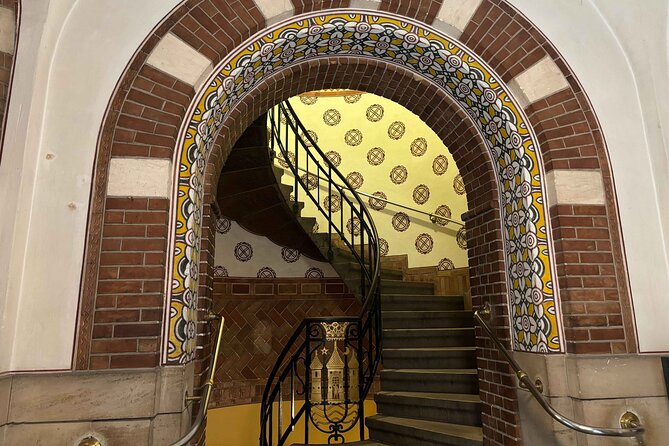
Thorvaldsen’s Museum presents one of the clearest lessons in changing taste. Bertel Thorvaldsen was a Danish sculptor who went to Italy and learned to work in the Classical style. His museum represents a period when ancient Greek and Roman forms carried great prestige.
The audio uses Thorvaldsen to show that design preferences do not stay fixed. What once looked modern and refined can later feel formal or old-fashioned. That idea connects directly to the move toward practical, organic, modern Danish design.
This is another point where the tour gives you more than a list of buildings. It asks you to compare styles across time. You may not agree with every judgment about what feels attractive, but the sequence makes Copenhagen easier to read.
Christiansborg, Nikolaj, and the Odd Fellows Palace
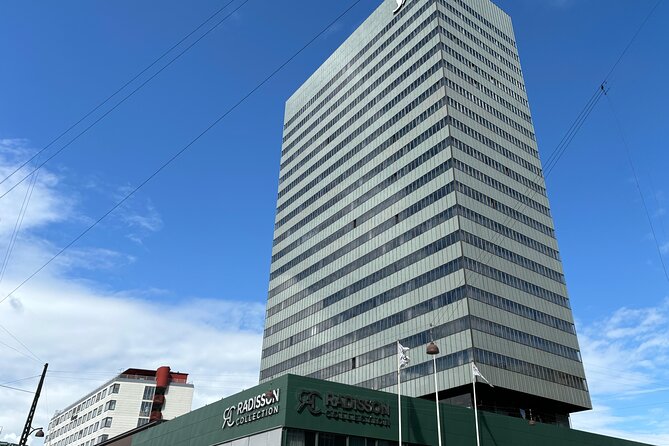
Christiansborg Palace brings politics into the route. It is used for state dinners and is home to the Danish Parliament, the Folketing. The building’s role shows how architecture can carry both ceremonial and everyday government functions.
Near Nikolaj Square, the restored church building adds a curious piece of urban history. The church burned down, and the 1909 restoration has never actually been used as a church. It served as a naval museum and a library, and it is now a modern cultural venue.
That unusual change of use is exactly the sort of detail that makes a self-guided route worthwhile. You might pass the building alone and see only a handsome facade. The audio gives you a reason to look twice.
The Odd Fellows Palace has its own change of purpose. It was associated with a Masonic Lodge for many years and is now mainly a wedding and party venue. Again, the theme is adaptation. Copenhagen’s buildings are not frozen exhibits. They are reused as the city changes.
Nyhavn and the final approach to design museum territory
Nyhavn is one of Copenhagen’s most recognizable places, a seventeenth-century waterfront canal and entertainment district lined with brightly colored buildings. It stretches from Kongens Nytorv toward the harbor near the Royal Playhouse.
The colorful facades make this an easy photo stop, but the audio gives it a place in the wider route. After formal squares, churches, palaces, and civic buildings, Nyhavn supplies a more relaxed waterfront setting.
It can also be one of the more crowded points on your walk. Since the tour is GPS guided, keep your phone accessible and listen carefully to location prompts rather than walking with your attention fixed on the screen. The route is meant to lead you through the city, not turn you into a person staring at a map.
Finishing at Designmuseum Danmark
The final destination is Designmuseum Danmark at Bredgade 68. Its collections cover Danish and international design and crafts, with work connected to figures such as Arne Jacobsen, Jacob Jensen, and Kaare Klint.
Ending here makes sense. The audio has taken you through the historical and architectural setting, and the museum offers a chance to look at design objects more closely. You can finish the walk and stop there, or return another day with more time.
Admission is not included, so treat the museum as an optional extension rather than part of the 70-minute experience. The stated end point is useful even if you do not go inside because it gives the route a clear finish instead of leaving you at a random street corner.
Why the GPS format works well
The strongest part of this experience is its independence. You are not tied to a guide’s schedule, a fixed group, or someone else’s walking speed. You can stop for a meal, take photographs, replay a section, or pause the tour when a museum catches your eye.
The GPS guidance is especially helpful for a route with many stops. One published assessment praised the precise location tracking and the useful tips in the narration. That matters because poor location cues can make an audio tour frustrating, while accurate triggers let you keep your eyes on Copenhagen.
The app also offers offline access to the audio, map, and geodata. Download everything before setting out. You still need your own smartphone and headphones, and the experience does not provide transportation, food, drinks, or admission fees.
Is $11.99 good value for 70 minutes?
At $11.99 per person, the tour costs less than many live city walks and gives you lifetime access. You can repeat it, split it into sections, or use it again on a later Copenhagen visit.
The value depends on what you want. If you need a personal guide who answers questions and adjusts the route for you, this is not a substitute. If you want background while walking alone or with your own group, the price is easy to justify.
The number of stops is both a strength and a limitation. Sixteen locations create a broad picture of Copenhagen design, but they also mean short listening segments and a brisk pace. You will get more from it if you accept that this is an overview route, not a full museum-and-architecture day.
Who should choose this Copenhagen audio tour?
I would choose it for independent visitors, couples, families, and small groups who dislike fixed tour schedules but still want a clear thread through the city. It is also a good fit if your group has mixed interests, since the route includes art, politics, religion, entertainment, royal buildings, and modern design.
Families may appreciate the ability to pause without delaying anyone else. You can stop at Tivoli, take a break near Nyhavn, or continue when everyone is ready.
I would be more cautious if you have limited walking time and want long visits inside the museums. The tour covers a lot quickly, and admission costs are separate. It is best used as a guided outdoor introduction, with selected interiors saved for later.
The experience includes free cancellation up to 24 hours before the start time. Changes or cancellations within 24 hours are not refunded, so keep that deadline in mind when planning.
Should you book it?
Book this tour if you want Copenhagen’s design story delivered at your own speed, with accurate GPS prompts and the freedom to pause. The strongest reason to choose it is the way it links Viking craftsmanship, Rococo grandeur, National Romantic civic architecture, and Jacobsen’s modern lines in one compact route.
Skip it if you want a live guide, extended museum time, or a relaxed stroll with no need to watch the clock. At $11.99, it is a practical introduction and a useful orientation tool, especially when you plan to continue at Designmuseum Danmark afterward.
FAQ
How long does the Danish Design Classic and Modern Style tour last?
The tour lasts approximately 1 hour and 10 minutes.
Where does the tour begin?
It begins at the Radisson Collection Royal Hotel, formerly Arne Jacobsen’s SAS Hotel, at Hammerichsgade 1 in Copenhagen.
Where does the tour end?
The route ends at Designmuseum Danmark, Bredgade 68, Copenhagen.
What does the tour cost?
The listed price is $11.99 per person.
Is this a guided group tour?
No. It is a private, self-guided activity, so only your own group participates.
What app does the tour use?
The tour uses the VoiceMap application.
Can I use the tour without mobile data?
Yes. Offline access includes the audio, maps, and geodata. Download the material before beginning.
Do I need to bring anything?
You need a smartphone and headphones. Transportation, food, drinks, and personal expenses are not included.
What is the cancellation policy?
You can cancel at least 24 hours before the start time for a full refund. Cancellations or changes made within 24 hours are not refunded or accepted.
Just added around the world
- Coba Ruins: Self-Guided Walking Audio Tour in Mexico★ 3.5 · 2 reviews
- Torino Walking Tour with Audio and Written Guide by a Local★ 4.5 · 35 reviews
- Self Guided Driving Audio Tour of Saguaro National Park★ 3.0 · 4 reviews
- Self-Guided Audio Driving Tour of Mount Lemmon★ 5.0 · 4 reviews
- Trondheim’s Inner Circle: A Self-Guided Audio Tour★ 4.0 · 15 reviews
- A Tromsø Introduction: A Self-Guided Audio Tour★ 3.5 · 19 reviews
- Panorama Bus Tour with Audio Guide★ 4.0 · 3 reviews
- Saguaro National Park Self-Guided Audio Tour★ 3.5 · 11 reviews
Self-Guided Tours, compared.

Acropolis Ticket & Optional Self-Guided Audio Tours
Read our review →


Ultimate Acadia National Park Self-Guided Driving Audio Tour
Read our review →

Santorini: Akrotiri Ticket with Optional Self-Guided Audios
Read our review →
Browse the lists this tour appears in