

REVIEW · MEXICO AUDIO TOURS
Chichen Itza: Self-Guided Tour with Audio Narration & Map
Ancient stones tell better stories with context. This $9.99 self-guided tour turns your phone into an audio guide at Chichén Itzá, using GPS to trigger narration as you walk from the entrance area through the main monuments. I like the freedom to pause, repeat, or leave the route whenever you wish, and I like that the app works offline after you download it. The main drawback is that setup must be done before you arrive, and a small number of users have had trouble accessing the tour or found the narration too basic.
The route covers more than two miles and includes over 37 audio stories. You can finish the main circuit in about one to two hours, though two to three hours is more comfortable if you stop for photos, shade, souvenirs, or extra listening. Chichén Itzá admission is not included, so this is an inexpensive guide, not an entrance ticket.
I see this as a strong choice for independent visitors who do not want to join a group or pay for a private guide. It is especially useful when you want to avoid standing shoulder to shoulder around a guide in the heat. Bring earbuds, download everything on reliable Wi-Fi or cellular service, and carry a power bank.
Key points before you buy
- GPS-triggered audio: Stories begin automatically as you approach many monuments, although you can also start them yourself.
- Offline operation: Once downloaded, the tour needs GPS but not mobile data or Wi-Fi inside the site.
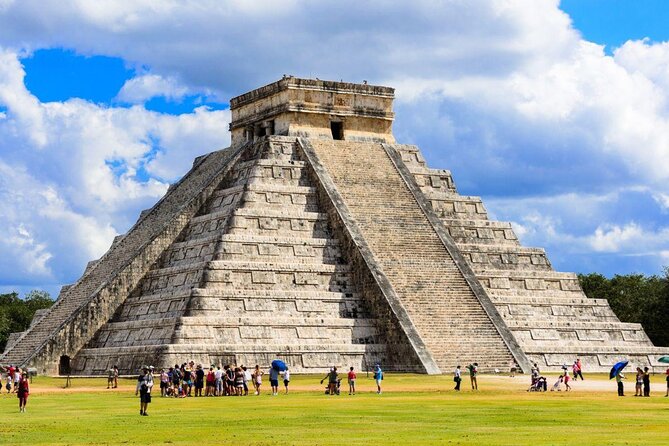
- More than 37 stories: The route covers El Castillo, the Great Ball Court, El Caracol, the Temple of Warriors, Las Monjas, and other major structures.
- $9.99 guide price: This is good value if a private guide would stretch your budget, but you still pay the archaeological site entrance fee separately.
- Lifetime access advertised: You can pause, replay, and reuse the tour on future visits or listen to sections later.
- English only: The supplied information lists English as the available language, so it will not suit every group.
What you are really buying for $9.99
This is not a guided group outing. Nobody meets you at the entrance, and no guide walks beside you. You receive access to the Action Tour Guide app, a recommended route, GPS positioning, audio narration, images, and written information.
That difference matters. A private guide can answer questions and adjust the explanation to your interests. This app cannot respond to you. But it also does not hurry you past a monument because a group is waiting, and it lets you listen from the shade or return to a stop later.
At $9.99 per person, the value is clear if you want basic historical context without adding another expensive service to an already costly day. The entrance ticket is separate, and some visitors have commented that admission can be a major part of the total expense. Even so, the app costs far less than hiring a private guide.
The narration aims to give you enough background to understand what you are seeing. It is not an academic course. Some sections are brief, which many people will appreciate after several hours in the sun. If you want lengthy discussion of Maya politics, astronomy, daily life, or the reasons the city declined, you may find the material limited.
More Self-Guided Audio Tours in the world:
- Athens: Acropolis Ticket & Optional Self-Guided Audio Tours
★ 4.1 · 2,542 reviews - Gettysburg Battlefield Self-Guided Driving Audio Tour
★ 4.5 · 910 reviews - Joshua Tree National Park Self-Guided Driving Audio Tour
★ 4.5 · 762 reviews
Download the app before you reach the ruins
The most important practical instruction is simple: install and test the app before you arrive. After booking, you receive setup instructions and a password by email and text. Search your messages for audio tour if the instructions are not immediately obvious.
Download the separate Action Tour Guide app while you have strong Wi-Fi or cellular service. Enter the password, open the tour, and make sure the map and narration load. Once the download is complete, the tour should work offline with your phone’s GPS.
That preparation can save your morning. A small number of users have reported trouble with the access code, including an app that asked for the code again. Closing and reopening the app solved the issue for one person, but you should not rely on a quick fix at the entrance.
The tour is recommended for an iPhone running iOS 15 or later, an Android device running version 9 or later, or an iPad or tablet with GPS and cellular capability. Use headphones or earbuds so you can hear the narration without disturbing people around you. A portable charger is a wise addition because one visitor lost the tour when the phone battery ran down.
Start at the Handicraft Market and get oriented
The route begins around the handicraft market near the Chichén Itzá entrance area. This opening section introduces the site and the wider Maya world before you reach the best-known monuments.
Do not rush this first step. You need to find the correct starting point, match your position with the app, and confirm that the audio is working. Once the route lines up, the GPS should guide you from one story to the next.
The market is also a practical place to get your bearings. The tour data describes a route of more than two miles, so take a moment to prepare your water, hat, headphones, and phone before setting off.
El Castillo gives the tour its grand opening
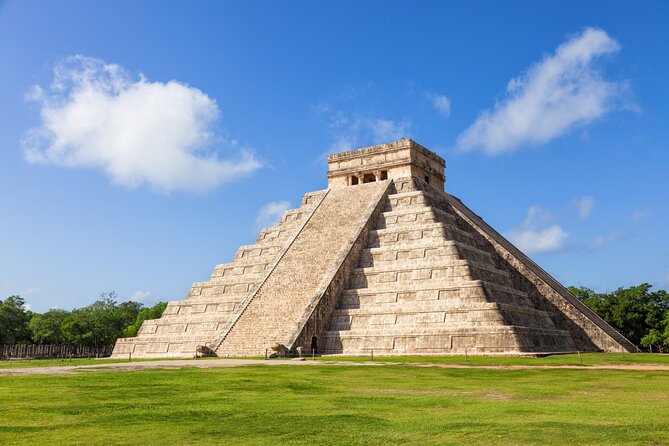
El Castillo, also called the Pyramid of Kukulkan, is the first major sight and the monument most people associate with Chichén Itzá. The audio explains its connection with Kukulkan, the feathered serpent deity, and points out how the pyramid’s design reflects Maya ideas about religion, time, and architecture.
You cannot climb El Castillo, so the experience depends on where you stand and what you notice. The audio is useful here because the pyramid can look simple from a distance. Its shape, stairways, proportions, and ceremonial role become easier to appreciate when you know what to look for.
Allow more time than the listed ten-minute stop if you want photographs. This is also one of the most crowded parts of the site, so the app’s hands-free format helps. You can move a little away from the main viewing area, listen from a quieter spot, and return when you are ready.
A few more audio tours around the world worth a look
- Barcelona: Sagrada Familia Entry Ticket with Audio Guide
★ 4.6 · 105,312 reviews - Rome: Pantheon Fast-Track Ticket and Official Audioguide
★ 4.5 · 27,353 reviews - Barcelona: Casa Batlló Entry with Self-Audioguide Tour
★ 4.7 · 25,359 reviews - Rome: Colosseum & Forum with Audio Guide App -Optional Arena
★ 4.2 · 24,770 reviews
The Great Ball Court reveals a more serious game
The Gran Juego de Pelota is not presented as a casual sports field. Its long walls contain sculpted reliefs showing ball players, and the audio explains the field’s place in Maya culture.
This stop helps correct the modern assumption that the game was simply entertainment. The carved scenes and scale of the court suggest ceremony, public display, and serious social meaning. The app gives you a reason to study the stonework instead of walking through it in a minute.
The five-minute listing is only a guide. If you want to inspect the reliefs, give yourself extra time. The narration is most helpful when paired with a slow look at the walls.
Tzompantli and the Eagles and Jaguars Platform
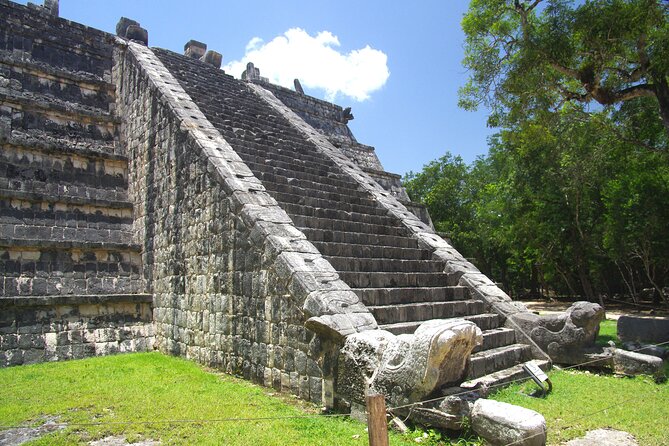
The Tzompantli is one of the more unsettling stops. Its name means skull rack, and the platform’s carved decoration includes warriors carrying human heads, along with skulls, snakes, and eagles.
This is a place where a short explanation adds real value. Without context, the carvings can seem like another band of weathered stone. The audio helps you understand the imagery and the role of sacrifice in the site’s ceremonial world.
Nearby, the Eagles and Jaguars Platform offers a different kind of monument. It appears to have functioned as a flat ceremonial stage for dances, rituals, or public speeches. The platform was not topped by a temple, which makes its open design important.
The two stops work well together. One focuses on powerful carved imagery, while the other shows how architecture could create a public setting without a large building above it.
El Caracol explains Maya sky watching
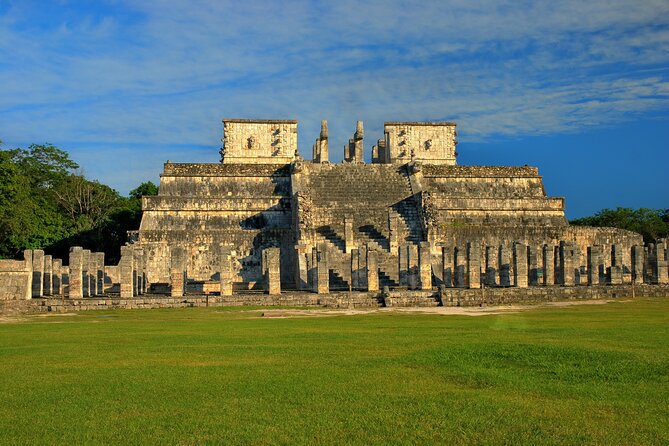
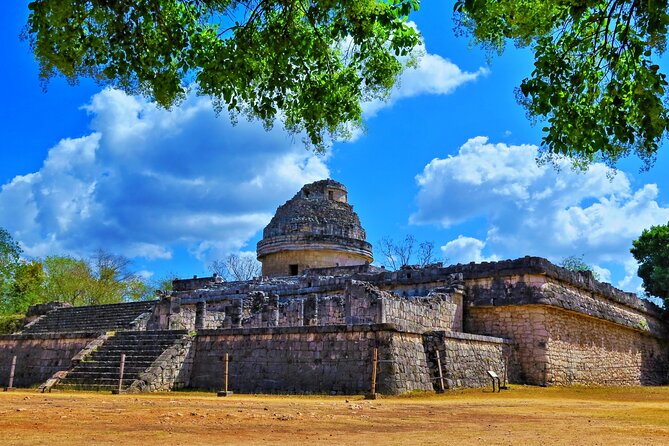
El Caracol is one of the most memorable buildings on the route. Its circular upper structure is linked with observation of the stars and the movement of planets.
The audio presents it as an observatory, a familiar description for the site. You will see the remains of the cylindrical structure rather than a functioning astronomical building, so the explanation helps you picture how the building may have been used.
The itinerary includes El Caracol twice, once in the central route and again near the Ossuary section. Treat this as a strength rather than a problem if you want to revisit the subject. You can replay the story or continue without stopping for a second full explanation.
The route’s GPS is designed to trigger stories by location, but it may begin an explanation slightly before you reach the exact monument. One user found the map a little off and treated that as a fun prompt to locate the building. I would keep your eyes on the map and listen for the next stop rather than expecting perfect pinpoint accuracy.
The Temple of Warriors and the Red House
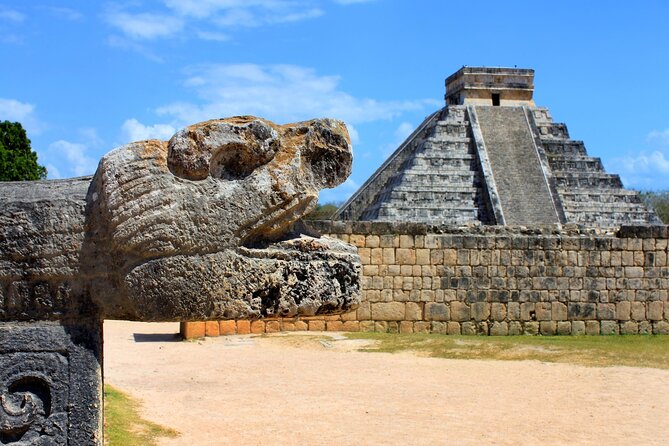
The Temple of Warriors has broad stepped tiers and a smaller temple above. Around it are rows of columns decorated with carved warrior figures. The audio connects the building’s design with the wider Maya and Toltec influences visible across Chichén Itzá.
This is a stop where looking upward and outward pays off. The scale of the columns can be easy to miss if you focus only on the temple itself. Listen first, then walk around enough to take in the carved figures and the arrangement of the complex.
The Red House, or Chichanchob, is smaller and more detailed. Its upper latticework gives it the nickname House of Little Holes. It is a useful reminder that Chichén Itzá is not only about giant pyramids. Smaller buildings can reveal different decorative styles and construction choices.
The Red House stop is short, so use the written material or replay the audio if you want to inspect the façade carefully.
The Ossuary, Las Monjas, and La Iglesia
The Ossuary, also called El Osario, is a pyramid connected with human and animal remains found at the site. A cavern beneath it contained seven tombs believed to have belonged to members of the Maya elite.
The app includes both the Ossuary and El Osario as separate entries. They refer to the same general monument, so do not worry if the names seem repetitive. One section may offer a second explanation or a slightly different way to approach the structure.
Las Monjas, or the Nunnery, is one of the most important buildings on this part of the route. Its walls contain many inscriptions, including references to a ruler named Kakupakal. The name can mislead modern visitors, since the building was not a convent in the European sense. The audio helps place the structure in its Maya setting.
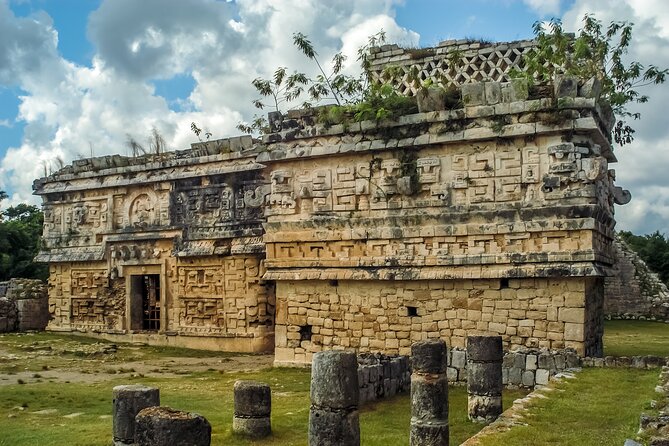
La Iglesia is one of the most photographed small buildings at Chichén Itzá. Its exterior is covered with decorative veneer, including masks of Chac, the rain deity. Look closely for the animal figures mixed among the masks, including an armadillo, crab, snail, and tortoise.
This final cluster rewards patience. The buildings are smaller than El Castillo, but their decoration is often more intricate. You may find the audio easier to follow here because it directs your attention to details that are not obvious at first glance.
How long the route takes in real conditions
The listed duration is about two to three hours, while the main audio route itself takes roughly one to two hours. Those figures make sense if you separate walking and listening from the rest of the visit.
Plan on at least two hours if you want to hear the main stories and walk the full route. Add time for photographs, buying souvenirs, sitting in the shade, and taking breaks. The site has refreshment stalls and a sitting area in the middle of the compound, which can make the long walk easier.
The route covers more than two miles. You should be comfortable walking that distance in warm conditions, and you should not treat the short stop times as strict limits. The GPS lets you pause the tour, take a side trip, or return to a story later.
The app can also help if you lose the sequence. You can use the map to find your position, and the next story should begin as you approach the right area. Still, take a moment at the start to understand the direction of travel. That small adjustment can prevent confusion later.
English narration, content quality, and limits
The tour is offered in English. The app provides audio, images, and text, so you can read a section if you prefer not to listen or if an explanation is hard to hear.
Most of the praise centers on ease of use, clear information, and the ability to explore without a group. The automatic GPS playback is the star feature. It lets you keep your phone in your hand or pocket instead of stopping constantly to search for the next recording.
The content has limits. Some users found it accurate and compelling, while others felt it was too brief or less useful than reading a general reference page. One person found the pronunciation and wording difficult in another language, but the listed version for this experience is English. If detailed cultural context is your priority, you may want a book or an in-person guide as a supplement.
I would treat this as a practical field guide, not a replacement for a specialist historian. It gives you a useful explanation at each major stop and helps the stones make sense. It does not answer every question that Chichén Itzá raises.
Who should choose this self-guided tour?
I would recommend it most strongly to:
- Couples or friends who can share earbuds and reduce the per-person cost
- Solo visitors who prefer to set their own walking speed
- Families who need the freedom to pause for breaks
- Budget-minded visitors who want context without hiring a private guide
- People who dislike standing in large groups around a guide
- Anyone comfortable preparing an app before arriving
You may prefer a private guide if you want live questions, a tailored route, or much more detailed discussion of Maya civilization. You may also want another option if your phone battery, operating system, or internet connection makes downloading difficult.
Should you book it?
Book it if you want a low-cost way to understand the main monuments and keep control of your day. The combination of GPS, offline maps, replayable audio, and a recommended route makes it far more useful than wandering among the ruins with only minimal signage.
Skip it if you expect a long scholarly lecture, live conversation, or perfect GPS accuracy at every stop. Also remember that the $9.99 price does not include admission to Chichén Itzá.
For most independent visitors, I think the value is strong. Download it before leaving your hotel, test the password, bring headphones and a portable charger, and give yourself about two hours for the circuit. That simple preparation should let you focus on the monuments instead of wrestling with your phone.
FAQ
Is admission to Chichén Itzá included?
No. The tour price covers the self-guided app, audio narration, maps, images, and route. You must buy the entrance ticket separately.
How much does the self-guided tour cost?
The listed price is $9.99 per person.
How long does the tour take?
The audio route takes about one to two hours, while the suggested overall duration is two to three hours. Extra time allows for walking, photographs, breaks, and souvenirs.
Does the tour work without mobile data?
Yes. You must download the tour while you have strong Wi-Fi or cellular service. After that, it works offline using GPS.
Where does the tour start?
The starting point is listed at 97751 Chichén-Itzá, Yucatán, Mexico, near the handicraft market and entrance area.
Will someone meet me at the starting point?
No. This is a self-guided activity. You open the app at the site and go to the first story point.
How does the audio begin?
The narration is designed to start automatically when you reach the appropriate GPS location. You can also start explanations manually.
What devices are recommended?
The tour recommends an iPhone with iOS 15 or later, an Android device with version 9 or later, or an iPad or tablet with GPS and cellular capability.
Is the tour available in languages other than English?
The supplied tour information lists English as the available language.
Can I pause and reuse the tour?
Yes. The experience is advertised with lifetime access and no expiry. You can pause, replay sections, and use it again on another trip.
Just added around the world
- Coba Ruins: Self-Guided Walking Audio Tour in Mexico★ 3.5 · 2 reviews
- Self Guided Driving Audio Tour of Saguaro National Park★ 3.0 · 4 reviews
- Torino Walking Tour with Audio and Written Guide by a Local★ 4.5 · 35 reviews
- Self-Guided Audio Driving Tour of Mount Lemmon★ 5.0 · 4 reviews
- Trondheim’s Inner Circle: A Self-Guided Audio Tour★ 4.0 · 15 reviews
- A Tromsø Introduction: A Self-Guided Audio Tour★ 3.5 · 19 reviews
- Panorama Bus Tour with Audio Guide★ 4.0 · 3 reviews
- Saguaro National Park Self-Guided Audio Tour★ 3.5 · 11 reviews
Self-Guided Tours, compared.

Acropolis Ticket & Optional Self-Guided Audio Tours
Read our review →


Ultimate Acadia National Park Self-Guided Driving Audio Tour
Read our review →

Santorini: Akrotiri Ticket with Optional Self-Guided Audios
Read our review →
Browse the lists this tour appears in